- The paper introduces a hierarchical spatio-channel low-rank compression framework that adapts to localized feature redundancy in CNNs.
- It achieves up to 81.1% reduction in FLOPs and speed-ups in latency while maintaining or improving classification accuracy on brain tumor MRI data.
- The method automatically allocates layerwise compression based on empirical redundancy, offering practical improvements for clinical and edge deployments.
Hierarchical Spatio-Channel Clustering for Structured CNN Compression in Medical Imaging
Motivation and Context
The increasing computational complexity and memory demands of modern convolutional neural networks (CNNs) significantly hinder their practical deployment in resource-constrained settings, especially in medical imaging applications where both efficiency and accuracy are critical. While traditional low-rank compression strategies such as global SVD and Tucker decomposition reduce storage and computational costs, they typically treat spatial and channel redundancy independently or apply uniform decompositions at the layer level. These methods fail to fully capitalize on the intricate, local spatio-channel structures prevalent in deep feature maps, risking the loss of discriminative information essential for medical diagnosis.
Hierarchical Spatio-Channel Compression Framework
This work presents a hierarchical spatio-channel low-rank compression framework that employs a three-stage, data-driven decomposition strategy to systematically adapt to localized redundancy within CNN feature maps.
After each convolutional layer, the proposed method partitions the output feature tensor into spatially coherent regions via SLIC-based superpixel clustering, followed by a second clustering stage that groups channels exhibiting similar co-activation patterns within each spatial region using K-means. Finally, it applies a truncated SVD with adaptive energy-based rank selection to each spatio-channel cluster.
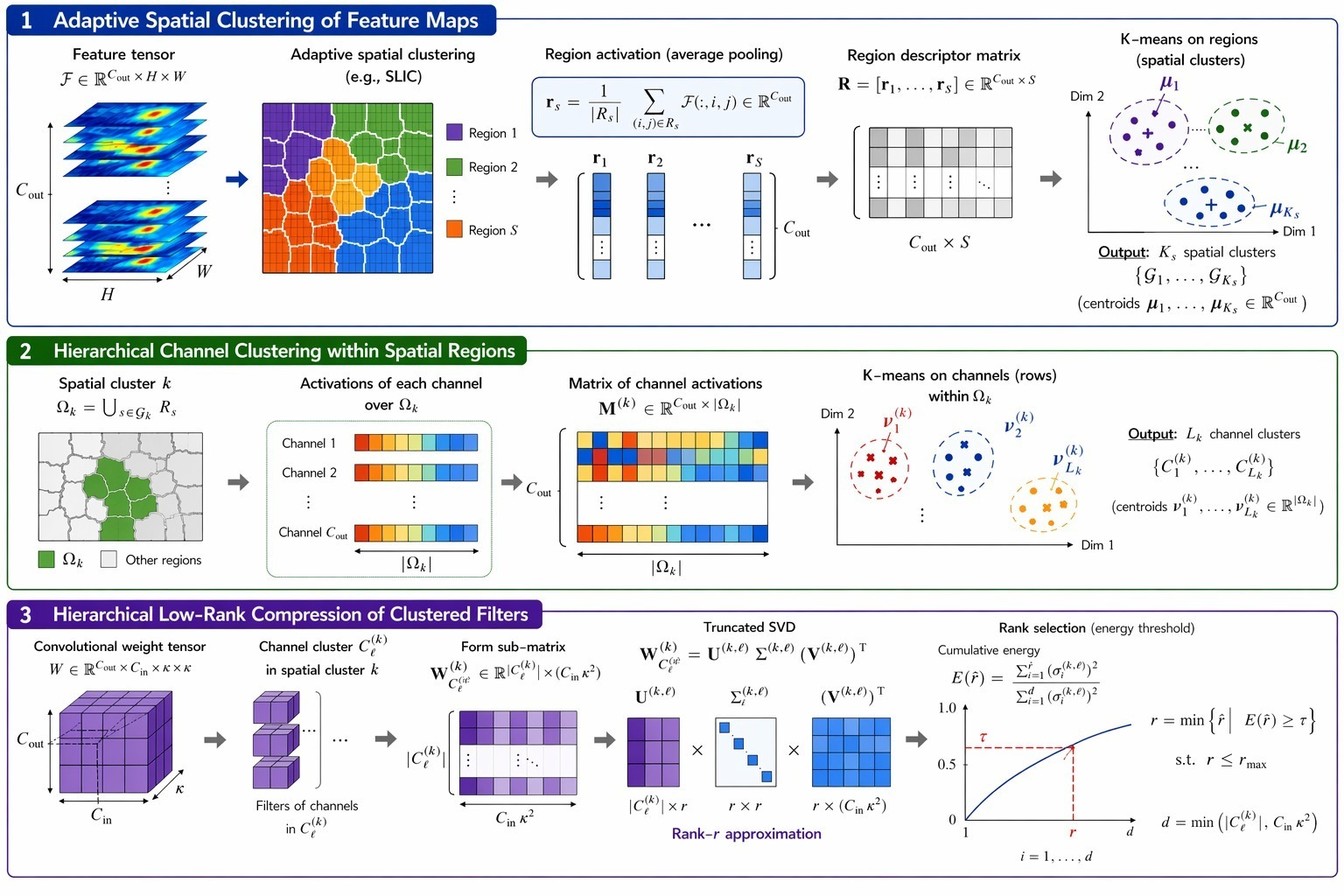
Figure 1: Overview of the proposed hierarchical spatio-channel low-rank compression framework.
This hierarchical approach enables a fine-grained alignment between compression and underlying data structure, supporting aggressive parameter and FLOPs reduction while maintaining or improving model predictive accuracy.
Experimental Setting: Brain Tumour MRI Classification
Evaluation is conducted on an AlexNet-based classifier trained for multi-class brain tumour detection using the Brain Tumour Classification (MRI) dataset, which encompasses four clinically relevant categories: glioma tumour, meningioma tumour, pituitary tumour, and no tumour. The data is augmented and normalized in accordance with best practices for deep medical image analysis.
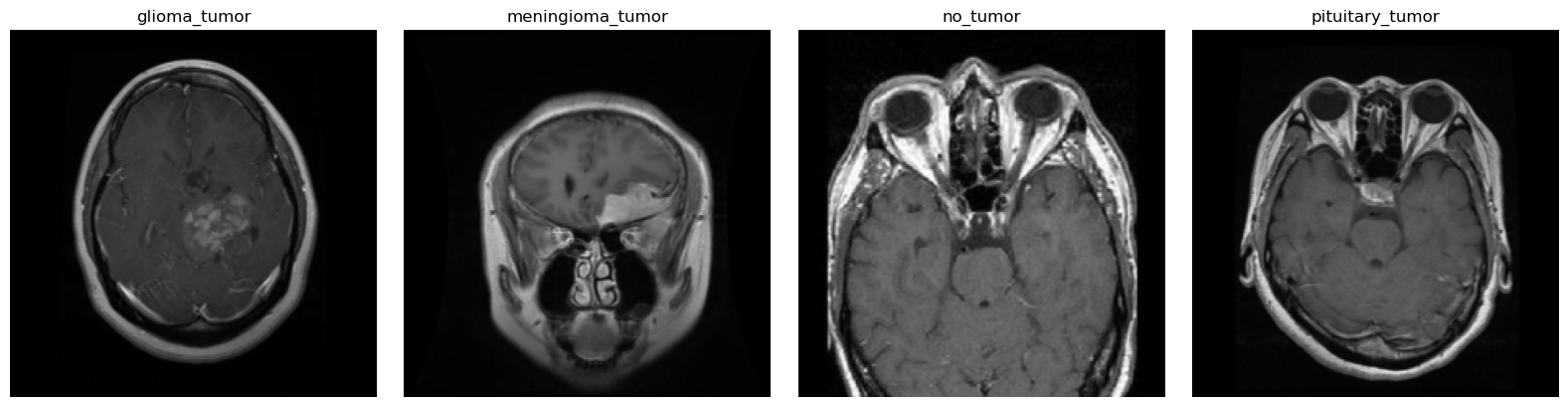
Figure 2: Example T1-weighted MRI slices from each class in the training set.
Three model compression pipelines are compared: Global SVD (Denton et al.), Tucker-2, and the proposed hierarchical spatio-channel clustering. Compression is applied to convolutional layers only, with layerwise and overall allocations controlled either globally (for the baselines) or adaptively (for the proposed method). All compressed models are fine-tuned equivalently for fair performance comparison.
Moderate Compression (3× Budget)
At a 3× compression ratio, all approaches significantly reduce computational and storage requirements. The proposed method achieves:
- A reduction in FLOPs from $8.21$G to $2.73$G (66.7% decrease)
- 1.26× latency speed-up (from $1.80$ ms to $1.44$ ms)
- Slight improvement in classification accuracy: 87.96% vs 87.76% (baseline/Global SVD), clearly surpassing Tucker decomposition (84.69%)
Class-specific 3×0-scores demonstrate sustained discrimination, with the proposed method achieving highest 3×1 in key tumor classes (notably pituitary and meningioma).
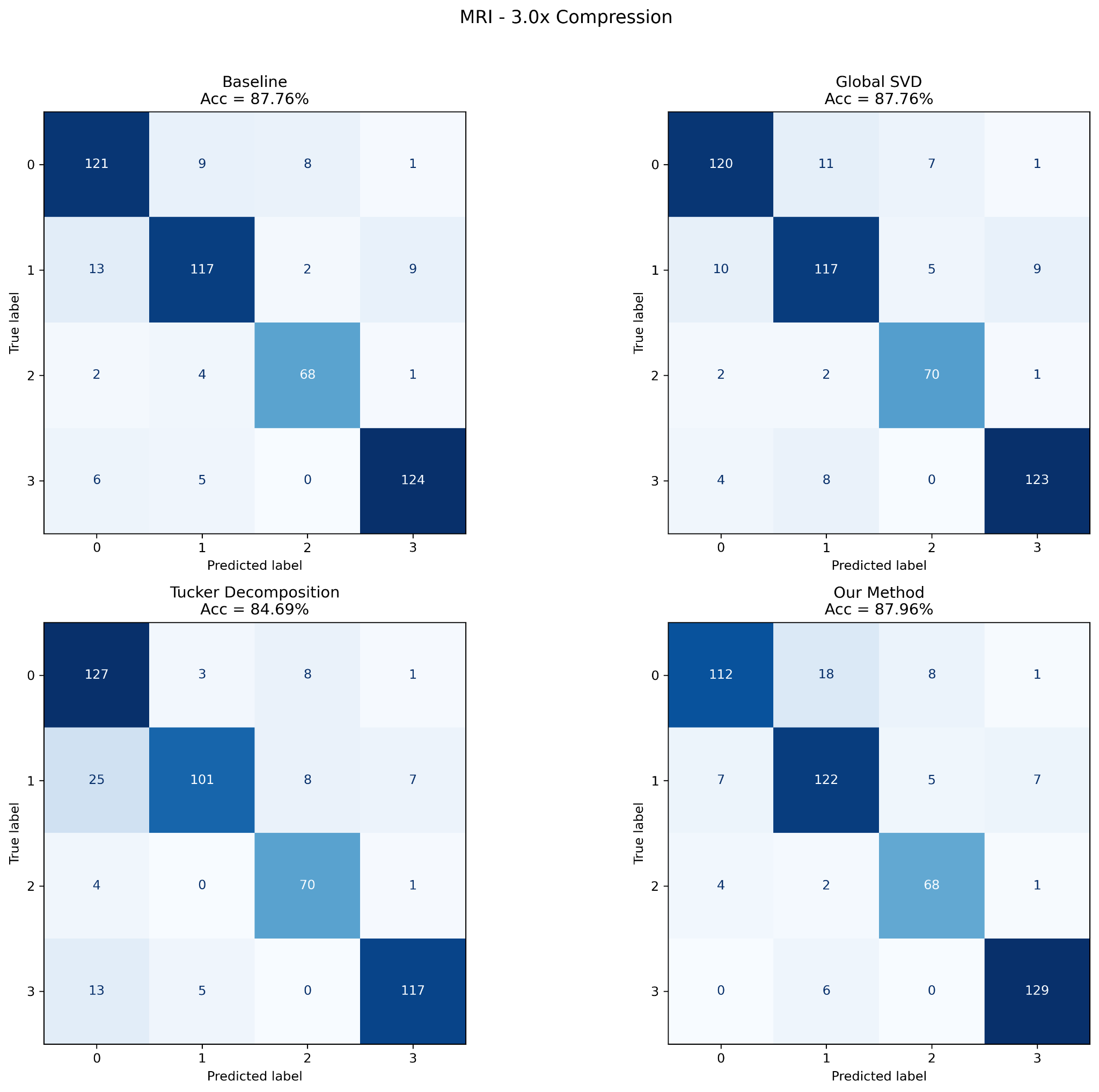
Figure 3: Confusion matrices at the 3×2 compression level, showing superior classwise retention with the proposed method.
Aggressive Compression (3×3 Budget)
At a stringent 3×4 compression, the differences are further accentuated:
- The proposed method increases accuracy to 3×5 (vs. 3×6 baseline), significantly outperforming both Global SVD (3×7) and Tucker (3×8).
- Macro 3×9 is also highest for the proposed method ($8.21$0 vs. $8.21$1 baseline).
- FLOPs are reduced by $8.21$2, with latency decreased by $8.21$3.
Notably, the hierarchical method adapts compression non-uniformly across layers, allocating more reduction to deeper layers at higher budgets, as evidenced in layerwise statistics. In contrast, baseline low-rank methods exhibit nearly uniform compression across all layers.
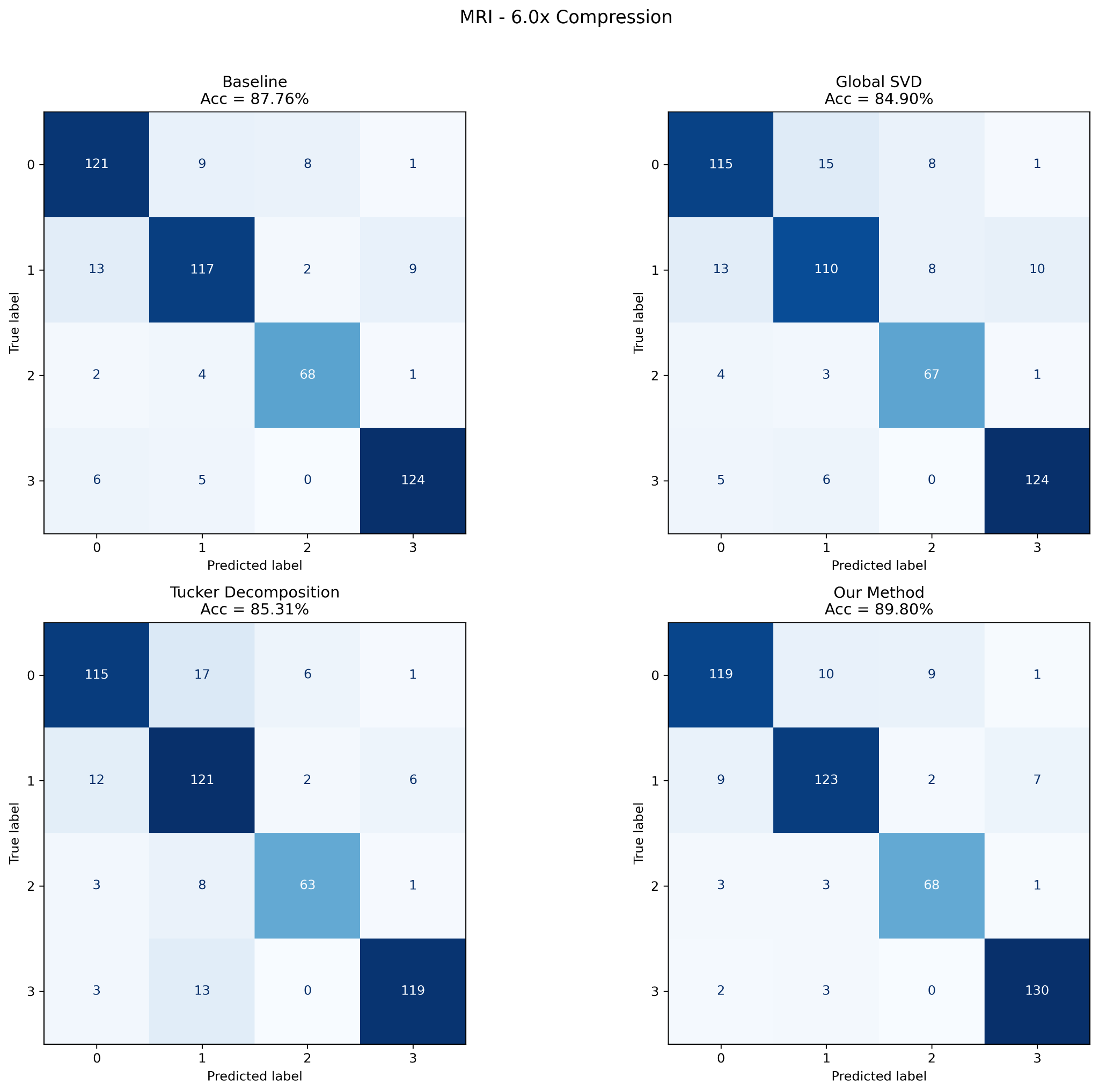
Figure 4: Confusion matrices under $8.21$4 compression, demonstrating the proposed method's preservation of class structure at high compression.
Hyper-Parameter Analysis and Pareto Trade-off
A comprehensive hyper-parameter exploration across spatial clusters, channel clusters, the SVD energy threshold, and maximum allowed rank reveals a broad region of operating points offering Pareto-optimal trade-offs between model accuracy and efficiency. Moderate values for all four hyper-parameters consistently yield substantial computational savings while avoiding notable degradation in predictive performance.
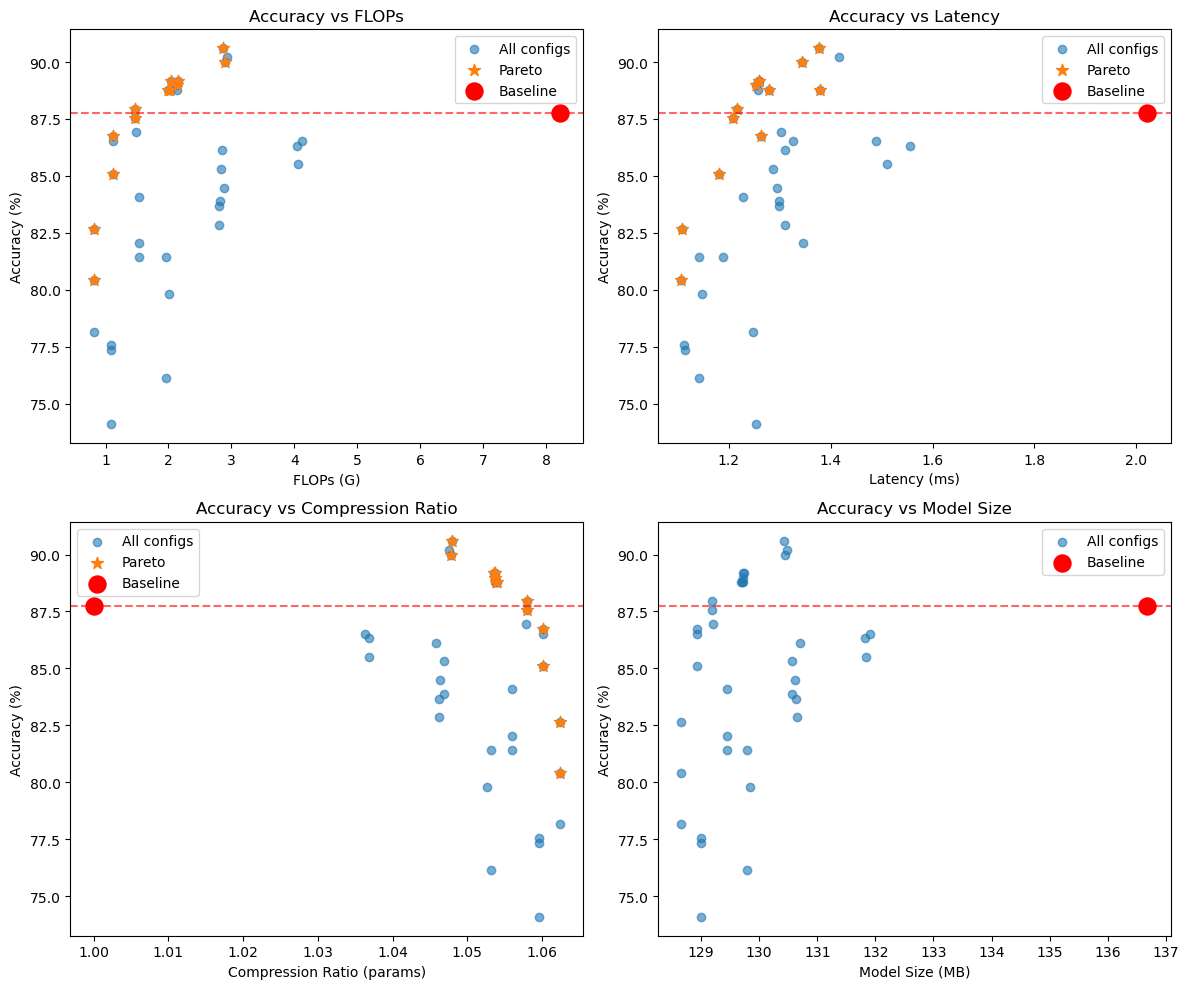
Figure 5: Pareto analysis of trade-offs between accuracy and efficiency across hyper-parameter settings.
Algorithmic Implications and Insights
- Structured Redundancy Exploitation: By leveraging localized clusters in both spatial and channel domains, the method more effectively matches compression granularity to actual feature map redundancy, avoiding the information loss typical of layerwise-agnostic approaches.
- Regularization Effect: Aggressive removal of correlated filter directions, followed by fine-tuning, leads not only to efficiency gains but also to improved generalization, particularly in challenging and imbalanced classes (e.g., meningioma).
- Automatic Layerwise Budgeting: The method adaptively compresses layers according to empirical redundancy, shifting compression towards later layers with greater representational degeneracy at strong budgets.
Practical and Theoretical Implications
On the practical side, this work enables high-throughput, accurate deployment of CNNs in clinical and edge scenarios where computation and memory are limited, without loss of critical class discrimination. Theoretically, the approach underscores the importance of localized analysis of activation structure over global or uniform low-rank decomposition, and points toward more refined, data-driven compression techniques that may synergize with quantization and pruning.
Limitations include the exclusive focus on convolutional layers (fully-connected layers remain uncompressed), and a pre-processing overhead for clustering, which, while amortized during inference, may become non-trivial for very large architectures or exhaustive parameter searches.
Future Outlook
Potential research directions include extension to fully-connected layer compression, integration with mixed precision/quantization, deployment on other deep architectures (e.g., ResNet, VGG), and adaptation to non-stationary data distributions. Combining the proposed framework with complementary sparsification or learning-based pruning may push hardware efficiency further while preserving diagnostic integrity for medical imaging applications.
Conclusion
The hierarchical spatio-channel low-rank compression framework achieves strong numerical gains in both computational efficiency and classification performance for CNNs in medical image analysis by introducing a data-driven, adaptive strategy that explicitly captures local redundancy structures. This provides flexible, robust, and scalable model compression with practical relevance for edge and clinical applications, while also suggesting theoretical directions for next-generation compression pipelines that tightly couple data structure with architectural adaptation.

