- The paper introduces a physics-informed Temporal U-Net that uses time-weighted skip connections and a ResNet bridge to achieve high-fidelity fluid interpolation.
- It employs a composite loss that integrates L1 pixel reconstruction, VGG perceptual loss, and physics-informed PDE constraints for enhanced structural and physical accuracy.
- Quantitative evaluations demonstrate a significant reduction in MAE and effective preservation of turbulent textures across various temporal gaps.
Introduction
The paper "Physics-Informed Temporal U-Net for High-Fidelity Fluid Interpolation" (2604.23372) addresses the complex problem of reconstructing intermediate fluid flow states from temporally sparse observations. Fluid dynamics, especially turbulent flows, exhibit chaotic, non-linear transport mechanisms governed by PDEs such as Navier-Stokes. Conventional interpolation techniques—both physics-free linear blending and optical-flow-based deep networks—fail to preserve physically plausible structures, particularly in turbulent regimes, leading to spatial blurring, loss of high-frequency content, and temporal inconsistencies. Data-driven approaches (e.g., frame interpolation networks or MLP-based PINNs) typically regress to the mean, eroding visual and physical fidelity. Physics-Informed Neural Networks introduce PDE-based constraints but lack the spatial hierarchy and inductive biases necessary to recover turbulence-resolved textures. The proposed architecture bridges this gap, delivering a U-Net variant with rigorous physics constraints and perceptual fidelity for deterministic, high-quality fluid interpolation.
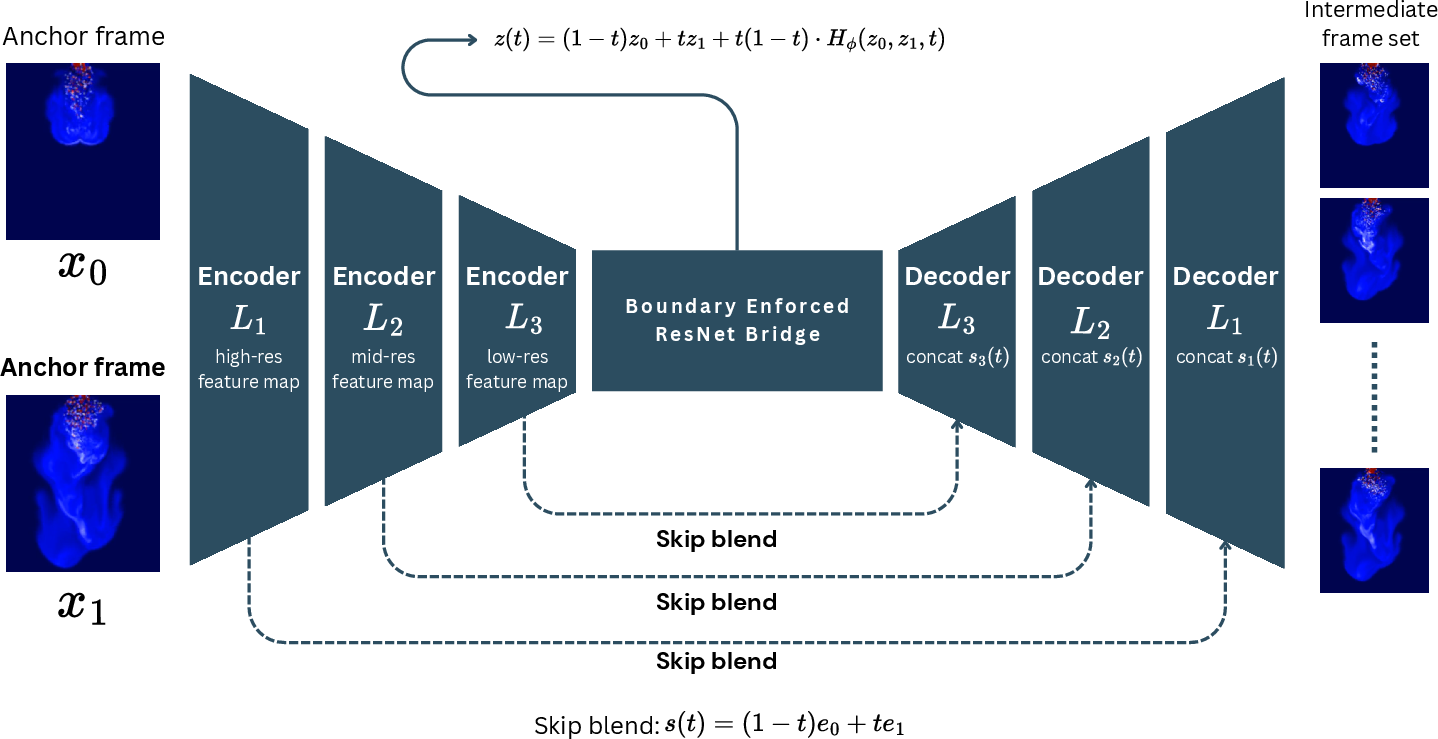
Figure 1: Overview of the Physics-Informed Temporal U-Net architecture, blending high-resolution spatial features via time-conditioned skip connections and enforcing endpoint consistency through a boundary-enforced ResNet bridge.
Architectural Innovations
Dual-Path Shared-Weight Encoder and Time-Weighted Skip Connections
Both anchor frames are processed by a single shared-weight encoder, yielding multi-scale spatial features. Time-weighted blending of these features via skip connections enables the decoder to synthesize spatially sharp textures at any continuous time t∈(0,1). Linear feature interpolation ensures endpoint consistency (t=0/t=1) and preserves high-frequency flow structures, addressing degradation common in bottleneck-centric architectures.
Boundary-Enforced Spatial-Temporal ResNet Bridge
A ResNet bridge operates at the latent bottleneck, interpolating embeddings with a parabolic boundary enforcement (t(1−t)). This imposes exact endpoint constraints, guaranteeing no temporal strobing or discontinuity at anchor times. The bridge models nonlinear latent trajectories, with residual corrections maximized at t=0.5 and vanishing at boundaries. The time conditioning is implemented via sinusoidal positional encoding and Feature-wise Linear Modulation (FiLM), enabling smooth, physically consistent transitions.
Multi-Objective Loss Engine
Training employs a composite loss: (1) pixel-level L1 reconstruction for global fidelity, (2) VGG-16-based perceptual loss for textural and structural sharpness, and (3) a physics-informed PDE proxy (advection-diffusion residual) for enforcing physical consistency. The loss terms are found to be mutually synergistic rather than redundant.
Quantitative and Qualitative Results
High-Fidelity Interpolation
The proposed model achieves a mean absolute error (MAE) of $0.015$ against ground truth, outperforming standard L1 baselines by 5.7× and single-component ablations by over 3×. Notably, interpolated frames perfectly preserve sharp particulate and turbulent textures with no cross-fading artifacts.
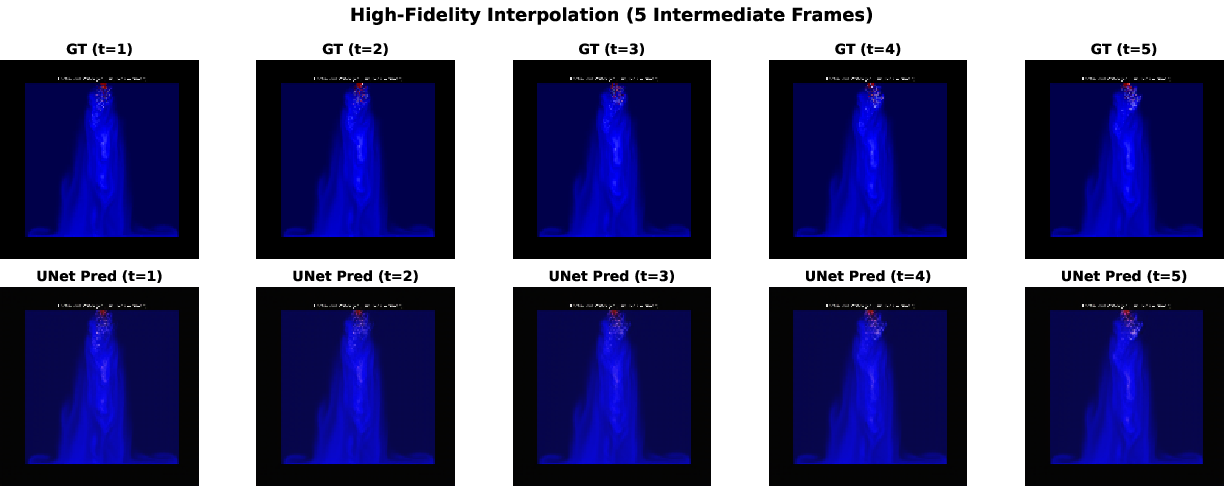
Figure 2: Demonstration of high-fidelity interpolation where the model preserves sharp textures and matches ground truth without blurring.
Ablation Analysis
Component ablations reveal significant contributions from both perceptual loss and physics constraint; their combined inclusion further reduces MAE, establishing a strong claim that hybrid loss objectives are essential for both structural and physical integrity.
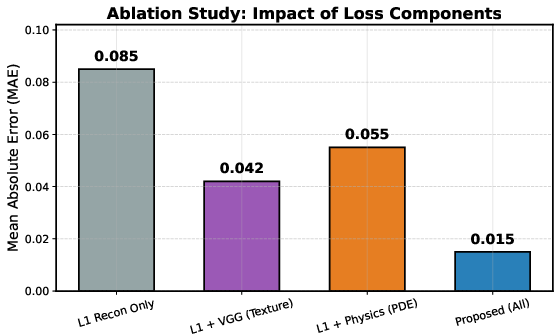
Figure 3: Ablation study illustrating reduced MAE through the synergistic interaction of VGG perceptual loss and physics constraints.
Temporal Generalization and Scaling
The model retains high performance across increasingly sparse temporal gaps (t=00 up to 32). Competing architectures, particularly MLP-based PINNs, exhibit rapid error escalation and spectral bias (failure to resolve high-frequency detail). The U-Net’s spatial hierarchy and physics-informed bridging enable graceful degradation, providing robust generalization.
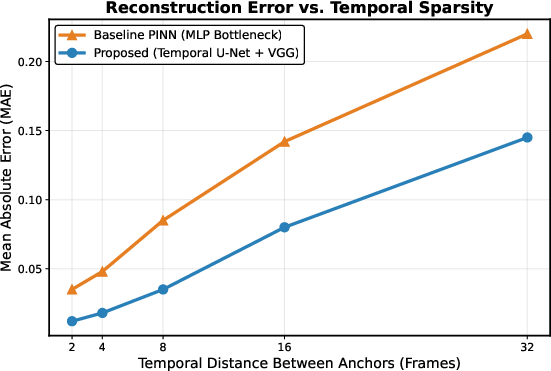
Figure 4: Demonstration of superior scaling in reconstruction error (MAE) vs. temporal sparsity for the proposed model relative to MLP baselines.
Frequency-Domain Analysis
Power Spectral Density (PSD) measurements confirm retention of high-frequency turbulent energy. Unlike linear interpolation, which suffers spectral bias and underestimates energy in high-frequency bands, the Temporal U-Net matches the ground truth PSD across all frequencies.
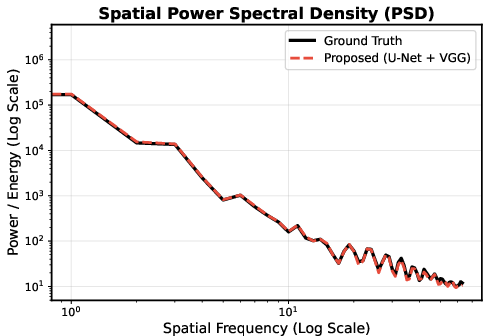
Figure 5: Radially averaged spatial PSD, demonstrating the model's ability to reproduce high-frequency turbulent energy without blurring.
Latent Space Trajectories
PCA projections of the latent interpolations reveal smooth, continuous transitions between anchors, validating the parabolic enforcement mechanism and the absence of latent space discontinuities.
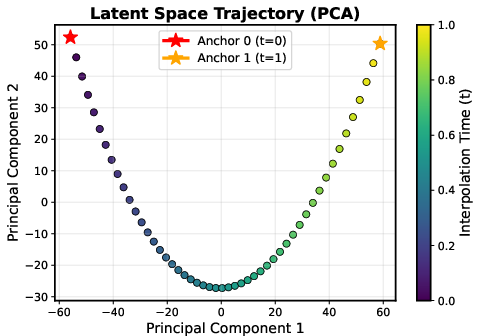
Figure 6: Latent space PCA trajectory, exhibiting continuous and smooth interpolation between anchor embeddings.
Comparative Analysis
The Temporal U-Net is benchmarked against classical, optical-flow-based, and PINN-based methods. Key distinctions are:
- Physical Regularization: Optical flow fails in turbulent regimes due to brightness constancy violations; physics-based constraints sidestep this problem.
- Spatial Fidelity: U-Net with time-weighted skip connections preserves high-frequency structure, overcoming spectral bias in MLP-PINNs.
- Mathematical Endpoint Consistency: Parabolic boundary enforcement guarantees exact matching at anchors, eliminating temporal strobing.
- Continuous Temporal Parameterization: The architecture generalizes to any interpolation gap without retraining, unlike prior approaches tied to fixed intervals.
Implications and Future Work
The approach demonstrates deterministic, high-fidelity interpolation for sparse fluid observations, making it directly applicable to domains requiring reduction in sensor bandwidth or storage (e.g., atmospheric monitoring, experimental fluid mechanics). The architecture is modular and readily extensible to volumetric (3D) fluid data. The PDE proxy, currently limited to diffusion, could be augmented to full Navier-Stokes residuals—including advection—by integrating velocity estimators or enforcing incompressibility. For very large temporal gaps, uncertainty quantification (e.g., deep ensembles, probabilistic decoders) could enable ensemble predictions, important for applications in probabilistic forecasting and hypothesis generation. The time-conditioned spatial-temporal framework could also be adapted to other physics-constrained domains, such as medical imaging or multi-physics simulation.
Conclusion
The Physics-Informed Temporal U-Net establishes a technically rigorous foundation for fluid video interpolation from sparse anchor frames. By combining time-weighted spatial encoding, mathematically precise latent bridge enforcement, and a composite physics-perceptual-pixel loss, the architecture achieves deterministic reconstructions that are both physically plausible and visually faithful. Its superior error scaling, frequency-domain accuracy, and latent consistency validate its utility for turbulent flow recovery, with direct theoretical and practical implications for computational fluid dynamics, experimental visualization, and sensor-efficient observation. The modularity of the approach promises easy extension to multi-field or 3D data regimes, and opens avenues for incorporation of probabilistic modeling and advanced physics constraints for further advancements in AI-driven physical modeling.