- The paper introduces an EKF-based method to accurately estimate real-time temperature using fiber-optic interferometry in micro-Kelvin regimes.
- The paper models temperature dynamics with a nonlinear exponential heating function and stochastic Ornstein–Uhlenbeck fluctuations, achieving an RMSE of 2.21e-5 K.
- The paper demonstrates superior performance over thermistors and conventional inversion methods, enabling robust sensing under challenging environmental conditions.
EKF-Based Fiber-Optic All-Optical High-Resolution Real-Time Temperature Estimation
Motivation and Background
High-resolution temperature monitoring is critical across industrial, environmental, and medical domains, yet mainstream sensors such as thermistors, platinum resistance thermometers, thermocouples, and digital sensors remain constrained in their resolution and susceptibility to electromagnetic interference. Fiber-optic interferometer-based sensors circumvent electromagnetic vulnerability with intrinsic immunity and offer enhanced sensitivity via phase-induced optical intensity variations. However, practical deployment is hampered by nonlinear temperature–intensity mapping, phase ambiguity, and environmental perturbations such as laser fluctuations and mechanical vibrations. Conventional inversion approaches further degrade in the presence of such external noise, especially in micro-Kelvin regimes.
The paper introduces a robust temperature estimation framework utilizing the Extended Kalman Filter (EKF) for real-time inference from interferometric signals. The temperature dynamics are modeled with a deterministic exponential heating function augmented by stochastic fluctuations captured as an Ornstein–Uhlenbeck process, thereby forming a nonlinear, time-variant system.
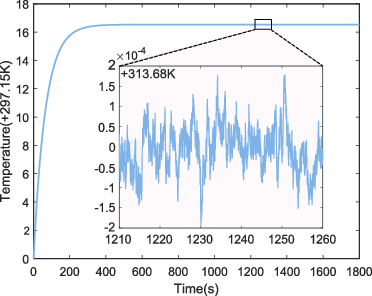
Figure 1: Simulation of a dynamic heating process with initial temperature $\SI{297.15}{\kelvin}$ and steady-state $\SI{313.68}{\kelvin}$.
Temperature changes cause phase shifts in a Mach-Zehnder fiber interferometer, translating to measurable optical intensity fluctuations. The light intensity I(t) is governed by a nonlinear cosine function of temperature, introducing the necessity for EKF over the standard Kalman filter due to the nonlinearity in observation mapping.
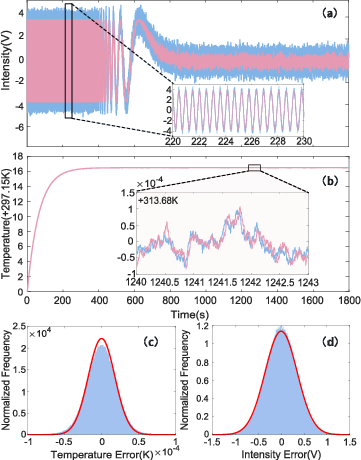
Figure 2: EKF-derived estimation of light intensity and temperature, with statistical consistency verification.
The state-space model treats real-time temperature and steady-state temperature as estimation targets, with EKF recursively linearizing and updating the posterior estimate based on prior prediction, measurement innovations, and associated noise statistics. Simulation studies demonstrate that EKF achieves micro-Kelvin fidelity with RMSE $\SI{2.21e-5}{\kelvin}$, and normalized estimation errors conform closely to zero-mean Gaussian distributions with theoretical covariance—confirming statistical rigor.
Experimental Implementation
The experimental configuration leverages a distributed Bragg reflector (DBR) laser at ∼795 nm within a Mach-Zehnder interferometry setup, featuring polarization-maintaining fiber, balanced photodetection, and environmental insulation to ensure stability.
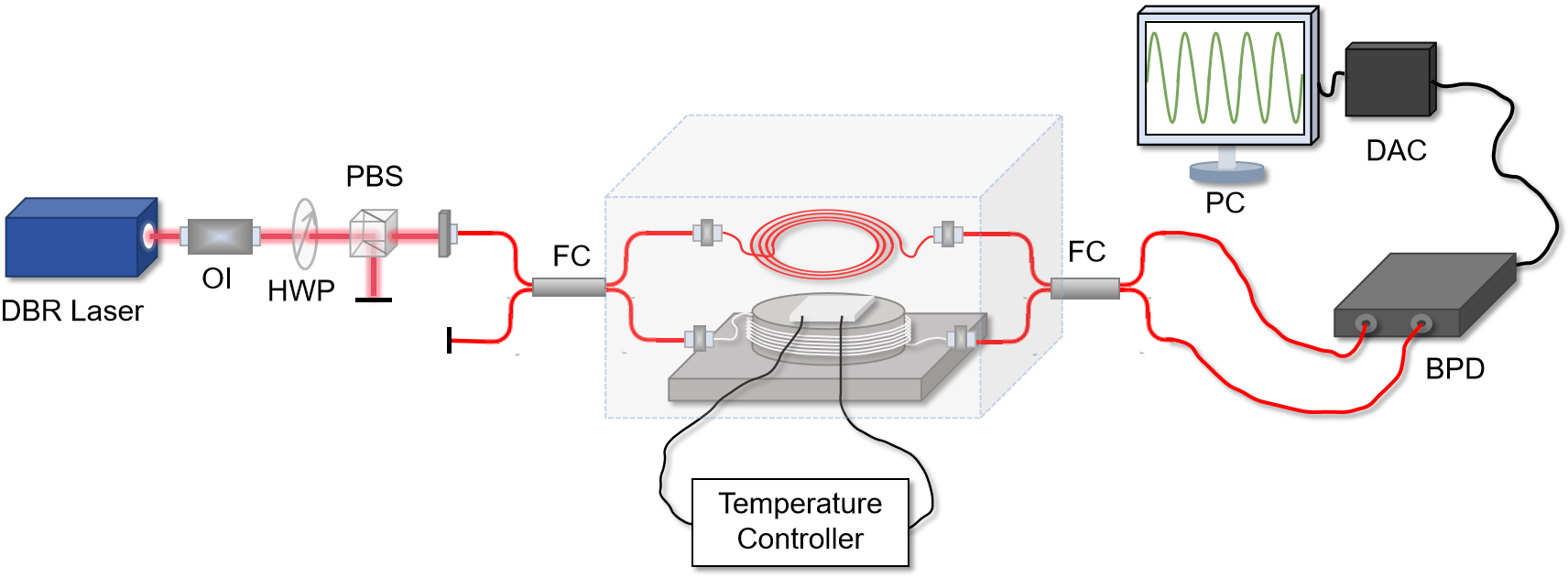
Figure 3: Schematic of the fiber-optic Mach-Zehnder interferometry experimental setup for temperature sensing.
Both nonstationary heating and disturbance-dominated scenarios were tested. Initial findings reveal that EKF-estimated intensity signals closely track experimental measurements, and EKF temperature estimates exhibit substantially reduced fluctuations compared to thermistor-based recordings, despite the latter’s limited accuracy.
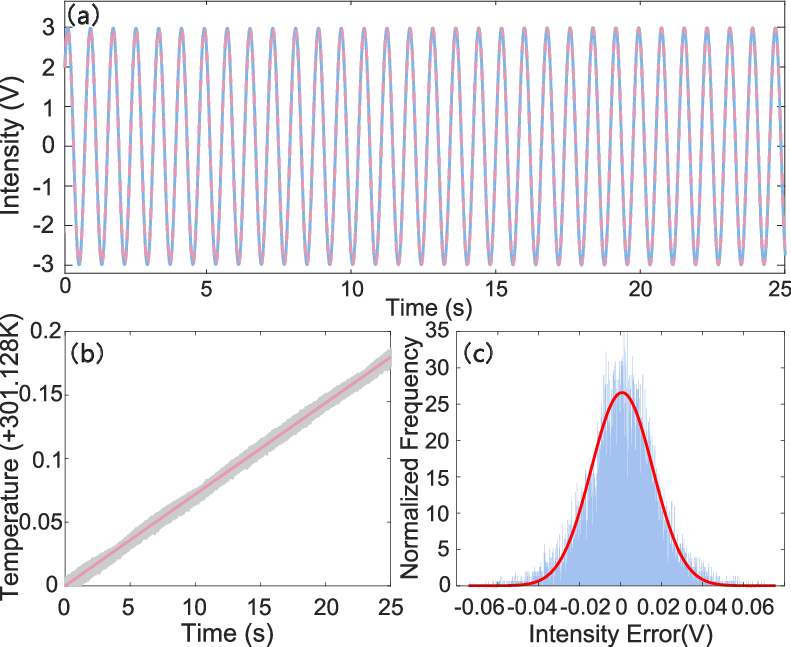
Figure 4: Measured light intensity vis-à-vis EKF estimation (a), and temperature monitoring comparison between thermistor and EKF estimate (b).
In more realistic, noisy operational contexts (e.g., laser instability and airflow effects), conventional inversion methods fail to isolate temperature-driven intensity shifts from extraneous noise, while the EKF continues to robustly track true temperature variations, outperforming both thermistor and classical inversion pipelines.
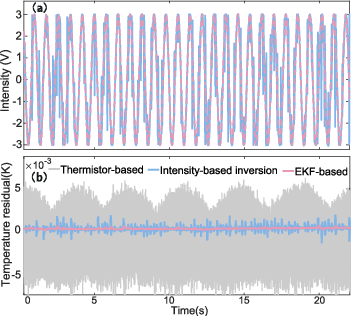
Figure 5: Effectiveness comparison of EKF against thermistor and conventional inversion methods regarding temperature residuals and robustness to disturbance.
Quantitative assessment shows that the EKF method achieves a resolution of 8.34×10⁻⁵ K, tripling the performance of conventional inversion methods (2.28×10⁻⁴ K) and far exceeding the thermistor baseline (4×10⁻³ K). The statistical distribution of residuals aligns with theoretical Gaussian noise, further confirming model validity.
Implications and Future Directions
The demonstrated EKF-based interferometric sensing paradigm enables high-resolution temperature tracking with strong resilience to electromagnetic and environmental disturbances. The combined system, featuring immunity, compactness, and low thermal inertia, is well-suited for precision applications in critical engineering, biomedical, and aerospace domains.
Theoretically, the framework formalizes temperature monitoring as a nonlinear state estimation problem, opening the way for further algorithmic enhancements (e.g., unscented Kalman filtering, particle filtering) or hardware integration (e.g., advanced interferometer architectures, spectral phase interrogation). Practically, the method’s robustness enables deployment in noisy environments previously inaccessible to micro-Kelvin sensors.
Moreover, in scenarios where the response curve is approximately linear, the system can revert to a standard Kalman filter, potentially reducing computational overhead with no loss in estimation quality.
Conclusion
The paper establishes an all-optical, high-resolution, real-time temperature estimation protocol leveraging fiber-optic interferometry and EKF. This approach integrates nonlinear modeling and stochastic estimation, yielding micro-Kelvin-level sensitivity, statistical consistency, and substantial robustness in practical noisy environments—a marked improvement over traditional sensor modalities (2604.23363). The methodology is poised to advance precision temperature sensing in electromagnetically challenging and dynamic measurement contexts.