- The paper introduces a zonal BNN framework that targets scalar (k-deficit) and tensorial (bijΔ) corrections to address RANS model inadequacies in separated shear layers.
- The paper demonstrates significant performance improvements with a test MSE of 9.84×10⁻⁶ and well-calibrated uncertainty through Monte Carlo inference.
- The paper emphasizes explicit epistemic and aleatoric uncertainty decomposition using invariant feature representations to enhance reliability in turbulent flow predictions.
Bayesian Neural Network Correction of RANS Turbulence Models: Uncertainty Quantification in Separated Flows
Overview and Motivation
This paper introduces a Bayesian neural network (BNN) framework for uncertainty-aware correction of Reynolds-averaged Navier–Stokes (RANS) turbulence models in separated flow regimes (2604.23300). RANS remains the computational backbone for engineering flow prediction, but its credibility in separated shear layers is compromised by structural assumptions, especially the use of linear eddy-viscosity closures that fail to resolve turbulence anisotropy and non-equilibrium dynamics. Traditional uncertainty quantification (UQ) strategies for RANS are predominantly diagnostic and do not directly address closure inadequacy. Data-driven correction approaches, both symbolic and neural-network-based, have improved accuracy but with insufficient treatment of uncertainty and weak generalization across different flow configurations.
The paper addresses two critical obstacles: (i) explicit propagation and decomposition of uncertainty in data-driven RANS corrections, including input-dependent aleatoric effects; (ii) zonal application of corrections, targeting model deficiencies only in separated shear layers identified via a physics-based classifier rather than over the entire domain. Corrections are formulated through two complementary mechanisms: a turbulent kinetic energy (TKE) source-term correction ($k_{\text{deficit}$), and a tensorial anisotropy correction (bijΔ). Both are learned as functions of invariant velocity gradient features, encoded via fully Bayesian neural architectures.
Discrepancy Extraction and Zonal Targeting
Discrepancies are rigorously extracted from baseline RANS (SST k–ω) using a frozen inversion technique, separating turbulence closure errors from numerical artifacts. Corrections are applied only within regions classified as separated shear layers by the Relative Importance Term Analysis (RITA) classifier. This spatial selectivity is crucial to avoid degrading predictions in attached regions where the baseline closure is valid.
Invariant Feature Representations and Tensor Basis
Corrections are expressed as functions of scalar invariants computed from local strain and rotation tensors (Sij, Ωij), ensuring Galilean and rotational invariance. The anisotropy correction employs a Pope tensor-basis expansion (bijΔ=n∑gn(x)Tij(n)) with direct regression on projection coefficients, optimizing representation efficiency and physical interpretability.
Bayesian Neural Network Training
Both corrections are modeled by BNNs with fully mean-field variational posteriors on weights (q(W)), heteroscedastic Gaussian likelihoods, and learnable weight precision (α) regularized via a Gamma hyperprior. A two-phase training protocol is used: deterministic (TBNN-equivalent) pretraining for initialization, followed by ELBO-based variational fine-tuning. Input normalization and hyperparameter selection are validated through systematic sweeps.
Monte Carlo Inference and Uncertainty Decomposition
Post-training, predictive uncertainty is decomposed via MC sampling (100 weight realizations) into epistemic, aleatoric, and epistemic-on-aleatoric components. Only sample means are propagated through the RANS solver to capture the effect of epistemic uncertainty (frozen-realization ensemble). Aleatoric uncertainty is spatially mapped but not directly injected, highlighting the distinction between surrogate and propagation-level UQ.
The scalar BNN achieves test MSE of bijΔ0, an order-of-magnitude improvement over deterministic pretraining. Uncertainty calibration is robust with empirical coverage (total 1bijΔ1/2bijΔ2: 75%/95%) matching ideal Gaussian intervals, and aleatoric variance dominating epistemic (mean aleatoric: bijΔ3, mean epistemic: bijΔ4). The spatial structure of the correction field faithfully resolves separation regions, with uncertainty concentrated around zones of high turbulence activity and strong gradients.
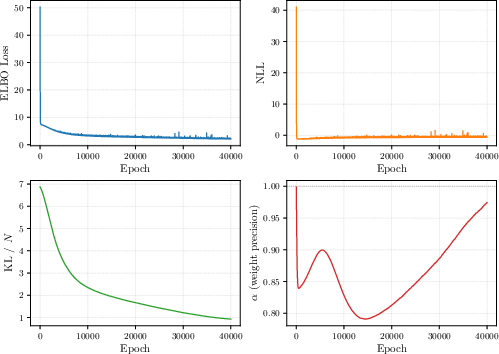
Figure 1: Bayesian training convergence for the scalar correction model, demonstrating stable ELBO, NLL, KL, and adaptive precision.
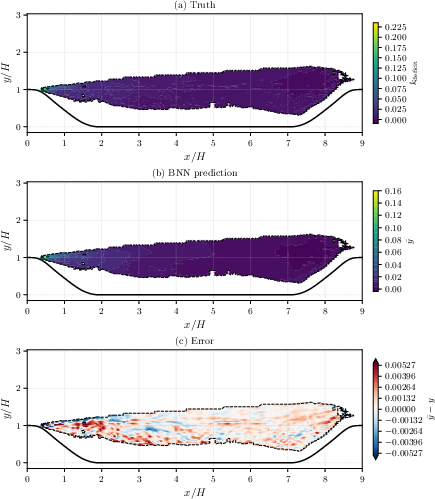
Figure 2: Reference and BNN-predicted spatial bijΔ5 fields along with residual error in the RITA-classified region.
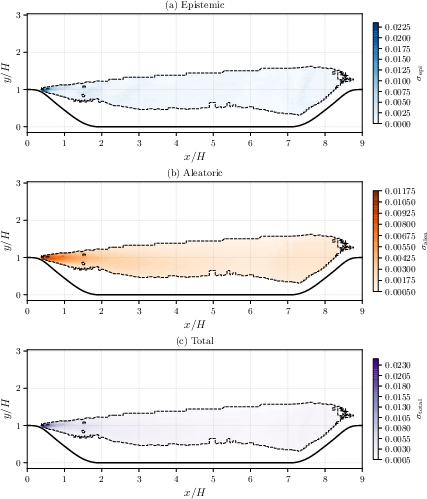
Figure 3: Decomposed spatial uncertainty for scalar correction: epistemic and aleatoric fields are localized within the separated shear layer.
Tensor-basis selection (especially bijΔ7, bijΔ8, bijΔ9) achieves k0 for coefficient projection. The reconstructed anisotropy tensor matches reference structure with global k1; k2 component accuracy is highest (k3). Coefficient-level uncertainty calibration is conservative (1k4/2k5 >81%/96%), while tensor-component coverage is lower (50–62%), emphasizing sources of mismatch in basis projection propagation. Epistemic uncertainty in k6 is highest near separation boundaries and zones of rapid flow change.
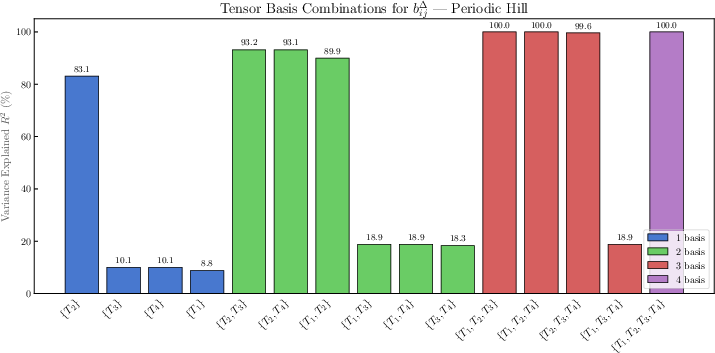
Figure 4: Variance explained (k7) for tensor basis selection, highlighting the critical role of strain-rotation commutator (k8).
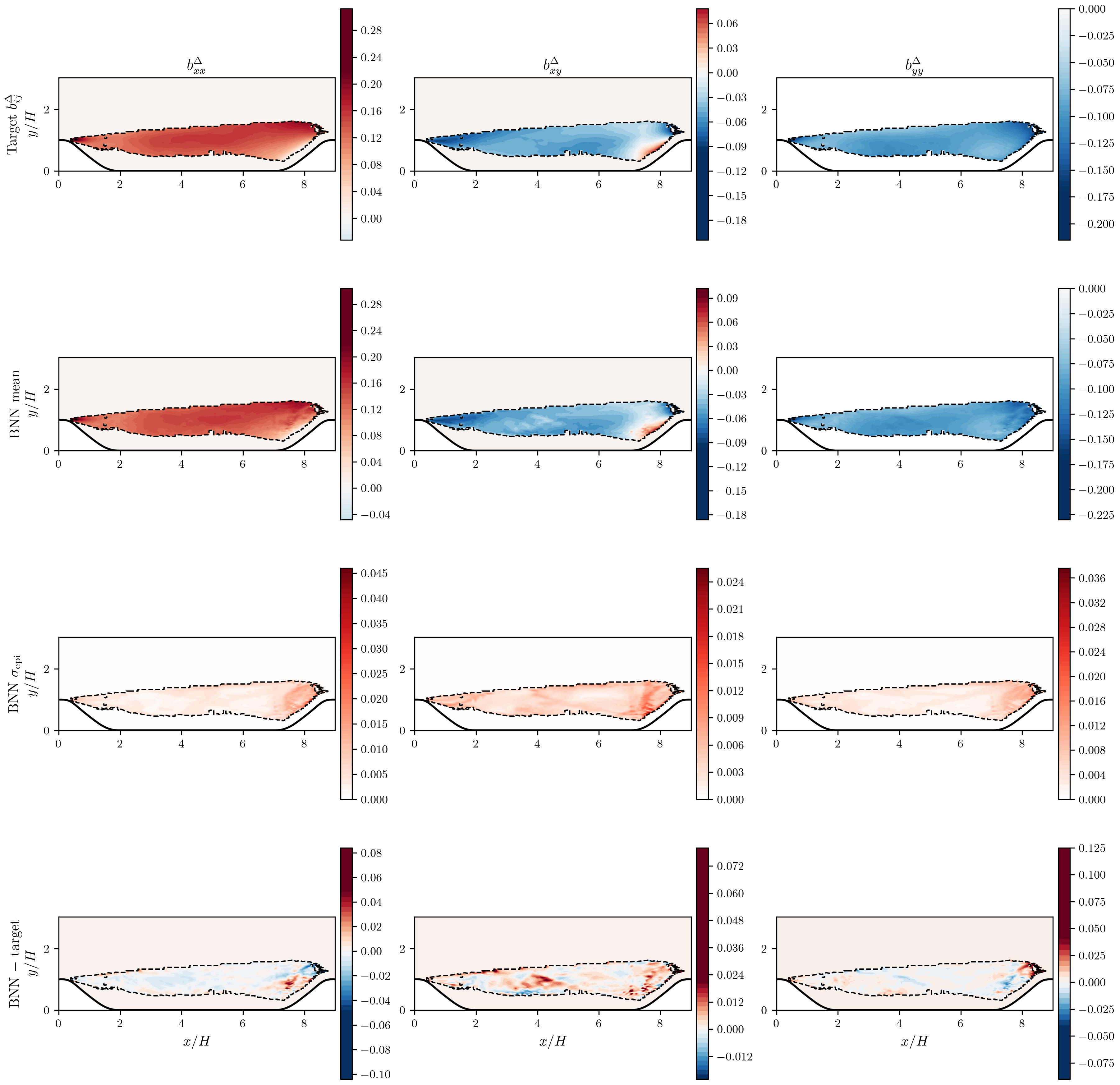
Figure 5: Spatial fields for BNN-predicted anisotropy correction components, errors, and epistemic uncertainty within the separated region.
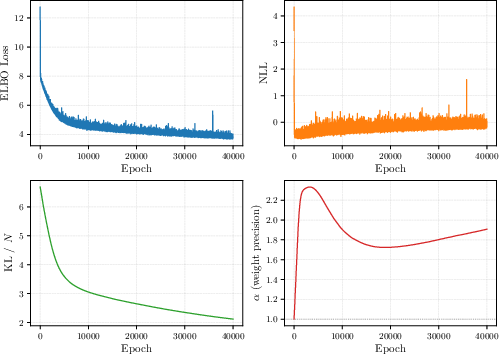
Figure 6: Training convergence curves for the anisotropy correction BNN, showing monotonic loss reduction and stable precision adaptation.
Correction Propagation and Coverage Metrics
Stage 1: k9-only Propagation
Propagation of scalar corrections recovers TKE profiles in the separated region with high fidelity but has negligible impact on the velocity field, consistent across both training and out-of-distribution cases. Uncertainty bands are tight and calibration remains mildy conservative.
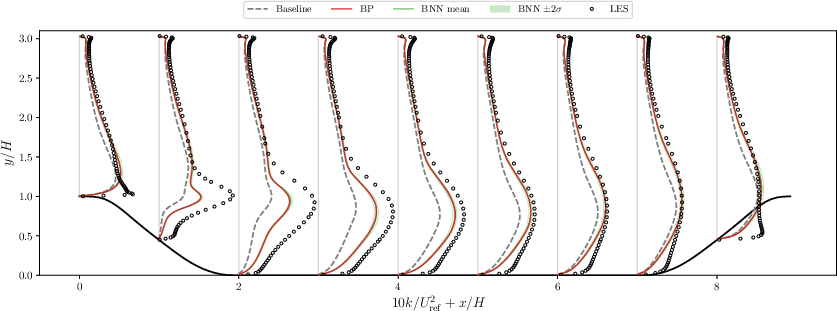
Figure 7: Vertical profiles of TKE at streamwise stations for ω0 propagation, showing matching with best-possible (BP) targets.
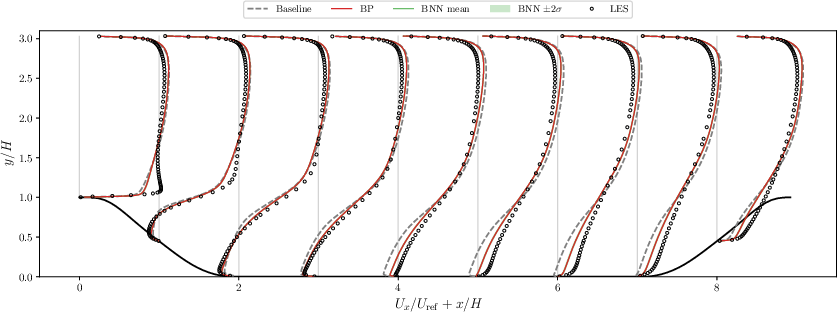
Figure 8: Vertical profiles of streamwise velocity for scalar-only correction indicate limited efficacy in correcting momentum fields.
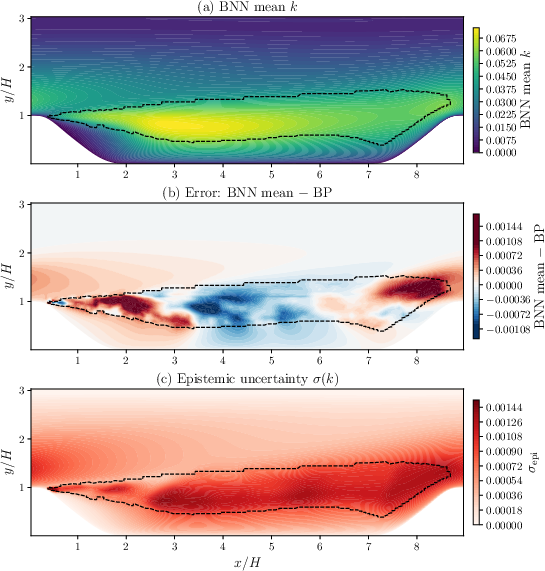
Figure 9: Contour comparison for TKE showing BNN mean, difference to BP, and uncertainty localizations.
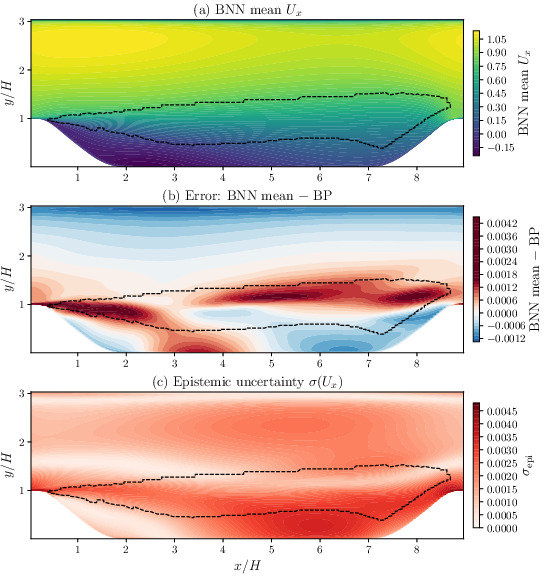
Figure 10: Contour comparison for streamwise velocity, emphasizing uncertainty in separation and reattachment regions.
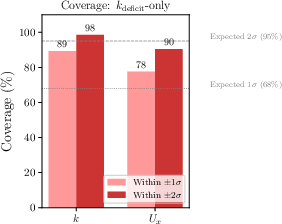
Figure 11: Coverage statistics for scalar-only propagation stage, evidencing conservative uncertainty intervals relative to Gaussian ideal.
Stage 2: Combined ω1 Propagation
Tensorial correction fundamentally alters mean flow predictions, accurately capturing recirculation, separation, and velocity deficit. Both TKE and velocity profiles show improved agreement with BP and LES references, but under-coverage in uncertainty metrics due to correction formulation ceiling and nonlinear interaction between corrections and baseline RANS.
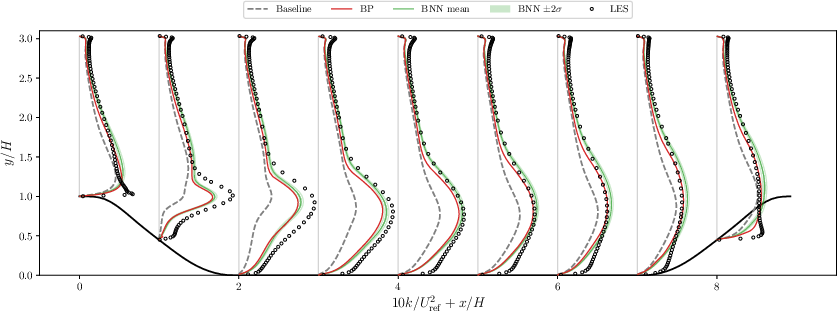
Figure 12: Vertical TKE profiles for combined correction; uncertainty band robustly captures reference solutions.
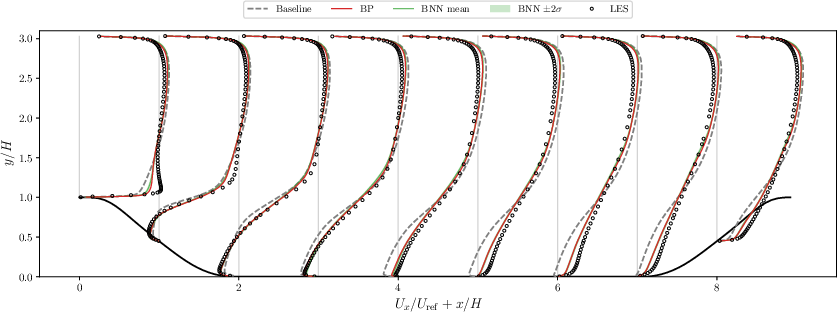
Figure 13: Vertical streamwise velocity profiles demonstrate successful recirculation modeling with anisotropy correction.
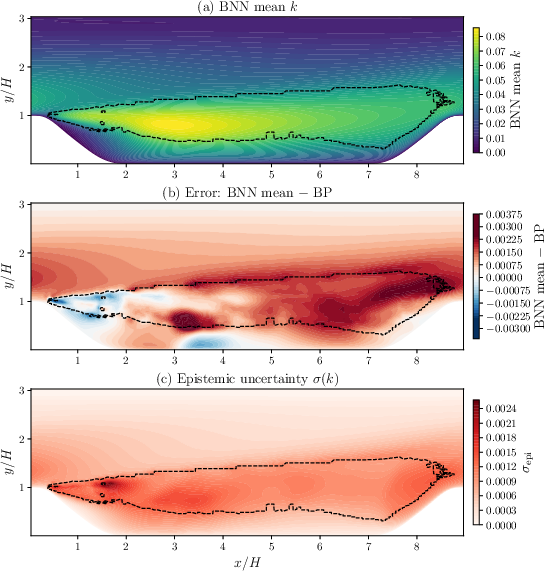
Figure 14: TKE contour comparison highlights spatial alignment of uncertainty with classified correction regions.
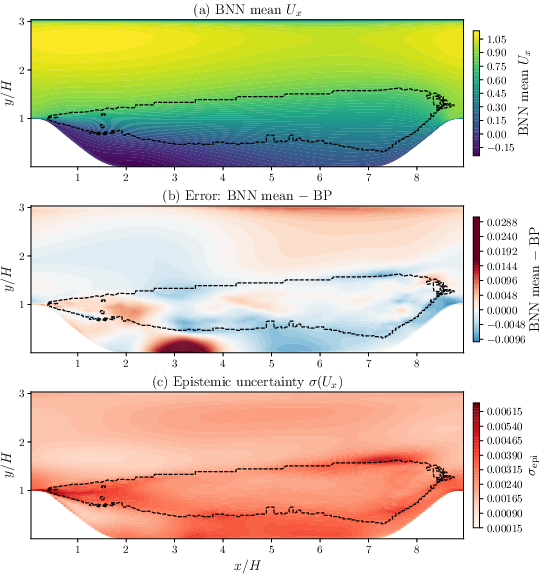
Figure 15: Streamwise velocity contour analysis evidences successful correction propagation in separated flow.
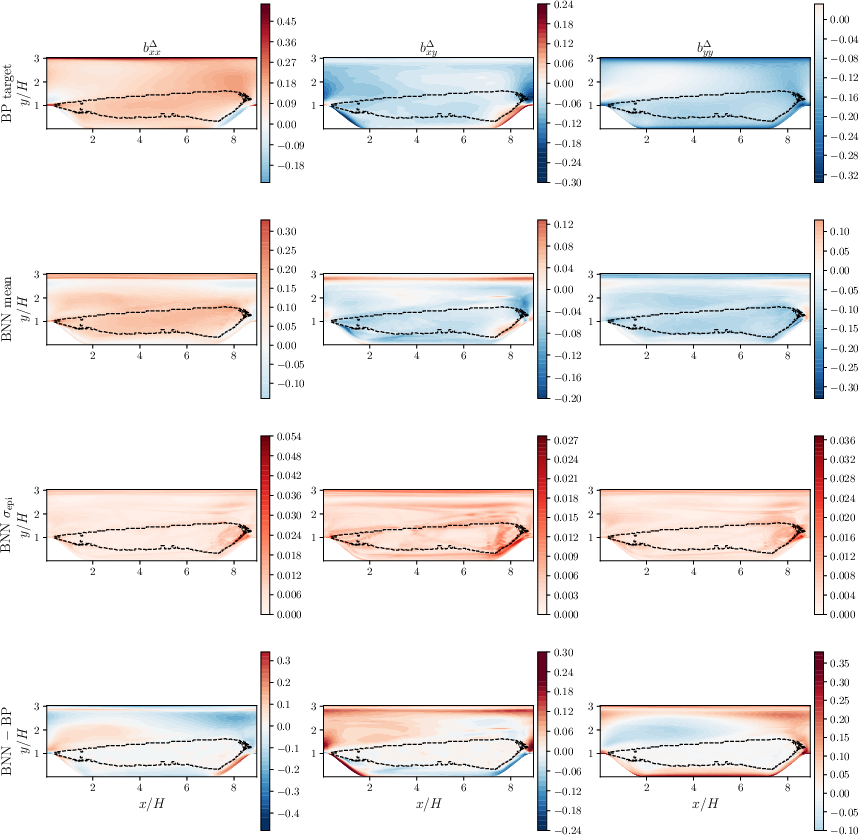
Figure 16: Anisotropy correction components for combined propagation, showing spatial coherence and uncertainty concentration.
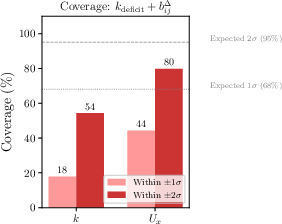
Figure 17: Coverage statistics for combined correction; velocity coverage improved but overall uncertainty is underestimated.
Out-of-Distribution Generalization: CBFS Case
On the CBFS flow, scalar correction is ineffective due to limited TKE deficit. Combined correction produces localized improvements, but overall accuracy and uncertainty coverage are reduced, with epistemic uncertainty failing to capture all reference discrepancies. These results reinforce the challenge of extrapolation for data-driven turbulence models and the necessity of improved aleatoric propagation.
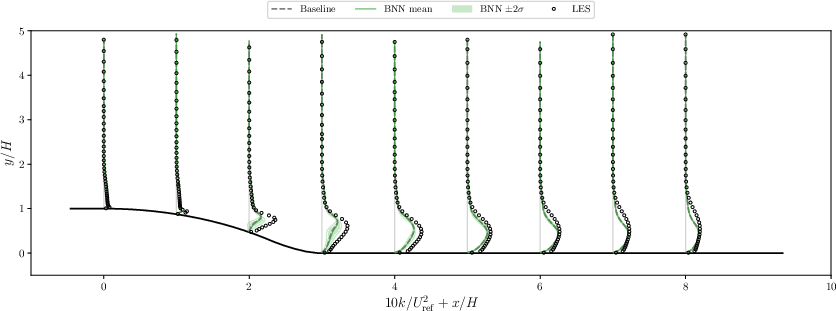
Figure 18: Vertical TKE profiles for CBFS under scalar-only correction; limited impact observed.
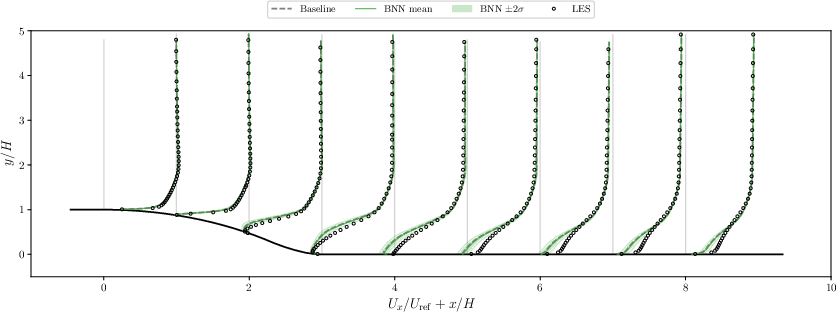
Figure 19: Streamwise velocity profiles for CBFS case; scalar correction does not alter mean flow.
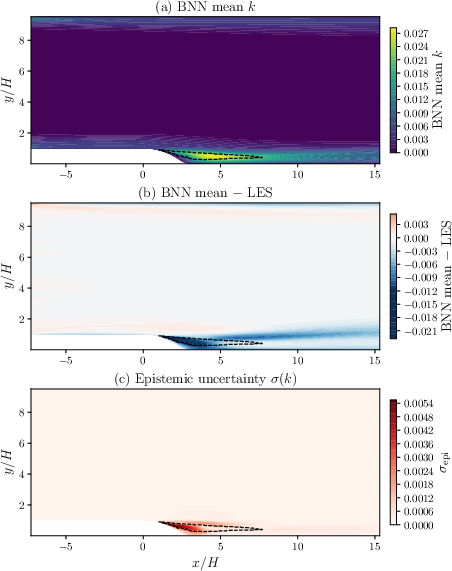
Figure 20: Contour comparison for TKE in CBFS; BNN mean and uncertainty remain localized and weak.
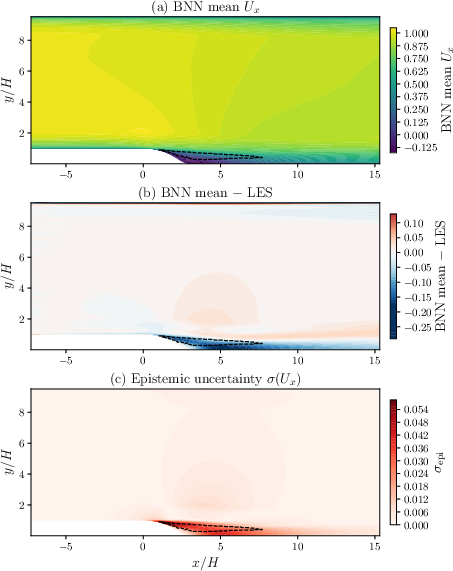
Figure 21: Streamwise velocity contours for CBFS; no substantial correction observed.
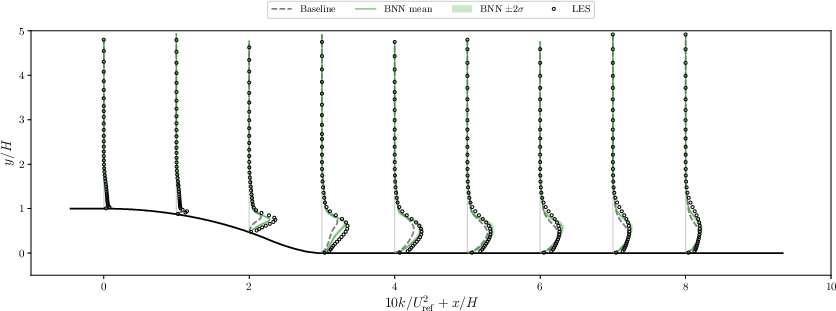
Figure 22: TKE profiles for CBFS under combined correction; BNN mean approaches LES reference in recirculation zone.
Implications and Future Outlook
The results demonstrate that separating scalar and tensorial corrections in a Bayesian regime with explicit uncertainty decomposition enables physically meaningful improvement in RANS modeling of separated flows. Scalar corrections alone reconstruct TKE fields but do not impact mean-flow dynamics. Anisotropy corrections are essential for velocity field accuracy and capturing nonlinear flow structures. Nonetheless, persistent under-calibration of uncertainty in out-of-distribution propagation underscores the limits of current correction formulations, particularly the additive SpaRTA-based framework.
Practically, this BNN approach offers a robust and interpretable pathway to uncertainty-aware computational fluid dynamics, with the ability to generalize across configurations and separate epistemic from model-form uncertainty. Theoretically, the explicit Bayesian treatment and tensor-basis regression allow for targeted, physically consistent corrections within dynamically relevant flow regions.
Further work should prioritize spatially correlated aleatoric field representation, extension to fully three-dimensional flows, and systematic study of normalization and training protocols. Improved uncertainty propagation and broader datasets will enhance generalization and reliability for engineering UQ and decision-making.
Conclusion
The zonally applied, invariant-feature-driven BNN correction framework achieves significant improvement in separated-flow RANS modeling, providing well-calibrated uncertainty and clarifying the distinct roles of scalar and tensor corrections. The methodology advances uncertainty quantification in data-driven turbulence modeling and lays groundwork for future developments in robust, generalizable, and uncertainty-aware CFD for complex flows.