- The paper finds deeply bound three-body states in DDK and D*D*K systems, typically about 70 MeV below the threshold, using a detailed coupled-channel framework.
- The study employs the Gaussian Expansion Method and Complex Scaling Method to resolve the three-body Schrödinger equation, distinguishing between compact configurations and halo-like states.
- The analysis demonstrates negligible coupled-channel effects from D*D*K admixtures while emphasizing the role of two-body forces constrained by heavy-quark symmetry and lattice-QCD findings.
Coupled-Channel Analysis of Three-Body DDK and D∗D∗K Dynamics
Overview and Motivation
This work undertakes a high-fidelity coupled-channel study of three-body systems composed of two charmed mesons and one kaon: DDK and D∗D∗K, with isospin and parity quantum numbers I(JP)=21(0−). The theoretical framework hinges on a combination of one-boson-exchange (OBE) models for the D(∗)D(∗) interactions, constrained by heavy-quark symmetry and fitted to pole positions of prominent exotic states (X(3872), Tcc+, Zc(3900)), and chiral-motivated interactions for D(∗)K, coherently linked to the molecular interpretation of D∗D∗K0 and lattice-QCD determinations of D∗D∗K1 scattering lengths.
The three-body Schrödinger equation is solved via the Gaussian Expansion Method (GEM), with resonance explorations conducted using the Complex Scaling Method (CSM). The primary objectives are: (i) to ascertain the existence and parameter dependence of bound and resonant states, (ii) to dissect internal spatial structures, and (iii) to quantify the impact of coupled-channel (D∗D∗K2) effects.
Two-Body Sector and Parameter Constraints
Fundamental pairwise forces underpinning the three-body calculation are formulated with robust phenomenological and lattice-QCD constraints:
- D∗D∗K3 OBE Potential: The OBE construction employs heavy-quark spin/flavor symmetry, chiral symmetry, and SU(2) isospin, with explicit cancellation between vector-meson exchange components (D∗D∗K4, D∗D∗K5) and scalar (D∗D∗K6) dominance in D∗D∗K7. Coupling constants are rescaled and fixed using empirical pole locations, minimizing model ambiguity.
- D∗D∗K8 Chiral Interaction: At leading order, the Weinberg–Tomozawa term asserts strong attraction in the D∗D∗K9 channel. Next-to-leading order corrections and lattice-QCD scattering lengths (DDK0 to DDK1 fm) inform Gaussian two-range parameterizations constrained by DDK2 and lattice fits.
A parametric survey (Figure 1) establishes admissible regions for DDK3 potential parameters, showing that the scattering length becomes insensitive to short-range repulsion above a threshold DDK4, and that the long-range interaction scale (DDK5) exhibits non-monotonic influence on the asymptotic scattering length.
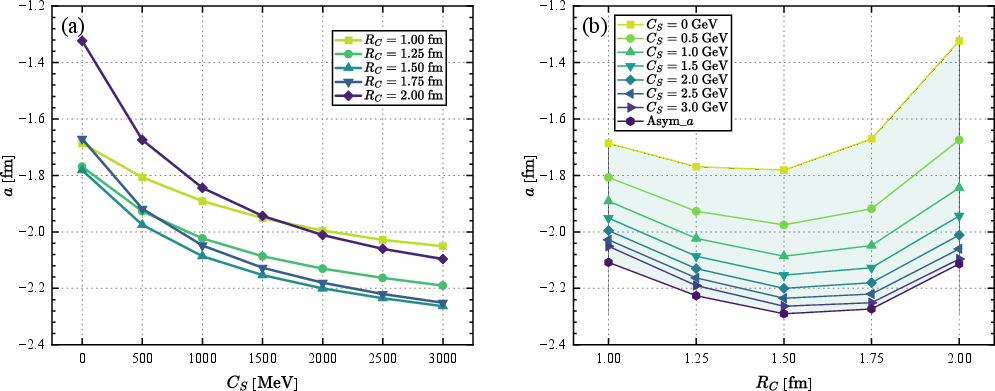
Figure 1: Scattering length landscapes for various DDK6 and DDK7, with shaded regions denoting allowed DDK8 parameter sets consistent with lattice-QCD.
Three-Body Spectrum and Cutoff Dependence
Employing the Gaussian Expansion Method for the DDK9 and D∗D∗K0 configurations, the spectrum reveals robust binding across a significant range of D∗D∗K1 cutoff values (D∗D∗K2–D∗D∗K3 GeV). The deeply bound state persists for all parameterizations constrained by lattice and experiment, with binding energies typically D∗D∗K4 MeV below three-body threshold, showing little sensitivity to cutoff variation (Figure 2).
Depending on the D∗D∗K5 interaction scale, the three-body problem may also admit a shallow bound state near the particle-dimer (D∗D∗K6-D∗D∗K7) threshold. The appearance of this state correlates with extended D∗D∗K8 range (D∗D∗K9), indicating sensitivity to the spatial structure of the underlying I(JP)=21(0−)0 contact term.
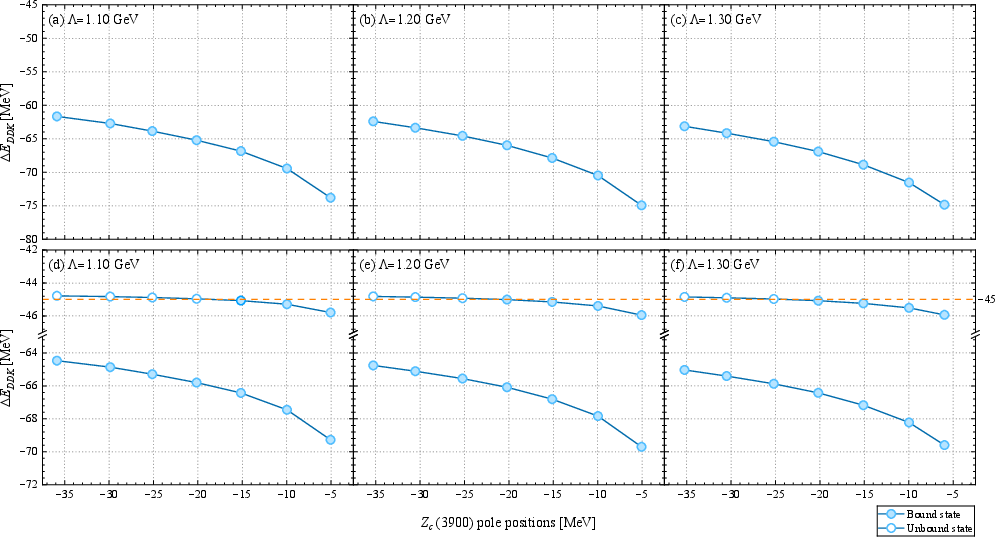
Figure 2: Cutoff dependence of I(JP)=21(0−)1 bound states; orange line marks the I(JP)=21(0−)2-I(JP)=21(0−)3 threshold, solid markers denote bound states.
A systematic scan with I(JP)=21(0−)4 interaction parameters set by lattice-QCD results (Figure 3) tightens the prediction, where deeply bound states are consistently produced, and shallow states or threshold behavior is confined to longer-range I(JP)=21(0−)5 potential scenarios.
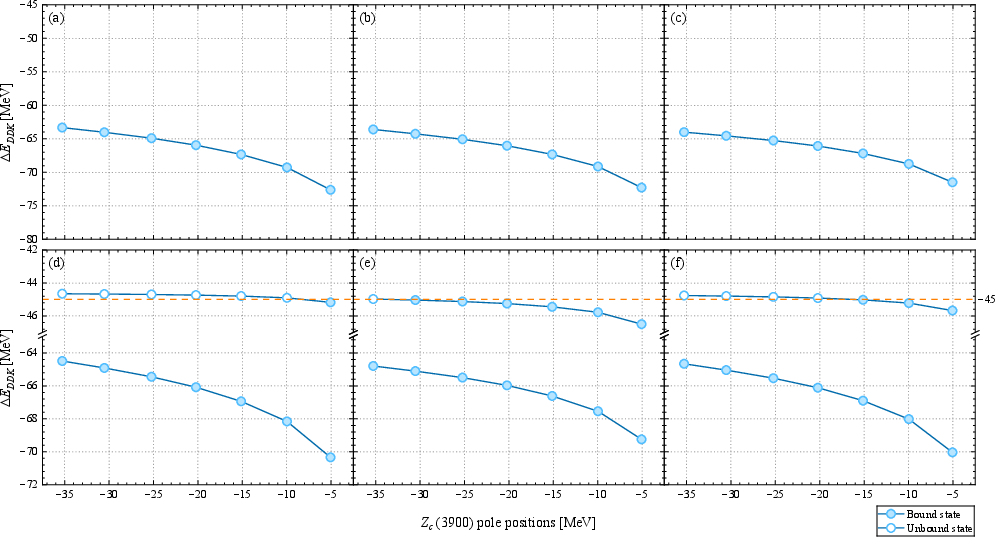
Figure 3: Variation of I(JP)=21(0−)6 bound states with I(JP)=21(0−)7 pole position and lattice-QCD constrained I(JP)=21(0−)8 interaction.
Spatial Structure and Halo States
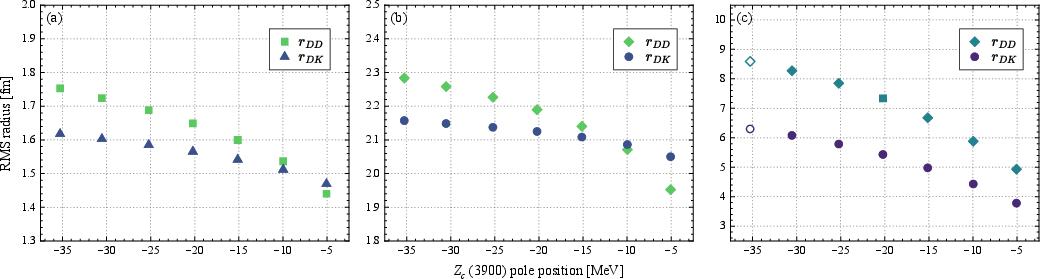
Analysis of the root-mean-square (rms) radii for constituent subsystems (I(JP)=21(0−)9, D(∗)D(∗)0) distinguishes two classes of bound states:
Similar results arise in the X(3872)1 system (Figures 7, 8), where deeply bound and halo states coexist for analogous X(3872)2 parameters, again with vanilla three-body spatial profiles.
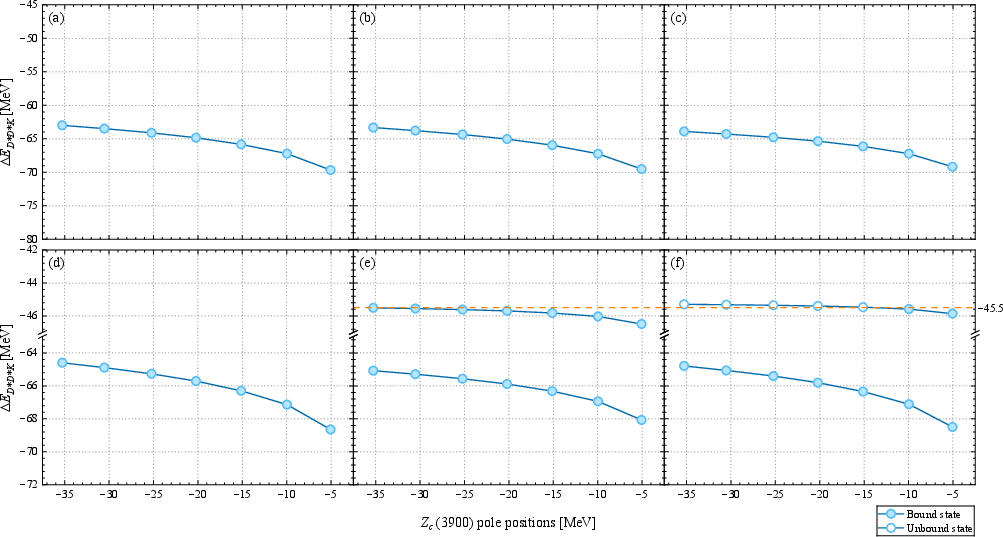
Figure 5: X(3872)3 binding energy dependence on X(3872)4 pole and lattice-QCD input.
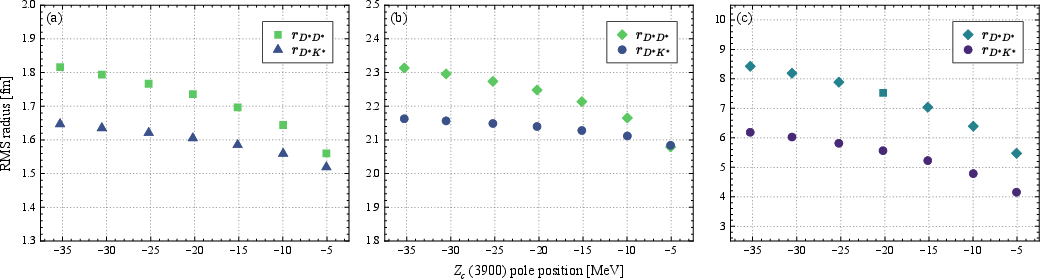
Figure 6: rms radii for X(3872)5 and X(3872)6 subsystems; halo and compact three-body states distinguished.
Coupled-Channel Effects and Resonance Analysis
The probability of X(3872)7 admixture in the total wavefunction is negligible (X(3872)8), implying that coupled-channel dynamics exert minimal influence on the spectrum and structure. The dominant configurations remain purely X(3872)9 (or Tcc+0).
Complex energy analysis via the Complex Scaling Method (CSM, Figure 7) reveals an absence of additional resonant states: all identified bound states appear as discrete negative real eigenvalues, unaffected by coordinate rotation, and the continuum rotates as expected. No resonance poles emerge in the explored parameter space.
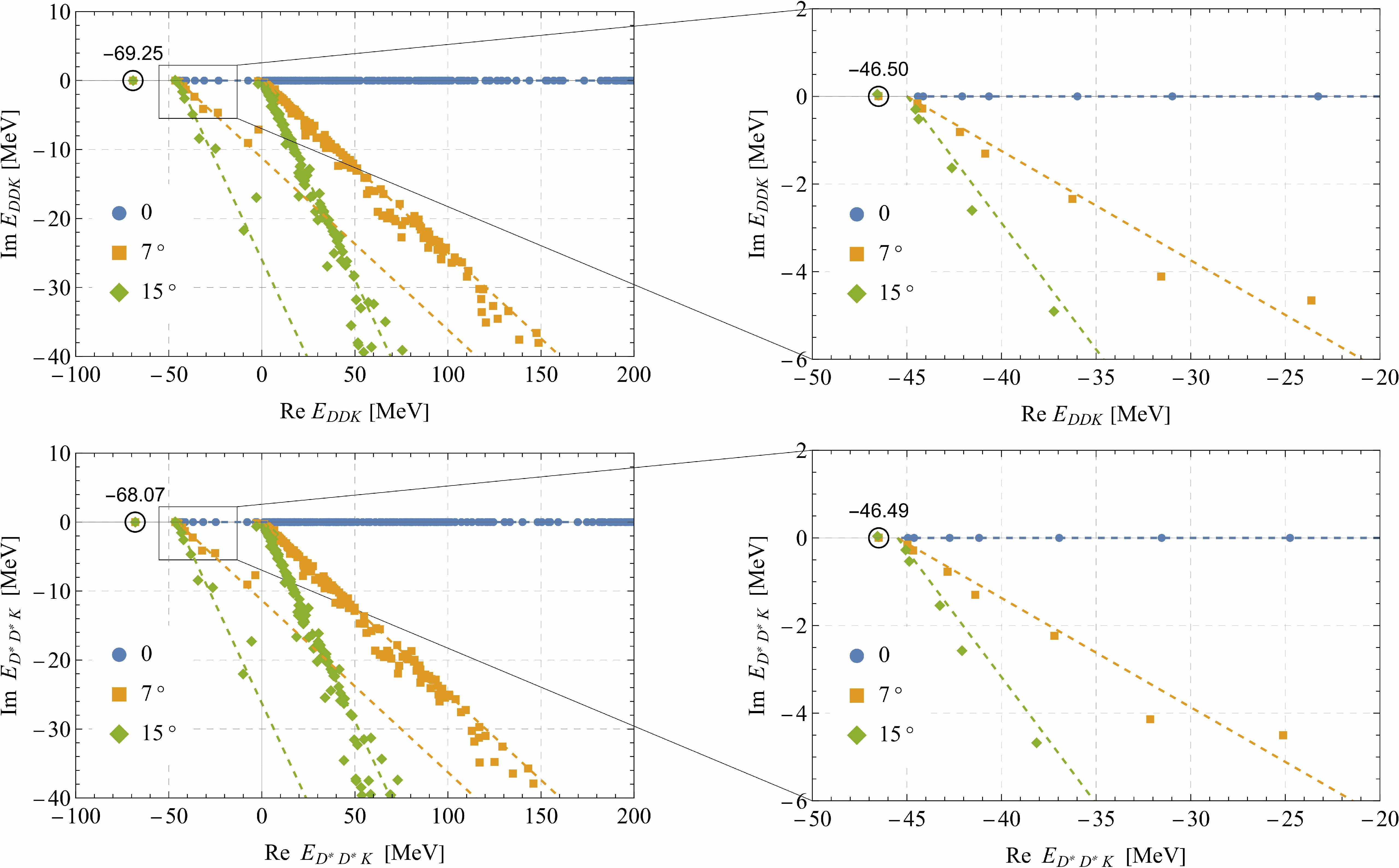
Figure 7: CSM complex-energy results for Tcc+1 (upper) and Tcc+2 (lower); bound states on negative real axis, no resonance poles.
Implications and Outlook
The results robustly establish that three-body charmed meson–kaon systems support deeply bound compact states insensitive to short-range regulator choice and lattice-QCD uncertainties. Additional halo-like states may arise for specific Tcc+3 interaction profiles, enriching the spectrum of possible exotic hadronic molecules.
Practically, these findings indicate prospects for experimental observation at BESIII, LHCb, and Belle II are promising if production thresholds can be accessed and relevant decay channels isolated. Theoretically, the work clarifies the nontrivial interplay between two-body and three-body interactions in heavy-flavor systems, and motivates further studies employing relativistic treatments, extended coupled-channel spaces (e.g., Tcc+4, Tcc+5), and more refined lattice-QCD inputs.
Future avenues include:
- Differential analysis of four-body (Tcc+6) and analogous Tcc+7-flavor systems.
- Investigation of three-body force effects and their impact on spatial structure.
- Inclusion of electromagnetic and weak decays to predict observable signatures.
Conclusion
A comprehensive coupled-channel study combining heavy-quark symmetry, chiral dynamics, lattice-QCD constraints, and advanced few-body methods demonstrates the existence of deeply bound and halo-like three-body states in Tcc+8 and Tcc+9 systems. Coupled-channel effects from Zc(3900)0 are quantitatively negligible. No resonances are found within the explored parameter space. This analysis provides rigorous benchmarks for both theoretical modeling and future empirical searches for exotic multihadron states in the heavy-flavor sector.