- The paper introduces the Correlation Concentration Ratio (CCR) as a quantitative metric to assess the distribution of entanglement in quantum cluster states.
- It employs a symplectic representation and covariance matrix analysis to compare linear, square, and T-shaped continuous-variable cluster states under varied squeezing conditions.
- The CCR metric is robust against squeezing variations, offering actionable insights for designing scalable and fault-tolerant measurement-based quantum computing architectures.
Quantitative Analysis of Quantum Cluster Topologies via the Correlation Concentration Ratio (CCR)
Overview and Motivation
Quantum cluster states form the backbone of Measurement-Based Quantum Computation (MBQC), particularly within the continuous-variable (CV) paradigm. The paper "Introducing the Correlation Concentration Ratio (CCR): Quantitative Framework for Comparing Quantum Cluster States" (2604.23258) presents a systematic numerical investigation of four-mode CV cluster states with linear, square, and T-shaped topologies. Employing symplectic representation and covariance matrix formalism, the study introduces the Correlation Concentration Ratio (CCR), a novel quantitative metric that characterizes the topological distribution of quantum correlations intrinsic to cluster graphs. The CCR facilitates rigorous comparison of entanglement structure in cluster states and informs the design of scalable and fault-tolerant quantum computational architectures.
Cluster State Topologies and Simulation Methodology
The construction of CV cluster states, as modeled in this work, hinges on initializing modes in momentum-squeezed vacuum states and sequentially applying controlled-phase gates following the underlying graph topology. The adjacency matrix and corresponding symplectic matrix encode the graph structure, enforcing specific patterns of bipartite correlations within the quantum state's covariance matrix.
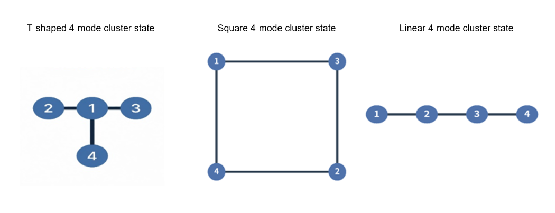
Figure 1: Schematic illustration of the linear, square, and T-shaped cluster state topologies analyzed in the study.
Numerical simulations were performed for squeezing parameters ranging from 3 to 16 dB—a regime spanning from accessible laboratory conditions to thresholds pertinent for fault-tolerant MBQC [Larsen et al., 2021]. The covariance matrices fully describe the Gaussian states and permit direct visualization and quantification of quadrature correlations.
Covariance Matrix Analysis and Entanglement Patterns
The linear cluster states display strong nearest-neighbor correlations in momentum-position quadrature pairs, corresponding precisely to nullifier relations underpinning ideal cluster states. As squeezing increases, target correlations are amplified while unwanted anti-squeezing components are suppressed, ensuring high-fidelity cluster formation.
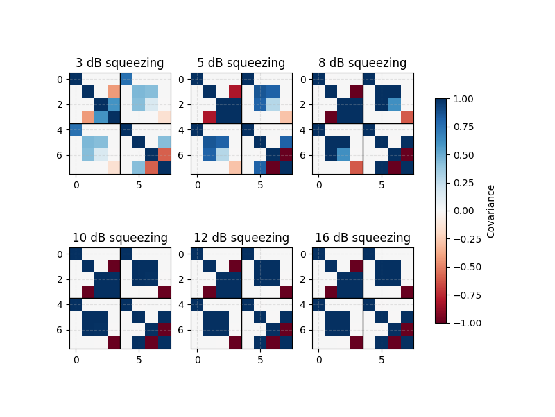
Figure 2: Covariance matrix for the four-mode linear cluster state over squeezing range 3–16 dB, showing enhancement of neighborly correlations.
Square cluster states exhibit symmetric correlation patterns between each mode and its two neighbors, reflecting the two-dimensional connectivity and facilitating redundant communication paths—a desirable feature for scalable MBQC.
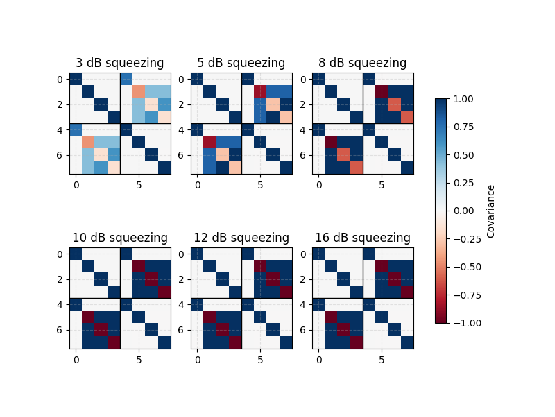
Figure 3: Covariance matrix for the four-mode square cluster state with squeezing parameter varied from 3 to 16 dB, demonstrating symmetry and distributed entanglement.
T-shaped cluster states yield GHZ-like central correlations, with the core mode acting as a hub linking peripheral modes. Peripheral modes remain uncorrelated, underscoring directional concentration of entanglement.
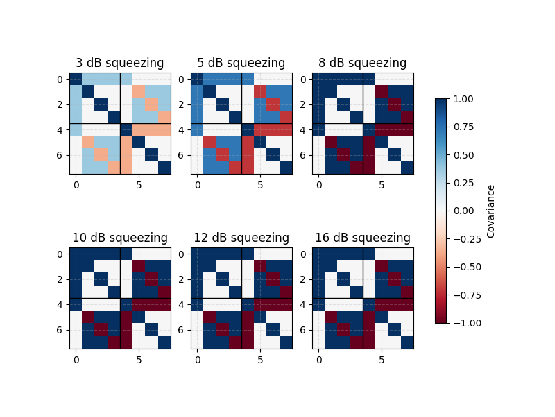
Figure 4: Covariance matrix for the four-mode T-shaped cluster state under squeezing variation, illustrating dominant central correlations and negligible peripheral-peripheral entanglement.
This covariance structure is consistent with theoretical cluster nullifiers and visually elucidates how graph topology imprints correlation anisotropy.
The Correlation Concentration Ratio (CCR): Definition and Topological Significance
CCR is formulated to quantify entanglement concentration relative to a cluster's adjacency matrix. Specifically, CCR is defined as the ratio of summed cross-quadrature correlations along graph edges to the total cross-quadrature correlations in the system:
CCR=∑i<j(∣Vxipj∣+∣Vpixj∣)∑i<jAi,j(∣Vxipj∣+∣Vpixj∣)
By construction, CCR ranges between zero and unity and remains agnostic to the global strength of correlations, instead probing their structural localization. The metric distinguishes between clusters with distributed centrality (low CCR, e.g., square topology), directionally concentrated correlations (intermediate CCR, e.g., linear topology), and strongly centralized hub structures (high CCR, e.g., T-shaped or generalized star topologies).
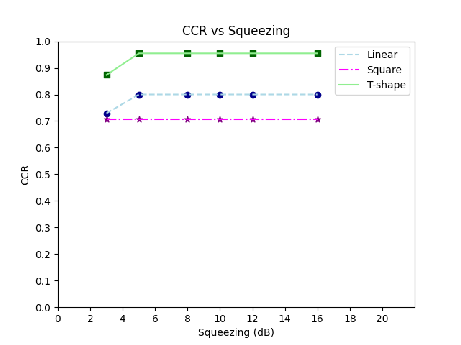
Figure 5: CCR as a function of squeezing parameter for linear, square, and T-shaped clusters, revealing topology-dependent anisotropy in correlation concentration.
CCR remains robust against variation in squeezing—correlation intensity increases with squeezing, but structural concentration dictated by topology persists. This stability is vital for architectural scaling and resource allocation in MBQC.
Scaling, Comparison with Standard Correlation Metrics, and Practical Implications
CCR is topologically structural, contrasting standard quantum correlation measures such as Quantum Mutual Information (QMI), negativity, or quantum discord, which quantify aggregate correlation or bipartite entanglement irrespective of graph structure. CCR's sensitivity to correlation distribution is critical for analyzing information propagation and error resilience in MBQC.
For larger clusters, CCR maintains low values for symmetric topologies (square/grid), scaling favorably for fault tolerance. Linear clusters see increasing CCR with chain length, reflecting growing inhomogeneity and vulnerability to intermediate node failures. Star-shaped (generalized T-shaped) clusters exhibit super-linear CCR scaling with mode count, making central hubs single points of failure—unsuitable for robust MBQC.
Conclusion
The introduction of the Correlation Concentration Ratio (CCR) enables precise, quantitative assessment of entanglement distribution relative to cluster topology in CV quantum computing architectures. The metric exposes critical topological distinctions relevant to information flow, computational robustness, and scalability. The symplectic-covariance simulation framework, validated against theoretical nullifiers, offers a rigorous methodology for cluster state analysis. The CCR provides a foundational tool for topology selection and optimization in measurement-based quantum computation, directly impacting the engineering of future scalable and fault-tolerant CV quantum processors.