- The paper demonstrates that mass-action SIRI ODEs can accurately mirror network dynamics on Poisson graphs under low transmission conditions.
- It employs a pairwise moment closure to derive a closed five-dimensional system, achieving errors below 0.041 and Pearson correlations above 0.96.
- The study validates simplified mean-field models for forecasting epidemic curves and guiding interventions in diseases with relapse dynamics.
Mean-Field and Pairwise Approximations for SIRI Dynamics on Poisson Networks
Introduction and Theoretical Framework
This paper analyzes the relationship between mass-action mean-field dynamics and pairwise network-based models for the Susceptible-Infectious-Recovered-Infectious (SIRI) process, specifically on Poisson random graphs. The SIRI model introduces relapse dynamics to classical epidemic modeling, allowing recovered individuals to return to the infectious state, with applications in infectious disease transmission (e.g., herpes, TB) and behavioral contagion models (e.g., substance abuse with relapse).
Classical mean-field compartmental models, grounded in mass-action kinetics, treat populations as homogeneously mixing, neglecting network structure. Network-based models, such as those on configuration-model graphs with Poisson degree distributions, account for heterogeneous contact patterns but are analytically more complex. Prior results demonstrate exact equivalence of the susceptible decay curve between classical SIR ODEs and network SIR dynamics on Poisson graphs, motivating the present investigation for SIRI dynamics.
Pairwise Modeling for SIRI on Poisson Networks
The authors construct the pairwise mean-field ODE system for SIRI dynamics on a configuration-model random graph with Poisson degree distribution. The stochastic SIRI process is defined by three rates: per-contact infection (β~), recovery (γ~), and reinfection (relapse, α~). The network is encoded via expected counts of nodes ([X]), pairs ([XY]), and triplets ([XYZ]). Pairwise moment closure (κ=1 for Poisson) allows expressing triplet terms as products of pairs normalized by singles, and [SS] factorizes as μxS2.
Normalized variables for population fractions and auxiliary ratios for infectious-neighbor and recovered-neighbor densities (xD, γ~0) lead to a closed five-dimensional system:
γ~1
Initial conditions reflect random seeding: γ~2, γ~3, γ~4, and the pair densities follow from degree and fractions.
Model Equivalence and Analytical Approximation
Rigorous analysis compares the epidemic curve equations for mean-field SIRI ODE and pairwise network SIRI. The derivation establishes parameter mappings that guarantee trajectory equivalence:
- γ~5
- γ~6
- γ~7
- γ~8
The approximation holds when per-contact transmission is small relative to recovery (γ~9), and the auxiliary ratios α~0 are preserved with matched initial conditions. Taylor expansion demonstrates that α~1 for small α~2, confirming asymptotic equivalence for the early epidemic regime.
Numerical Results and Quantitative Evaluation
Direct numerical comparison is provided for network simulations and ODE solutions across multiple parameter sets, focusing on the susceptible and infectious fractions. The main finding is the close alignment of epidemic curves between the two models under the specified parameter mapping and assumption of low transmission.
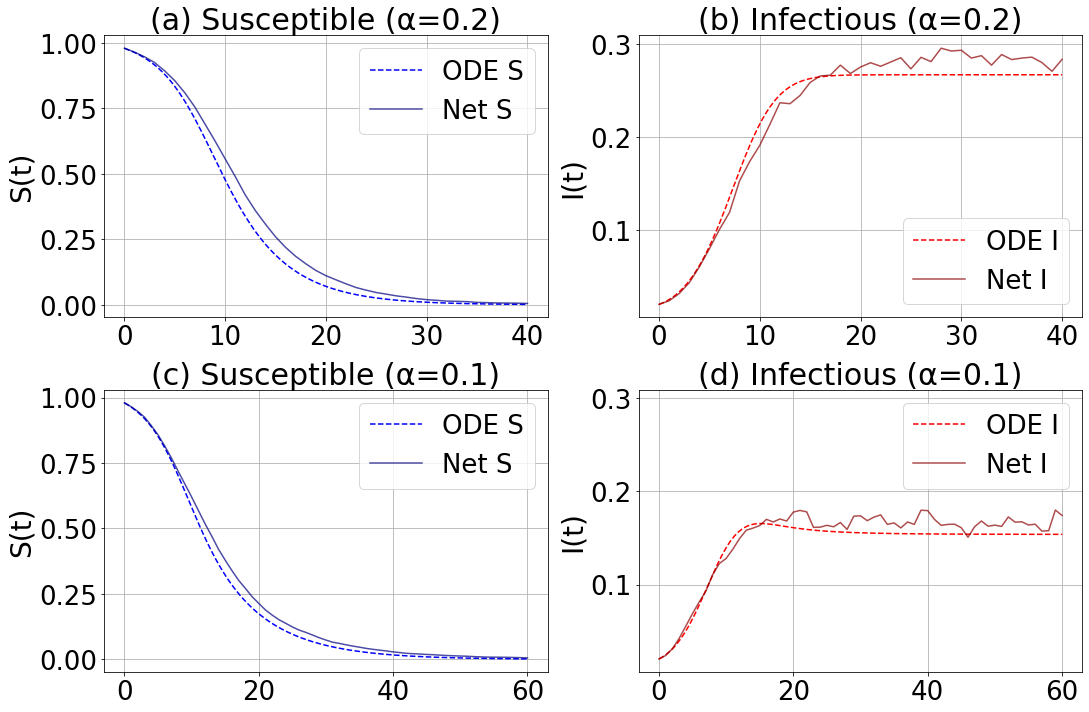
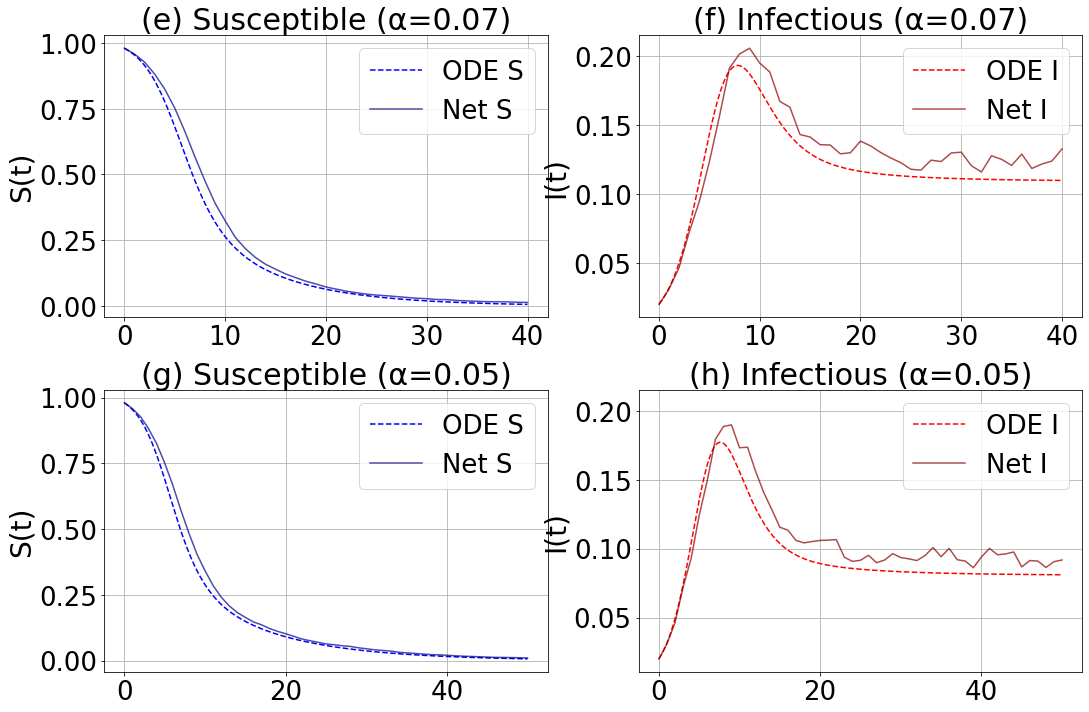
Figure 1: S and I fractions in time for Poisson networks vs mass-action ODEs; solid lines represent network, dashed lines ODE, for four parameter sets.
S-RMSE and I-RMSE stay below 0.041 and 0.015, respectively, with Pearson correlation coefficients exceeding 0.96. This demonstrates quantitative agreement between mass-action ODE and network pairwise dynamics despite underlying structural complexity.
Additional steady-state analyses examine the recovered and infectious fractions as functions of transmission (α~3) and reinfection (α~4) rates.
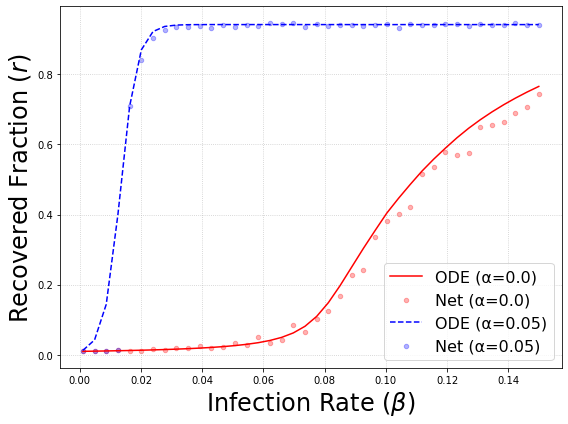
Figure 2: Steady-state recovered fraction as function of infection rate for different reinfection rates; ODE (solid) and network (dots) closely agree at low α~5.
Deviation increases for larger α~6, as the multiplicative effect amplifies errors introduced by mean-field approximations, especially in the ratio approximations. For low transmission, alignment is precise, affirming the validity of mean-field surrogacy in this regime.
Implications and Future Directions
This research supports the practical use of mass-action ODE models for epidemic forecasting and intervention policy even when network structure is present, provided the contact rates are low and the network is sufficiently random (Poisson). The theoretical justification for parameter mapping between network and ODE models enables reliable estimation of epidemic curves and steady-state outcomes without full network simulation.
From a modeling perspective, this establishes conditions under which nonlinear dynamics with relapse (SIRI) can be reduced to tractable mean-field ODEs with high fidelity. The result is particularly relevant for large-scale epidemic scenarios, behavioral contagion modeling, and rapid policy evaluation.
Future work should address robustness to deviations from Poisson structure (degree heterogeneity, clustering), multi-stage infection dynamics, and adaptive network interventions. Extending the approximation framework to models with explicit spatial structure or temporal contact variation remains an open challenge.
Conclusion
The paper rigorously demonstrates that mass-action SIRI ODEs can serve as accurate surrogates for SIRI dynamics on Poisson networks under specific parameterizations and moment closure assumptions. Analytical derivations and numerical simulations confirm high agreement for both epidemic curves and steady-state outcomes, particularly when per-contact transmission is small. The results formally justify the practical adoption of mean-field models in structured populations, providing theoretical and quantitative foundations for simplifying epidemic modeling in various domains.