- The paper’s main contribution is a standardized framework that implements widely-used traffic controllers to enable reproducible performance evaluations in SUMO simulations.
- It details modular implementations for freeway ramp metering and urban intersection control, providing rigorous guidelines for stochastic evaluation and parameter calibration.
- The results demonstrate stable controller performance and highlight trade-offs in traffic management, paving the way for future adaptive and learning-based methods.
sumoITScontrol: Standardized Traffic Controller Benchmarking for SUMO Simulations
Motivation and Problem Statement
Effective performance evaluation of traffic control strategies in microscopic simulation environments is hindered by the lack of standardized, reproducible benchmarks and reliable baseline implementations. Existing research leveraging SUMO often relies on custom, project-specific controller code with limited documentation or comparability. Moreover, the stochasticity of microscopic traffic simulation—including random departures, heterogeneous driver behavior, and vehicle interactions—renders single-run evaluations insufficient for robust assessment. This leads to questionable improvements and stifles scientific progress in ITS algorithm design.
sumoITScontrol: Framework Design and Scope
sumoITScontrol is introduced as an open-source, extensible Python package that implements a curated collection of widely adopted traffic controllers for the SUMO simulation environment, interfacing via TraCI. The framework prioritizes transparency, modularity, and reproducibility, providing well-documented implementations for both freeway ramp metering and urban intersection management.
Freeway Control: sumoITScontrol covers ALINEA, PI-ALINEA, METALINE, and HERO ramp metering schemes. ALINEA variants are implemented as integral or PI controllers relying on downstream or upstream occupancy and can be tuned via proportional and integral gains to maintain the desired occupancy setpoint. METALINE is implemented as a multivariable, corridor-level PI controller with full gain matrices, supporting both coordinated and independent ramp metering. HERO introduces hierarchical queue management through master-slave coordination, dynamically redistributing queue pressure upstream.
Urban Signalized Intersection Control: The framework implements two major classes, Max-Pressure (with fixed and flexible sequencing) and coordinated SCOOT/SCATS-style adaptive control. The Max-Pressure algorithm can operate under strict cyclic policies (fixed order and duration) or flexible, acyclic event-driven policies where green phases are dynamically assigned to the highest-pressure approaches based on real-time queue measurements.
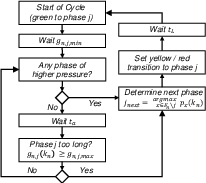
Figure 2: Finite state machine transition structure for Max-Pressure (flexible) controller, illustrating phase selection, pressure evaluation, and state transitions.
Coordinated Corridor Control: The SCOOT/SCATS-inspired approach implements hierarchical adaptive optimization: cycle-length adaptation tied to network-wide lane saturation, green split optimization based on local lane saturation disparities, and offset adjustment for multi-intersection progression harmonization. All controllers expose modular parameter configuration and sensor assignment, supporting diverse network setups.
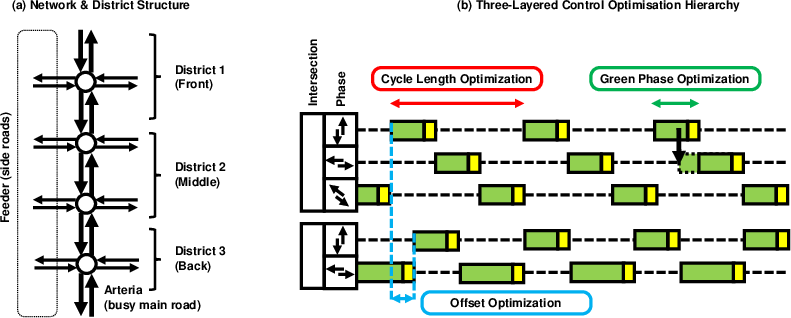
Figure 4: SCOOT/SCATS controller architecture for coordinated signalized intersections, showing three-layer adaptation (cycle length, split, offset) and district-level congestion handling.
Methodological Rigor: Stochastic Evaluation and Calibration
A major emphasis is placed on rigorous methodological guidelines for simulation design, sensor placement, demand definition, and, critically, stochastic evaluation. The paper demonstrates that stochastic noise in microscopic simulations is nontrivial: reported gains in performance metrics can be confounded by random seed selection unless sufficient replication is performed.
Replication and Variance Reporting: Strong recommendations are given for multiple (10–20) independent simulation runs per configuration. Performance metrics must be reported with statistical dispersion (e.g., standard deviation, 95% confidence intervals) and evaluated via formal hypothesis testing. For paired controller comparison, matched random seeds are advocated to maximize statistical power.
Statistical Evaluation: The framework provides examples of null hypothesis testing via paired and unpaired t-tests, with fallback to nonparametric Wilcoxon or Mann-Whitney tests if normality is not established. Controller ranking and parameter optimization are shown to be sensitive to stochastic layer effects; single-run evaluations are shown to be unreliable.
Parameter Calibration: Calibration is formalized as stochastic black-box optimization on a specified parameter domain, minimizing (or maximizing) expected performance across seeds rather than per-run outcomes. This is illustrated with ALINEA’s KP gain calibration, demonstrating that "best" configurations are not statistically significant without rigorous analysis.
Case Studies: Freeway and Urban Control
Two detailed case studies are provided—the first covering a realistic motorway segment with three on-ramps under varied geometry configurations; the second involving a German arterial network with seven signalized intersections.
Freeway Model Design: Dedicated guidelines are established for realistic network and model setup in SUMO. Manual network construction is advised over map imports to avoid topological inaccuracies. Specific recommendations are given for ramp signal placement, junction priority settings, and lane-change restrictions to reproduce real-world merging and congestion phenomena.
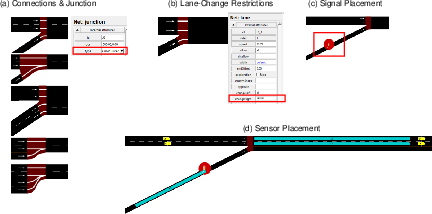
Figure 1: Freeway network design and critical aspects for accurate simulation of ramp metering use cases in SUMO.
Sensor placement is detailed (E2 lane detectors for ramp queues, E1/E2 for mainline flows), and demand is made heterogeneous via multi-class, multi-behavior fleet definitions. Probabilistic (rather than periodic) vehicle departure processes are prescribed for naturalistic congestion formation.
Intersection Model Design: For urban networks, explicit link-to-phase mappings are constructed, and sensor placement strategies are shown to ensure high-resolution queue/density measurement. Demand composition matches regional statistics and includes public transport routes.
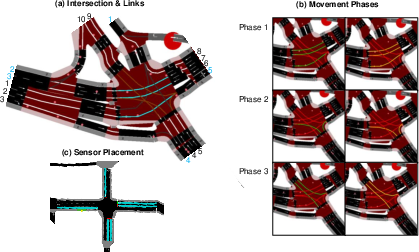
Figure 3: Urban network design elements and critical sensor/phase configuration for intersection management benchmarks.
Demonstration Results and Baseline Behaviors
Demonstration results validate the correct operation of provided controllers. For ramp metering, ALINEA stably maintains mainline occupancy at the setpoint at the cost of ramp queue growth; METALINE and HERO illustrate trade-offs in multiramp coordination and queue spillback mitigation, respectively.
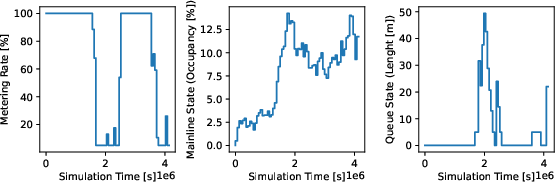
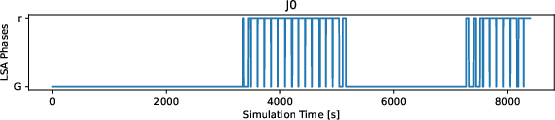
Figure 8: Time series of occupancy and queue length for ALINEA, demonstrating stabilization around the target setpoint.
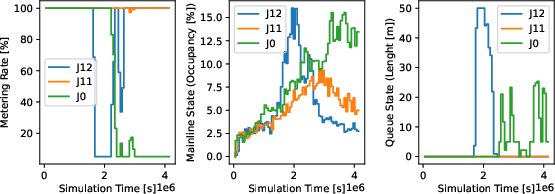
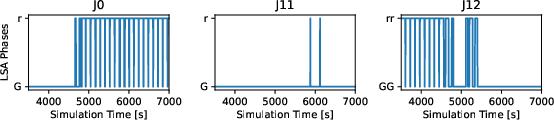
Figure 5: Occupancy and control signal demonstration for METALINE with three coordinated ramps, illustrating spatial interaction and calibration challenges.
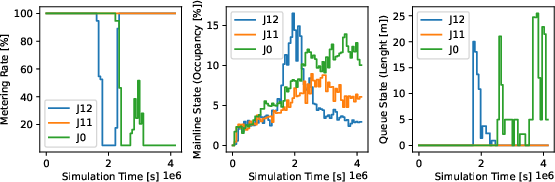
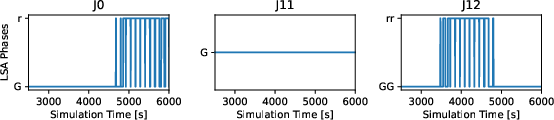
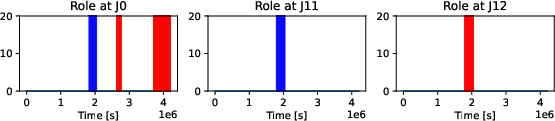
Figure 11: System state and control actions for HERO, with color-coded master/slave ramp assignments over time.
For intersection management, Max-Pressure controllers (fixed and flexible) generate phase scheduling patterns conformant with theoretical policies. SCOOT/SCATS achieves joint cycle and split adaptation with demonstrated network-wide coordination, corroborated by time-aligned SPAT plan visualizations.
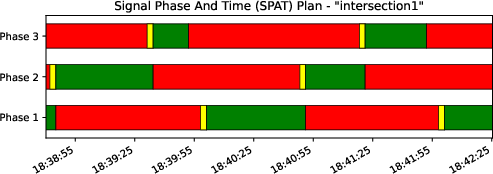
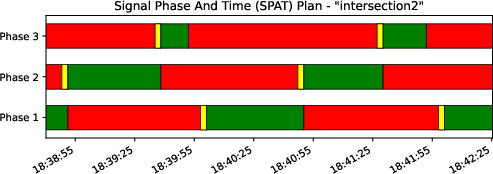
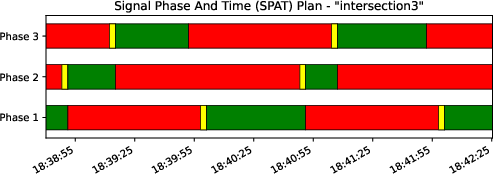
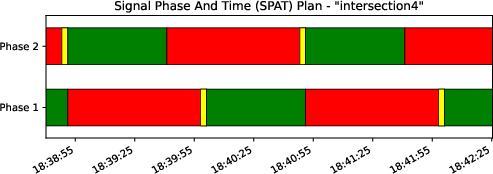
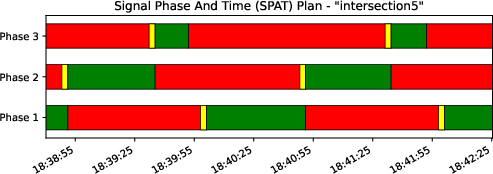
Figure 6: Signal plan evolution for Max-Pressure (fixed) intersections, showing pressure-driven split adaptation with static cycle.
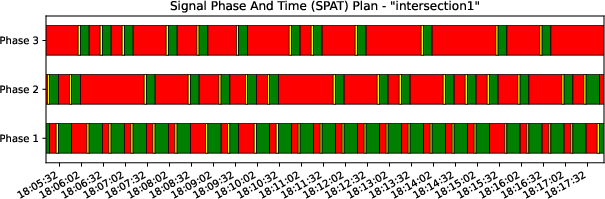
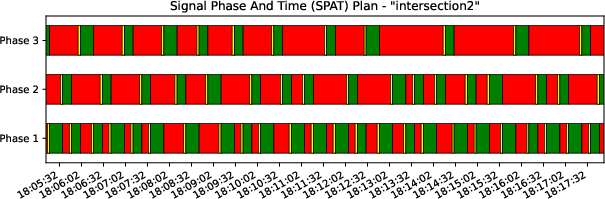
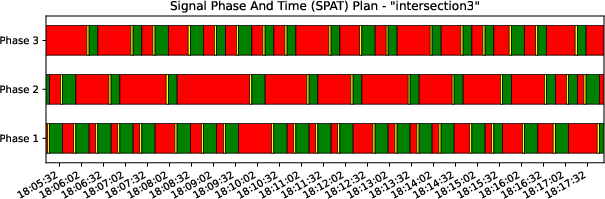
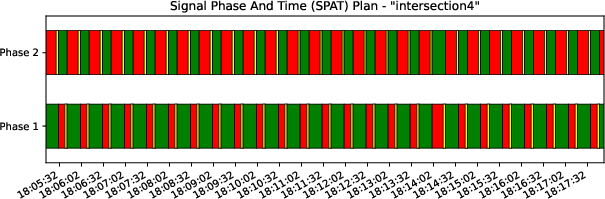
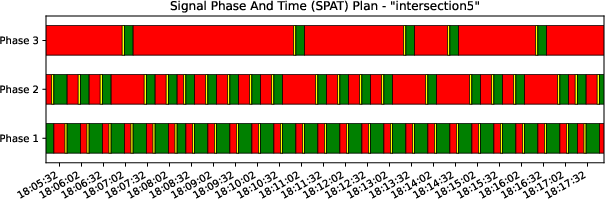
Figure 7: Signal plan for Max-Pressure (flexible) in multi-intersection scenario, highlighting dynamic phase sequencing in response to real-time pressure shifts.
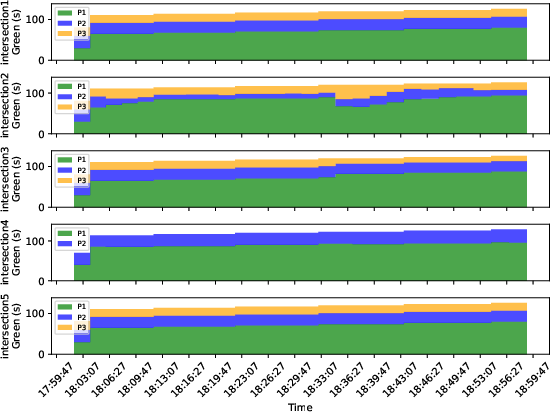
Figure 9: Time series of signal scheduling under SCOOT/SCATS, with variable cycle length and intersection group coordination.
Implications and Future Directions
By providing open, standardized, and extensible implementations for foundational ITS controllers, sumoITScontrol addresses a longstanding gap in traffic simulation research. The framework’s emphasis on reproducible experimentation and statistically robust methodology directly enables fair benchmarking for new algorithmic work, including reinforcement learning–based approaches and hybrid systems.
Practically, this foundation facilitates rapid prototyping and reliable comparison of control schemes in both academic studies and industrial applications. Theoretical implications include improved generalizability and convergence in controller evaluation as stochastic variance is systematically incorporated at the experimental design level.
Future extensions include integration of variable speed limit control, perimeter control policies, and advanced adaptive/learning-based methods, as well as automated benchmarking workflows and incorporation of sensor noise and connected vehicle penetration.
Conclusion
sumoITScontrol represents a substantive step forward in methodological rigor and experimental transparency for ITS controller evaluation in microscopic simulation environments. By aggregating well-documented controller baselines, supporting reproducibility-oriented evaluation, and codifying best practices for simulation and data handling, the framework enables robust, variance-aware, and statistically justified performance assessment. This is poised to enhance both the credibility and practical impact of novel control strategies within the SUMO and ITS research communities.
Reference: "sumoITScontrol: Traffic Controller Collection for SUMO Traffic Simulations" (2604.23240)