- The paper develops a framework for fractional QFTs using direct fakeon and spectral decomposition methods.
- It demonstrates that inequivalent analytic continuations yield distinct Minkowskian theories despite identical Euclidean formulations.
- The research confirms that proper fakeon implementation maintains unitarity, gauge invariance, and a finite number of initial conditions.
Introduction and Motivations
The paper "Fractions and Fakeons in Quantum Field Theory" (2604.23215) provides a thorough investigation of quantum field theories (QFTs) whose kinetic operators involve fractional or continuous powers of the d'Alembertian. The principal challenge addressed is how to structure such models to preserve perturbative unitarity and ensure a well-defined classical limit with a finite set of initial conditions. The author develops a systematic framework: both direct fakeon prescriptions and spectral decompositions for fractional operators are analyzed, with explicit demonstration of how these inequivalent constructions yield different Minkowskian theories despite sharing identical Euclidean counterparts.
The study contrasts two fundamental strategies for fractional QFTs using scalar models:
- Direct Fakeon Approach: Propagators are analytically continued from Euclidean space to Minkowski via average continuation, applying the fakeon projection to branch cuts associated with fractional powers.
- Decomposition Approach: Fractional operators are represented as integrals over spectra—a continuum of ordinary fakeonic propagators—each subsequently treated by established fakeon diagrammatic procedures.
The paper carefully delineates the technical non-equivalence of these approaches: although the Euclidean propagators −i/zγ and −i/(z2)γ/2 are identical for z>0, their Minkowskian analytic structures and ensuing physical interpretations diverge. For instance, the direct approach for L1 yields real effective actions and well-defined classical limits, while decomposition for L2 leads to complex conjugate pole structures.
Diagrammatics: Bubble Diagrams and Infinite Inequivalence
A central result concerns loop diagrams, especially bubbles, as probes of nonlocality and fakeon handling. Explicit calculation demonstrates that fractional models, even for the same Euclidean action, lead to an infinite spectrum of inequivalent Minkowskian theories depending on the spectral decomposition chosen. The decomposition approach, by integrating over fakeon spectra, effectively implements average continuation by default, but the numerical coefficients diverge from the direct fakeon prescription, notably for the coefficient g(γ) in the bubble amplitude.
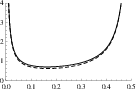
Figure 1: Numerical comparison between −2iB2M(1)/λ2 (thick plot) and −2iB2M′(1)/λ2 (dashed plot) as functions of δ=γ−1/2 for 0<δ<1/2.
Strong numerical evidence is presented for the distinctness of results—−i/(z2)γ/20 deviates from unity and from −i/(z2)γ/21, confirming the analytic inequivalence at both tree and loop levels. The infinite class of possible decompositions (indexed by −i/(z2)γ/22 in spectral density) each generates unique physical predictions.
Classical Limit and Degrees of Freedom
A rigorous analysis of the classical limit, especially regarding initial conditions and degree-of-freedom counting, demonstrates that fractional/fakeon theories, when properly constructed, propagate only the expected physical content. Despite the nonlocality induced by fractional operators and fakeon prescriptions, the field equations admit finitely many initial conditions, and do not suffer from the proliferation of degrees of freedom sometimes anticipated in nonlocal models. This is shown explicitly for −i/(z2)γ/23 quantum mechanics analogues, considering polynomial equations for spectral roots and their physical acceptability.
Coupling to Gauge and Gravity: Preservation of Ward and Unitarity Identities
The fractional models are systematically extended to include covariant derivatives, both for gauge theory and gravitational couplings. The paper provides explicit expressions for vertices, propagators, and demonstrates the maintenance of fundamental Ward–Takahashi–Slavnov–Taylor (WTST) identities. Notably, the diagrammatic rules (both direct and decomposed) guarantee that both gauge invariance and Cutkosky–Veltman unitarity relations are satisfied in all formulations, underscoring the operational consistency of fractional/fakeon QFTs with established quantum field principles.
Implications and Future Directions
The formalism developed has several profound implications:
- Infinite Inequivalence Principle: Fractional QFTs defined via fakeon procedures manifest an infinite landscape of inequivalent Minkowskian models for any single Euclidean action, complicating the effective field theory paradigm in nonlocal models.
- Physical Consistency: When fakeons are correctly implemented, fractional QFTs can be rendered unitary and possess well-defined classical limits, avoiding unphysical ghosts and ensuring probabilistic interpretation.
- Model Building in Quantum Gravity and Gauge Theories: The techniques shown facilitate construction of nonlocal and fractional QFTs, including UV-complete scenarios relevant for quantum gravity and gauge models.
- Spectral Engineering: The results highlight the need for precise spectral decomposition when generalizing fractional kinetic operators, as these subtleties materially affect prediction and phenomenology.
It is anticipated that further developments may extend these fakeon methods to more complex gauge and gravitational sectors, and that the infinite inequivalence will play a crucial role in understanding the landscape of viable nonlocal QFTs. Applications to cosmology and renormalization will likely require care in the choice of continuation or spectral representations.
Conclusion
This work provides a rigorous and comprehensive analysis of the formal structure, diagrammatics, and practical implications of fractional and fakeon QFTs. It establishes the infinite multiplicity of inequivalent Minkowskian theories for a given Euclidean action, demonstrates the preservation of unitarity and gauge invariance, and confirms the absence of anomalous degree-of-freedom proliferation. The theoretical framework enables systematic model construction and analysis in both gauge and gravitational contexts, with implications for future exploration of nonlocal quantum field theories.