- The paper introduces the constrained multiplier criterion, unifying minimax and KL-penalized approaches to address model misspecification.
- It rigorously axiomatizes penalty-based objectives to align estimation procedures with decision theory under ambiguity.
- It validates adaptive estimation methods that balance efficiency and robustness through numerical simulations and theoretical bounds.
Misspecification-Averse Estimation: A Technical Synthesis
Decision-Theoretic Foundations of Misspecification-Robust Estimation
This work advances a rigorous framework for estimation in the presence of model misspecification by grounding inferential procedures in a decision-theoretic structure informed by ambiguity aversion. It leverages axiomatic preference theory to derive optimal estimators across families of objectives that interpolate between worst-case (minimax) and regularized (multiplier) risk functionals, linking foundational results from economic theory of ambiguity to modern econometric inference.
The central innovation is the constrained multiplier criterion, a hybrid preference that generalizes classical minimax and KL-penalized multiplier preferences. This criterion enables precise modeling of a researcher's concern for misspecification, allowing both hard constraints over classes of distributions (e.g., moment conditions the researcher is certain hold) and a flexibly tuned penalty for deviations from a reference (usually parametric) model.
Axiomatization and Dual Representations
The manuscript systematically derives which penalized risk indices (objectives for estimator selection) are coherent with respect to rational preference families. Starting from the variational (maxmin/penalized maxmin) class, it specifies the additional axioms required to isolate constraint (Gilboa-Schmeidler-type), multiplier (Hansen-Sargent-type), and the new constrained multiplier preferences.
- Constraint Preferences correspond to complete distrust outside an "ambiguity set" and are justified via certainty independence.
- Multiplier Preferences (e.g., KL neighborhoods of the nominal model) are characterized by the Sure-Thing Principle and uniformity of misspecification concern.
- Constrained Multiplier Preferences (introduced here) blend the above, ruling out some forms of misspecification a priori (via constraints) and penalizing the remainder by relative entropy.
Crucially, the penalty function for the last class, when constraints are expressed as moment conditions, leads to a convex dual representation. The worst-case expected loss can be analytically expressed as an exponential tilting of the likelihood (akin to generalized empirical likelihood), with finite-dimensional dual variables (Lagrange multipliers) enforcing the constraints:
Vθ(L)=βinfλ⋅logEQθ[exp(λ1L(θ,X)−β′φ(θ,X))]
where λ modulates aversion to misspecification, Qθ is the model-implied distribution, and φ encodes the moment constraints.
Local Asymptotic Minimax Theory Under Misspecification
Building on the classical LAN/limit experiment apparatus, the authors extend local asymptotic minimax (LAM) theory to the misspecification-averse setting. Specifically, they characterize the minimax risk in a Gaussian shift limit experiment, but where the "nature" adversary is restricted by both KL proximity and preservation of low-order moments of chosen statistics (M-fold constraints).
This leads to a limit experiment in which feasibility is determined by both identification-relevant statistics (e.g., sufficient/ancillary statistics in the LAN family) and all admissible distributions consistent with the imposed constraints. The LAM lower bound is realized not merely over all distributions, but over those in a constraint-defined and regularized ambiguity class.
Structural and Numerical Characterization of Optimal Procedures
The optimal estimator under the constrained multiplier criterion is shown to be, in the limit regime, the Bayes rule under a tilted likelihood that incorporates both the moment constraints and a flat prior, generalizing standard efficiency characterizations:
- If the only constraints are on the mean, or none at all, the MLE (in LAN experiments, the limit experiment mean) is minimax.
- Adding higher-moment constraints yields estimators that linearly adjust the MLE by statistics derived from the constraint function (e.g., sample moments), with weights determined by the Lagrange multipliers of the dual problem.
- The effect of increasing aversion (decreasing λ) is analyzed, recovering the entire path between MLE and optimally robust (e.g., GMM- or generalized method-of-moments-type) estimators.
Numeric computations and simulations (Figure 1) illustrate the adaptive properties of several canonical rules across the range of misspecification-aversion parameters.
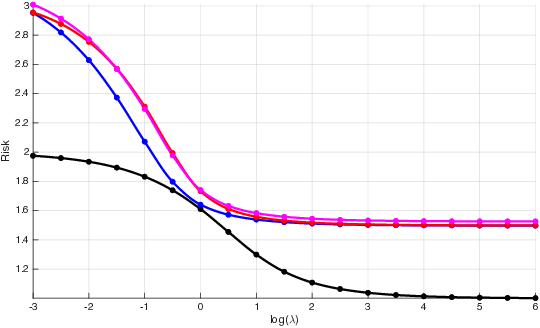
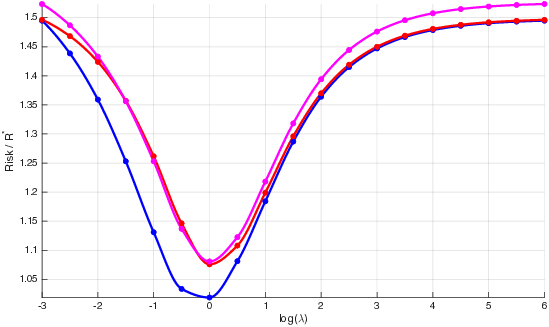
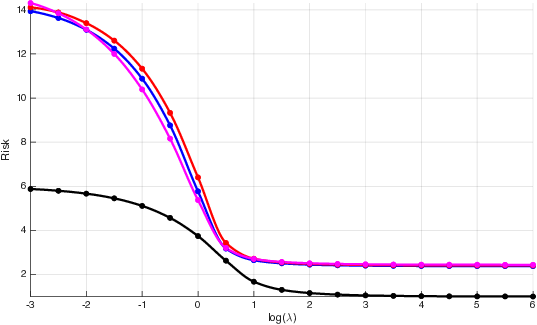
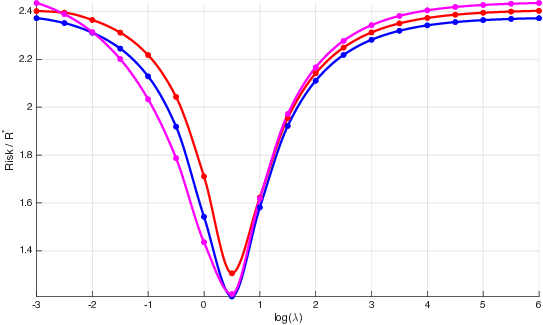

Figure 1: The risk ratio (relative to pointwise optimal procedures) for several candidate adaptive estimators under Ω=2, as a function of the penalty parameter λ, highlighting the trade-offs between robustness and efficiency across the spectrum of misspecification concern.
Adaptive Estimation and Practical Rule Selection
Recognizing the impracticality, in empirical research, of precise specification of the misspecification-aversion parameter, the authors adapt ideas from Armstrong, Kline, and Sun (2025) to the constrained multiplier setting. They analyze classes of "adaptive" rules (like soft-threshold and empirical risk minimization estimators) that minimize worst-case regret relative to the in-sample optimal risk. It is shown that these simple procedures achieve regret ratios close to one (within 50%) across a wide range of specifications, providing justification for their practical use when model uncertainty is difficult to calibrate.
Implications and Discussion
The implications are profound both theoretically and for applied inference in economics (and related fields):
- Existing practice, in which researchers ignore (overly) the likelihood and rely on a small set of robust moments due to model doubt, is shown to be inadmissible except under extreme aversion. Optimality demands judicious incorporation of both the model and credible moment conditions.
- This framework delivers a tractable, axiomatically sound algorithm for the construction of estimators and robustified confidence intervals that are tunable on the robustness-efficiency frontier.
- The approach can be extended to partial identification, weak identification, and more generally to semiparametric and high-dimensional settings, as duality arguments and local parameterizations do not rely inherently on parametric structure.
Future research will naturally extend toward Bayesian misspecification, adaptive selection of moment constraints, and the interface with selective inference and robust ML.
Conclusion
This manuscript rigorously synthesizes axiomatic preference theory with advanced asymptotic statistics, providing a comprehensive toolbox for robust and efficient estimation in misspecified models. The constrained multiplier framework subsumes central robustness paradigms, reveals the structure of efficient adaptation to model misspecification, and offers procedures with strong numerical properties and clear behavioral interpretations. The connection to empirical practice is explicit: while the selection of estimators and inference strategies must reflect both model-based information and plausible forms of misspecification, adaptation is possible and optimal rules are within computational reach even in complex, high-dimensional, or ambiguity-laden econometric environments.

