- The paper demonstrates that quantum corrections (α) induce measurable waveform dephasing in EMRIs when the spin parameter is low.
- It employs a revised Newman-Janis algorithm and FEW's AAK framework to accurately compute gravitational waveforms near strong-field regimes.
- Results reveal that higher spin values suppress quantum signatures, challenging the detectability of quantum effects with space-based detectors like LISA.
Summary of "Assessing EMRI Detectability of the Rotating Quantum Oppenheimer-Snyder Black Hole" (2604.23163)
Introduction
The paper addresses the detectability of quantum gravity effects, as modeled by loop quantum gravity (LQG), in extreme-mass-ratio inspirals (EMRIs) for rotating quantum Oppenheimer-Snyder (qOS) black holes. Astrophysical black holes are rarely static, so the extension of LQG-corrected metrics to include rotation is essential for precision gravitational-wave (GW) tests against space-based detectors like LISA. The authors leverage a revised Newman-Janis algorithm (NJA) to construct the rotating qOS metric and focus specifically on the consequences for gravitational waveforms generated by EMRIs, emphasizing both the quantum correction parameter α and the spin parameter a.
Rotating Quantum Oppenheimer-Snyder Black Hole Model
The rotating qOS model is derived by extending the static quantum-corrected Schwarzschild metric with NJA, yielding an axisymmetric metric that interpolates between Kerr (α=0) and quantum-corrected Schwarzschild (a=0) limits. The event horizon structure depends critically on a/M and α/M2, as summarized in the phase diagram Figure 1.
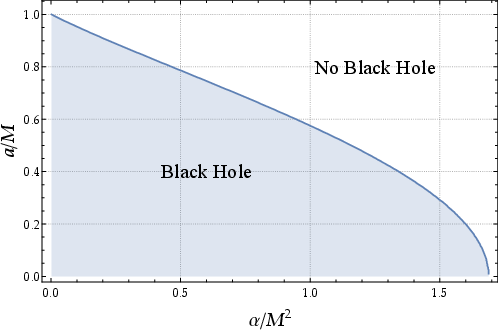
Figure 1: Phase diagram of the rotating qOS model in the space of a/M and α/M2, with the blue line denoting extremal black holes.
Quantum corrections α must obey α/M2≤27/16 for horizon existence. Above this threshold, naked singularities or horizonless configurations arise.
Adiabatic Orbital Evolution and GW Dephasing
The authors model EMRIs as point particles in equatorial geodesics, with orbital parameters extracted numerically. The energy and angular momentum fluxes, responsible for radiation reaction, are computed with quadrupole formulas, using a bicubic spline interpolation on a logarithmic/separatrix-adapted a0 grid to ensure resolution near strong-field regions.
Of primary importance is the GW dephasing a1, which quantifies cumulative phase differences between quantum-corrected and GR predictions. The results indicate that for year-long LISA observations, quantum corrections induce observable dephasing for sufficiently large a2. However, for fixed a3, increasing a4 significantly suppresses dephasing, making quantum signatures weaker for highly spinning black holes Figure 2.
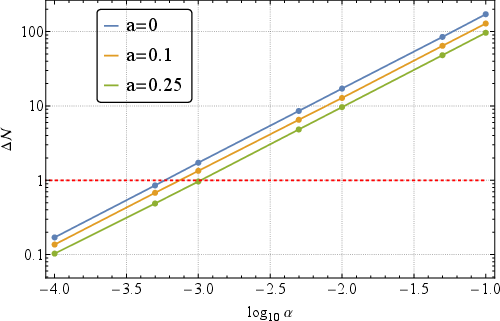
Figure 2: Dephasing a5 as a function of quantum parameter a6 for different spin a7 values; rotation suppresses quantum-induced dephasing.
Detectability is benchmarked with a threshold a8 rad, which is consistent with the literature for distinguishable GW signals.
The study utilizes FEW's augmented analytic kludge (AAK) EMRI waveform framework to generate signals for different quantum and rotational parameters. The AAK waveforms show that both a9 and α=00 impact the signal morphology; quantum corrections are more pronounced for low-spin objects and suppressed for higher spins Figure 3.
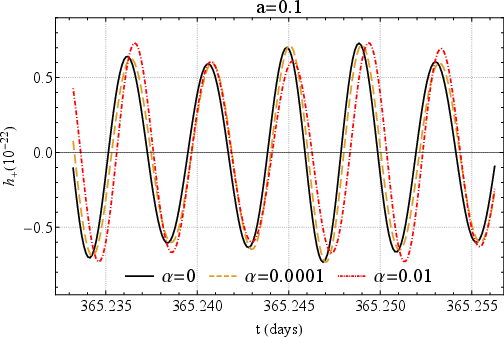
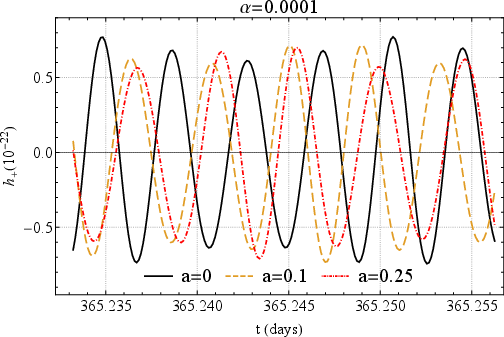
Figure 3: AAK waveforms for rotating qOS backgrounds across varying α=01 and α=02, illustrating both quantum and spin effects.
To robustly quantify detection prospects, the faithfulness metric α=03 is computed between waveforms with and without quantum corrections. Lower faithfulness implies greater distinguishability. The results show α=04 decreases with increasing α=05 (stronger quantum effects) and increases with α=06 (stronger rotational suppression), converging near the empirical criterion of α=07 for LISA Figure 4.
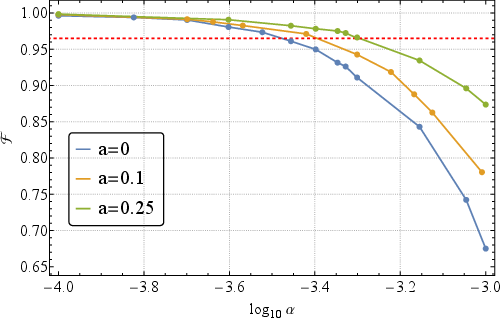
Figure 4: Faithfulness α=08 between quantum-corrected and GR waveforms as a function of α=09, for multiple a=00 values; rotational effects mask quantum imprints.
Implications and Theoretical Outlook
The findings underscore that quantum gravity signatures in EMRI signals are not only sensitive to the quantum correction parameter a=01, but also strongly modulated by the astrophysical black hole’s spin. For practical GW astronomy, this mandates careful consideration of rotation in any quantum-corrected model, as high-spin objects will likely yield weaker quantum gravity imprints, challenging LISA’s detectability thresholds.
On the theoretical front, the results reinforce the necessity of axisymmetric quantum gravity solutions for robust observational tests. The numerical framework adopted—bicubic spline interpolation and direct frequency computation in FEW—successfully circumvents analytic intractability in the strong-field regime.
Future developments could include systematic characterization of transition surfaces or quantum bounces in fully dynamical rotating collapse, integration with population synthesis for EMRI rates, and refined discrimination strategies in LISA data analysis. Additionally, as space-based GW detectors approach operational maturity, the role of quantum gravity corrections in black hole spectroscopy and GW phase evolution will be pivotal in shaping constraints on LQG and other quantum gravity theories.
Conclusion
This work provides a rigorous assessment of quantum gravity corrections in rotating qOS black hole backgrounds, highlighting the suppression of observable EMRI signatures due to rotation. The combined waveform and faithfulness analyses yield quantitative estimates for detectability with LISA, offering practical guidance for future GW searches targeting quantum gravity effects. The explicit demonstration that rotation masks quantum imprints necessitates axisymmetric modeling in all quantum-corrected GW studies going forward.