- The paper introduces MiGFEM, achieving high-order smoothness on standard C0 finite element meshes via patch-based constrained weighted least-squares reconstruction and PoZ blending.
- It unifies weak and strong-form discretizations, enabling pointwise evaluation of high-order PDEs while avoiding extra degrees of freedom.
- Numerical results verify the method’s accuracy, robustness under mesh distortion, and efficient boundary condition enforcement through the BA-CWLS strategy.
Mesh-Intrinsic GFEM: High-Order Smoothness on C0 Unstructured Meshes
Introduction and Context
The paper "Mesh-Intrinsic GFEM: High-Order Smoothness on C0 Unstructured Meshes" (2604.23155) presents a mesh-intrinsic generalized finite element method (MiGFEM) designed to enable high-order smoothness for partial differential equation (PDE) discretizations using standard C0 finite element infrastructures on unstructured meshes. The central challenge addressed is the mismatch between the continuity requirements of high-order PDEs (e.g., plate/shell bending, strain-gradient continua, phase-field models, biharmonic-type systems) and conventional C0 FE spaces, particularly in strong-form discretizations where direct evaluation of derivatives is required. The MiGFEM achieves high-order smoothness through patch-based polynomial reconstruction and partition of unity (PoU) blending, without augmenting the global system with extra degrees of freedom (DOFs), leveraging interface coherence and a partition-of-zero (PoZ) mechanism for smoothness transfer.
MiGFEM defines local polynomial reconstructions Ui(x) on overlapping nodal patches ωi, utilizing only the global nodal DOF vector {uj}. Each patch employs a constrained weighted least-squares (CWLS) reconstruction operator to maintain exact interpolation at the patch star node, while satisfying sufficient sampling requirements for polynomial degree p.
The global approximation is given by:
uh(x)=∑iNi(x)Ui(x),
where Ni(x) form a C00 partition of unity. The resulting basis functions C01 are constructed from local reconstructions on patches containing node C02, ensuring a standard nodal expansion and interpolatory property.
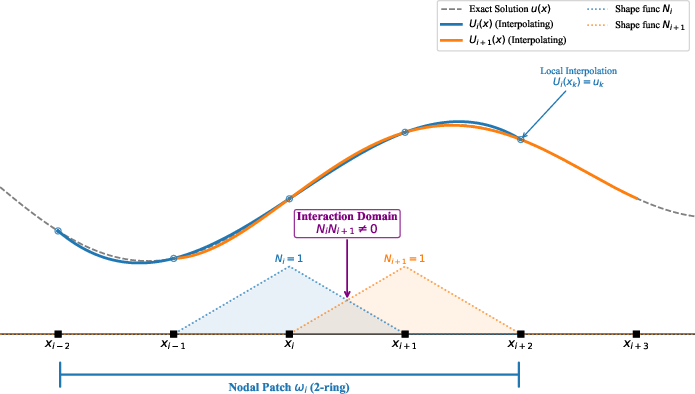
Figure 1: Illustration of the mesh-intrinsic GFEM framework in 1D: (a) Overlapping nodal patches and local reconstructions; (b) Partition of unity blending functions; (c) Resulting global approximation with enhanced continuity.
Patch construction involves selecting C03 topological layers to guarantee sufficient sampling, extended for boundary nodes—see the arrangement on unstructured triangular meshes.
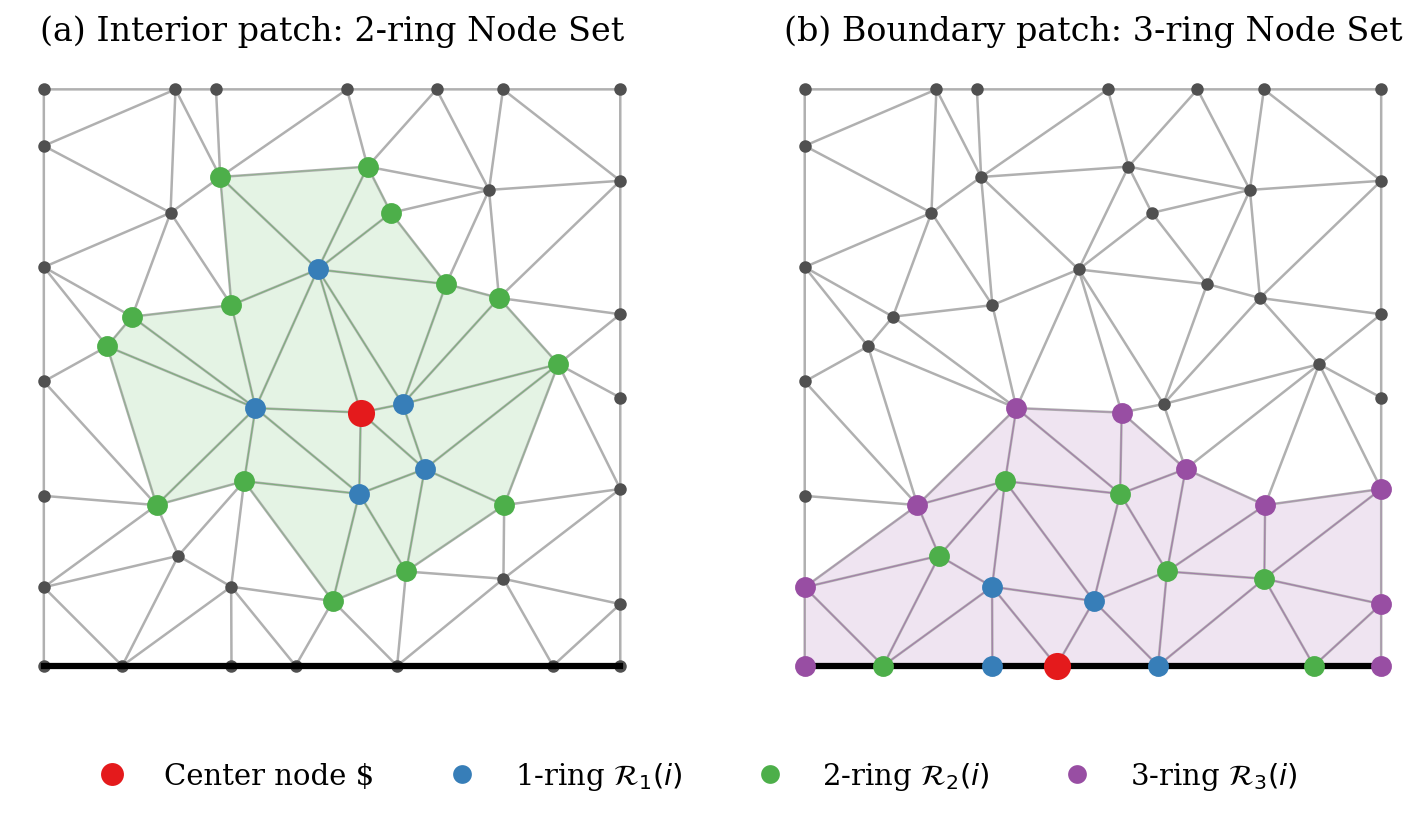
Figure 2: Patch node sets and stencils on an unstructured triangular mesh. (a) Interior patch with C04 layers. (b) Boundary patch with C05 layers.
Unlike conventional GFEM/NMM/PUFEM approaches, MiGFEM does not introduce node-specific enrichment DOFs and avoids linear dependence issues by reconstructing all patch fields from the shared global nodal vector, ensuring structural interface coherence.
PoZ-Based Smoothness Transfer and Intrinsic Derivatives
The paper introduces a PoZ-based jump decomposition, rooted in the derivative-space partition-of-unity property:
C06
This identity, together with patch reconstruction coherence, enables cancellation of weighted derivative jumps at internal interfaces. For polynomial reproduction, strict C07 continuity is ensured; for smooth nonpolynomial fields, jumps decay as C08 under mesh refinement.
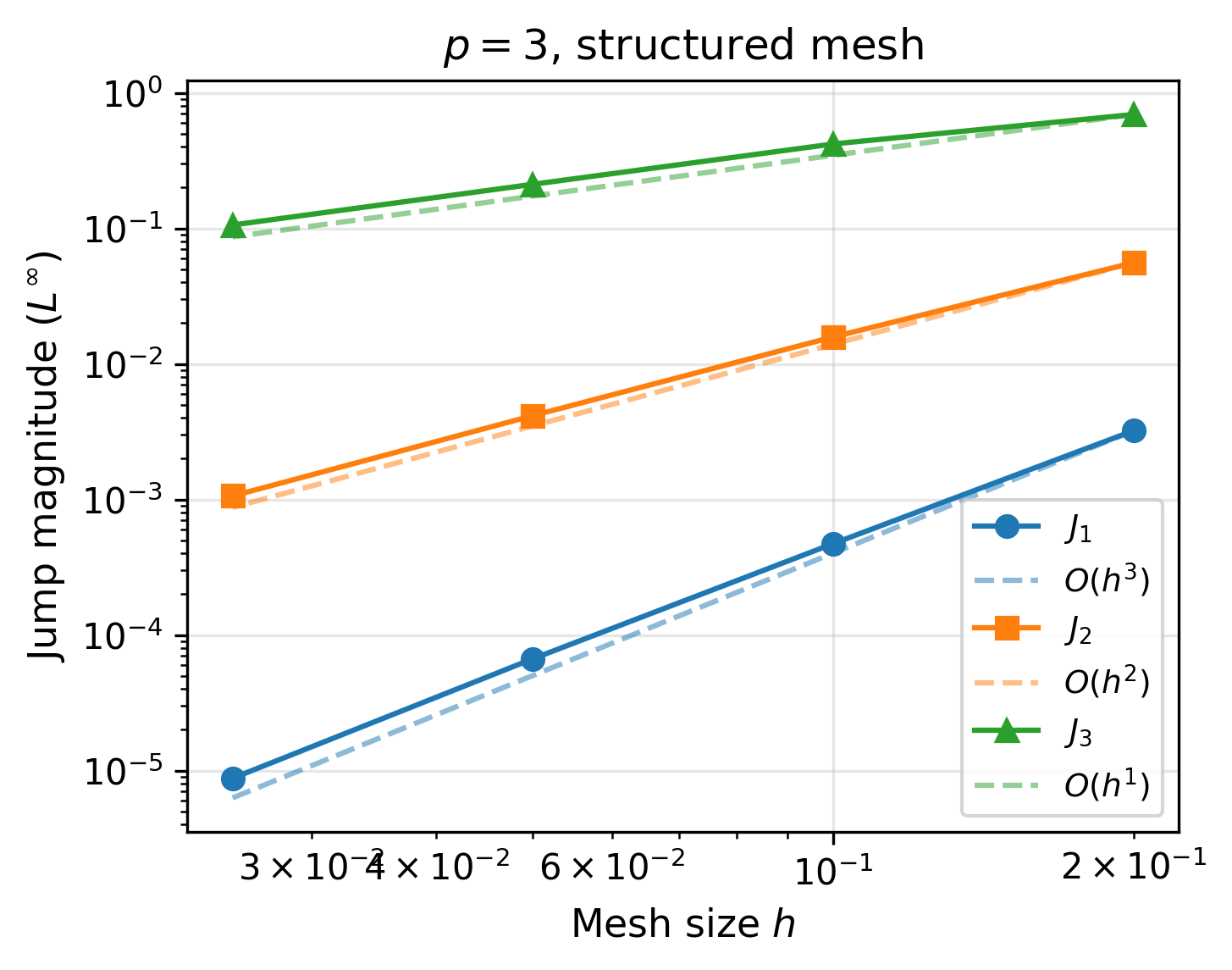
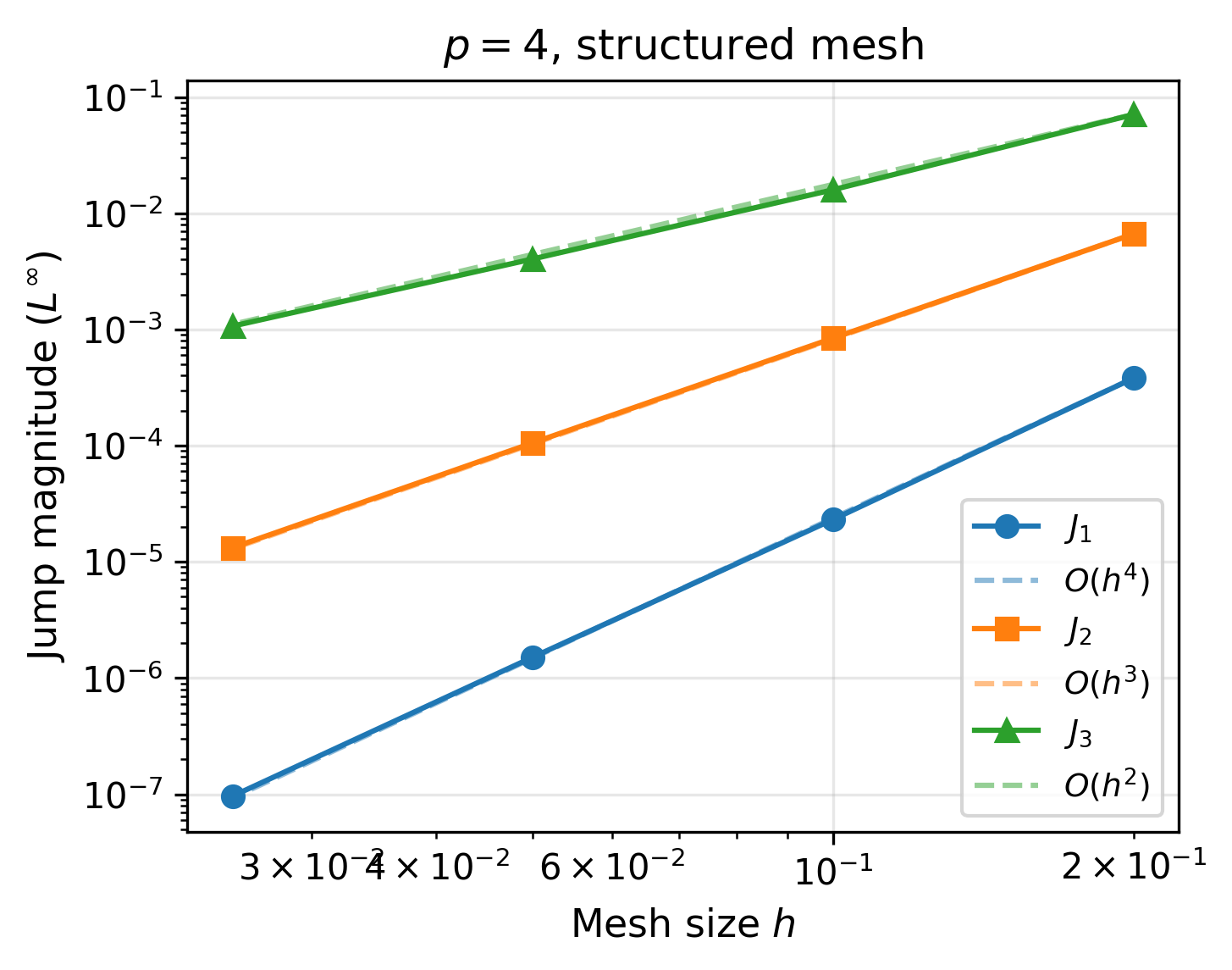
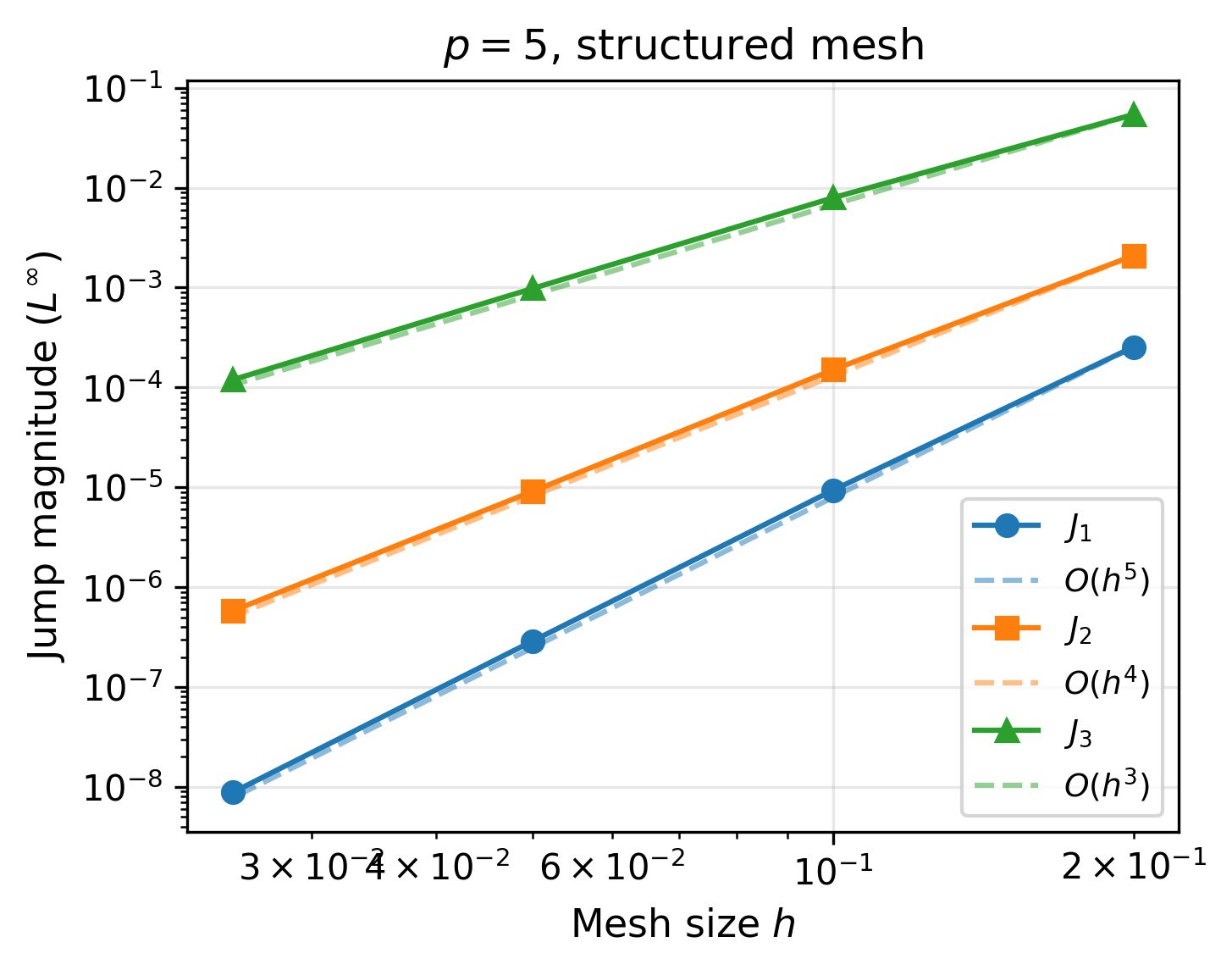
Figure 3: Case 2: Asymptotic C09-continuity on triangular meshes with zero node perturbation for C00. The plots show the decay of pointwise C01 jump metrics C02 under uniform C03-refinement, with dashed reference lines indicating the predicted rates C04.
Intrinsic derivatives are then defined by:
C05
ensuring polynomial exactness and asymptotic consistency with local reconstruction accuracy. For strong-form discretizations, this allows pointwise evaluation of high-order PDEs on C06 meshes without introducing auxiliary global DOFs or requiring C07 basis functions.
Boundary Absorption–CWLS: Exact Enforcement of Derivative-Type Boundary Conditions
MiGFEM introduces a BA-CWLS strategy for strong-form boundary condition enforcement via local absorption into the patch reconstruction. Supplementary linear constraints (e.g., C08 at boundary points) are imposed directly in the CWLS system, keeping the global algebraic system square and sparse, avoiding the conditioning and inefficiency of globally overdetermined boundaries or penalization.
This mechanism is extensible to traction, free boundary, and flux conditions in elasticity and biharmonic problems, embedding constraints locally while preserving polynomial reproduction properties and square global assembly.
A core feature of MiGFEM is its unified trial space supporting both weak-form Galerkin and strong-form collocation formulations. Weak-form discretizations use the Leibniz derivative and integration by parts (with Nitsche-type weak Dirichlet enforcement), while strong-form collocation operates directly at interior/boundary collocation points using intrinsic derivatives, enabling primal high-order PDEs and precise boundary treatments.
This unification facilitates both variational and primal discretization paths with the same nodal unknowns and global basis functions, avoiding extra-DOF proliferation and preserving sparsity and compatibility with standard FEM infrastructure.
The paper presents rigorous diagnostics on approximation space behavior, strong/weak form benchmarks, conditioning scaling, and robustness under mesh distortion. Numerical evidence confirms:
- Machine-precision satisfaction of polynomial patch tests up to degree C09 for both weak and strong form variants.
- Asymptotic C00 continuity in jump metrics for smooth nonpolynomial fields as predicted.
- Consistent discrepancy between interpolation-optimal rates and full strong-form PDE solves for fourth-order problems (empirically, a reduction of C01 order from C02 to C03), specifically attributed to pointwise collocation consistency/stability rather than reconstruction accuracy.
- Robustness of BA-CWLS boundary absorption, maintaining boundary fidelity and stable conditioning across mesh refinement and heavy distortion.
For elasticity benchmarks, DOF-normalized comparisons with standard C04-FEM and classical PUFEM show favorable error and conditioning profiles for MiGFEM, avoiding the extreme ill-conditioning of unstabilized enrichment schemes.
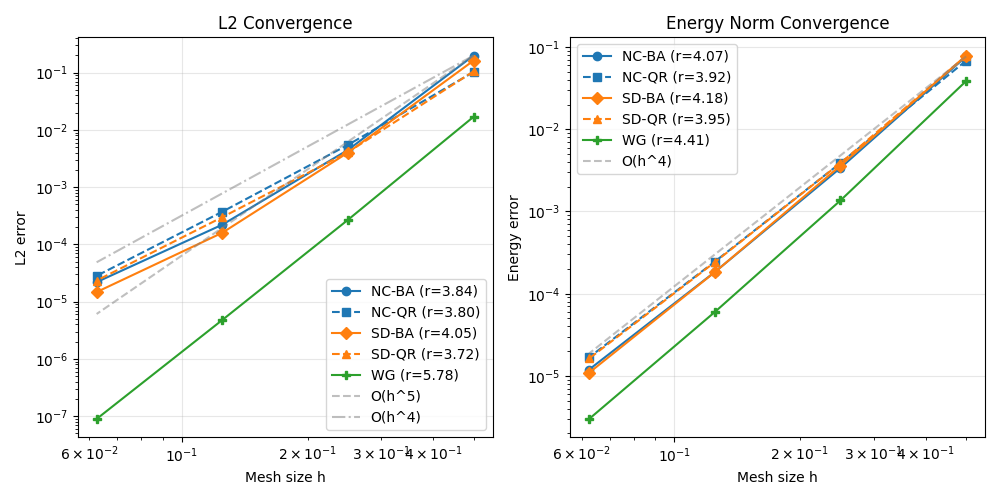
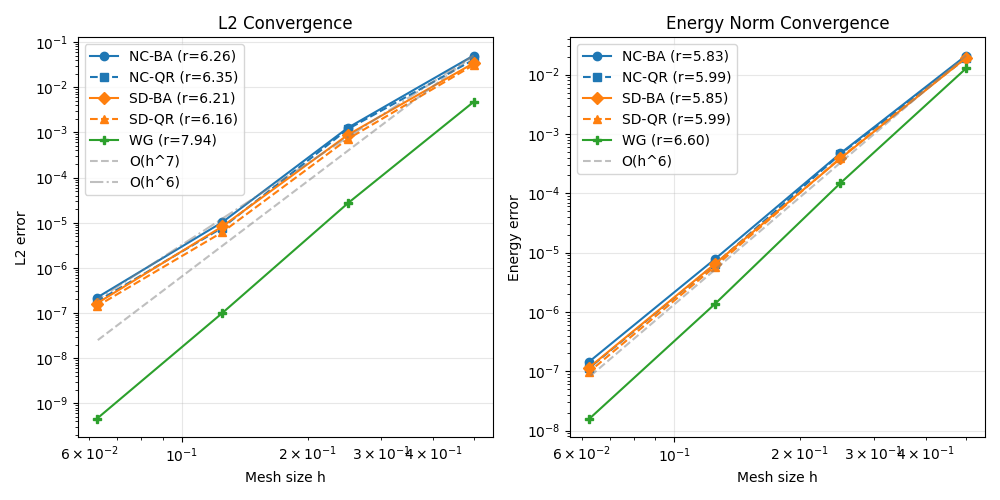
Figure 4: Mixed Dirichlet--Neumann elasticity benchmark: NC-QR, NC-BA, SD-QR, SD-BA, and WG comparison in C05 and energy norms for two polynomial orders. Strong-form variants impose Dirichlet data strongly, with Neumann handled by QR overdetermined enforcement or BA local absorption; WG uses Nitsche Dirichlet and natural Neumann treatment.
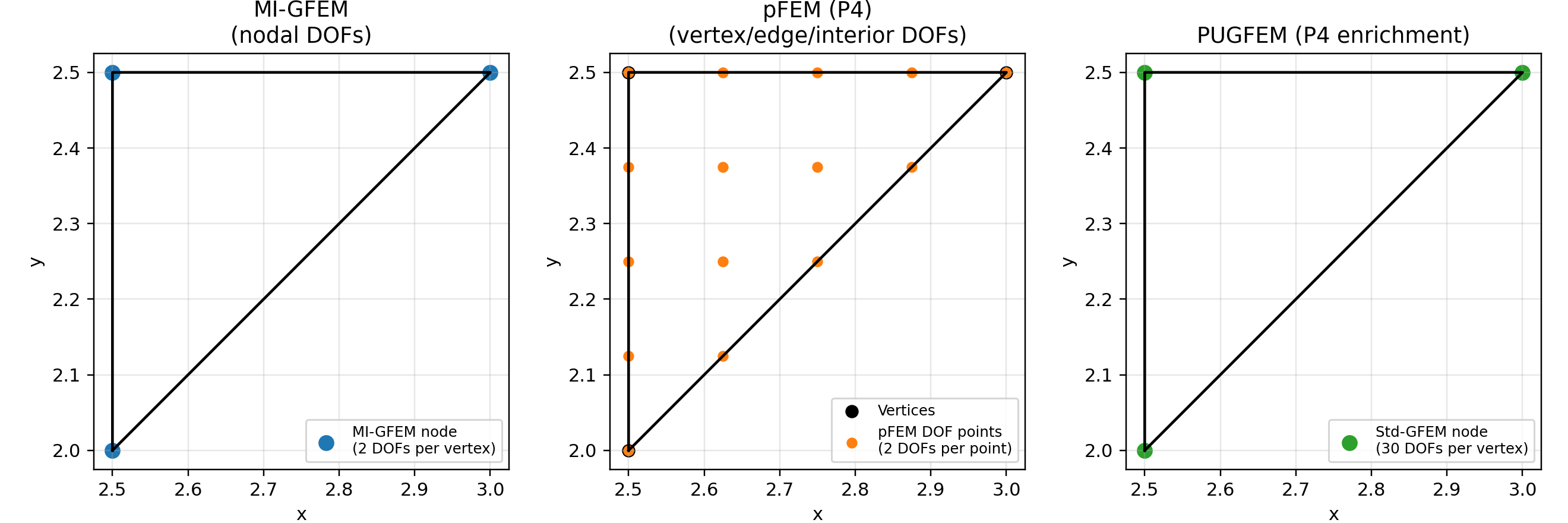
Figure 5: Illustration of DOF layouts for MiGFEM WG (nodal DOFs), standard C06 C07-FEM (vertex/edge/interior DOFs), and PUFEM (enriched nodal DOFs) on a representative triangle.
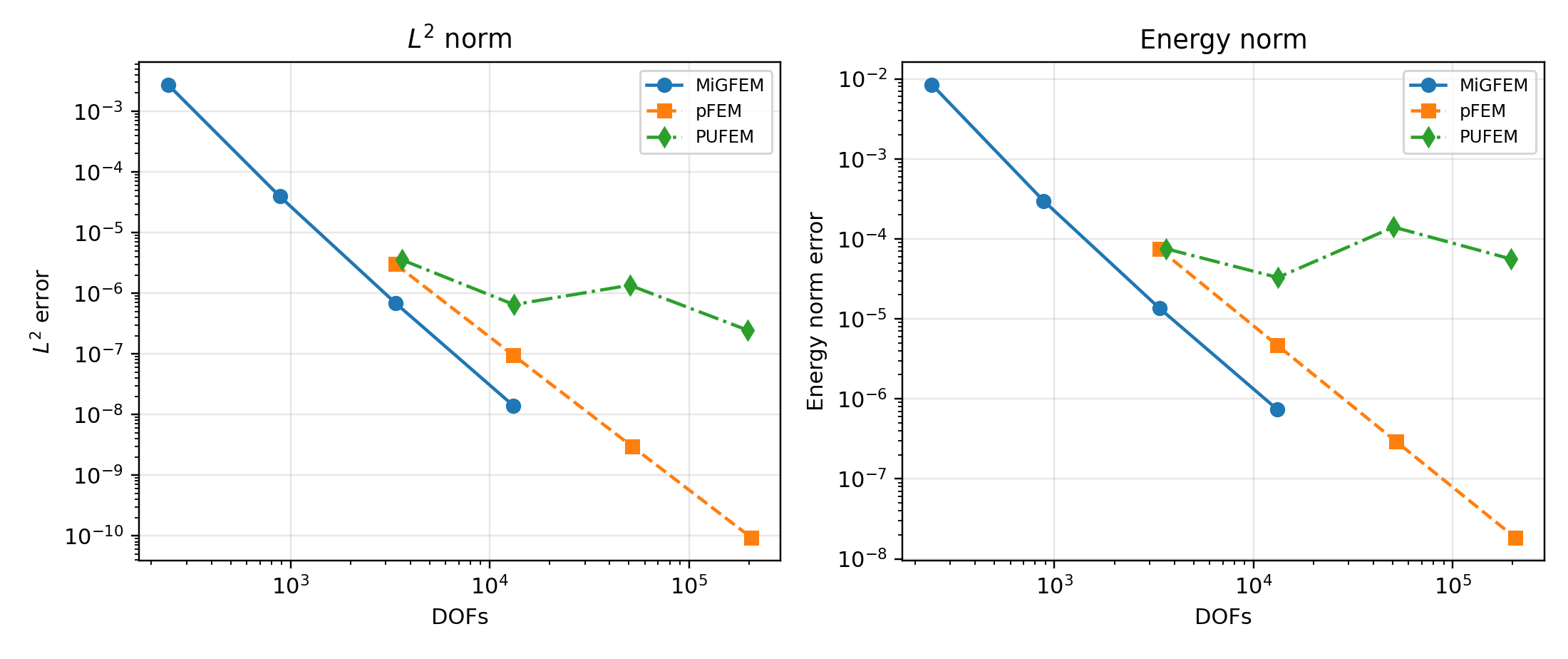
Figure 6: DOF-based comparison of MiGFEM WG, standard C08-FEM, and PUFEM on C09 with Ui(x)0. Left: Ui(x)1 error versus total vector DOFs. Right: energy-norm error versus total vector DOFs.
Conditioning remains moderate for MiGFEM variants under refinement, with near-linear scaling (Ui(x)2), while higher-order Ui(x)3-FEM exhibits stronger conditioning growth.
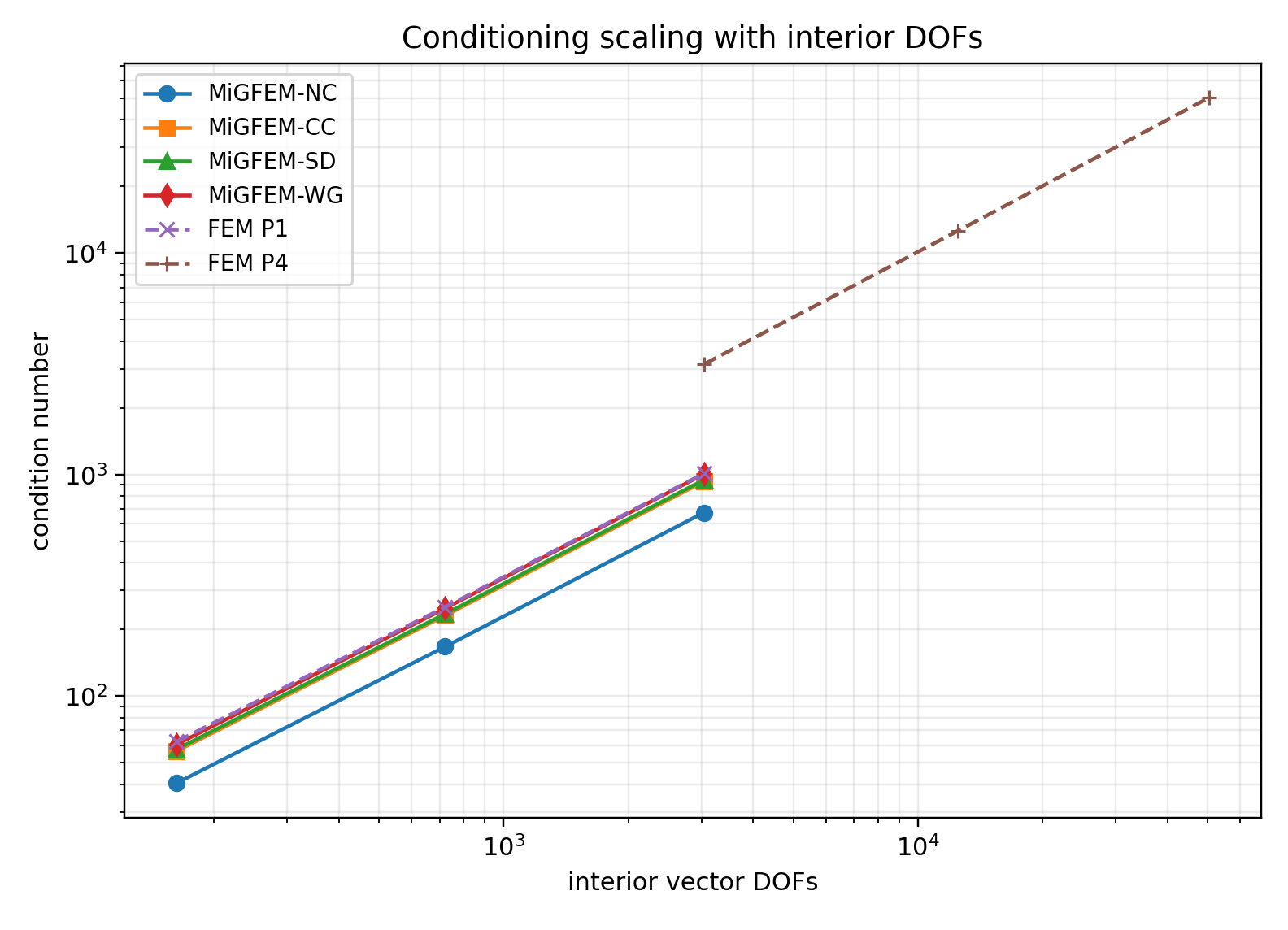
Figure 7: Conditioning against interior vector DOFs for MiGFEM (NC/CC/SD/WG), FEM P1, and FEM P4.
Robustness persists under severe mesh perturbation, with MiGFEM retaining monotone convergence in all error norms, confirming stability of CWLS reconstruction.
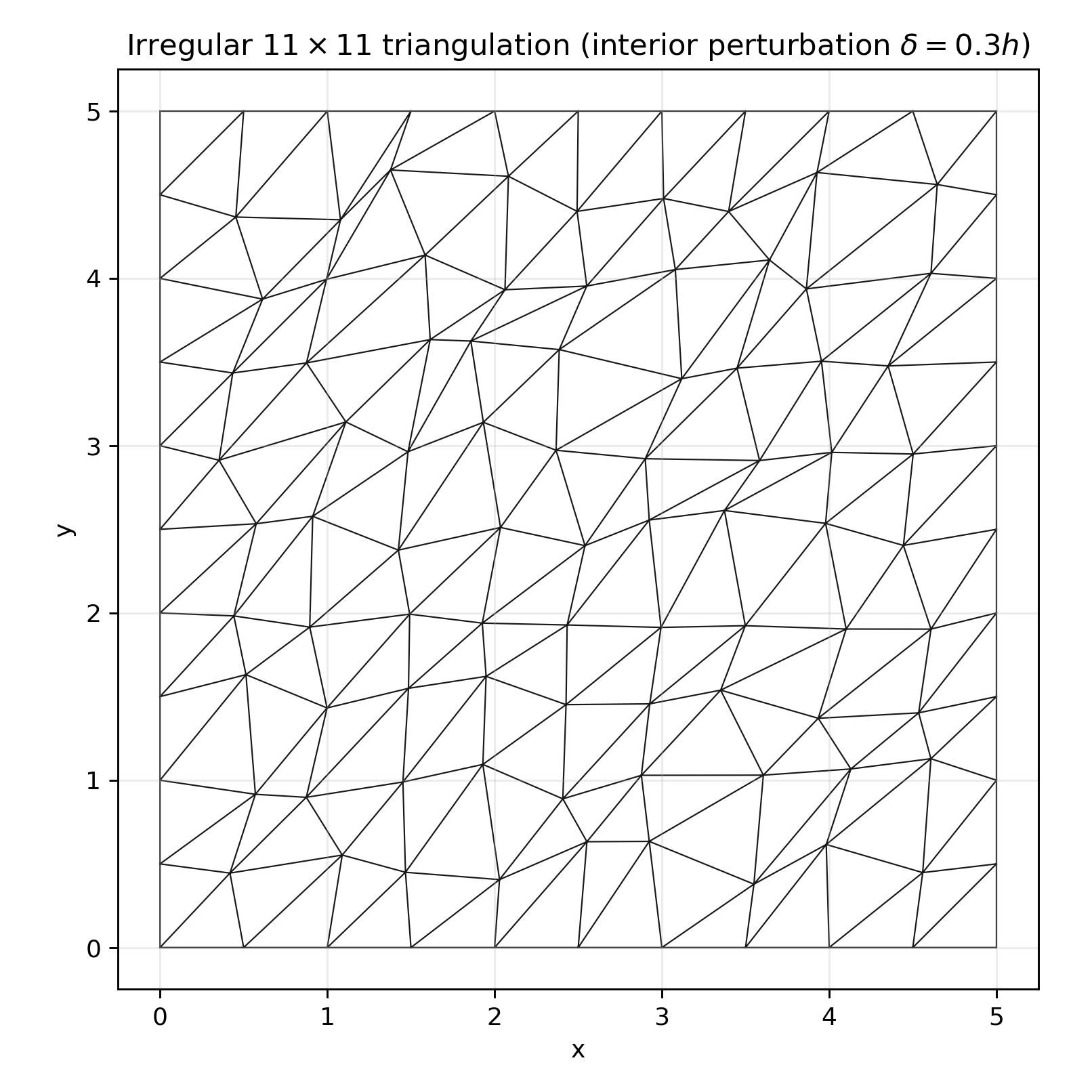
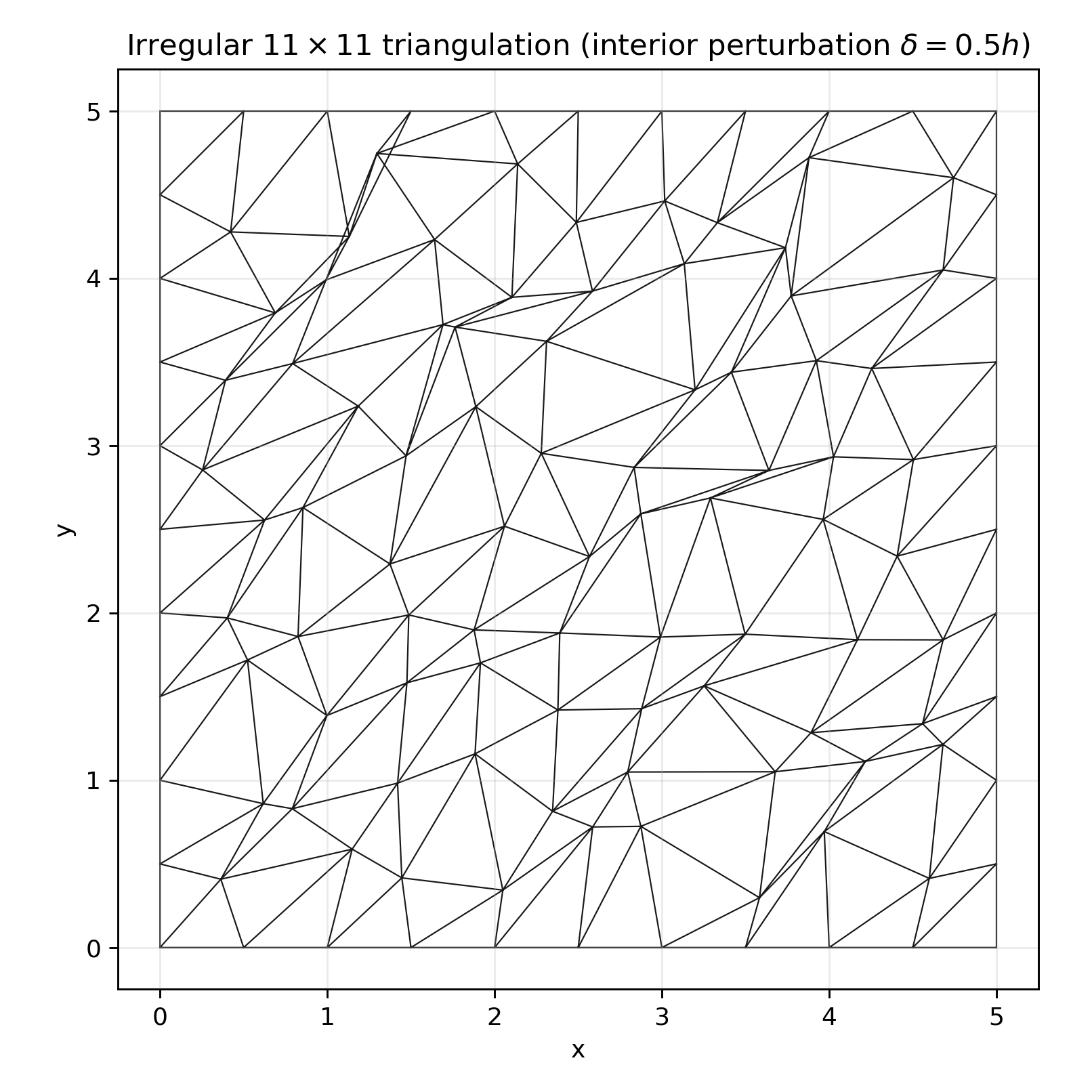
Figure 8: Representative irregular Ui(x)4 triangulations on Ui(x)5 obtained by perturbing interior nodes by fractions Ui(x)6.
(Figure 9, Figure 10)
Figure 9: Elasticity benchmark on perturbed meshes with delta=0.3h: DOF-based Ui(x)7 and energy-norm errors for MiGFEM NC/CC/SD strong-form discretizations, MiGFEM WG, and Ui(x)8 Ui(x)9-FEM.
Figure 10: Elasticity benchmark on perturbed meshes with increased distortion (delta=0.5h): DOF-based ωi0 and energy-norm errors for MiGFEM NC/CC/SD, MiGFEM WG, and ωi1 p-FEM.
Intrinsic derivative post-processing in WG yields equivalent asymptotic convergence to standard Leibniz derivatives; differences arise only in constants for low ωi2.
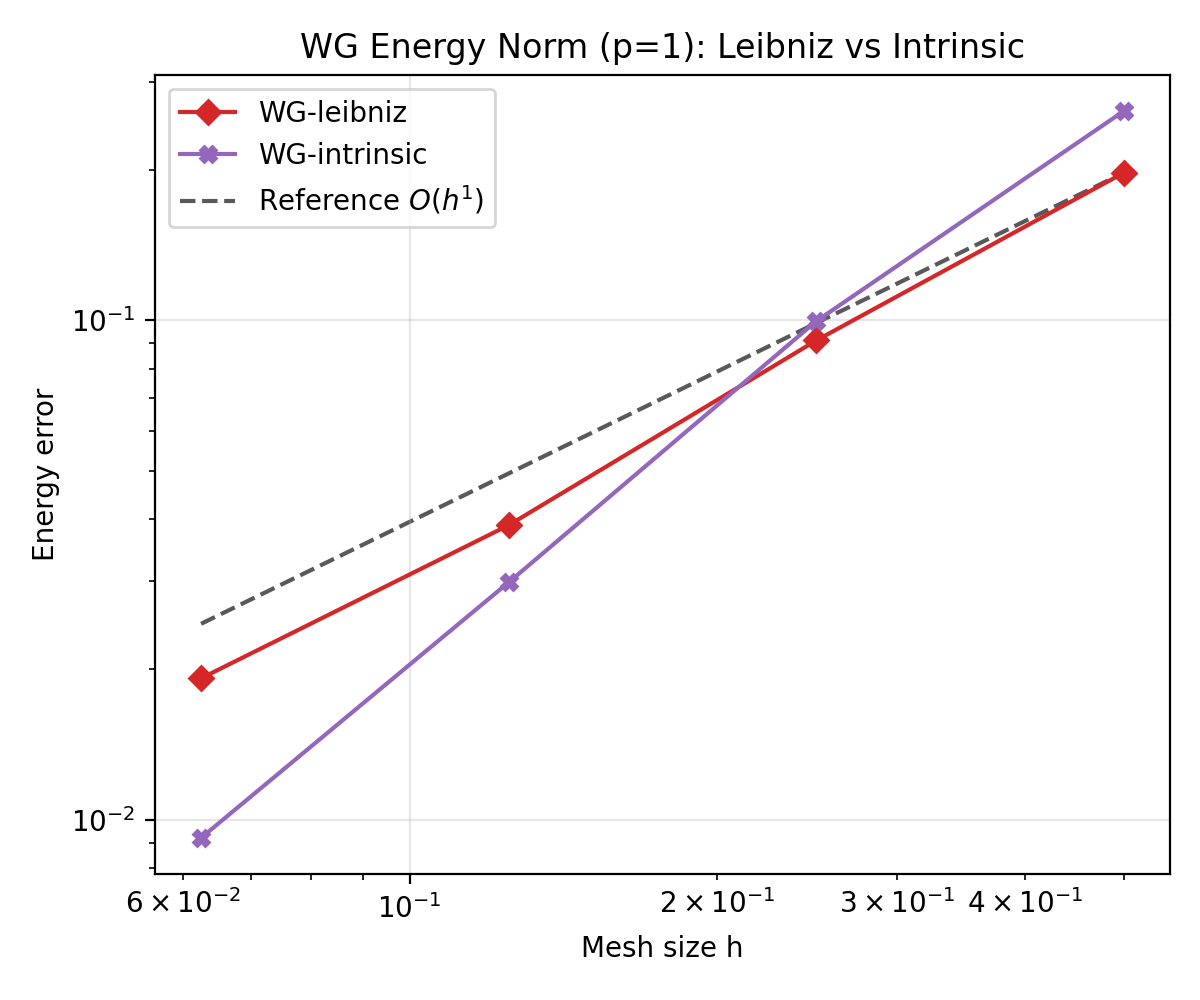
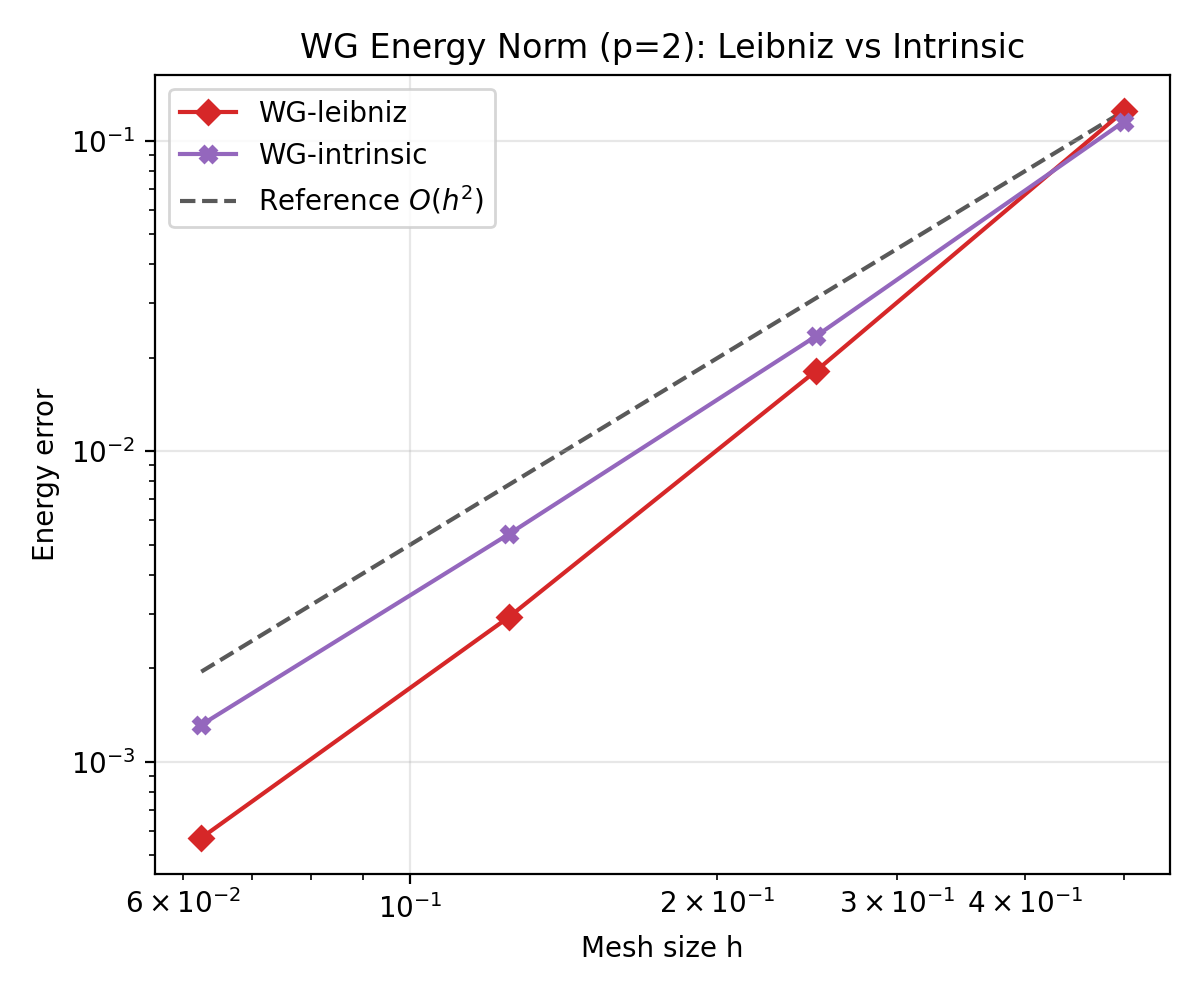
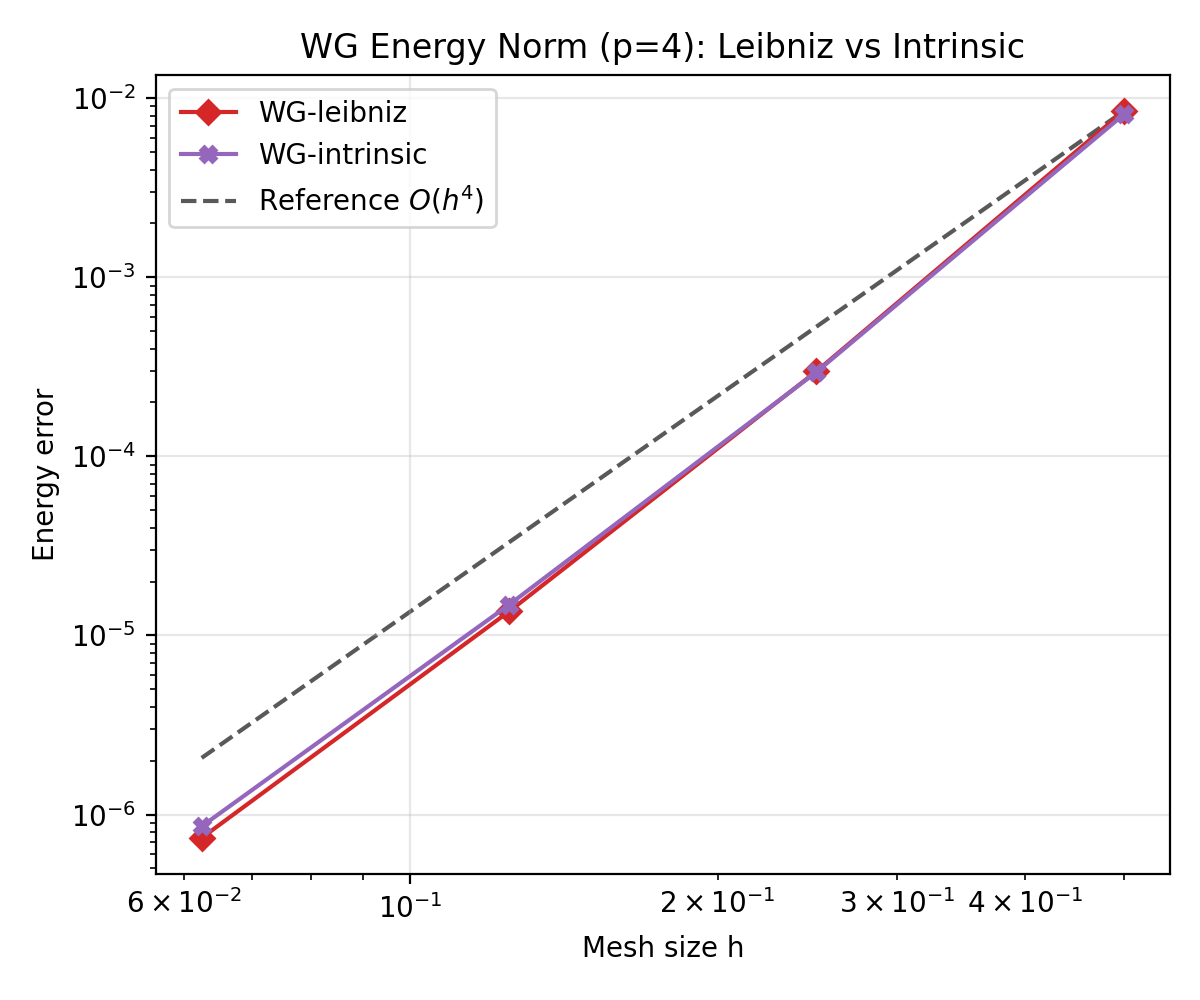
Figure 11: WG post-processing comparison of Leibniz and intrinsic derivatives for ωi3p.</p></p><p>Fourth−orderbiharmonicbenchmarksconfirmmonotoneerrordecayevenonseverelydistortedmeshes,withBA−CWLSpreservingboundaryconditionadmissibilityandmatrixconditioning.</p><p>(Figure12–16)</p><p><pclass="figure−caption">Figures12–16:Meshperturbationdiagnostics,nodalinjection,andfull−solveconvergenceforbiharmonicNC/CC/SDat\omega_i$4, $\omega_i$5.
Comparative diagnostics in MiGFEM-NC with CWLS vs. RBF reconstructions demonstrate similar accuracy, while BA-CWLS systematically improves matrix conditioning and runtime over penalty-based enforcement.
(Figure 13–20)
Figures 17–20: NC biharmonic comparison, conditioning, and runtime for $\omega_i$6, CWLS-Penalty, CWLS-BA, and RBF-Penalty.
Implications and Future Directions
Practically, the mesh-intrinsic approach provides a high-order, weak/strong-form compatible discretization pathway for standard $\omega_i$7 FE infrastructures, aligning with industrial CAE requirements for robustness, sparsity, and interoperability. The avoidance of extra-DOF proliferation and ill-conditioning is a fundamental advance over traditional enrichment schemes. The BA-CWLS mechanism presents a tractable enforcement strategy for boundary conditions in primal high-order collocation, maintaining boundary fidelity and system efficiency.
Theoretically, the PoZ-based smoothness transfer bridges local reconstruction and global continuity, leveraging interface coherence in a manner distinct from global $\omega_i$8 or meshfree bases. Intrinsic derivatives provide a rigorous framework for high-order PDE evaluation on $\omega_i$9 meshes.
Key directions for further development are: (i) systematic analysis of BA-CWLS boundary absorption regarding sampling density, patch geometry, and conditioning; (ii) parameter-sensitivity mapping for patch reconstruction across polynomial order, weight kernels, and mesh topology; (iii) extension and validation to three-dimensional domains; and (iv) integration of singular enrichment strategies for non-smooth and interface-dominated problems within strong-form discretization.
Conclusion
This paper establishes MiGFEM as an extra-DOF-free, mesh-intrinsic GFEM that achieves high-order smoothness on $\{u_j\}$0 unstructured meshes. Through patch-based CWLS reconstruction and PoU blending, MiGFEM delivers strict polynomial patch-test accuracy, PoZ-induced asymptotic $\{u_j\}$1 continuity, and unified weak/strong-form discretizations. The BA-CWLS boundary absorption mechanism enables exact enforcement of derivative-type boundary conditions with improved conditioning and efficiency, verified numerically across elasticity and biharmonic benchmarks on severely distorted meshes.
The approach directly addresses the engineering gap between standard FE mesh infrastructure and high-order PDE requirements, providing a flexible, robust foundation for further developments in high-regularity CAE methodologies and computational PDE solver architectures.