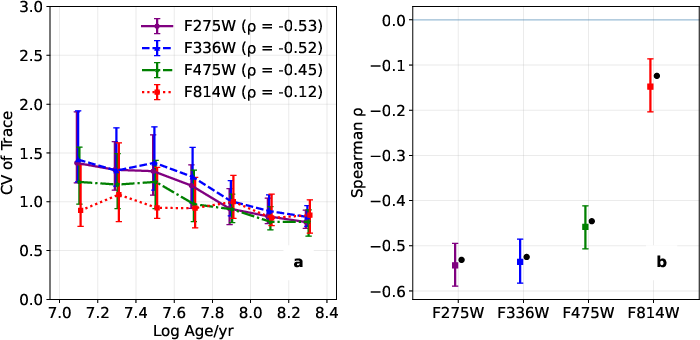
- The paper introduces the Hessian-based trace coefficient (CV_tr) to quantify photometric substructure, linking its decline to cluster aging.
- It demonstrates robust anti-correlations (Spearman ~ -0.53) between CV_tr and age in UV/blue bands, validating the metric’s evolutionary sensitivity.
- The study extends the method to large-scale extragalactic surveys, offering a quantitative tool for assessing young cluster evolution without relying on CMD-based analysis.
Hessian-Based Photometric Substructure as an Evolutionary Tracer of OB Cluster Candidates in M31
Introduction and Motivation
The analysis of young star clusters beyond the Milky Way is challenged by limited spatial resolution, which precludes individual stellar photometry and classical CMD-based age dating for the majority of compact and crowded systems. Traditional morphological or integrated photometric analyses are insufficient to capture internal structural complexity. This paper adopts a second-order, Hessian-based structural metric—the trace coefficient of variation (CVtr)—to quantify and track spatial photometric substructure in partially resolved OB cluster candidates (OBCs) in M31. The approach exploits high-resolution, multi-band imaging from the PHAT and PHAST HST surveys and targets structural evolution linked to stellar population aging.
Methodological Framework
The central metric, CVtr, is computed as the coefficient of variation of the Hessian trace within selected high-curvature regions of cluster images in four HST broadband filters (F275W, F336W, F475W, and F814W). The identification of cluster candidates leverages the MeanShift algorithm on the F275W images, followed by visual verification. Full-light and half-light radii are determined via a semi-automated, non-parametric growth curve convergence criterion, improving reproducibility for irregular morphologies.
Curvature analysis employs Gaussian smoothing tuned to the angular resolution of each band, with discrete central differences for second-order derivatives. The effective region Ωeff is defined by thresholding absolute curvature, and CVtr is extracted from the corresponding pixel distribution.
This dimensionless metric mitigates dependence on absolute flux scaling and is sensitive to spatial heterogeneity and morphological complexity—correlated with evolutionary stage due to the rapid fading and disappearance of massive OB stars.
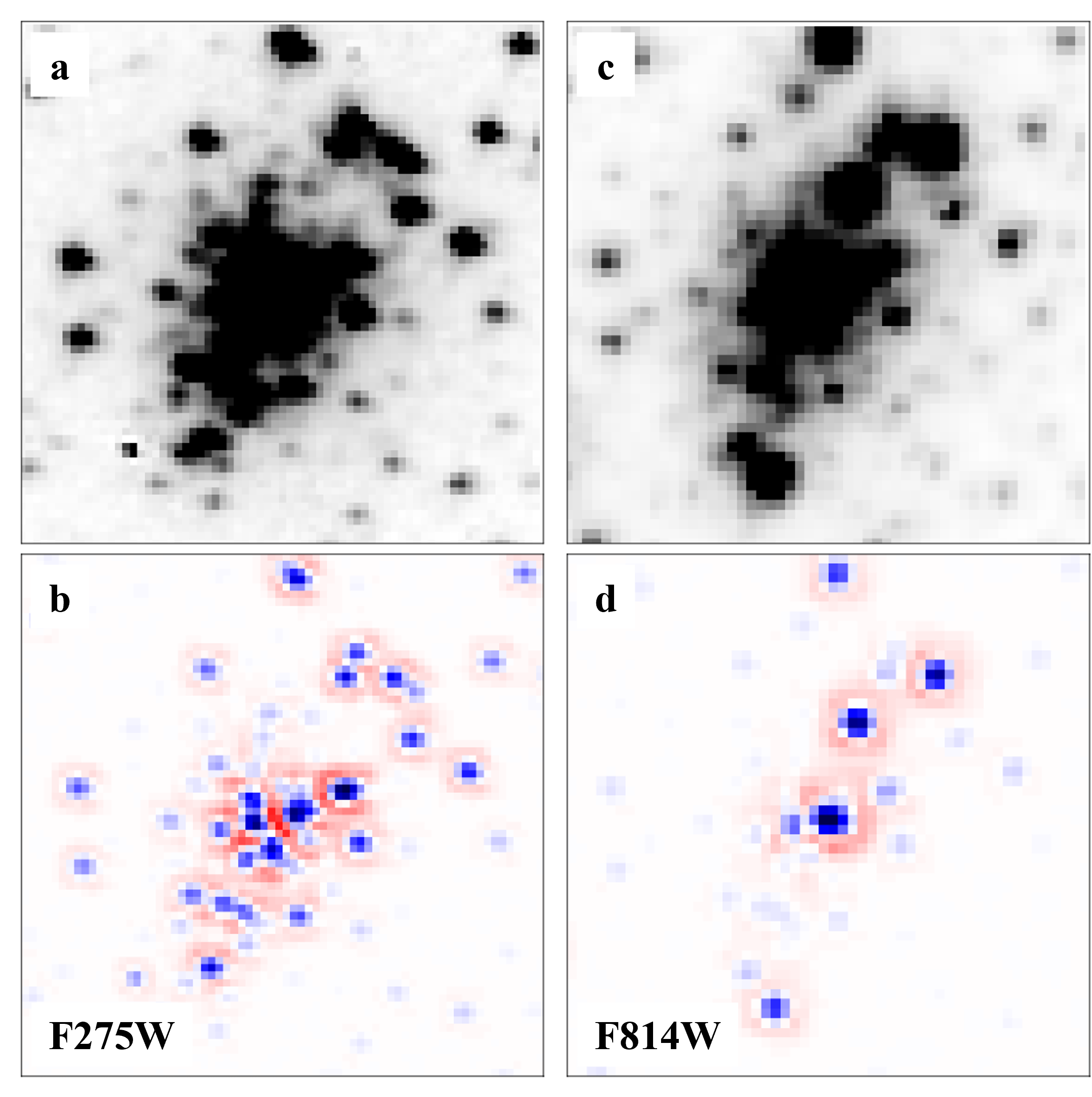
Figure 1: Panels demonstrate the application of Hessian-based curvature analysis to a cluster in two HST bands, showcasing that curvature maps reveal substantial substructure not apparent in the surface brightness images.
Results: Catalog Extension and Structural Trends
The updated catalog incorporates 747 OBC candidates, realized by expanding MeanShift scales and automating structural measurements. Spatial distributions are consistent with prior catalogs, and the refined measurement methodology yields half-light radii predominantly in the 1–2 pc range, aligning with literature (e.g., [Brown 2021]).
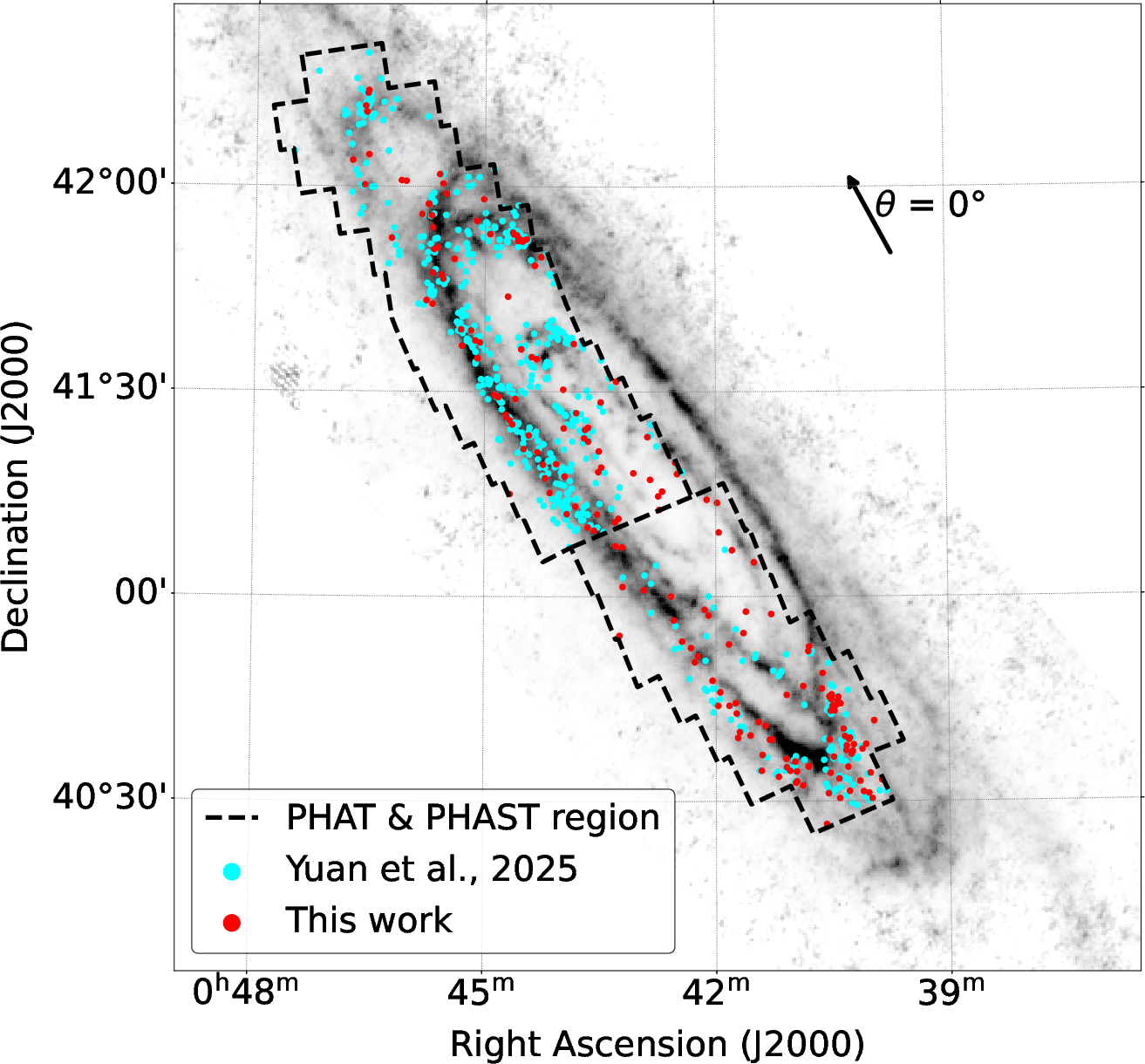
Figure 2: Spatially mapped OBC candidates relative to M31’s dust emission, indicating survey coverage and highlighting sample expansion in high-density regions.
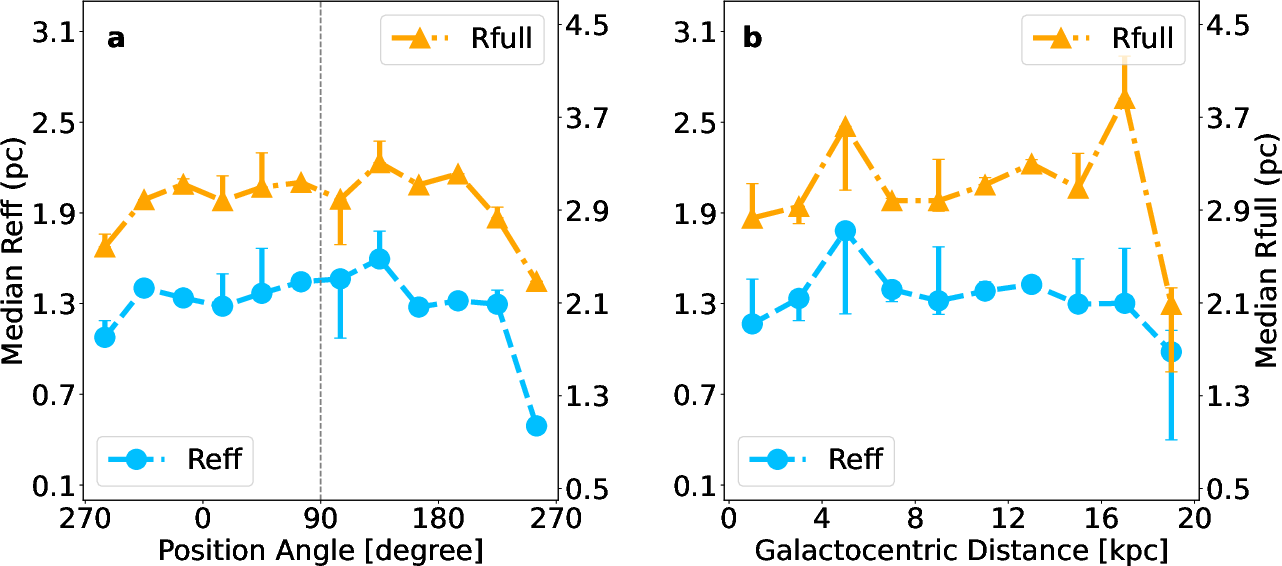
Figure 3: Spatial dependence of median cluster radii as a function of position angle and galactocentric distance, demonstrating methodological consistency in structural measurement.
Cross-matching with CMD-based age catalogs ([Johnson et al. 2016]) provides 247 clusters for evolutionary analysis. Statistical anti-correlations between CVtr and age are demonstrated in UV and blue bands (Spearman ρ∼−0.53 in F275W, −0.52 in F336W):
Partial correlation analysis confirms the trend is not mass-driven; controlling for cluster mass yields only minor changes in the age–CVtr relationship.
Forward Modelling: Physical Plausibility
Synthetic clusters constructed under simplified, physically motivated assumptions (IMF, mass, radius, substructure) and processed through identical pipelines reproduce the observed monotonic CVtr0–age relation in all bands. Spearman CVtr1 values from the simulations reach CVtr2 to CVtr3 across 38 realizations.
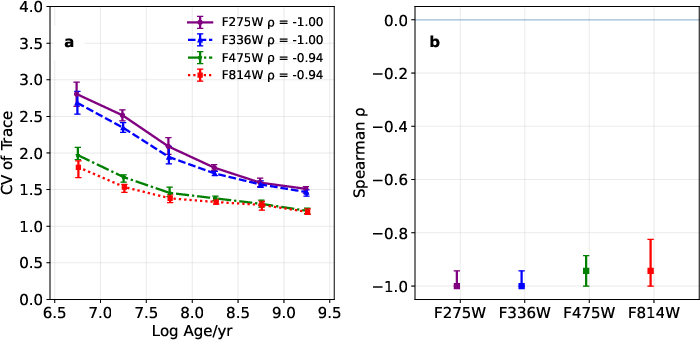
Figure 5: Evolution of CVtr4 in synthetic cluster simulations as a function of input age, confirming the monotonic relationship and narrow realization scatter.
The disparity between simulation and observation in F814W strength is attributed to UV/blue light dominance by massive stars, whose rapid fading accentuates structural evolution, whereas longer-lived stars in redder bands yield weaker photometric changes.
Catalog and Survey Limitations
Survey coverage is incomplete, constrained mainly to two-thirds of M31, with significant gaps in dust-rich southwestern regions. Catalog completeness is thus limited, especially in environmental parameter space. The growth-curve definition of CVtr5 reduces subjective bias in size measurements, but incompleteness and varying background conditions restrict absolute structural parameter comparability across the full galactic footprint.
Implications and Future Directions
Practical Implications
The Hessian-based structural index CVtr6 provides a quantitative, band-sensitive, and reproducible morphological tracer for young cluster evolution in the partially resolved regime. Its monotonic decline with age enables population-level evolutionary inferences even where classical CMD-based age dating is infeasible—applicable to large-scale extragalactic cluster surveys. The methodology is scalable to next-generation wide-field imaging platforms (e.g., CSST).
Theoretical Implications
The wavelength dependence of CVtr7’s evolutionary sensitivity substantiates the physical interpretation: structural complexity in UV images primarily traces the presence and spatial arrangement of massive OB stars. Progressive fading yields morphological smoothing, observable as reduced photometric substructure. Mass-independent persistence of the trend points to a genuine evolutionary origin, not simply population-sampling effects.
Future Directions
- Incorporation of realistic instrumental, crowding, and noise effects in forward modelling will refine the translation of CVtr8 to evolutionary diagnostics.
- Extension to larger, more diverse cluster populations (including SED-based ages) will test universality and environmental dependence.
- Exploration of higher-order Hessian metrics (eigenvalue structure, anisotropy) may yield further discriminatory power for complex cluster morphologies.
- The intersection with spectroscopic OB star content and resolved stellar population work may clarify the statistical link between CVtr9 and massive-star dominance.
Conclusion
This work establishes the Hessian-derived trace coefficient of variation as a robust, statistically sensitive tracer of internal photometric substructure and evolutionary stage in young OB cluster candidates in M31. Empirical anti-correlations with CMD-based age and forward-model supported monotonicity validate the approach within the observational regime. The methodology is readily extensible to broader cluster catalogs and upcoming high-resolution imaging surveys, presenting new avenues for quantitative extragalactic stellar population studies and morphological classification. Further methodological development and expanded sample analysis will enhance diagnostic precision and theoretical insight into cluster evolutionary processes.