- The paper introduces a rigorous NEGF framework to model phonon-mediated spin Seebeck effect at NM–CI interfaces.
- It demonstrates nonlinear spin transport with negative differential behavior tunable via thermal bias, chemical potential, and interface potentials.
- It reveals robust spin-current rectification with diode-like performance, linking effective interfacial spectral density to macroscopic spin current.
Introduction and Theoretical Foundation
This work presents a comprehensive theoretical study of the phonon-mediated spin Seebeck effect (SSE) at the interface between a normal metal (NM) and a chiral insulator (CI), focusing on angular-momentum-carrying chiral phonons as mediators for interfacial spin current generation—a regime distinct from magnon-based SSE commonly explored in conventional spintronics. The study is motivated by the growing evidence for chiral phonons and their capacity to carry well-defined angular momentum via circularly polarized atomic motion, with explicit conversion into electron spin angular momentum through interfacial scattering processes (2604.23111).
The authors establish a nonequilibrium Green's function (NEGF) framework to model the coupled NM–CI system and quantitatively analyze the spin current induced by a thermal gradient across the interface. Key tunable parameters include the thermal bias, chemical potential in the NM, and the properties of any inserted interfacial layer. The main Hamiltonian incorporates electronic, phononic, tunneling, and electron–phonon coupling contributions, with rigorous treatment of spin-microrotation interactions responsible for phonon–spin angular momentum conversion.
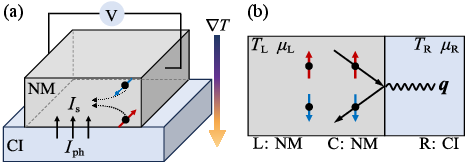
Figure 1: Schematic of the NM–CI device. The temperature gradient is perpendicular to the interface; black arrows denote conversion of phonon angular momentum current to spin current at the interface.
Spin Current Generation via Chiral Phonons
The spin current, Is, arises despite the absence of net charge flow due to the insulating nature of the CI. Instead, the chiral phonons with nonzero angular momentum in the CI, thermally activated by ∇T, drive spin-selective inelastic electron scattering in the adjacent NM. The NEGF-derived formalism expresses Is in terms of lesser and greater Green's functions for both spin channels, incorporating self-energies due to electron-phonon and lead couplings. The phonon reservoir is characterized using a super-Ohmic spectral density, and full self-consistency is enforced in evaluating the dynamical Green's function hierarchy.
Nonlinear Spin Transport: Negative Differential SSE and Rectification
The model yields two pronounced nonlinear transport phenomena:
Negative Differential Spin Seebeck Effect: For ΔT<0 (opposite temperature drop), the spin current initially increases but subsequently decreases with further increase in ∣ΔT∣. This nontrivial response is attributed to competing effects: increased thermal bias strengthens interfacial driving, but reduced NM temperature suppresses the supply of thermally excited electrons, thus diminishing interfacial spin-phonon conversion. Notably, increasing the chemical potential in the NM can eliminate this negative differential behavior via compensation of electron density depletion at low NM temperature. The presence of an interfacial layer, modeled by modulating on-site potentials, enables further control over spin current magnitude and sign.
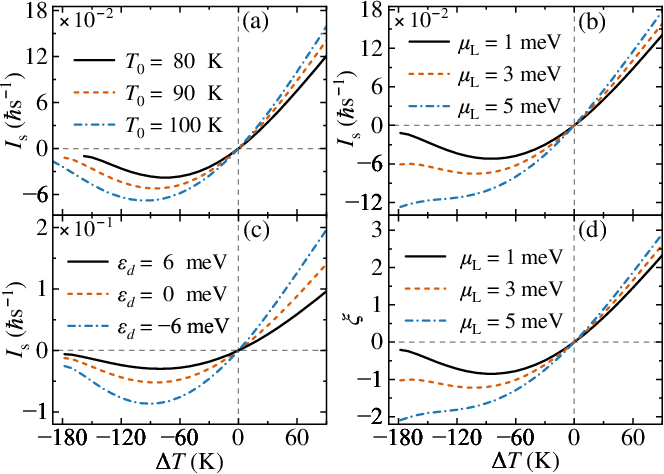
Figure 2: Spin current dependence on thermal bias, chemical potential, and interface potential; clear demonstration of negative differential SSE and tunability via system parameters.
Spin-Current Rectification and Spin Diode Behavior: The model identifies a robust rectification effect: Is(ΔT)=Is(−ΔT), rooted in left-right asymmetry. The rectification ratio η=Is(−ΔT)/Is(ΔT) can reach values as high as 25, signifying efficient thermal spin diode operation. This asymmetry and diode-like behavior are tunable via baseline temperature, interfacial properties, and applied biases.
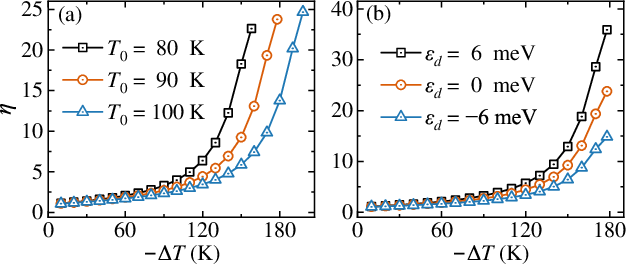
Figure 3: Rectification ratio η as a function of reversed thermal bias for different temperatures and interface conditions, demonstrating strong diode action.
Role of Interfacial Spectral Density
A central conceptual advance in this work is the identification of the effective interfacial spectral density Jeff(E), interpreted as the spectral measure of electron–chiral-phonon coupling responsible for spin current transduction. The scalar ξ=∫Jeff(E)dE closely tracks both the magnitude and nonlinear response of ∇T0, establishing a direct link between interface spectral engineering and macroscopic spin transport.
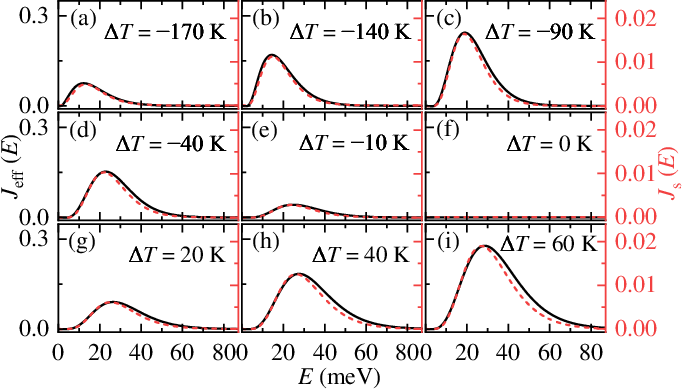
Figure 4: Effective interfacial spectral density ∇T1 and corresponding energy-resolved spin current for different thermal biases, visualizing the spectral origin of SSE nonlinearities.
Implications and Outlook
From a practical perspective, the phonon-mediated route to thermally pumped spin currents expands the material and device palette for spin caloritronics beyond magnon-based platforms. The results suggest that chiral insulators, when integrated with standard metals, enable efficient and tunable spin current generation in the absence of magnetic order. The discovery of strong negative differential SSE and high rectification ratios points toward possible implementation of thermal spin diodes and logic elements that operate at nanoscales and can leverage phononic rather than magnonic angular momentum.
On the theoretical front, the formal NEGF treatment and explicit connection to interface spectral density provide a rigorous framework for the broader class of hybrid quantum systems where angular-momentum transfer is mediated by non-electronic quasiparticles. Given recent experimental advances in the detection and control of chiral phonons, including their angular momentum properties [Ueda2023, Juraschek2025], the analysis provides concrete guidance for spectroscopic and time-resolved probes of interfacial spin-phonon physics.
Future work may focus on extending these results to more elaborate interface engineering, nonperturbative electron–phonon coupling regimes, and dynamical modulation of chiral phonon populations by optical or other means. Additionally, integration into multilayer or heterostructured spintronic circuits—where competing magnonic, orbital, and phononic SEEs may coexist—presents considerable opportunities for multifunctional information processing.
Conclusion
This paper develops a rigorous theoretical description of the spin Seebeck effect mediated by chiral phonons at NM–CI heterostructures, uncovering rich nonlinear spin transport phenomena—negative differential SSE and significant rectification—deriving from the underlying effective interfacial spectral density. The work provides actionable insights for the realization of thermally controlled spintronic devices, charting new directions for both fundamental and applied research in spin caloritronics where chiral phonons play a central role (2604.23111).