- The paper demonstrates that quark exchange dominates over meson exchange in off-diagonal D D* to π J/ψ scatterings.
- It employs a coupled-channel effective model, incorporating heavy-quark symmetry and meson exchange mechanisms to align with lattice QCD findings.
- The study clarifies the dynamic interactions of Zc(3900), emphasizing the importance of short-range quark exchanges in exotic hadron research.
Coupled-Channel Analysis of DDˉ∗-πJ/ψ Scatterings for the Zc(3900) Channel
Context and Motivation
The characterization of exotic hadrons with heavy flavor, particularly the Zc(3900), remains central in clarifying the nature of the so-called "tetraquark" candidates. Zc(3900), identified as a genuine exotic state if its existence is confirmed, has been observed experimentally in both hidden-charm (πJ/ψ) and open-charm (DDˉ∗) channels. Despite extensive experimental efforts and lattice QCD simulations, notably by HALQCD, the underlying dynamics governing interactions within these channels—especially their coupled-channel nature—are incompletely understood. This work presents a comprehensive coupled-channel effective model approach to analyzing DDˉ∗, J/ψπ, and related scatterings, aiming to reconcile and quantify both meson exchange and quark exchange contributions within the framework relevant for Zc(3900).
Effective Interaction Framework and Channel Structure
The model incorporates the following channels consistent with πJ/ψ0 and πJ/ψ1 quantum numbers:
- πJ/ψ2 (open charm channels, with appropriate spin-parity combinations)
- Hidden charm channels: πJ/ψ3, πJ/ψ4, πJ/ψ5
Couplings among these channels are evaluated using both meson exchange mechanisms (pion, vector mesons, and πJ/ψ6 exchange) and quark exchange diagrams (one-gluon exchange potentials with color and spin structure). The theoretical apparatus comprises Yukawa-type Lagrangians for meson exchange, static potentials in coordinate space, and diagrammatic Born amplitudes for nonrelativistic quark model-based quark exchange. Heavy-quark symmetry and angular momentum considerations are strictly enforced.
Meson Exchange Potentials
Meson exchange diagrams, including both diagonal (e.g., πJ/ψ7 to πJ/ψ8 via pion or rho exchanges) and off-diagonal processes (e.g., πJ/ψ9 by Zc(3900)0 exchange), are treated using heavy-quark limit approximations and appropriate form factors reflecting hadron spatial distributions. The resulting static potentials for meson exchange exhibit suppressed strengths, especially for the isospin Zc(3900)1 channels relevant for Zc(3900)2, due to isospin factors, effective mass shifts, and form factor effects.

Figure 1: Diagrammatic illustration of meson exchange mechanisms between open and hidden charm channels.
Phase shift calculations demonstrate negligible impact from meson exchange alone in both the diagonal Zc(3900)3 and off-diagonal Zc(3900)4 channels.
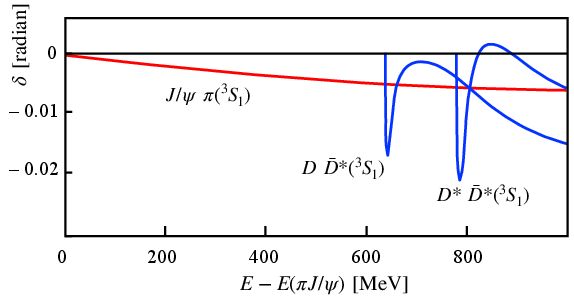
Figure 2: S-wave phase shifts induced by meson exchange potentials in Zc(3900)5 and Zc(3900)6 channels show minimal interaction strength for Zc(3900)7, Zc(3900)8 sector.
Quark Exchange Mechanisms
The dominant interaction emerges from quark exchange diagrams evaluated in the constituent quark model, with one-gluon exchange incorporating Coulomb, confinement, and hyperfine interactions, and full color and spin factorization.

Figure 3: The six distinct quark exchange diagrams classified as capture and transfer processes contributing to off-diagonal channel transitions.
Non-locality in resultant potentials is substantial, but localization approximations enable direct comparison to lattice-extracted potentials. The quark exchange is effective exclusively for off-diagonal transitions such as Zc(3900)9 and not for diagonal scattering due to color-singlet nature of mesons.
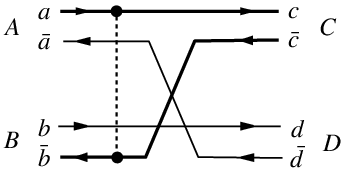
Figure 4: Schematic of momentum assignments in transfer-type quark exchange processes.
Numerical Results for Potentials and Amplitudes
The coupled-channel Schrödinger equations with the full Zc(3900)0 matrix potential are solved for the relevant channels. A reduction factor (Zc(3900)1), justified by the running of the QCD coupling Zc(3900)2 at high momentum transfer scales (Zc(3900)3 GeV), is applied to quark exchange strengths to achieve quantitative agreement with HALQCD lattice results.
The off-diagonal potentials, particularly Zc(3900)4 and Zc(3900)5, exhibit substantial short-range strength (up to 0.2 GeV) but rapidly diminish at distances beyond 0.5 fm. The volume integrals of these potentials, crucial for low-energy scattering, are quantified, and all relevant components (hyperfine, confinement, Coulomb) are dissected.
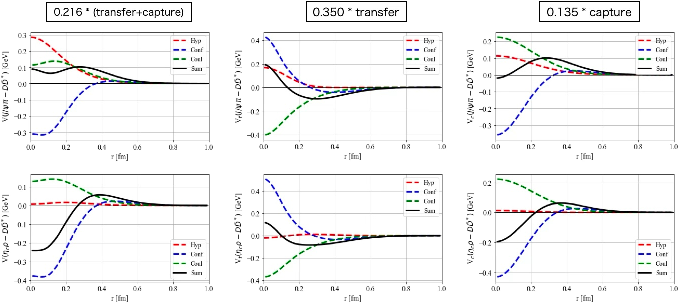
Figure 5: Radial dependence of quark exchange potentials for key off-diagonal channel transitions, decomposed by interaction type and diagram classification.
Additional off-diagonal potentials involving higher channels (e.g., Zc(3900)6, Zc(3900)7) are likewise constructed, revealing that their inclusion in the coupled-channel system is essential for realistic amplitude analysis.
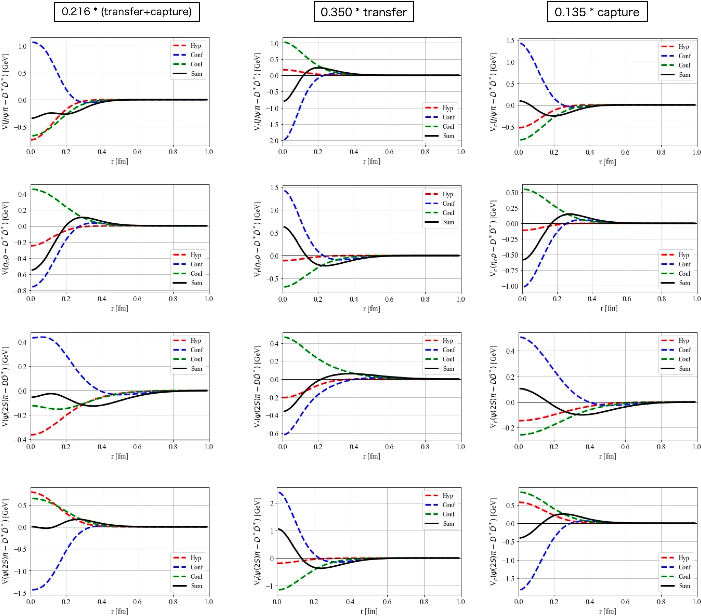
Figure 6: Quark exchange-induced potentials for further off-diagonal channel combinations, showing complexity of coupled-channel landscapes.
Scattering Amplitude Analysis
The calculated coupled-channel amplitudes, with thresholds aligned to the HALQCD lattice mass spectrum, faithfully reproduce the qualitative features seen in lattice simulations: strong off-diagonal transition amplitudes, absence of bound or resonant poles in the Zc(3900)8 region, and sensitivity of amplitude shapes to the number of included channels, with kink-like structures at added channel thresholds.
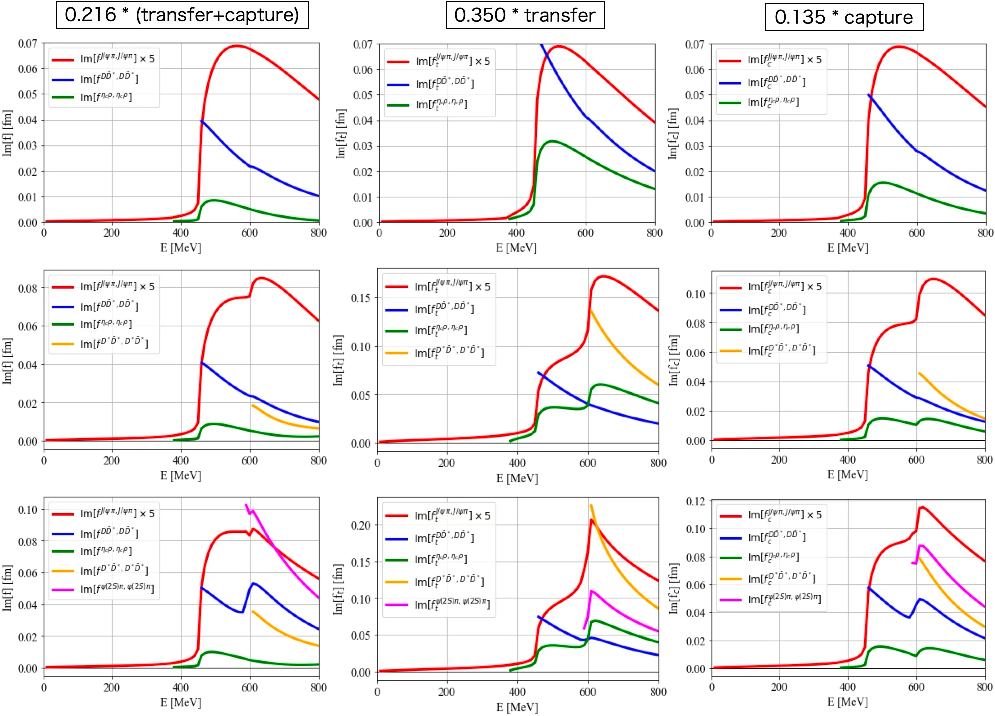
Figure 7: Energy dependence of scattering amplitudes across four main channels with increasing coupled channel complexity; amplitude enhancement and threshold singularity emerge as additional channels are included.
A simplified toy model with three channels and contact interactions corroborates the main conclusions of the full model. The line shapes and amplitude ratios agree closely with both the effective model and lattice results when parameterized according to potential volume integrals.
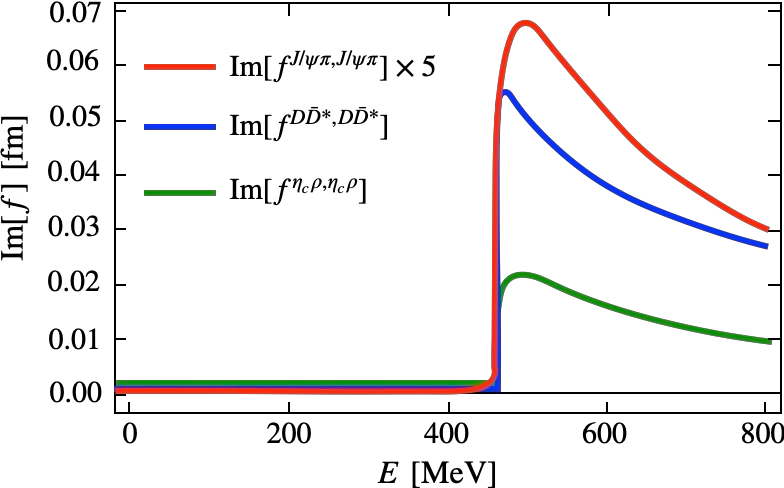
Figure 8: Toy model amplitude profiles for comparison, illustrating agreement with both detailed model and lattice data.
Implications and Future Directions
The analysis firmly establishes that meson exchange processes play a negligible role, while quark exchanges at short distance are responsible for the strong off-diagonal transitions relevant for Zc(3900)9. This finding is consistent across effective models and lattice QCD, provided the quark interaction strength is scale-appropriate. Sensitivity to coupling strengths and channel treatment underscores the necessity of precise coupled-channel analysis in exotic hadron studies.
Practical implications include guiding experimental investigations to focus on channel coupling structures and informing the interpretation of coupled-channel lattice QCD results. Theoretically, further refinement in separating spin states, inclusion of genuine quark-dominated channels, and extension to other exotic candidates (e.g., Zc(3900)0, pentaquarks) is warranted. Future work should prioritize updated lattice simulations at physical pion masses and the incorporation of higher-order exchanges (e.g., two-pion exchange) to fully elucidate the mechanisms underlying tetraquark phenomena.
Conclusion
This study provides a stringent coupled-channel analysis for Zc(3900)1-Zc(3900)2 and related scatterings, establishing the dominance of quark exchange at short distances and demonstrating quantitative consistency with lattice QCD in the Zc(3900)3 sector. The results underscore the necessity of accurate treatment of channel couplings and scale-dependent interaction strengths for reliable interpretation of exotic hadron states.