- The paper introduces KilonovaSCORER, a simulation-based framework that applies Bayesian prior predictive checking to score kilonova candidates in real time.
- It employs two complementary metrics—tail probability and density mass—to integrate sparse, multi-band photometry and quantify candidate likelihood.
- Validation on known events like AT 2017gfo and kilonova impostors demonstrates its ability to robustly distinguish genuine kilonovae for efficient multimessenger follow-up.
Simulation-Based Scoring of Kilonovae: The KilonovaSCORER Framework for Real-Time Multimessenger Follow-Up
Introduction and Motivation
Gravitational wave (GW) observatories and time-domain optical surveys such as the Vera C. Rubin Observatory Legacy Survey of Space and Time (LSST) are driving a new era in multimessenger astrophysics, in which joint GW and electromagnetic triggers can be followed by the discovery of faint, fast-evolving optical transients: kilonovae (KNe). Rapid, robust photometric vetting of transient candidates is critical for efficient allocation of spectroscopic and multiwavelength follow-up. However, most wide-field follow-up observations, particularly those enabled by LSST’s Target of Opportunity (ToO) strategy, produce only sparse, early-time, multi-band photometry per candidate, rendering conventional Bayesian inference or machine-learning classification unreliable.
"KilonovaSCORER: Prior-Predictive Scoring of Kilonovae for Real-Time Multimessenger Follow-Up" (2604.22994) confronts this problem by presenting an open-source, statistically rigorous simulation-based framework specifically optimized for scoring and ranking transient candidates in the low-data regime characteristic of multimessenger follow-up.
Framework Overview and Scoring Methodology
KilonovaSCORER evaluates photometric candidates against a broad, physically informed grid of synthetic kilonova light curves in absolute magnitude space, sampled from a two-component ejecta model with wide priors. The methodology is formulated within a Bayesian simulation-based paradigm, centering on prior predictive checking (PPC) and with diagnostics inspired by Approximate Bayesian Computation (ABC).
Two complementary per-observation metrics are introduced:
- Ptail,KNe: Quantifies the two-sided tail probability—how extreme the observed magnitude is with respect to the prior predictive distribution (PPD) for the kilonova model at a given time and band, taking into account photometric and distance uncertainties.
- Pnear,KNe: Measures the proportion of simulated light curves (“density mass”) whose predicted apparent magnitude matches the observation within a tolerance interval, employing the region of practical equivalence (ROPE) formalism from Bayesian equivalence testing.
Individual per-epoch scores are aggregated using an inverse-variance weighted mean in logit space, ensuring robust sequential incorporation of heterogeneous uncertainties as new photometry arrives. Multi-epoch photometric histories are further evaluated for temporal coherence via a sequential ABC diagnostic, which applies a survival filter to the simulation ensemble as new observations are added, sharply penalizing candidates whose evolution becomes inconsistent with any model light curve in the grid.
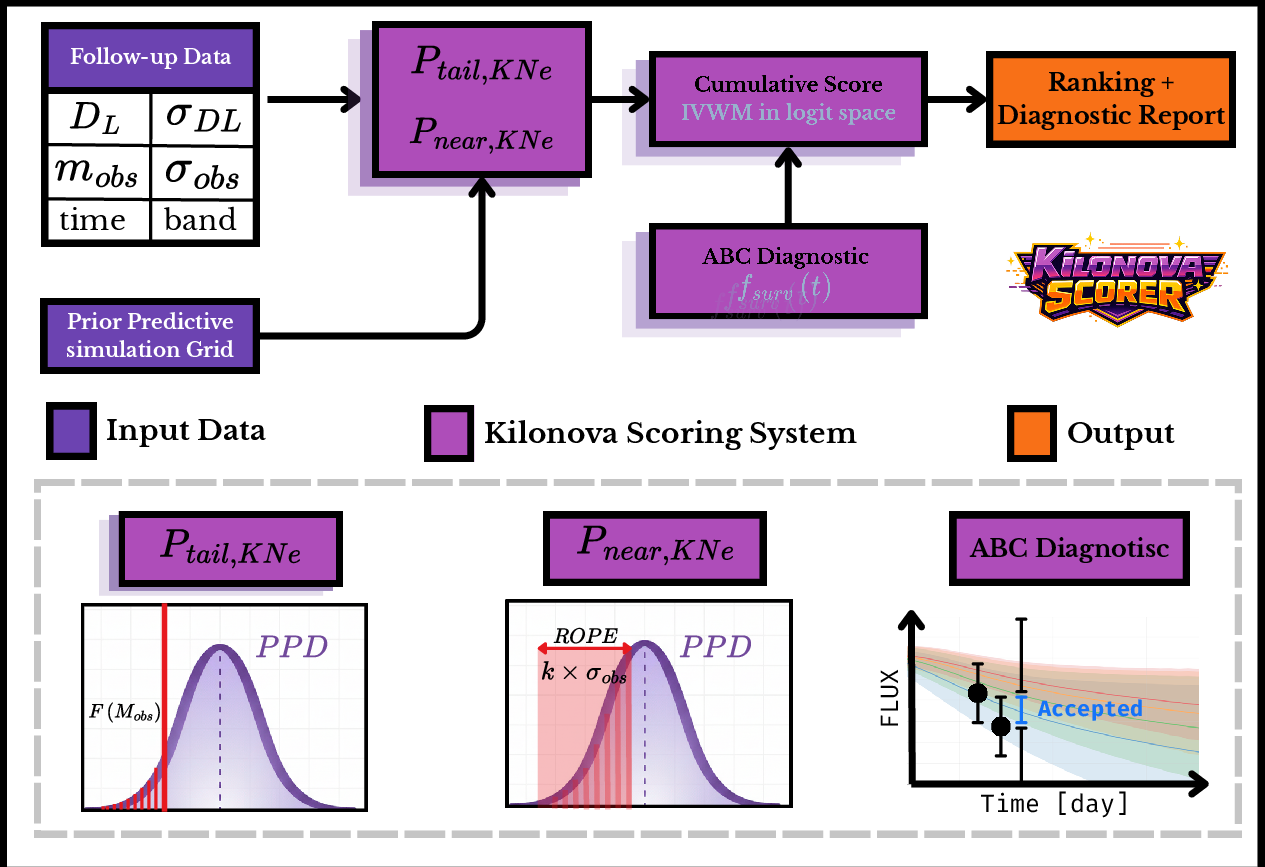
Figure 2: Schematic data flow in KilonovaSCORER, showing ingestion of photometry and GW distance, scoring against a simulated light-curve grid, and sequential diagnostics.
The kilonova simulation grid and its sampled diversity are shown below.

Figure 1: Simulated multi-band kilonova light curves from the adopted two-component model grid (Villar et al.), with median magnitude and 1σ spread over time in griz bands.
KilonovaSCORER is validated across multiple regimes: the multi-band photometry of the canonical kilonova AT 2017gfo; the powerful kilonova impostor SN 2025ulz (a Type IIb SN initially suspected to accompany a GW event); a set of gamma-ray burst (GRB)–associated kilonovae; and controlled synthetic populations of common GW contaminants such as Type Ia and core-collapse supernovae.
Gold-Standard Kilonova: AT 2017gfo
Scoring the only robustly confirmed kilonova, AT 2017gfo, the framework produces stable, high cumulative scores (∼0.6 after one night, declining to ∼0.44 after 10 days), demonstrating statistical sensitivity to the dense region of prior-simulated kilonova behavior and expected monotonic decline in temporal survival fractions.
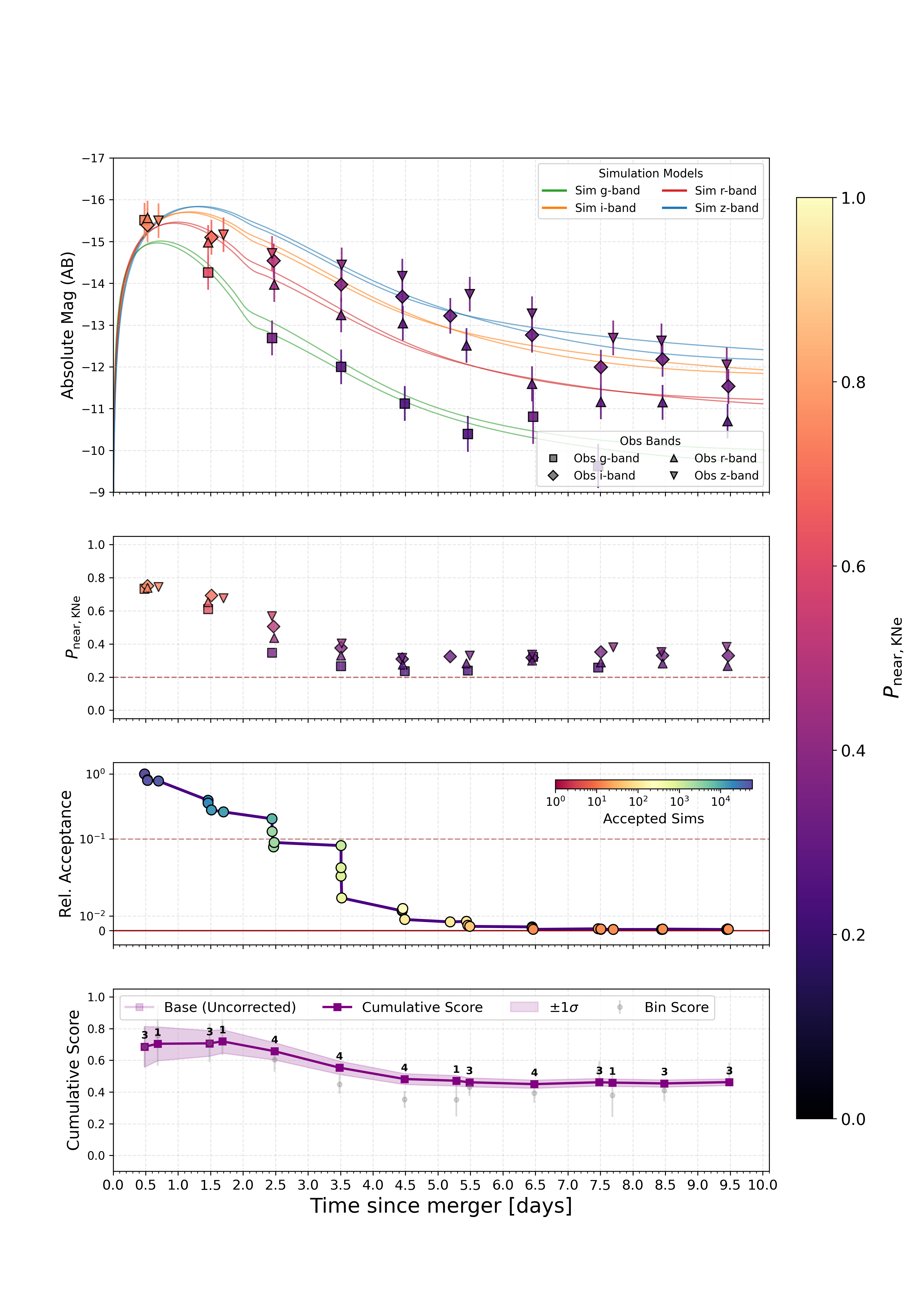
Figure 3: Candidate Diagnostic Report for AT 2017gfo in griz bands; high Pnear,KNe and robust cumulative tail scores validate efficiency in early kilonova ranking.
Kilonova Impostor Rejection: SN 2025ulz
For SN 2025ulz, the framework delivers intermediate cumulative scores at early times (reflecting genuine initial photometric similarity with kilonovae), but as photometric rebrightening emerges at t≳5 days post-discovery the sequential ABC diagnostic survival fraction collapses, and the cumulative rank is penalized to zero, facilitating robust early rejection.
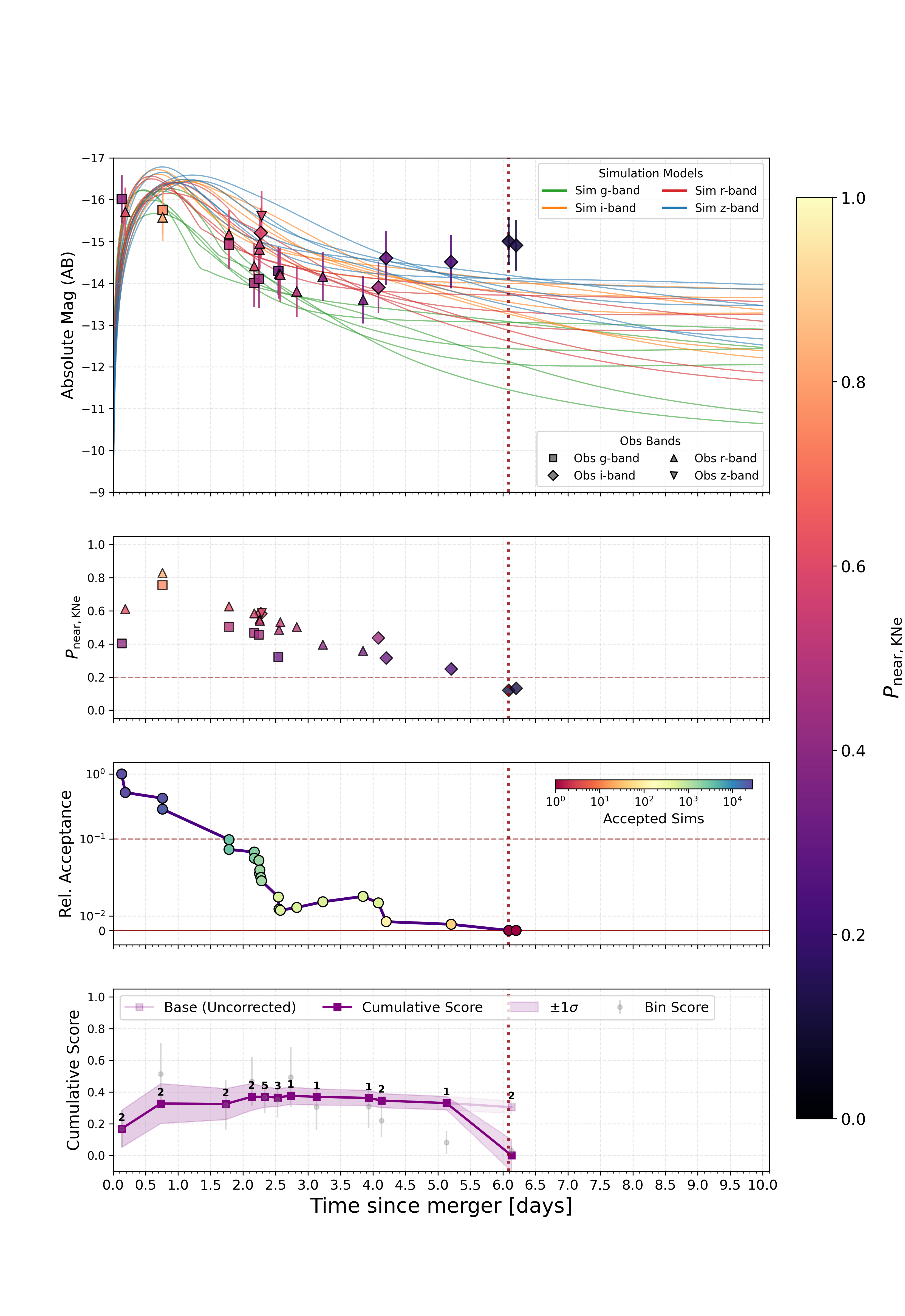
Figure 5: SN 2025ulz, a Type IIb SN transient, receives early non-zero scores but is rapidly down-ranked after temporal evolution diverges from all plausible kilonova models.
GRB-Associated Kilonovae
Applying KilonovaSCORER to afterglow-subtracted optical/IR light curves of five GRB-associated kilonovae (including both long and short GRB hosts at z∼0.07−0.36), the framework maintains cumulative scores Pnear,KNe0 0.2–0.8 across all events and never rejects physical kilonovae, demonstrating insensitivity to moderate observer–rest-frame filter mismatch and suitability for high-latitude/IR-rich search strategies.
Statistical Population Discrimination
In LSST ToO simulations, with BNS/NSBH kilonovae and three supernova emission models (Type Ia, shock cooling, CSM interaction), median cumulative scores for SN impostors drop to zero by Pnear,KNe1–Pnear,KNe2 days after GW trigger, while kilonova scores remain above 0.4, achieving strong separation efficiency from the leading contaminant populations.
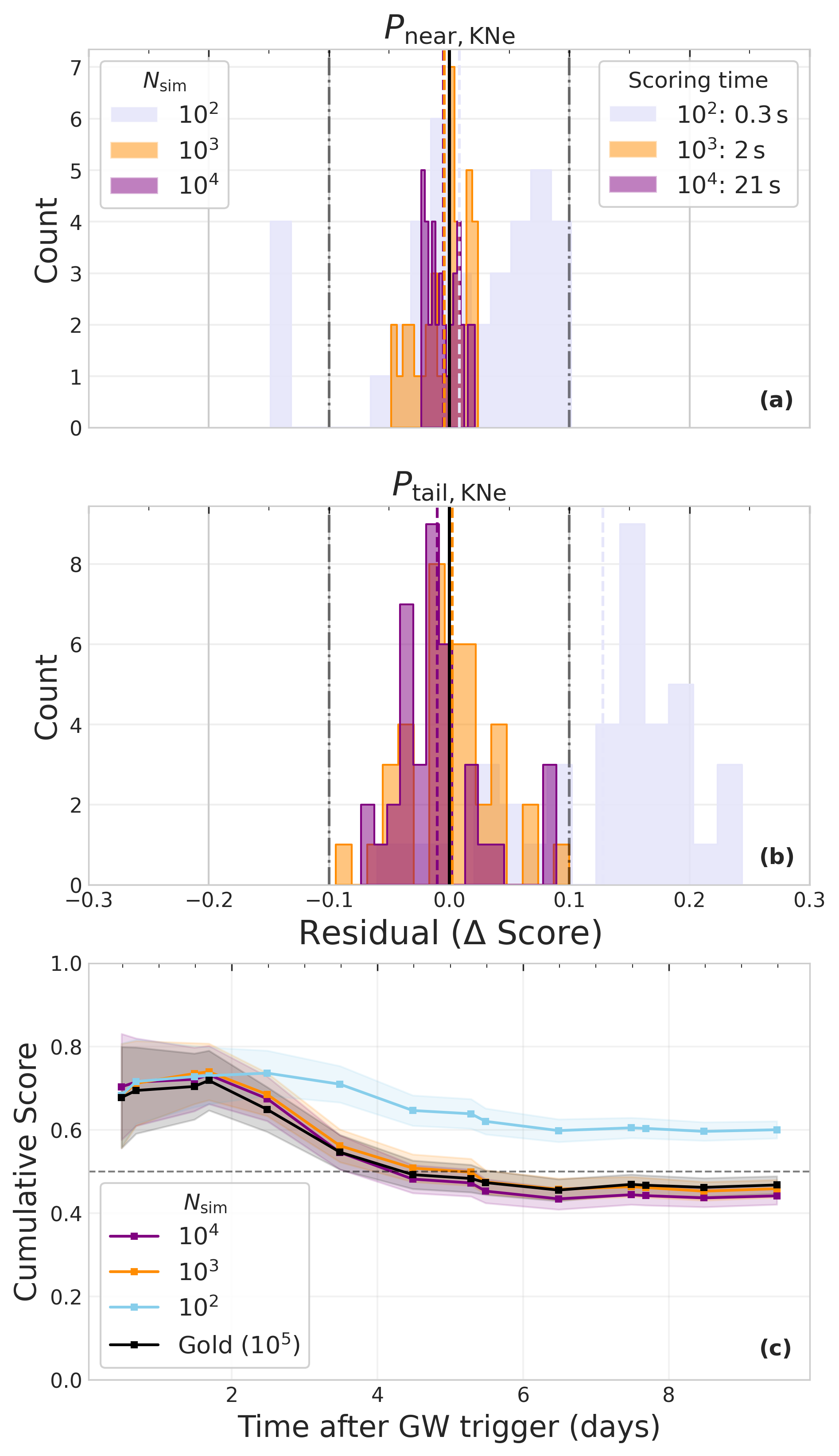
Figure 4: Cumulative Pnear,KNe3 score distributions for simulated kilonova and supernova populations under a 4-night LSST ToO scenario; kilonovae persist, while all SN classes are suppressed within days.
Practical and Theoretical Implications
KilonovaSCORER demonstrates that simulation-driven, uncertainty-aware metrics can deliver early, robust, physically interpretable candidate ranking and temporal rejection in the low-data, real-time regime of current and future multimessenger surveys. The algorithm is natively compatible with streaming follow-up infrastructures (e.g., TROVE), can operate with minimal input (apparent magnitude, uncertainty, time, filter, GW distance), and is extensible to NIR/IR bands for next-generation platforms (e.g., Roman Space Telescope).
From a methodological standpoint, the framework offers a clear answer to the challenge of vetting rare, information-sparse transients by inverting the standard inference paradigm: by simulating from broad priors and asking not what parameters best fit the data, but whether the data are plausible under any reasonable physical model realization, controlling Type II errors without fragile parametric tuning.
Extensions and Limitations
While the framework is highly effective for GW-cued kilonova searches, some caveats remain:
- Incomplete Prior Coverage: Candidates whose emission physics fall outside the simulation prior grid may be under-ranked.
- Low-Cadence Bias: Early, sparse photometry before light-curve divergence can result in temporarily ambiguous or high impostor scores, mitigated as multi-epoch data accumulates.
Potential extensions include targeted searches for EM emission from BBH mergers in AGN disks, untriggered fast transient surveys with marginalizing over explosion time and distance, and integration as a feature layer for meta-classifiers in next-generation alert broker architectures.
Conclusion
KilonovaSCORER (2604.22994) establishes a principled, simulation-based standard for photometric candidate scoring in multimessenger astronomy, with explicit uncertainty quantification, temporal coherence enforcement, and demonstrated efficacy in both real and simulated data contexts. Its integration-ready architecture is matched to the needs of real-time brokered follow-up in the LSST era and beyond. The framework’s statistical design philosophy—prior predictive rigor, conservative scoring, sequential update—provides a template extendable to other transient types where data sparsity and heterogeneity defeat conventional methods.
Software Availability
The full open-source implementation and documentation are available at:
https://github.com/phelipedarc/KilonovaSCORER/tree/main
References
P. Darc & C. D. Kilpatrick, "KilonovaSCORER: Prior-Predictive Scoring of Kilonovae for Real-Time Multimessenger Follow-Up" (2604.22994).
See also [Metzger 2017], [Villar 2017], [Bulla 2019], [Franz 2025], [Rastinejad 2025], [Raaijmakers 2021], and references therein for further context on kilonova modeling and candidate vetting.