- The paper proposes SwarmDrive, leveraging event-triggered, intent-level V2V communication powered by edge SLMs to mitigate latency while ensuring safety.
- It demonstrates a 94.1% collision-free success rate and reduces decision cycle latency to 151.4 ms under optimal 6G communication settings.
- The study reveals a scalable, decentralized framework with optimal entropy thresholds and inverse-distance weighting to handle occlusions and packet loss.
Semantic V2V Coordination for Latency-Constrained Cooperative Autonomous Driving: An Analysis of SwarmDrive
Introduction
The paper "SwarmDrive: Semantic V2V Coordination for Latency-Constrained Cooperative Autonomous Driving" (2604.22852) investigates the problem of bridging the performance-latency gap for real-time autonomous driving decision making within the context of occlusions and partial observability, focusing on urban intersection scenarios. The work critiques both cloud-hosted LLM-based approaches, which incur prohibitive round-trip latencies, and standalone edge-model inference, which remains brittle under occlusion due to restricted perceptual context. To address these limits, the authors propose SwarmDrive, a decentralized V2V framework enabling nearby vehicles to perform intent-level information fusion powered by edge-deployed Small LLMs (SLMs), triggering communication only when scene uncertainty is high.
System Architecture and Semantic Cooperative Mechanism
SwarmDrive's architecture operates without any reliance on external cloud infrastructure. Each vehicle executes three core modules: (i) Multimodal Perception, (ii) Local SLM Inference, and (iii) Swarm Consensus for intent aggregation. Synchronized camera, LiDAR, and radar data are locally encoded into an ego-centric scene graph and processed by an SLM, which yields an action-intent distribution. Only when the entropy of this distribution surpasses a pre-set threshold—implying high uncertainty—does the vehicle initiate V2V semantic communication.
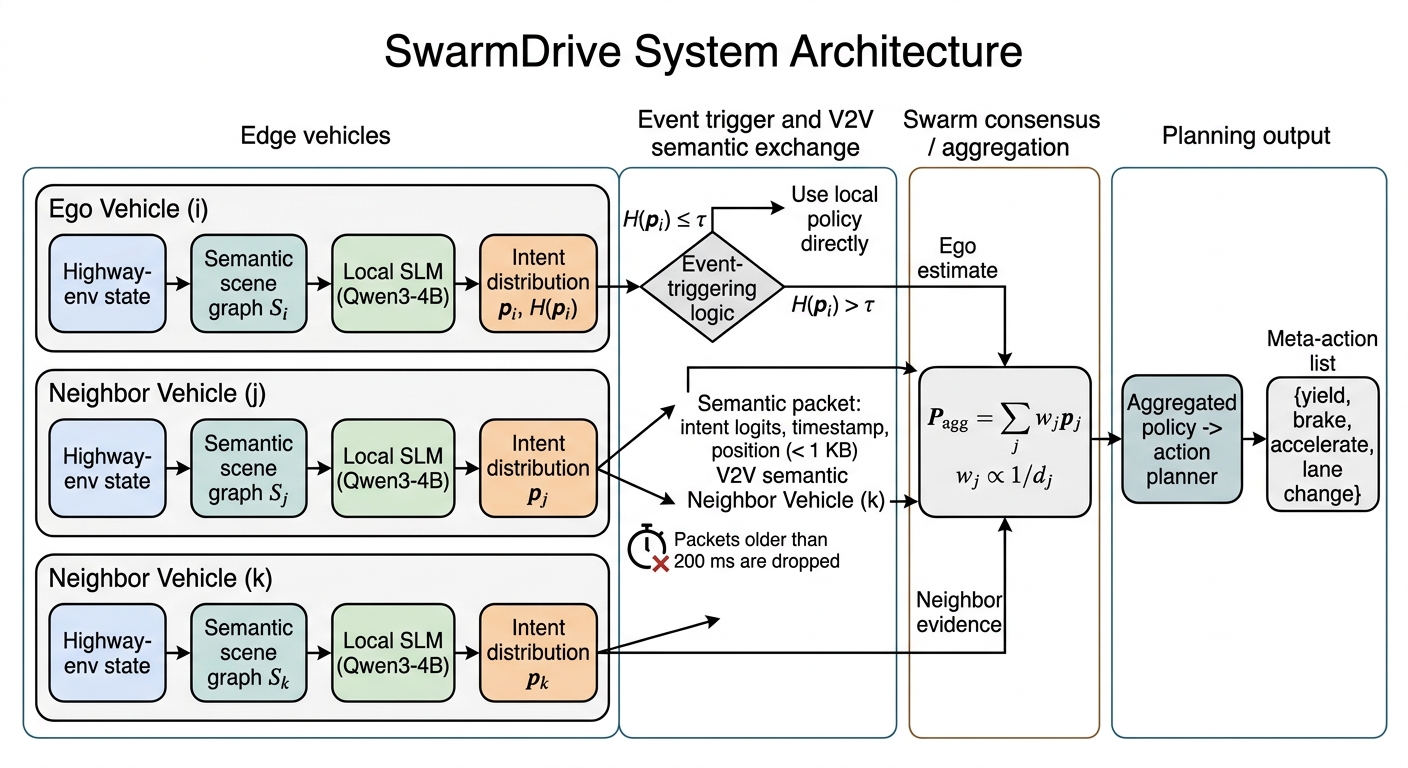
Figure 1: High-level architecture; edge SLMs process local sensor data, broadcast compact intent messages over V2V, and fuse these into a driving policy via a consensus module.
The V2V semantic messages consist of post-inference intent distributions and spatial metadata, rather than full perceptual tensors, substantially reducing bandwidth requirements. Each ego vehicle aggregates received neighbor intent vectors using inverse-distance weighting, prioritizing those with optimal vantage points relative to the conflict (e.g., occluded intersection).
Communication and Prompt Protocol
The cooperative protocol is built upon event-triggered intent sharing governed by entropy gating. When a vehicle's action distribution entropy exceeds threshold τ, a V2V broadcast is issued containing only the compact intent vector.
This protocol is realized via distinct prompt engineering for ego and helper vehicles. Helper vehicles generate concise, decision-critical risk reports and candidate maneuvers, while the ego vehicle fuses these along with its local perception into a final action distribution, explicitly requiring reasoning over occlusion, conflict zone risk, and message consensus.
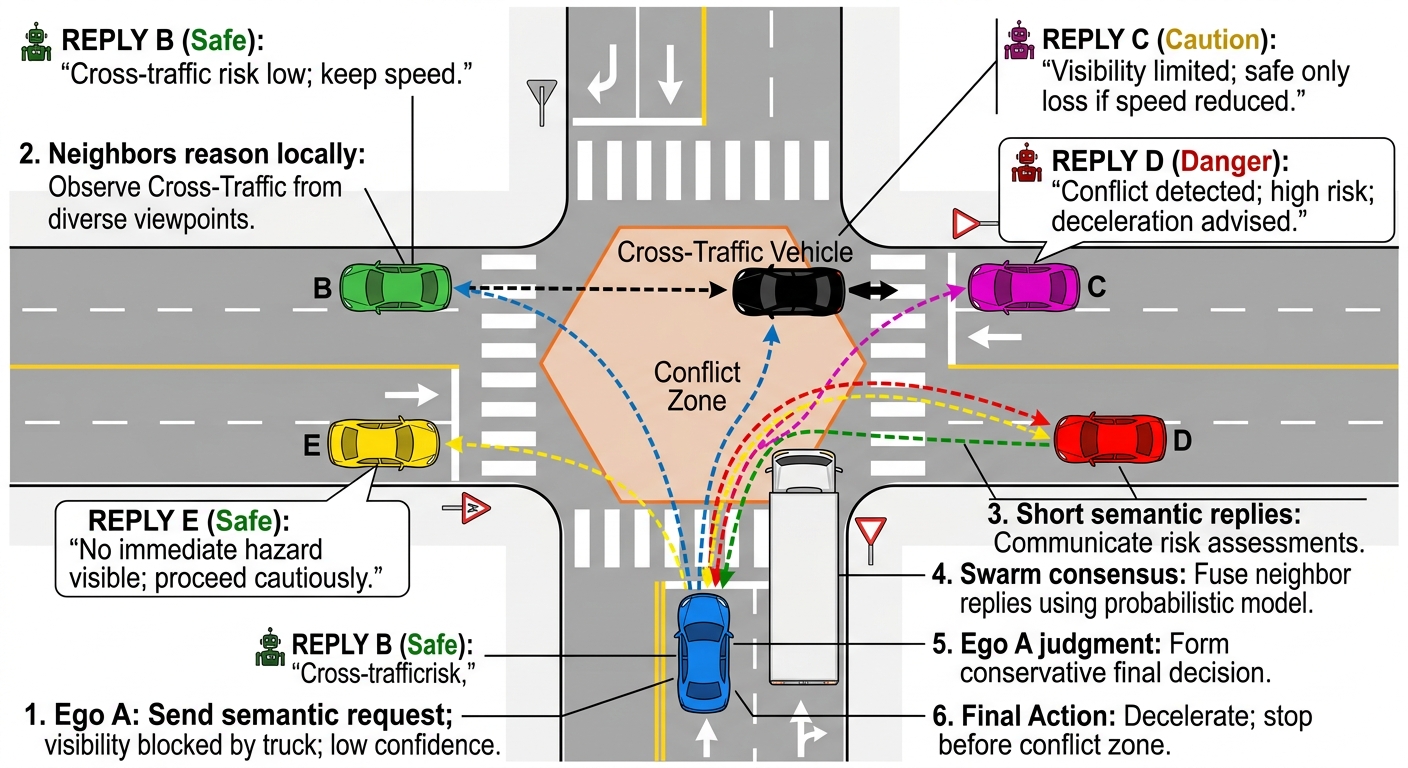
Figure 2: Canonical occluded-intersection scenario; ego vehicle A, occluded by structure, queries neighboring vehicles for risk cues to inform action policy.
Experimental Design and Metrics
The primary evaluation utilizes a calibrated, reproducible simulation campaign centered on a high-occlusion intersection scenario. Key baseline configurations include: (1) a standalone SLM (no V2V); (2) a V2X swarm with legacy communication parameters (baseline latency/loss/bandwidth); and (3) Swarm 6G—a best-effort semantic V2V scenario using aggressively low-latency, low-loss, high-bandwidth settings meant to approximate future 6G capabilities.
Core metrics include mean decision cycle latency, consensus trigger rate, V2V message count, and episode success rates (collision-free completion).
Empirical Results
Results demonstrate that SwarmDrive under its 6G communication assumptions attains a 94.1% success rate (collision-free completion) and reduces mean decision cycle latency to 151.4 ms, compared to 68.9% success with 145.0 ms latency for a standalone edge SLM and 510 ms latency for cloud GPT-4 inference (which, while more reliable, is impractically slow for safety-critical real-time control).
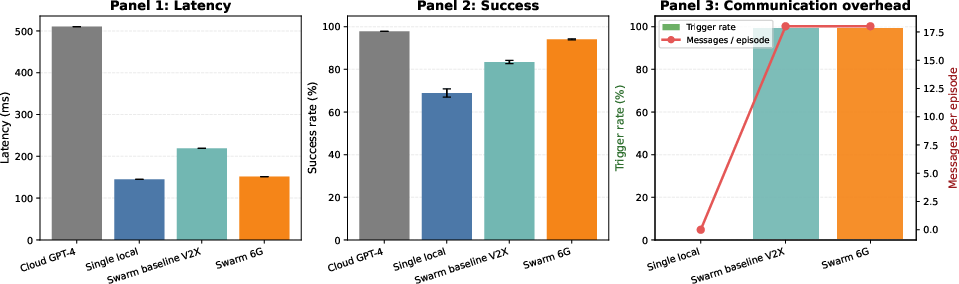
Figure 3: Operating-point comparison highlighting the latency, success rate, and communication overhead for local, baseline V2X, Swarm 6G, and cloud-based driving stacks.
The baseline V2X configuration achieves intermediate results (83.5% success at 218.9 ms). SwarmDrive, with its event-triggered intent aggregation and semantic message optimization, thus matches or exceeds the collision avoidance of cloud-based reference stacks while achieving edge-suitable latencies.
Robustness and Mechanism Studies
Mechanism ablations show SwarmDrive's cooperative gain persists across variations in active swarm size, packet loss, and entropy threshold:
- Swarm Size: Success rate increases from 69.8% (N=1) to 92.6% (N=4), after which communication contention leads to plateau/decline.
- Packet Loss: Gradual performance degradation observed; robust success (>90%) maintained up to 10% loss.
- Entropy Threshold: Optimal cooperation-trigger regime identified around τ=0.65–0.70; too low triggers communication overuse, while higher values suppress cooperation and reduce success to local-model baseline.
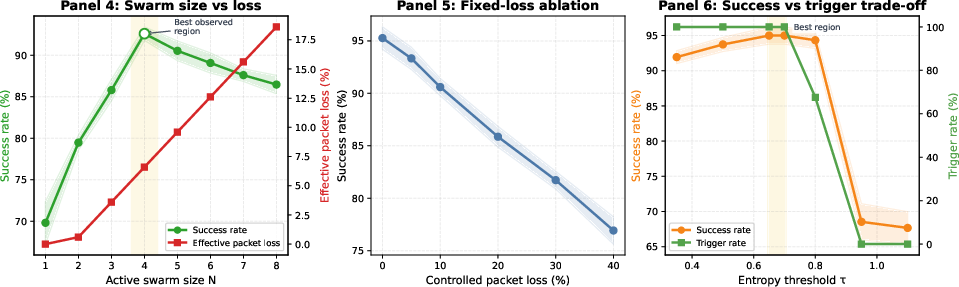
Figure 4: Detailed mechanism/robustness analyses investigating the impact of swarm size, synthetic packet loss, and entropy-trigger threshold on system performance.
The aggregate evidence substantiates the claim that event-triggered, intent-level semantic communication is both communication-efficient and robust, outperforming traditional V2V/edge schemes without the latency drawbacks of large-scale cloud inference.
Practical and Theoretical Implications
SwarmDrive underlines the viability of semantic communication within multi-agent autonomous systems, asserting that intent-level information is sufficiently rich for robust decision making under partial observability, yet bandwidth-efficient for deployment within real vehicular networks. By decoupling local model choice and limiting bandwidth overhead, SwarmDrive is adaptive to heterogeneous fleets and supports incremental, distributed deployment.
While the analysis is limited to a canonical intersection scenario and idealized (non-hardware-in-the-loop) communication models, the methodology could generalize to other cooperative driving primitives—merging, joint parking, emergent swarm maneuvers—provided appropriate scenario-adaptive trigger designs and downstream consensus logic are engineered. The approach is also compatible with incremental advances in V2X PHY/MAC (e.g., hardware-accelerated 6G) and can compound with ongoing research in compact representation learning for semantic V2X.
Theoretically, the paper strengthens the case for event-triggered, uncertainty-aware communication as an organizing principle for scalable cooperative autonomy, supporting a transition from sensor-level fusion to higher-order, post-inference information sharing. This exemplifies a pragmatic step toward integrating edge intelligence within vehicular collectives in anticipation of future ultra-low-latency networks.
Limitations and Future Directions
Current evidence is from an executable but non-homologation-grade prototype with constrained scenario diversity and communication models abstracted from deployment reality. The work does not constitute a deployment-validated performance claim for real 6G V2X, nor does it provide direct measurements of energy or bandwidth efficiency on real hardware. Communication contention and security/trust concerns in large, unsynchronized swarms are likewise left open. The framework's generalizability to high-density, adversarial, or radically unstructured environments remains an active area for further research.
Future advancements may address hardware-in-the-loop validation, richer scenario families, adversarial robustness, and adaptive communication scheduling. Trust- and intent-certification mechanisms and their implications for consensus integrity in heterogeneous swarms present particularly compelling directions for theoretical and applied research.
Conclusion
SwarmDrive presents a technically rigorous, experimentally calibrated framework for latency-constrained, robust cooperative decision support in autonomous driving via intent-level, event-triggered V2V semantic communication. The study provides scalable evidence for the efficacy of edge-SLM-powered vehicle collectives, achieving a strong safety-utility tradeoff under realistic communication constraints. While limited in direct deployability, the architecture and empirical findings offer meaningful trajectories for the synthesis of next-generation edge intelligence, cooperative autonomy, and communication-savvy AI in vehicular systems.