- The paper demonstrates that including ambipolar diffusion and decaying turbulence significantly relaxes constraints on primordial magnetic fields during reionization.
- It employs advanced simulations with HyRec and exo21cmFAST to capture PMF effects on the intergalactic medium, dark matter structure, and UV luminosity functions.
- Forecasts indicate that upcoming HERA 21cm measurements may improve PMF sensitivity by one to two orders of magnitude.
Reionization and 21cm Sensitivity to Primordial Magnetic Fields: Accounting for Energy Losses
Overview and Motivation
This work systematically revisits cosmological constraints on primordial magnetic fields (PMFs) by explicitly incorporating PMF energy loss mechanisms—ambipolar diffusion (AD) and decaying turbulence (DT)—during the post-recombination epoch through reionization. The analysis connects PMFs to the evolution of the intergalactic medium (IGM), the growth of small-scale structure, and the resulting impact on reionization, the UV galaxy luminosity function (UV LF), and the 21cm cosmological signal. The principal claims of the paper are that self-consistent modeling of PMF evolution substantially relaxes previous bounds on their properties and that 21cm probes (particularly HERA) will dominate future PMF sensitivity.
Modeling Primordial Magnetic Fields and Their Evolution
Magnetic fields with strengths in the range 10−17–10−9G are plausible in the IGM, with their origin either from late-time astrophysical sources (e.g., AGN outflows) or, more fundamentally, from early universe processes such as inflation or cosmic phase transitions. The focus here is on PMFs generated in the early universe, which impact the IGM via two principal mechanisms after recombination:
- Ambipolar Diffusion (AD): Conversion of magnetic energy into heat via relative motion of ions and neutrals.
- Decaying Turbulence (DT): Magnetic turbulence decay sourced by increased plasma mean free path after recombination.
These mechanisms produce redshift-dependent energy loss rates, crucially modifying the time evolution of the PMF power and thus their cosmological imprint. The paper implements these loss terms directly in the HyRec and exo21cmFAST codes, allowing tracking of the evolving PMF amplitude, χB(z), and its impact on the IGM temperature, ionization fraction, and structure growth.
The enhancement of small-scale power by PMFs arises through Lorentz-force-induced density perturbations. The paper provides a full treatment of the magnetic growth function and its explicit redshift suppression due to PMF decay:
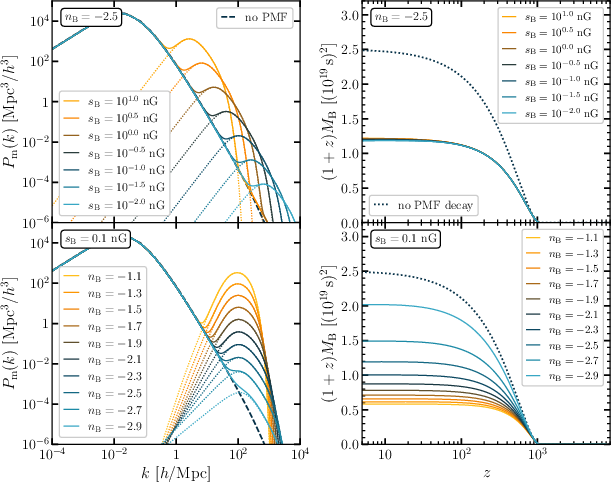
Figure 1: Matter power spectrum and magnetic growth function as a function of wave number and redshift for varying PMF parameters. The suppression from PMF energy losses compared to naive redshifting is clearly visible.
The matter power spectra show that even a modest reduction in χB (due to energy losses) results in a significant suppression of small-scale enhancements previously attributed to PMFs. The effect on the halo mass function—the abundance of halos per mass interval—is similarly reduced:
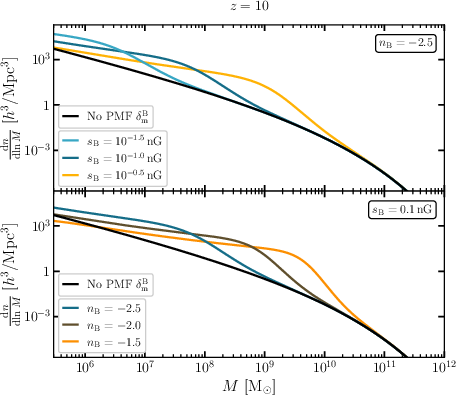
Figure 2: The halo mass function is enhanced for increasing PMF normalization or spectral tilt, over a restricted mass range set by magnetic Jeans and Alfvén scales.
This scale-dependent effect directly modulates the abundance of early galaxies, impacting UV LFs and the reionization history.
IGM Thermal/Ionization Evolution and Observational Imprints
Self-consistent coupling of PMF heating (AD and DT) and structure boost modifies the ionization and temperature histories of the IGM. The computation combines the high-redshift HyRec evolution with position- and time-dependent simulations in exo21cmFAST.
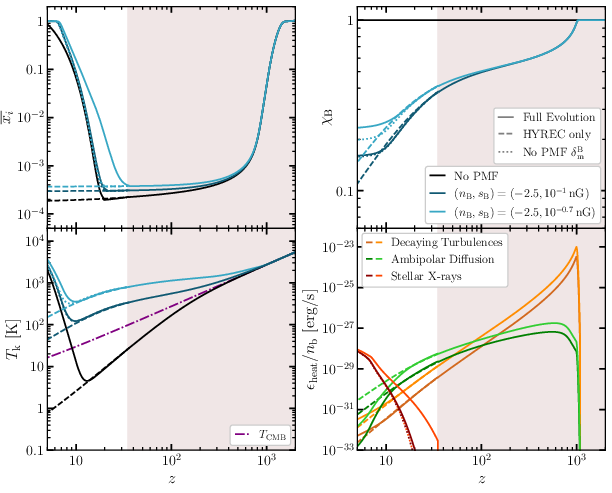
Figure 3: Evolution of ionized hydrogen fraction, IGM temperature, PMF amplitude, and heating rates for varying PMF amplitudes and redshifts. The impact of PMF decay is visible, with substantial suppression of χB at low redshift.
A key result is that (for fixed PMF parameters) the increase in optical depth and IGM temperature—critical for CMB and 21cm observables—is significantly reduced relative to analyses neglecting these energy losses.
Cosmological Constraints: Reionization, UV Luminosity Functions, and Degeneracy Structure
Constraints are extracted with a simulation-based emulator (NNERO) trained on exo21cmFAST output, enabling full MCMC sampling of astrophysical and PMF model space.
- Optical Depth to Reionization (τ): The PMF-induced boost of early structure and IGM heating leads to measurable increases in τ for PMF parameters above certain thresholds.
- UV Luminosity Functions: Enhanced small-scale structure formation increases the number of faint galaxies, with data at 210 from HST placing additional constraints.
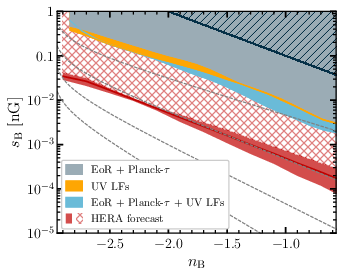
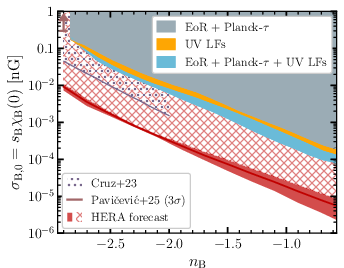
Figure 4: 211 CL exclusion regions for PMF normalization as a function of spectral index, comparing Planck-212, UV LF, and combined likelihoods. The combined constraint is dominated by structure formation enhancement, closely tracing contours of constant Lorentz force.
A central result is that, once PMF decay is included, exclusion regions in the 213–214 plane are shifted upward by roughly an order of magnitude compared to those derived with purely redshifting (215 scaling) PMFs, and detailed degeneracies with star-formation efficiency and X-ray luminosity remain critical.
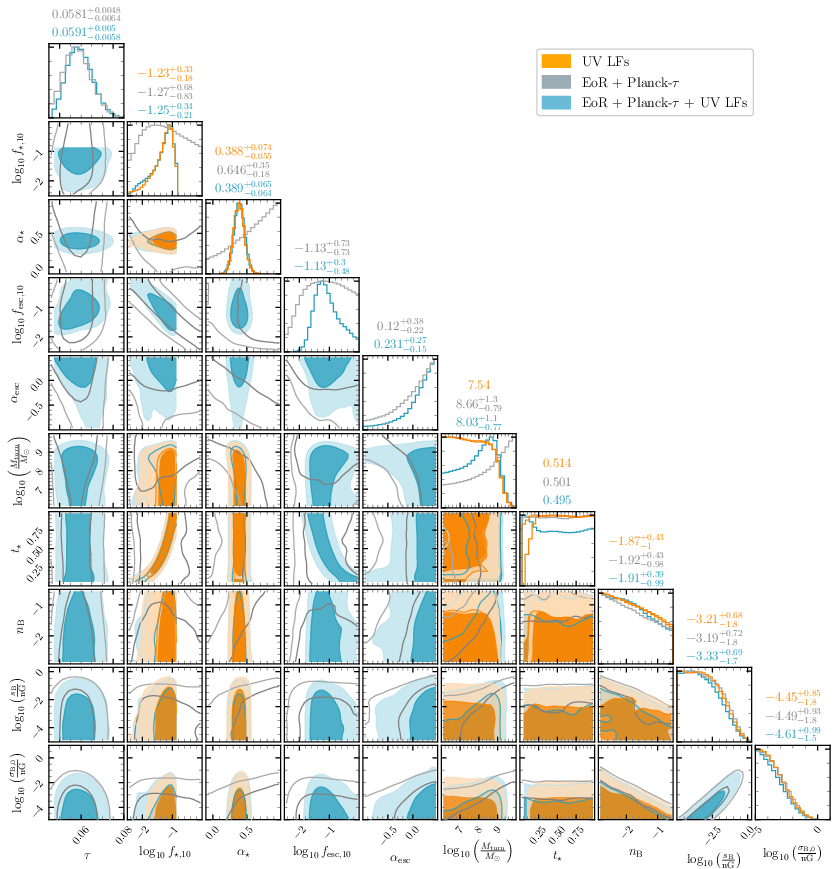
Figure 5: Corner plot showing joint posteriors for main astrophysical and PMF parameters from combined likelihoods. The key degeneracies are in star formation efficiency and UV escape fraction, with no strong correlation to PMF amplitude.
21cm Forecasts and Fisher Analysis for HERA
The 216cm power spectrum from Cosmic Dawn and reionization is highly sensitive to IGM heating. The paper investigates the forecasted reach of HERA through Fisher matrix analysis, focusing on the suppression of the 217cm signal’s absorption trough (due to early heating from PMFs).
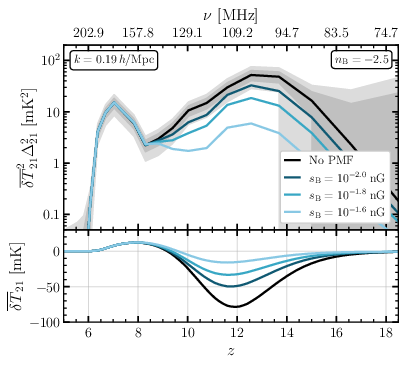
Figure 6: 218cm power and global signal as a function of redshift for various PMF amplitudes. PMF heating suppresses the absorption trough and power spectrum peak at 219.
Projected HERA sensitivity offers improvements of 10−170–10−171 orders of magnitude over current cosmological probes:
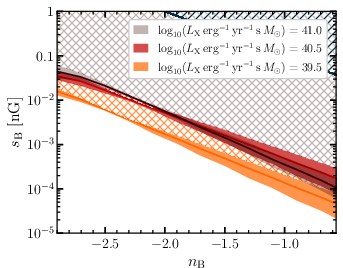
Figure 7: Sensitivity forecasts for PMF amplitude from HERA, illustrating dependence on astrophysical X-ray luminosity.
The strongest degeneracy is between PMF heating and X-ray heating from star formation; for low 10−172 (astrophysical X-ray amplitude), HERA is limited nearly exclusively by its experimental noise, while high 10−173 scenarios show degraded PMF sensitivity. The 10−174cm constraints are not very sensitive to structure-growth enhancement below current bounds, as the relevant minihalos have masses below the star-formation threshold in the present modeling.
Implications and Outlook
The explicit inclusion of AD and DT energy losses dramatically alters the derived constraints on PMFs, resolving the long-standing discrepancy between naive estimates and realistic evolution of PMFs through the relevant epochs. The demonstrated relaxation of bounds closes the gap between cosmological and astrophysical limits and shifts the focus of future searches toward low-10−175, low–10−176 parameter space, best addressed by 10−177cm observations.
The analysis highlights the importance of astrophysical degeneracies—notably with X-ray heating—in future CMB and 10−178cm analyses. Systematic inclusion of forthcoming galaxy luminosity function data (e.g., from JWST) and more sophisticated modeling of minihalo populations should further refine these constraints.
Conclusion
This study presents the most sophisticated treatment to date of PMF imprint on reionization, galaxy luminosity, and 10−179cm cosmology. The authors find that including realistic PMF energy loss mechanisms significantly loosens previous cosmological PMF limits. The combined use of 10−90cm power spectra and galaxy UV LF data, alongside improved simulation and emulation pipelines, demonstrates that future HERA measurements will supersede existing constraints by up to two orders of magnitude, contingent on improved knowledge of astrophysical X-ray processes. These results establish 10−91cm cosmology as an essential probe of magnetic fields from the early universe (2604.22703).