Curvature of optimal transport with respect to the cost and applications to inverse optimal transport
Published 24 Apr 2026 in math.OC and math.PR | (2604.22670v1)
Abstract: We study the inverse optimal transport problem of recovering the ground cost from an optimal transport plan. In discrete settings, this problem reduces to inverse linear programming and is intrinsically ill-posed, exhibiting non-identifiability and flat directions. We show that in the continuous setting, the regularity of the marginals fundamentally alters the structure of the inverse problem. Assuming smooth positive densities for the source and target measures, we characterize the second variation of the optimal transport functional with respect to the ground cost in Hölder spaces. In particular, we show that it is non-degenerate modulo the natural transport invariances, yielding a strict curvature property that is absent in discrete transport. As a consequence, we obtain local identifiability and stability results for inverse optimal transport. For the structured family of bilinear costs (i.e. Mahalanobis parametrizations), the ground cost can be uniquely recovered--up to the intrinsic invariances--from a single optimal coupling under a natural spanning condition. We further show that this identifiability property is generic under arbitrarily small perturbations of the marginals, while settings where the optimal transport map is affine (for instance Gaussian or elliptical marginals) remain degenerate. Finally, we establish precise bounds on the bias and statistical variance of inverse optimal transport under entropic regularization. These results reveal a structural parallel between forward and inverse optimal transport: regularity of the marginals ensures smooth optimal maps in the forward problem, while non-degeneracy of the induced transport plan yields curvature and local invertibility in the inverse problem.
The paper establishes strict negative curvature directions in the optimal transport cost functional, ensuring identifiability in non-degenerate regimes.
It leverages a second-order expansion of the OT functional to demonstrate local quadratic stability and a precise bias-variance tradeoff via entropic regularization.
The study delineates conditions under which cost recovery is well-posed, particularly identifying when bilinear cost matrices are uniquely determined up to scale.
Curvature and Identifiability in Inverse Optimal Transport
Introduction
This work establishes a rigorous functional-analytic and geometric framework for the inverse optimal transport (iOT) problem, with a focus on the identifiability and stability of transport cost recovery. The analysis advances understanding of curvature in the optimal transport functional with respect to variations in the ground cost, the structure of inverse problems under smoothness assumptions, and the local and statistical properties of entropic regularization within iOT. The paper systematically delineates settings in which cost recovery is ill-posed or non-identifiable—such as in fully discrete or symmetric (e.g., elliptical) cases—and contrasts them with continuous, regular regimes where invertibility and local well-posedness can be rigorously established.
Geometry and Curvature of the OT Functional
A central contribution is the derivation of a second-order expansion of the optimal transport value OTα,β(c) in the cost variable c, under general regularity conditions for α, β, and c. While first-order sensitivity is standard, showing that
∂cOTα,β(c)[δc]=∫δc(x,Tc(x))dα(x),
a primary advance here is the identification of strict and degenerate directions in the second variation, yielding the formula
where A(x)=∂11c(x,Tc(x))+∇2ϕc(x). Degeneracy is precisely characterized: the only zero-curvature directions are those arising from the intrinsic invariances of OT (namely, additive and scaling changes of c). In all "transverse" directions, the functional exhibits strict negative curvature, which is critical for identifiability.
Identifiability in Bilinear and General Cost Families
Focusing on bilinear costs cA(x,y)=−x⊤Ay, with c0, the analysis establishes conditions under which a single observed coupling (optimal for some c1) identifies c2 up to scale. The core identifiability result is the following:
If the family of Hessians c3, as c4 ranges over the support of c5, spans the space c6 of symmetric trace-zero c7 matrices, then any other cost matrix c8 making the same plan optimal must be a positive scalar multiple of c9.
This spanning criterion fails in degenerate settings, e.g., when α0 and α1 are Gaussian or more generally elliptical—then the transport map is affine and all costs along a high-dimensional cone yield equivalent optima. Nevertheless, the paper demonstrates that identifiability is a generic property under smooth perturbations: any nontrivial deformation of the marginals breaks the degeneracy in typical parameter spaces.
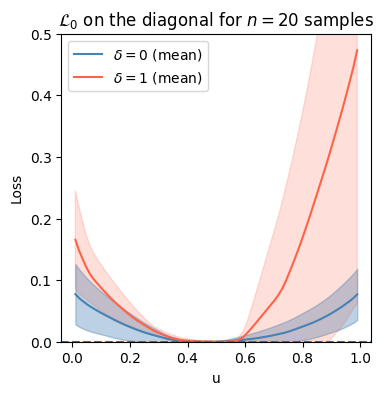
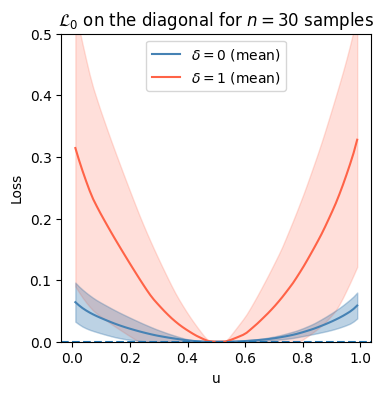
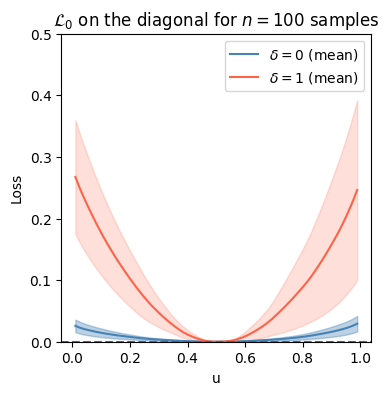
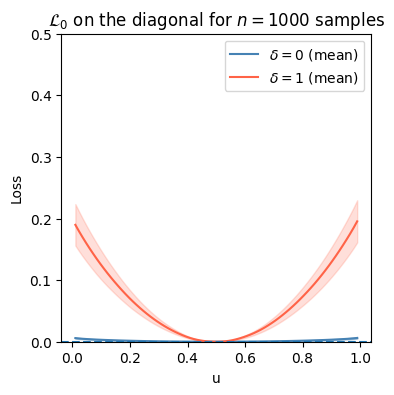
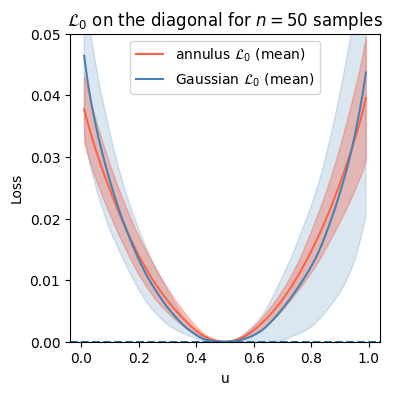
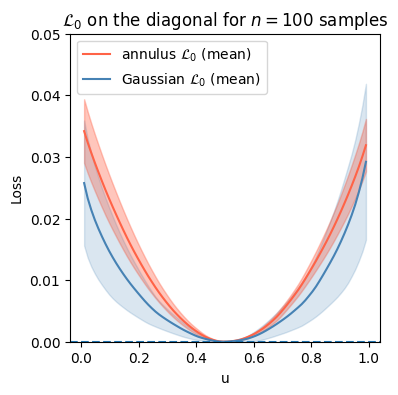
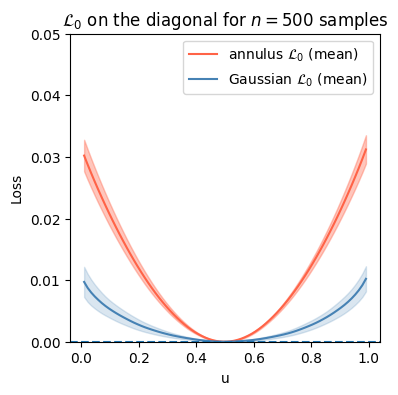
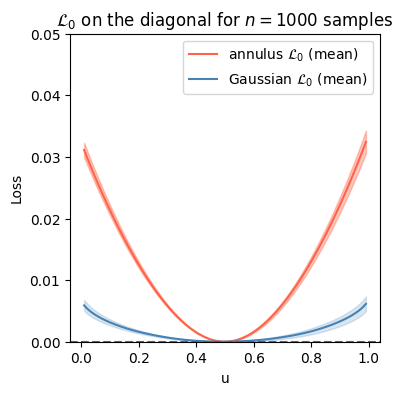
Figure 1: α2 along the diagonal for Gaussian-to-Gaussian (blue, flat) and Gaussian-to-perturbed-Gaussian (red, strict minimum) iOT, with α3 samples—perturbations restore identifiability.
Stability, Local Curvature, and Regularization
The curvature theorem is leveraged to prove a quantitative local quadratic stability result: the optimality gap for the inverse OT cost is strongly convex in directions orthogonal to the scaling invariance. Around the admissible set (the ray generated by α4), the objective grows quadratically in the Frobenius norm off this ray, ensuring both local well-posedness and robustness of estimation.
To address practical issues (numerical tractability and statistical noise), the framework studies entropic regularization: α5
It derives explicit bias and variance controls for the regularized solution, showing that the estimator's deviation from the true cost decays as α6 in norm and α7 in direction—hence establishing an optimization-theoretic bias-variance tradeoff.
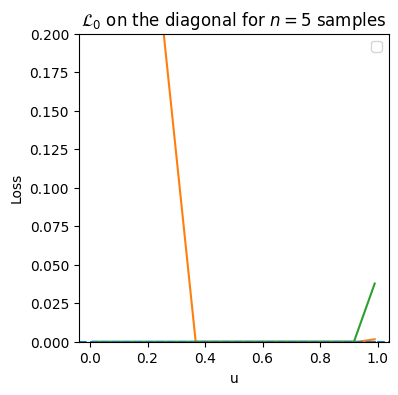
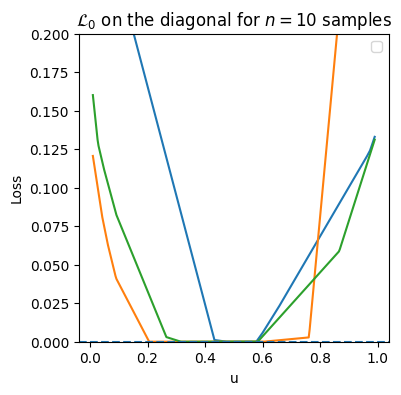
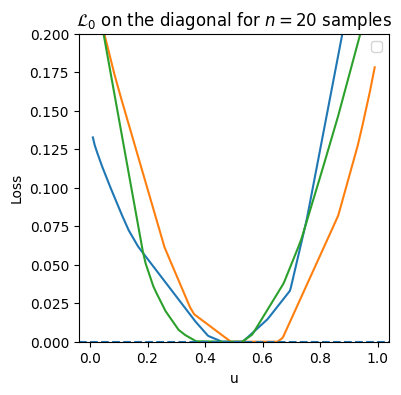
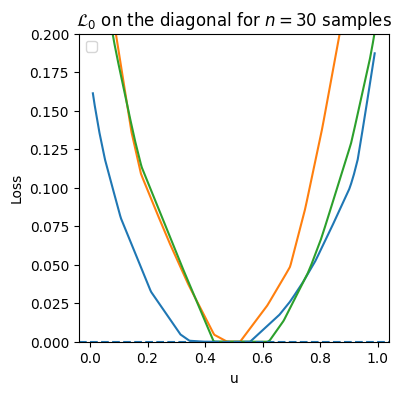
Figure 2: Loss landscape α8 for α9 samples, showing increasingly sharp identification as β0 increases and degeneracies are resolved.
Degenerate Regimes: Discrete and Symmetric Settings
The work characterizes classes of problems where recovery is impossible:
Discrete plans: In empirical or discrete settings, the set of compatible ground costs is polyhedral and generically of dimension at least β1, leading to non-identifiability unless the sample size is large relative to the number of model parameters.
Elliptical/affine settings: For elliptical marginals (e.g., Gaussians), the set of admissible β2-matrices is a positive cone of width β3, reflecting the symmetry of the data-generating process under affine mappings.
In both cases, only in the high-sample or symmetry-broken (generic) continuous limit do these pathologies resolve.
Figure 3: Polyhedral loss landscape for β4 samples in the discrete Gaussian-to-perturbed Gaussian regime, with flat regions indicating ambiguity in cost recovery.
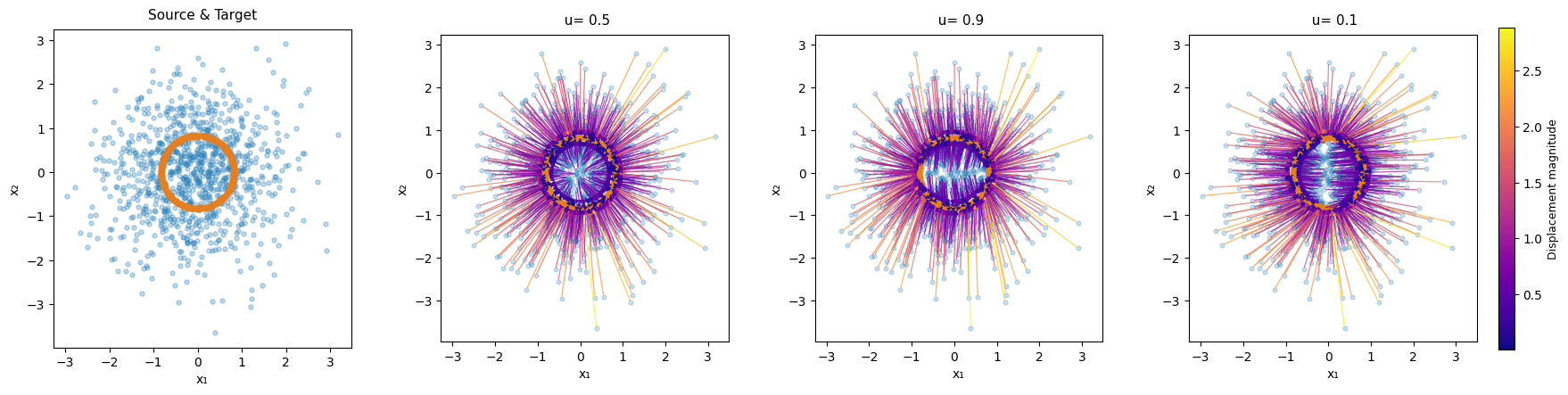
Figure 4: Transport maps β5 for varying β6, showing sensitive dependency on the cost parameter in the non-degenerate, identifiable regime.
Statistical Efficiency and Sample Complexity
Under sub-Gaussian assumptions, high-probability, non-asymptotic sample complexity bounds are established for regularized iOT estimators. The main result quantifies the estimation error as a function of both the entropic regularizer β7 and the sample size β8: β9
with the angle to the true ray converging at rate c0. Key constants are controlled in terms of the geometry of the transport problem and regularity of the marginals.
Implications and Future Directions
This geometric and statistical theory gives a precise description of when the iOT problem is locally invertible, how transport functionals respond to cost perturbations, and how regularization affects practical estimation. It provides a theoretical basis for cost learning in matching, generative models, and applied fields such as single-cell genomics—where model interpretability relies on sharp identifiability. The analyses clarify the necessity of smoothness, regularization scale selection, and the pitfalls of working in discrete or highly symmetric regimes.
Further directions include extension to more general parametric or nonparametric cost families, non-Euclidean geometry (e.g., manifold settings), multi-marginal problems, and robustification beyond entropic penalties.
Conclusion
The paper establishes a functional-analytic foundation for the inverse OT problem, identifying when cost recovery is mathematically feasible, quantifying the geometric curvature essential for local invertibility, and giving precise numerical and statistical guidance for practical estimation in finite-sample and regularized regimes. It delineates the boundaries between identifiable, robust learning of the ground cost and regimes of intrinsic ambiguity.
“Emergent Mind helps me see which AI papers have caught fire online.”
Philip
Creator, AI Explained on YouTube
Sign up for free to explore the frontiers of research
Discover trending papers, chat with arXiv, and track the latest research shaping the future of science and technology.Discover trending papers, chat with arXiv, and more.