- The paper presents exact relations that map all density-density correlators in a spin multiplet from a fully polarized reference state.
- It employs SU(2) symmetry to simplify evaluations of static structure factors and pair correlations, key to understanding fractional quantum Hall systems.
- The framework reduces computational complexity in determining Coulomb energies in bilayer FQH states and offers potential extensions to more complex symmetries.
Exact Relations Between Density-Density Correlators in Spin Multiplets: Structure, Consequences, and Applications
Introduction
The paper "Exact relations between the density-density correlators of states in a spin multiplet" (2604.22628) presents a set of exact algebraic identities that relate the spin-resolved pair-correlation functions gσ,σ′(r) and static structure factors Sσ,σ′(q) between different members of an SU(2) spin multiplet. These results dramatically compress the complexity of evaluating correlation-related observables for multiplet states in strongly correlated quantum systems. By deriving universal relations on the basis of symmetry alone, the authors provide a framework that reduces the computation of all density-density correlators in a multiplet to that of a single reference state, typically the highest-weight (fully polarized) state.
The approach is developed with a focus on Fractional Quantum Hall (FQH) systems but is formulated to apply broadly to any setting where SU(2) spin or pseudospin symmetry governs the structure of the many-body Hilbert space. Significant implications emerge for computations of energetics in bilayer FQH states, where density imbalance, layer separation, and spin polarization play crucial roles.
Algebraic Structure of Correlators in a Spin Multiplet
For a translation and rotationally invariant N-particle state ∣Ψ⟩ with well-defined spin quantum number S, the Sz-resolved pair-correlation function gσ,σ′(r) encodes the probability of finding two particles of spin σ and Sσ,σ′(q)0 separated by Sσ,σ′(q)1. The central result establishes that, inside the same multiplet characterized by fixed Sσ,σ′(q)2, all Sσ,σ′(q)3 are uniquely determined once the correlator for the fully polarized state is known. Specifically, in the thermodynamic limit:
Sσ,σ′(q)4
where Sσ,σ′(q)5 is the pair-correlation function for the maximally polarized state and Sσ,σ′(q)6, Sσ,σ′(q)7 represent spin-resolved populations. For the static structure factor, analogous expressions hold:
Sσ,σ′(q)8
with analogous forms for Sσ,σ′(q)9 and mixed spin components.
These relations are direct consequences of SU(2)0 symmetry and the symmetrization of spin degrees of freedom within a multiplet, and do not apply to states with different total spin SU(2)1. All nontrivial vanishing properties, e.g., behavior as SU(2)2, are inherited identically up to the normalization prefactors.
Energetics and Application to Bilayer Fractional Quantum Hall States
The pair-correlation function is a critical ingredient for the Coulomb energy in the FQH context. The total energy per particle can be expressed as:
SU(2)3
where SU(2)4 is the interaction potential (parameterized by layer separation SU(2)5 in bilayer systems). Using the derived relations, the full set of energies for all members of an SU(2)6 multiplet can be obtained analytically and efficiently from the reference state alone.
A key demonstration is the calculation of the energy for the Halperin-(1,1,1) state—a model for the bilayer exciton condensate at total filling SU(2)7—as a function of polarization imbalance SU(2)8 and interlayer distance SU(2)9.
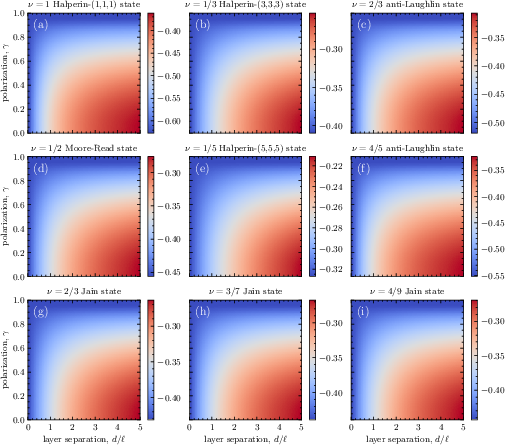
Figure 1: Coulomb energies in units of SU(2)0 for various fully polarized FQH states plotted over polarization SU(2)1 and layer separation SU(2)2; SU(2)3 is the magnetic length, SU(2)4 the dielectric constant.
The pair-correlation and energetics for other multi-component FQH states (e.g., Halperin-SU(2)5, various Jain and Moore-Read states, and their particle-hole conjugates) follow immediately by algebraic transformation of the corresponding single-component SU(2)6. The framework thus allows for efficient calculation across a vast regime of parameter space, including density imbalance and varying layer separations.
Theoretical and Practical Implications
The presented equalities formalize and extend the role of SU(2)7 spin-rotation symmetry in constraining measurable density-density correlation functions for all members of multiplets, establishing a one-to-many algebraic mapping. As a consequence, computational requirements for evaluating many-body observables across polarizations are drastically reduced, even as parameter sweeps (e.g., in FQH phase diagrams) remain demanding for individual states.
This analytical compression is particularly beneficial for studying realistic systems with experimental control over polarization and layer (or valley/orbital) degrees of freedom, such as moiré heterostructures (multilayer graphene, TMDs) where zero-field FQH analogs are observed. The numerical bottleneck associated with calculating SU(2)8 and SU(2)9 for each polarization sector is directly alleviated.
The extension to other symmetries (e.g., N0 with N1 for multicomponent systems), and to higher-order N2-density correlators, is highlighted as a promising direction with potential for generalization to non-Abelian statistics and more complex projective spaces.
Conclusion
This work establishes exact algebraic relations governing density-density correlators in spin multiplets, enabling the entire set of correlation functions and related observables (especially energies) in high-symmetry many-body systems to be inferred from a single reference state. These results apply broadly to systems with internal N3 degrees of freedom and carry significant computational and conceptual utility, evidenced by their utility in mapping out FQH energetics under experimentally tunable conditions. The framework is robust, not restricted to specific geometry (planar or sphere), and extendable to more complex symmetries and higher-order correlations, providing a solid analytical foundation for further exploration of correlated quantum phases.

