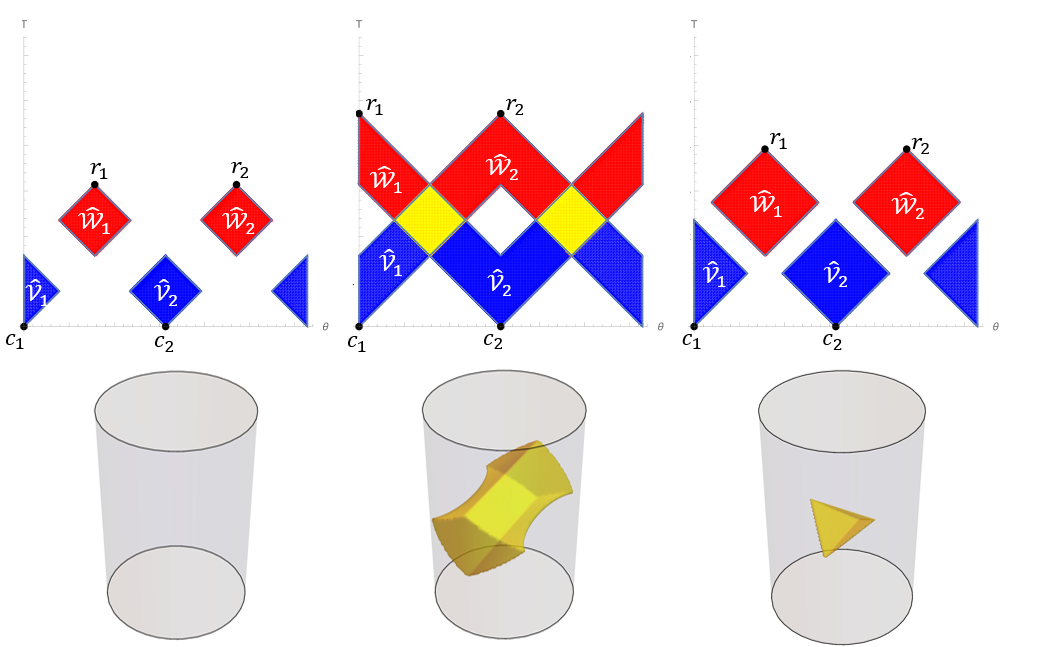
- The paper presents a reformulation of the Connected Wedge Theorem using generalized entanglement wedges to capture bulk connectivity.
- It employs max/min wedge constructions and area focusing arguments to establish rigorous upper and lower mutual information bounds.
- The framework extends holographic principles to asymptotically flat spacetimes, clarifying the quantum information-geometric interplay in gravity.
Generalized Entanglement Wedges and the Connected Wedge Theorem
Introduction and Context
This work provides a unified reformulation of the Connected Wedge Theorem (CWT) by utilizing the recent framework of generalized entanglement wedges, extending the holographic dictionary from boundary-anchored entanglement wedges to arbitrary bulk regions. Through this lens, the CWT—which relates mutual information between boundary subregions and causal connectivity in the bulk—is elevated to a bulk-centric statement, circumventing limitations inherent to the AdS/boundary-centric perspective and enabling robust generalizations to asymptotically flat spacetimes.
The Connected Wedge Theorem: Holography and Bulk Causality
The AdS/CFT correspondence encodes bulk spacetime connectivity in the entanglement structure of the boundary CFT. The original CWT asserts that the existence of a bulk-only scattering region delineated by two input and two output points on the boundary (with no causal path between them on the boundary, but with a connected region in the bulk) forces a large mutual information between specific boundary “decision regions”:
Generalized Entanglement Wedges: Max, Min, and Beyond
The entanglement wedge program, post-HRT/RT, was extended to arbitrary bulk regions in the max/min wedge formalism of Bousso and Penington. For any wedge-shaped bulk region a, two generalized entanglement wedges are constructed:
- emax(a): the largest reconstructible wedge from a, built from antinormal expansions.
- emin(a): the smallest wedge beyond which no reconstructible information about a remains, built from normal expansions.
Crucially, these regions differ in time-dependent backgrounds, even classically, and encode operational quantum information features via smooth conditional entropy variants. This generalized approach detaches the wedge construction from the conformal boundary, making it suitable for limits where boundary causal structure degenerates (as in the Carrollian limit or flat space).
The authors establish new upper and lower bulk bounds on the mutual information in terms of the generalized entropy of entanglement wedges of specific bulk regions:
Sgen(emax(spts′′))≤I(V1:V2)≤Sgen(emin(sent))
where I(V1:V2)0 is the bulk points-based scattering region and I(V1:V2)1 is an entanglement-induced bulk region related to decision wedges. The bounds are proved using area expansion theorems and focusing arguments for null congruences, leveraging the geometric/causal structure of lightsheets and extremal surfaces.
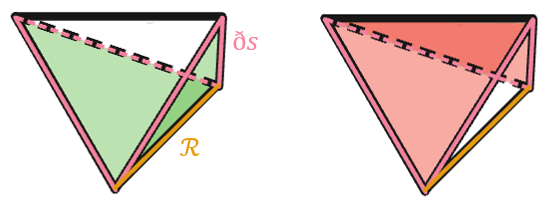
Figure 2: The scattering region I(V1:V2)2 displays the geometric set for bulk causal connectivity.
The lower bound follows from focusing from the input points' lightcones, while the upper bound is controlled using a composite "ridge" defined by appropriate Cauchy horizons and maximal cross-sections via the generalized wedge formalism.
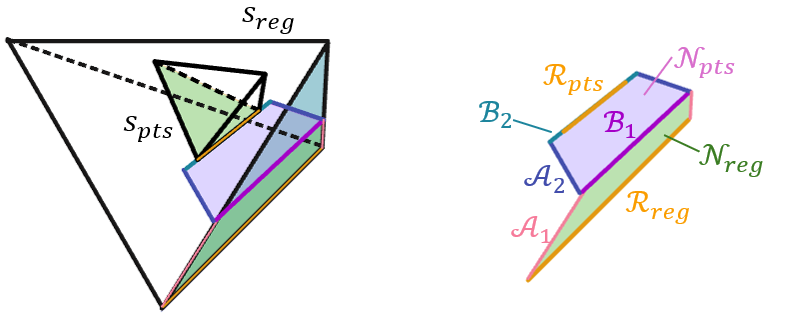
Figure 3: The left image displays the nested structure of the points-based scattering region I(V1:V2)3 inside the regions-based I(V1:V2)4. Null surfaces and focusing constructions facilitate the entropy bounds.
Generalized Bulk Connected Wedge Theorem
The main theorem is reformulated in bulk terms: Given bulk regions I(V1:V2)5 (decision regions in the bulk), nontrivial bulk scattering (I(V1:V2)6) implies the connectedness of I(V1:V2)7. The proof adapts the contradiction/focusing logic of the original boundary CWT, but now applies it directly to bulk wedges, utilizing the full machinery of generalized wedge construction and their causal structure.
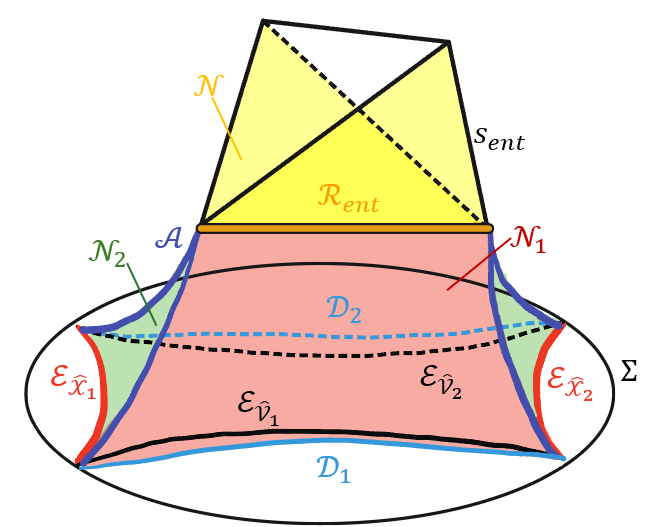
Figure 4: Null surfaces and associated geometric constructs for bounding and propagating the wedge edge and establishing (dis)connectedness.
This formulation is robust under the flat space limit, as the identification of decision regions and wedges no longer requires nondegenerate boundary causal data. This circumvents boundary limitations in the Carrollian limit and addresses issues in the ultralocal regime (where the boundary degenerates to a set of points or rays).
Flat Space Limit: Screens and Carrollian Degeneracy
Transitioning to flat space, the conventional AdS boundary regions become degenerate due to the Carrollian limit: the speed of light on the boundary scales to zero, and causal diamonds lose all but a single light ray. The bulk-centric CWT now persists by recasting decision regions as either causal diamonds with endpoints in the bulk or as regions on a timelike screen (codimension-1 submanifold outside the scattering region), employing the generalized wedge formalism for entropies and connectivity.
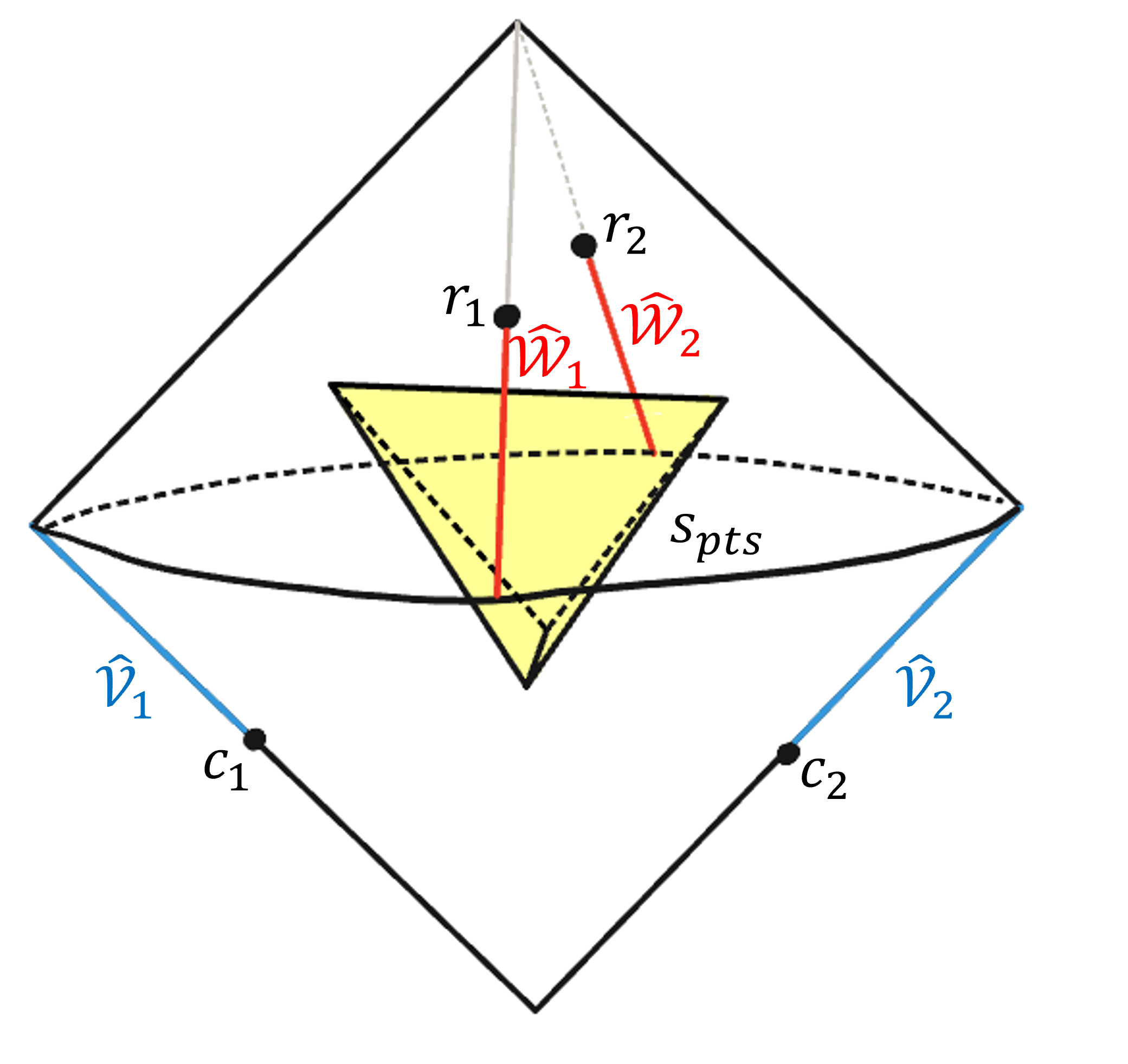
Figure 5: In the flat limit, boundary decision regions collapse, but the bulk scattering region I(V1:V2)8 retains full causal data.
Thus, the CWT and its information-theoretic consequences survive the ultralocal boundary, provided the bulk construction is used.
Implications and Theoretical Developments
- Bulk-first holography: The reformulation of CWT in terms of generalized bulk entanglement wedges supports a bulk-centric (as opposed to boundary-centric) paradigm, especially essential when boundary causal structure is degenerate or ill-defined.
- Extension to flat (and de Sitter) holography: The machinery developed equips the field with operational tools for characterizing quantum information flow in general, possibly dynamical, spacetimes, including asymptotically flat and dS backgrounds, where the dual CFT prescription is at best indirect.
- Quantum information/geometry interface: The tight correspondence between mutual information, quantum tasks, and bulk wedge structure provides a geometric handle for one-shot entropy tasks, state merging, and compositionality (via smooth min/max entropy), sharpening the connection between quantum Shannon theory and semiclassical gravity.
Conclusion
This work offers a comprehensive and rigorous reformulation of the Connected Wedge Theorem in the language of generalized bulk entanglement wedges. The resulting statements persist in AdS and extend to asymptotically flat spacetime, with both lower and upper bounds on mutual information realized via geometric quantities in the bulk. The framework provides a flexible foundation for future explorations of non-AdS holography, quantum information dynamics in gravity, and the operational meaning of spacetime connectivity.