- The paper introduces a hybrid Wigner phase-space framework that accurately predicts superballistic MSD scaling (t^6 and t^7) in quantum active matter.
- It employs a master equation that couples quantum fluctuations with a classical active driving process, validated through numerical and analytical methods.
- The results demonstrate robust anomalous transport behaviors across various initial conditions, guiding experimental efforts in observing exotic quantum dynamics.
Anomalous Mean-Squared Displacement in Quantum Active Matter: A Wigner Phase-Space Approach
Introduction and Context
The study investigates the dynamics of quantum active matter—systems in which quantum entities are driven persistently out of equilibrium via local energy influx. While the classical regime of active matter is well characterized, far less is understood regarding the interplay of quantum effects and active driving. This paper formulates a comprehensive quantum framework for active matter employing Wigner phase-space techniques, enabling a systematic exploration of anomalous transport behaviors such as superballistic scaling in the mean-squared displacement (MSD). By deriving and analyzing a hybrid Wigner master equation that couples quantum and classical degrees of freedom, the work provides exact analytical expressions for the MSD in quantum active matter and identifies the conditions under which anomalous temporal scaling regimes (notably, MSD ∼t6 and MSD ∼t7) manifest.
Hybrid Wigner Master Equation for Quantum Active Matter
The core theoretical advancement is the derivation of a hybrid Wigner master equation capturing both quantum fluctuations and the classical stochasticity of active driving. The framework models a prototypical system, such as a quantum particle in a harmonically trapped atom, whose trap center is dynamically modulated by a classical active Ornstein–Uhlenbeck process (AOUP). The quantum system evolves under a time-dependent Hamiltonian whose parameters inherit stochasticity from the classical active process, generating non-equilibrium perturbations that induce energy injection and persistent motion.
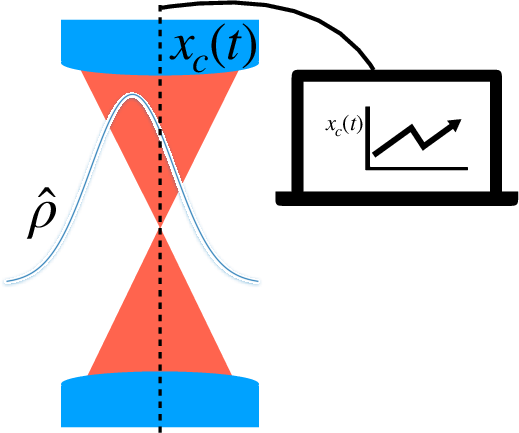
Figure 1: Conceptual scheme for the quantum active matter model—quantum dynamics in an optical tweezer with actively modulated trap center.
The hybrid Wigner master equation resulting from this construction retains a Fokker–Planck structure in the combined phase space (x,p,xc,u), facilitating direct analytical computation of correlation functions. Notably, for quadratic Hamiltonians and Lindbladian dissipators quadratic in x^,p^, all moments of the hybrid quantum–classical system can be mapped to solutions of associated Ornstein–Uhlenbeck processes. Crucially, this equivalence allows established tools from classical active matter and stochastic processes to be rigorously extended to the quantum regime.
Analytical Results: MSD Scaling and Regimes
The principal observable under scrutiny is the quantum mean-squared displacement:
MSD(t)=⟨(x^(t)−x^(0))2⟩,
evaluated from the full solution of the master equation. The paper systematically classifies the scaling regimes of the MSD as a function of system parameters (trapping frequency, dissipation, noise intensity, persistence time of activity) and initial conditions.
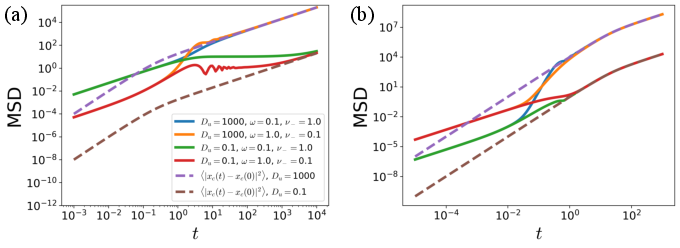
Figure 2: MSD vs. time for various Du and τ under thermal initial conditions, highlighting transitions from linear to ballistic to anomalous regimes.
A key analytical finding is that, for appropriately chosen initial conditions and in the regime of strong persistent activity and weak dissipation, the quantum MSD exhibits a steep superballistic scaling as MSD(t)∼t6 over significant intermediate time windows. This is anomalous compared to classical active matter systems, where short-time MSD typically crosses over from ballistic t2 to diffusive t scaling.
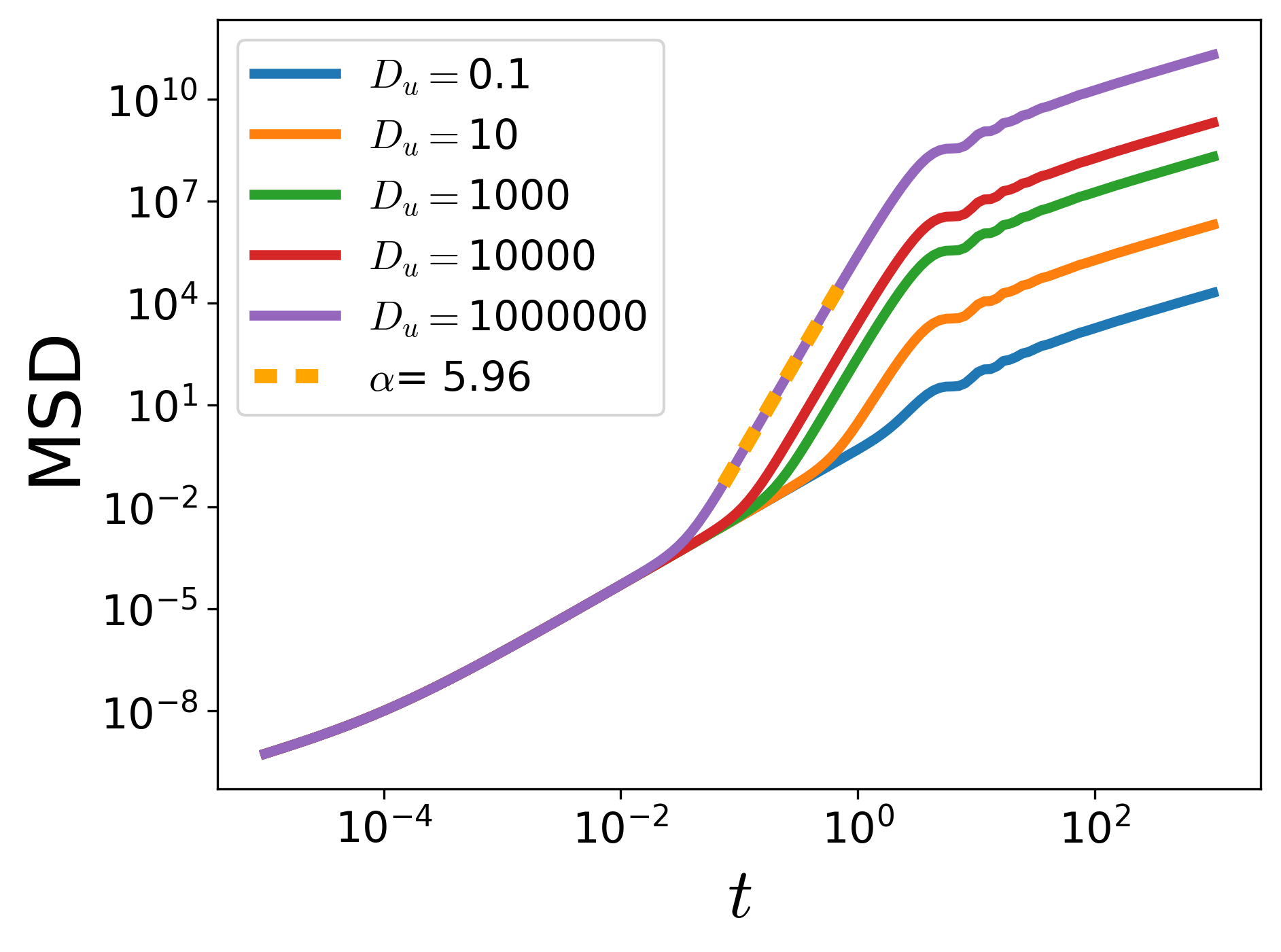
Figure 3: MSD scaling with varying ∼t70 (noise strength), with exponents approaching 6 in the intermediate regime, confirming the ∼t71 analytical prediction.
Even more strikingly, under delta-like initial conditions (vanishing initial velocity of the trap), a ∼t72 regime emerges for large noise strength and long activity correlation time, as validated by both analytical expansion (short-time series) and numerical solution of the master equation.
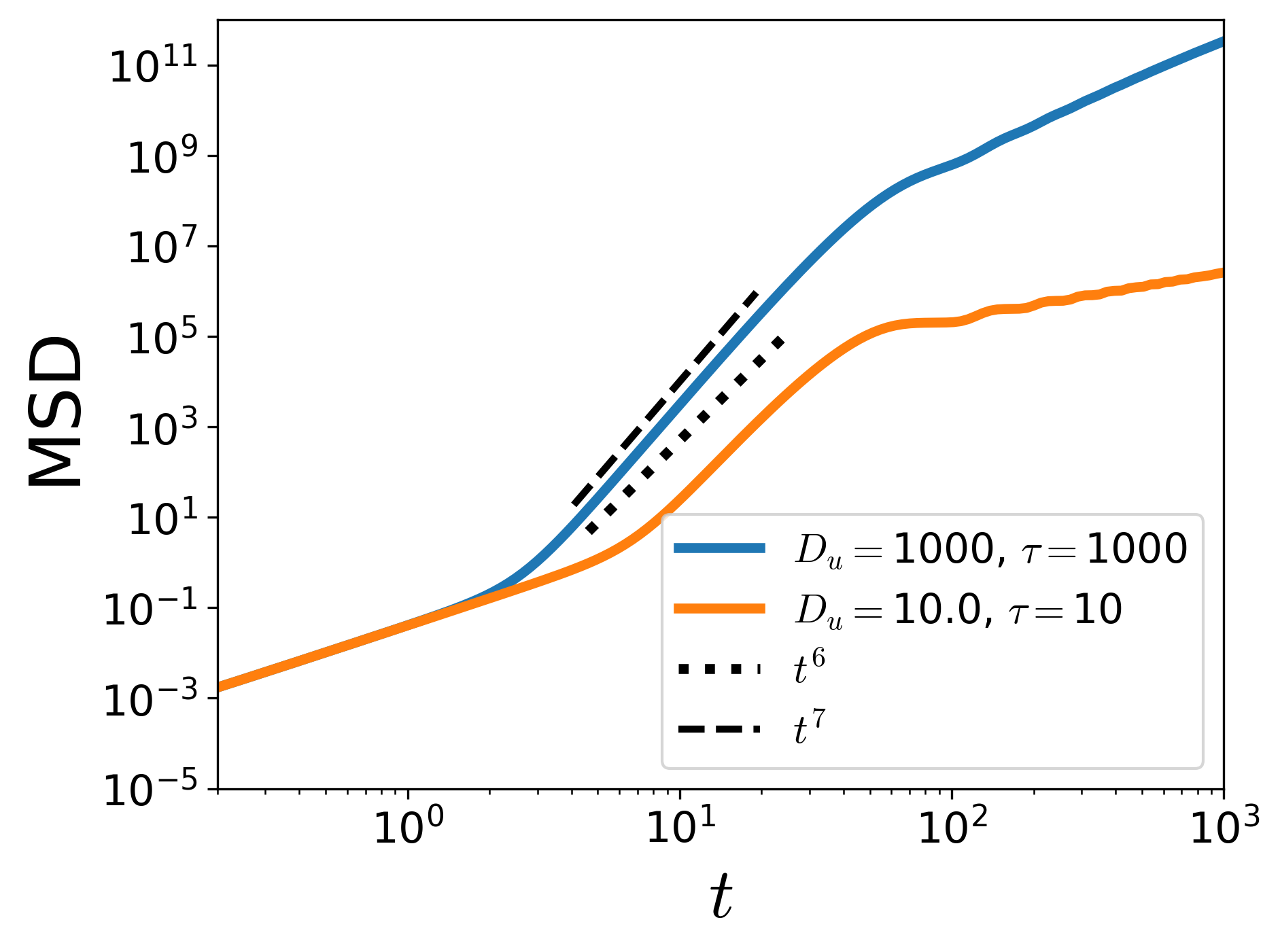
Figure 4: MSD curves for high activity (∼t73) and moderate activity, showing the emergence of a ∼t74 scaling window for the former and ∼t75 for the latter.
Analytical Structure of MSD Scaling
As detailed in the paper, the closed-form series for the quantum MSD (expanded at small times and weak dissipation) is
∼t76
where the coefficients are explicit functions of system parameters. The ∼t77 contribution dominates in the limit of strong activity, while ∼t78—requiring delta initial conditions and large persistence—emerges only when lower-order terms are dynamically suppressed. The absence of positive ∼t79 scaling is analytically established by sign structure in this expansion.
The scaling hierarchy and crossovers are systematically mapped for regimes of short vs. long activity persistence, small vs. large active noise, and weak vs. strong dissipation. A summary of these crossovers is tabulated in the paper to guide experimental or numerical exploration.
Robustness to Initial Quantum State
The anomalous MSD scaling is shown to be robust with respect to the choice of initial quantum state. Numerical propagation with highly squeezed initial states (narrow in position or momentum) reveals that, while the amplitude of the MSD is affected according to initial quantum kinetic energy, the temporal exponent of the scaling regime remains unchanged. Thus, the (x,p,xc,u)0 and (x,p,xc,u)1 regimes are generic non-equilibrium features of the open quantum active matter model, insensitive to quantum state preparations.
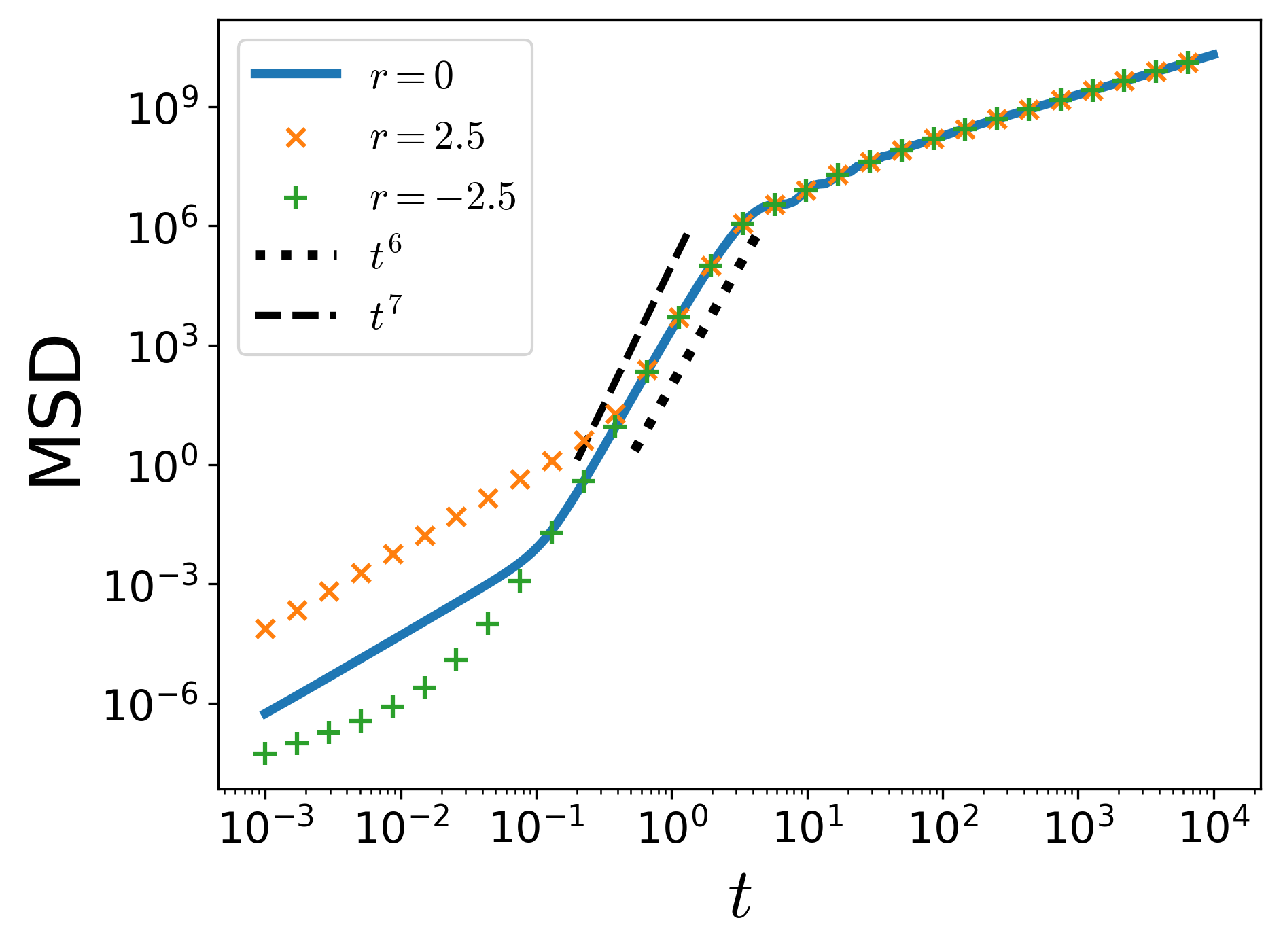
Figure 5: MSD for squeezed initial conditions with fixed activity parameters, demonstrating the invariance of scaling exponent to initial quantum state.
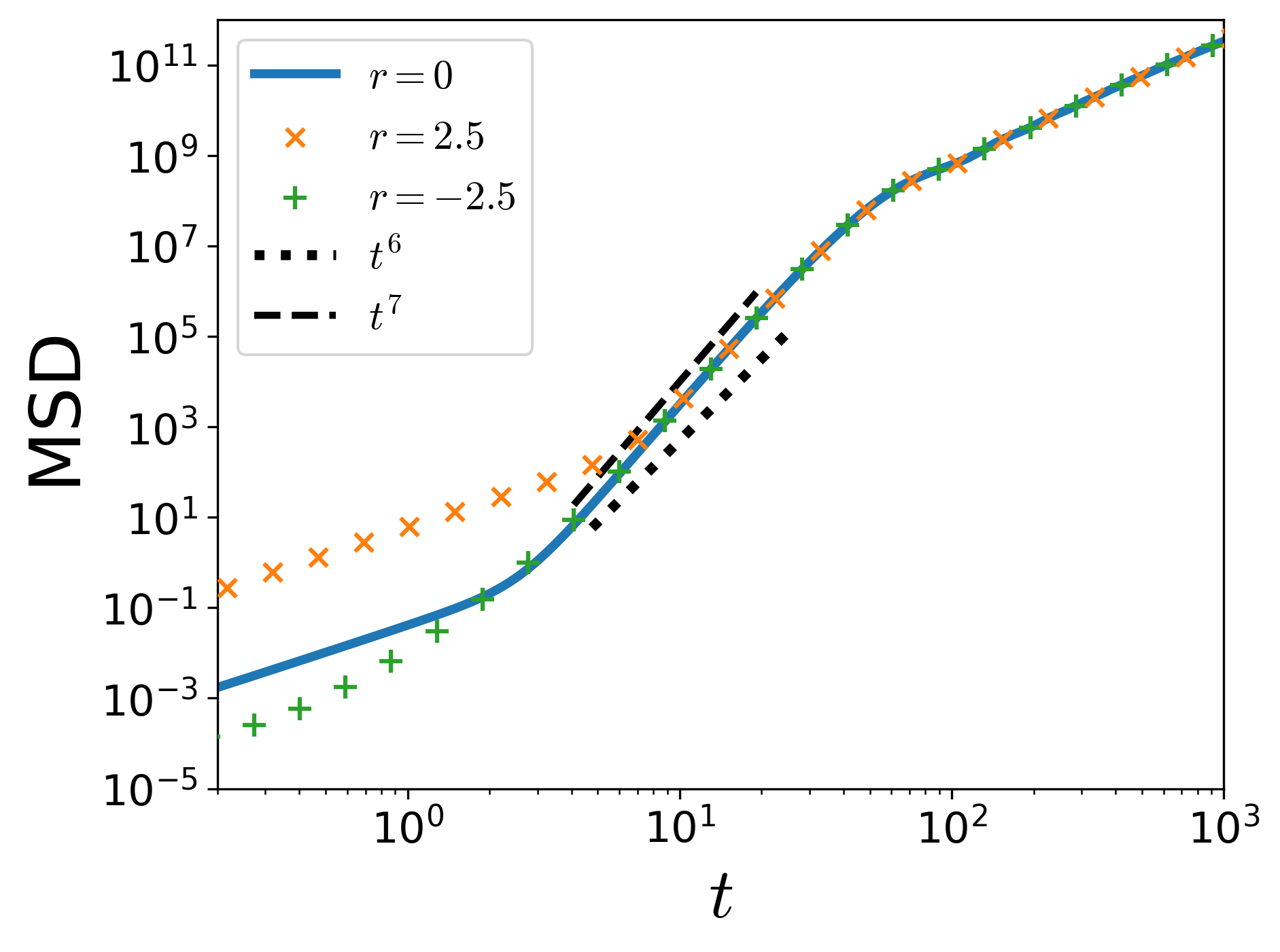
Figure 6: Complementary case for small trap frequency; again, scaling exponent is invariant under squeezing.
Computational Methods and Validation
The analytical results are supplemented by direct numerical integration of the associated matrix ODEs for the covariance matrix and by evaluation of exact integrals in the Wigner formalism. These approaches yield indistinguishable results, confirming both the stability and computational tractability of the approach. Furthermore, the analytic series expansions are benchmarked against numerics in all relevant regimes.
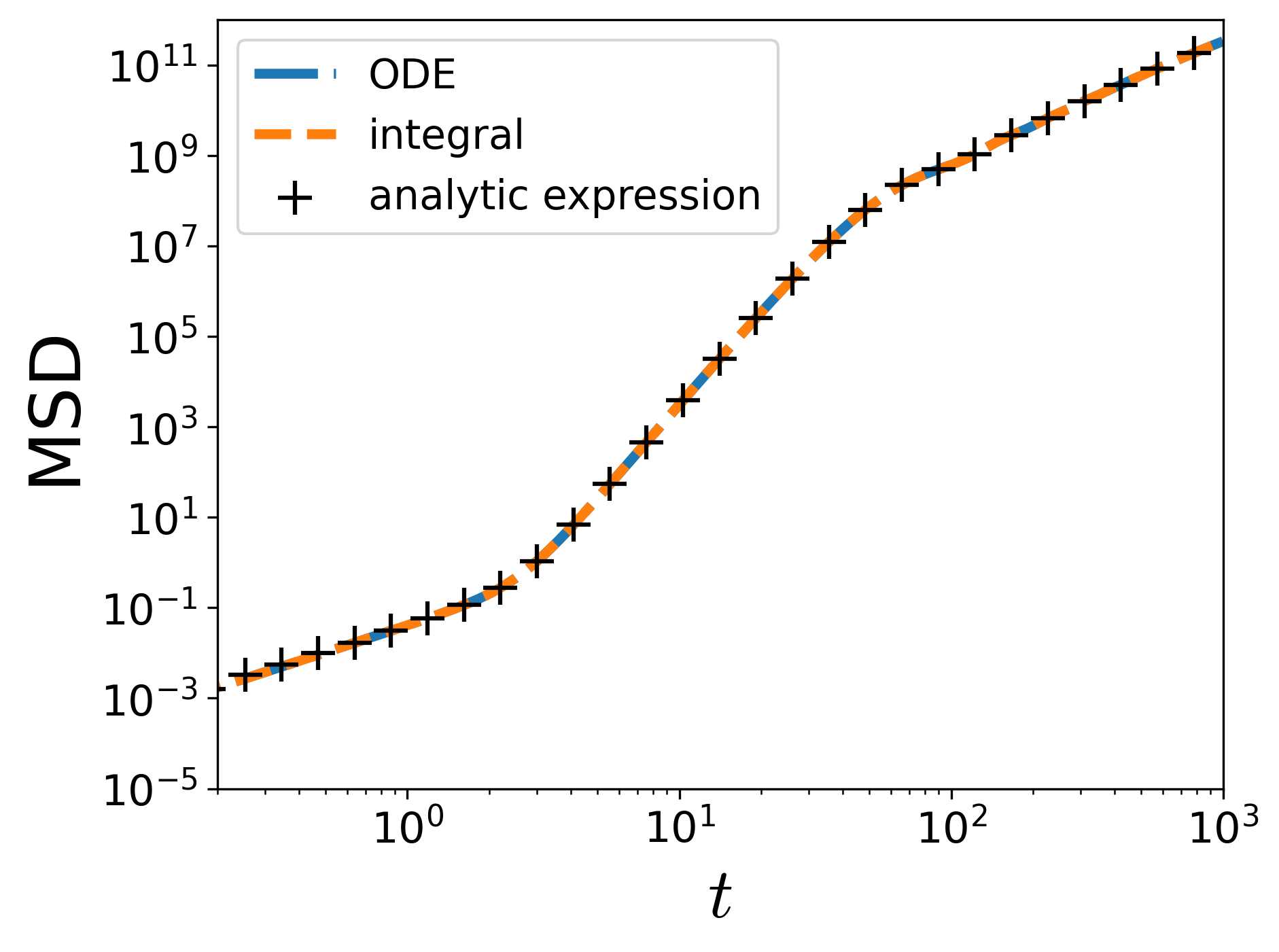
Figure 7: Agreement of various computational methods—ODE solving, integral evaluation, and explicit analytics—for MSD time evolution.
Implications and Theoretical Impact
This rigorous phase-space treatment substantiates the possibility of experimentally detectable anomalous transport phenomena in quantum active matter, potentially observable in cold atom platforms or engineered systems with tunable dissipation and active control. The methodology provides a template for deriving further dynamical observables and may be generalized to higher dimensions and more complex driving protocols.
On the theoretical side, the demonstration of strong sensitivity of transport exponents to initial mixing between quantum and classical components, and the emergence of superballistic scaling from hybrid dynamics, significantly broadens the known landscape of quantum nonequilibrium physics. By establishing the precise conditions for exotic scaling (and rigorously proving the absence of even higher exponents), the work closes methodological gaps in the active quantum matter literature and enables controlled studies of quantum-classical interface phenomena.
Conclusion
The study presents a comprehensive analytical and computational framework for quantum active matter based on the Wigner phase-space formalism. By implementing a hybrid master equation coupling quantum and classical dynamics, it reveals that quantum active particles can display anomalously steep MSD scalings ((x,p,xc,u)2 and (x,p,xc,u)3) under specific regimes, with these regimes persisting across a range of initial quantum states and being sharply controlled by the nature of classical activity and its stochasticity. This advances our understanding of nonequilibrium behavior in quantum systems subject to active driving, and provides a solid foundation for future experimental realization and extension to more complex quantum dynamical systems.
Reference:
"Anomalous Mean-Squared Displacement in Quantum Active Matter from a Wigner Phase-Space Framework" (2604.22600)