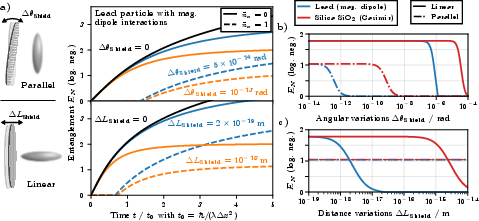
- The paper establishes a quantitative framework to define precise geometric stability thresholds required for detecting gravitational entanglement.
- It employs both covariance matrix methods and Schrödinger-cat models to analyze decoherence effects from Casimir and magnetic dipole interactions.
- The study outlines experimental implications, emphasizing the necessity for advanced stabilization and noise mitigation in future GIE experiments.
Stability Thresholds for Gravitationally Induced Entanglement in Shielded Setups
Introduction and Motivation
Gravitationally induced entanglement (GIE) experiments aim to probe the interplay between quantum mechanics and gravity by studying the generation of entanglement between massive particles interacting solely through gravity, with electromagnetic interactions suppressed to negligible levels. The detection of GIE would provide evidence for the non-classicality of gravity and challenge local operations and classical communication (LOCC) frameworks. The primary experimental strategy involves spatially delocalized nanoparticles with masses in the pico- to nanogram range and sufficient isolation to enable detection of the extremely weak gravitational interaction. However, suppression of non-gravitational interactions, particularly those arising from Casimir and magnetic dipole forces, is essential but technically challenging, necessitating the use of shields (e.g., Faraday or superconducting Meissner shields) between test masses.
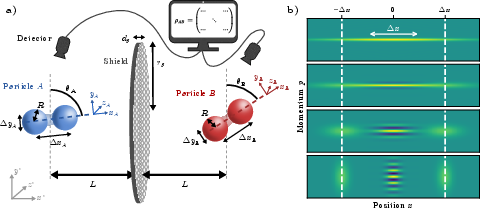
Figure 1: Schematic of the proposed GIE experimental setup with two trapped particles and a central shield to suppress electromagnetic cross-talk while preserving gravitational coupling.
Particle–Shield Interactions and Induced Decoherence
The introduction of shielding elements such as conductive or superconducting plates complicates the interaction landscape. While such shields effectively suppress direct electromagnetic coupling between particles, they do not eliminate residual interactions between each particle and the shield itself. The dominant non-gravitational interactions considered are Casimir–Polder (for dielectric particles like silica) and magnetic dipole (for strongly diamagnetic particles such as superconducting lead). These interactions generate both static shifts in particle equilibrium positions and position-dependent phase accumulations across the delocalized quantum states. The latter effect is acutely sensitive to geometric fluctuations—including run-to-run variations in particle or shield placements and orientations—which, when sampled over many experimental repetitions, act as a dephasing channel degrading observable entanglement.
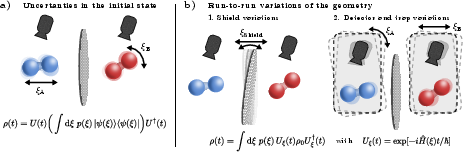
Figure 2: Illustration of geometry variations—both initial state uncertainty and run-to-run setup fluctuations—and their impact on quantum coherence and entanglement dynamics.
The Casimir interaction in the relevant sphere-plane regime is overapproximated using the proximity-force approximation (PFA), capturing worst-case decoherence impacts. For magnetically levitated superconducting particles, the imposed magnetic dipole interaction with the shield is numerically found to exceed the gravitational coupling by orders of magnitude unless shield-induced noise is minimized below extraordinarily stringent thresholds.
Quantitative Analysis of Stability Thresholds
The study provides a systematic quantification of the maximum admissible fluctuations in setup geometry:
Entanglement dynamics are computed for both (i) Gaussian squeezed states (covariance matrix formalism) and (ii) idealized Schrödinger-cat-states (2-level model), with both displaying similar qualitative dependencies on setup noise. The analysis extends between these extremes by considering continuous families of delocalized superpositions.
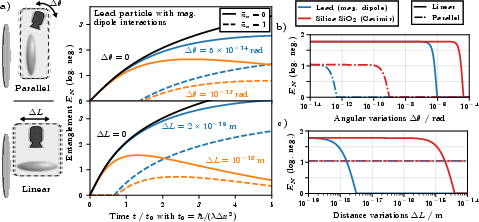
Figure 4: Suppression of entanglement for Gaussian states due to detector and trap variations, emphasizing the influence of uncorrelated vs correlated noise sources.
A critical observation is that while the 'linear' (perpendicular) orientation of particle delocalization relative to the shield maximizes gravitational entanglement rates, it is also most vulnerable to positional noise. Conversely, the 'parallel' orientation exhibits superior robustness against such fluctuations, offering an avenue for optimizing state preparation with respect to experimental constraints.
Trap Fluctuations and Timing Constraints
Fluctuations in trapping potentials—arising either from slow drifts (quasi-static regime) or rapidly fluctuating forces (Markovian regime)—are analyzed through master equations for the covariance dynamics. These induce further decoherence independent of shield effects. In the quasi-static regime, entanglement is only detectable within narrow time windows synchronized with periodic trap dynamics, with window widths inversely proportional to noise amplitude.
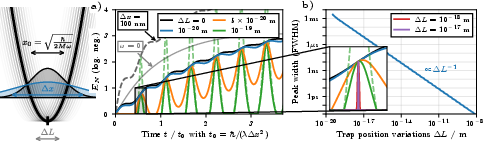
Figure 5: Entanglement evolution in the presence of quasi-static trap fluctuations, showing time-localized windows of observability dependent on fluctuation amplitude.
In the Markovian regime, diffusion eliminates entanglement entirely when the decoherence rate matches or exceeds the gravitational entanglement rate. This sets a bound on residual environmental noise tolerable in any viable GIE experiment.
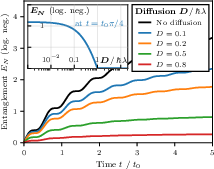
Figure 6: Markovian trapping noise irreversibly erases entanglement generation, even if coherent interactions are present, for sufficiently large diffusion constants.
Quantum Shield Dynamics and Non-Gravitational Channels
The shield's vibrational degrees of freedom are modeled quantum mechanically as a finite set of thermally populated mechanical modes. These modes act as auxiliary systems, capable of (1) entangling with the test masses and thus causing decoherence, and (2) mediating 'false-positive' non-gravitational entanglement between masses. The latter is a critical loophole—any observed bipartite entanglement could be misattributed to gravity if not carefully bounded.
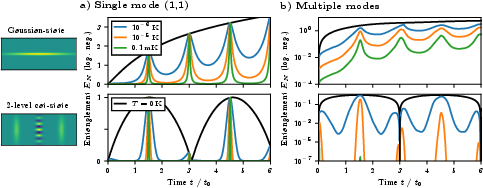
Figure 7: Suppression and revival of entanglement due to resonant coupling of particle states to vibrational shield modes; multi-mode effects prevent perfect revivals, leading to persistent degradation.
Mitigation strategies proposed include shield cooling, modification of shield geometry (e.g., increasing thickness, reducing lateral extent), and careful mode engineering to minimize unwanted couplings, though these are also bounded by practical limits (e.g., shield must be sufficiently large to prevent direct non-gravitational interactions).
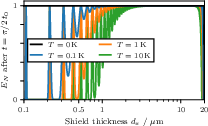
Figure 8: Dependence of entanglement dynamics on shield thickness, revealing the possibility to suppress decoherence by increasing shield eigenmode frequencies.
The predicted shield-mediated entanglement in the absence of gravity is mapped for various shield temperatures and configurations, highlighting where gravitational signatures could be mimicked.
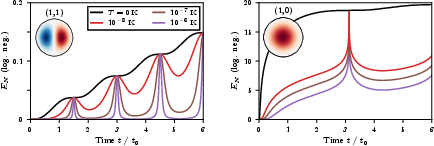
Figure 9: Quantification of shield-mediated bipartite entanglement arising purely from non-gravitational virtual phonon exchange for varying shield temperatures.
Experimental Implications and Future Directions
This work delineates the maximal geometric, thermal, and temporal stability thresholds necessary for GIE detection under realistic shielding protocols. Magnetically levitated superconducting platforms, though attractive for quantum control, are especially challenged by magnetic-dipole-induced noise. Even for Casimir-dominated configurations, tolerances approach the picometer and nanoradian regime. The analysis exposes the need for advanced feedback stabilization, precision metrology, and noise characterization well beyond state-of-the-art. The results are also directly applicable to free-fall or space-based platforms, though these shift the dominant source of decoherence to Casimir or spurious electromagnetic interactions.
The theoretical framework developed can accommodate further extensions, including the treatment of other decoherence sources (e.g., patch potentials, dielectric response), more complex shield geometries, and multipartite GIE scenarios. In addition, the explicit quantum modeling of shield-mediated channels is relevant for protocol design in quantum gravity tests, where unambiguous attribution of observed entanglement to gravity is crucial.
Conclusion
A rigorous quantitative assessment of shield-induced noise and geometric stability thresholds in gravitationally induced entanglement experiments demonstrates that both Casimir and magnetic dipole interactions with the shield act as major sources of decoherence, tightly constraining experimental design tolerances. The results inform the design and interpretation of next-generation GIE experiments by identifying parameter regimes where purely gravitational entanglement can in principle be unambiguously observed, offering a state-independent framework applicable to both Gaussian and non-Gaussian states.
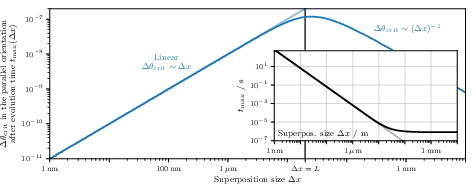
Figure 10: Angular stability thresholds as a function of superposition size; stability is maximized for small delocalization but rapidly degrades as the superposition approaches or exceeds the inter-particle separation.
Optimal integration of stabilization, shield design, and state preparation remains essential for progress in experimental tests of the quantum nature of gravity. The analytical and numerical tools introduced here will remain central to accurately quantifying non-gravitational limitations in future experimental proposals.