- The paper introduces FlowAnchor, a training-free, inversion-free framework that employs Spatial-aware Attention Refinement (SAR) and Adaptive Magnitude Modulation (AMM) to stabilize the video editing signal.
- It demonstrates enhanced spatial localization and robust signal strength across challenging multi-object and long-duration video sequences, outperforming previous methods.
- Empirical evaluations and user studies confirm superior alignment, fidelity, and efficiency, establishing FlowAnchor as a new baseline for text-guided video editing.
Stabilizing Inversion-Free Video Editing via FlowAnchor
Introduction
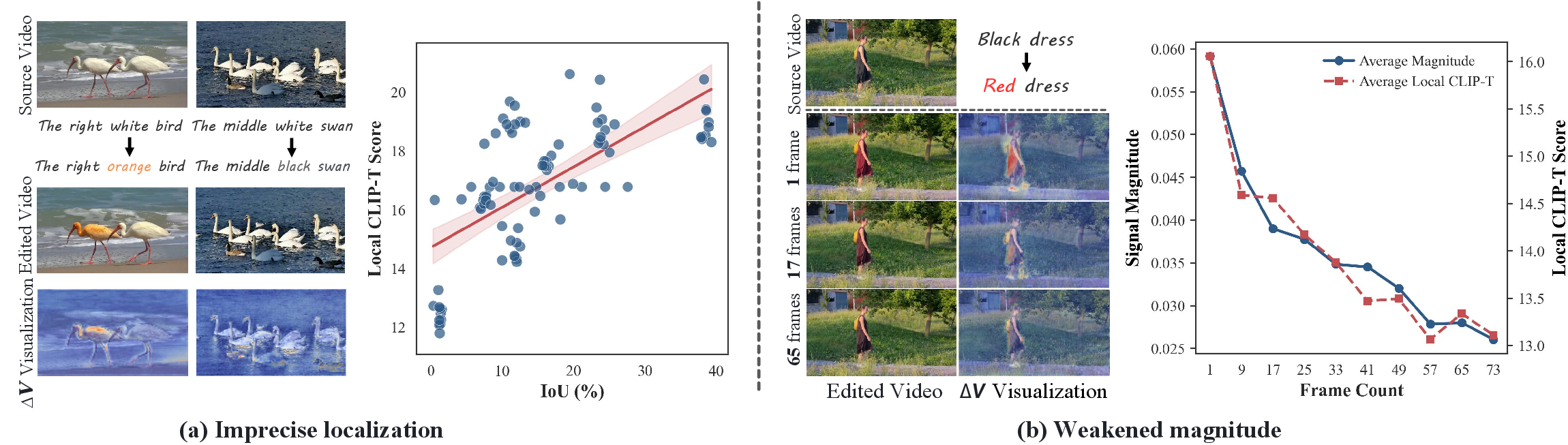
FlowAnchor (2604.22586) introduces a training-free, inversion-free flow-based framework for video editing in text-guided scenarios, addressing the instability of the editing signal observed when prior image-centric paradigms are naively extended to videos. Existing inversion-free methods such as FlowEdit demonstrate efficiency and structure preservation in image editing; however, their direct application to videos suffers from imprecise spatial localization and weakened signal magnitude, especially in multi-object or long-duration sequences. FlowAnchor rectifies these deficiencies through explicit anchoring mechanisms: Spatial-aware Attention Refinement (SAR) for precise semantic localization and Adaptive Magnitude Modulation (AMM) for robust signal strength.
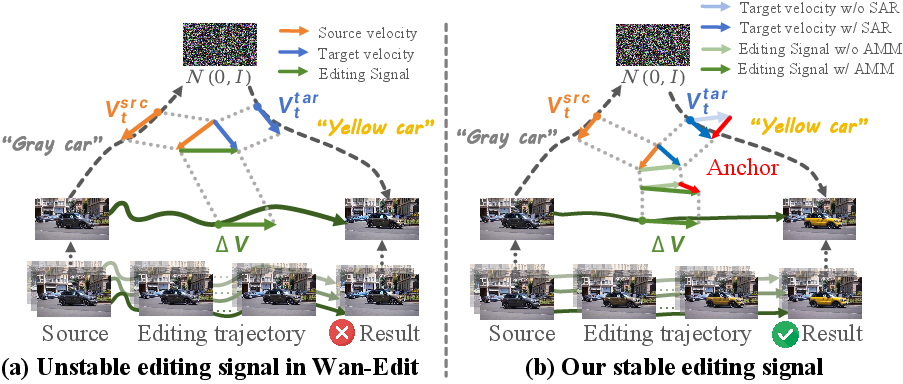
Figure 1: Comparative visualization of Wan-Edit versus FlowAnchor, demonstrating the stabilized editing trajectory achieved by FlowAnchor.
Failure Modes in Inversion-Free Video Editing
Naive adaptation of inversion-free flow-based editing to video tasks results in degraded editing quality for the following reasons:
FlowAnchor Framework
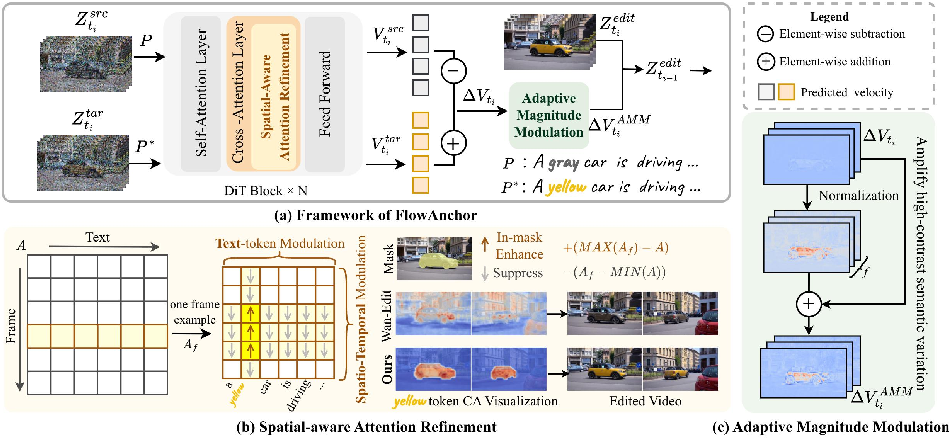
FlowAnchor operates on DiT-based video diffusion models and leverages rectified flow with explicit signal anchoring for robust editing. The editing signal is formally defined as the difference between source- and target-conditioned velocity fields, ΔVti, and is stabilized by two principal modules:
Spatial-aware Attention Refinement (SAR)
SAR directly modulates cross-attention (CA) maps in the backbone model to achieve precise alignment between textual guidance and target spatial regions. This is performed in two stages:
Adaptive Magnitude Modulation (AMM)
AMM addresses attenuation by adaptively rescaling the editing signal based on intrinsic signal contrast and frame count. A dynamic amplification factor γF ensures reinforcement is proportional to sequence length, with high-contrast regions specifically amplified. This prevents background noise magnification and maintains faithful editing trajectories in longer videos.
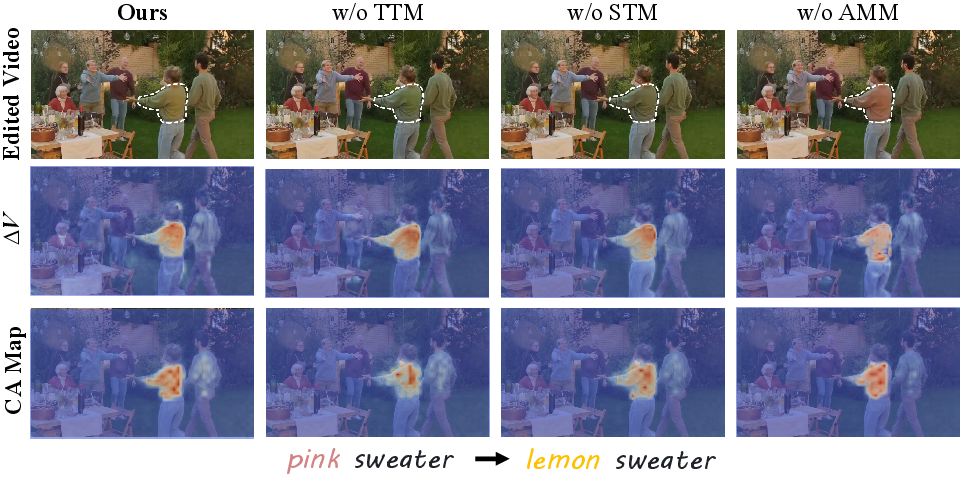
Figure 4: SAR and AMM module effects; SAR sharpens localization and AMM ensures sufficient semantic strength for precise editing.
Experimental Evaluation
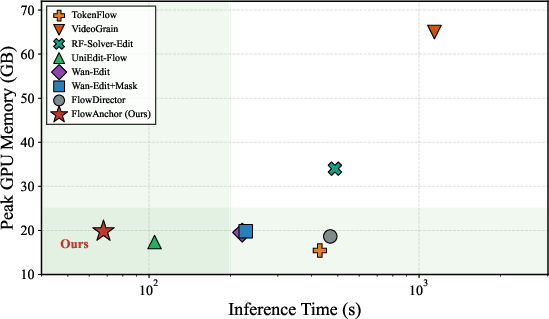
Evaluation was performed on FiVE-Bench and the newly proposed Anchor-Bench, the latter focusing on challenging multi-object scenarios and fast-motion videos. Metrics include global and localized text alignment (CLIP-T, Local CLIP-T), fidelity (M.PSNR, Local DINO), temporal consistency (CLIP-F, Warp-Err), and computational efficiency.
FlowAnchor demonstrates:
Human user studies further confirm consistent preference for FlowAnchor over all baselines in text-region alignment, visual fidelity, temporal stability, and overall editing quality.
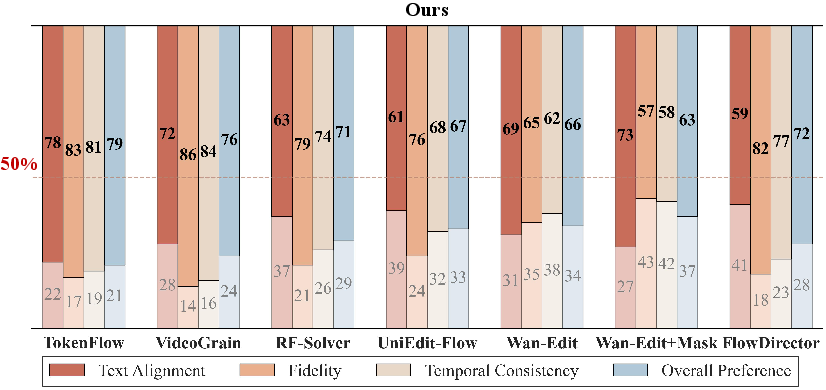
Figure 6: User preference rates for FlowAnchor relative to baselines across four aspects.
Qualitative results further highlight robust editing localization, effect quality, background preservation, and temporal consistency, notably outperforming baselines in scenes with challenging motion dynamics and complex spatial layouts.
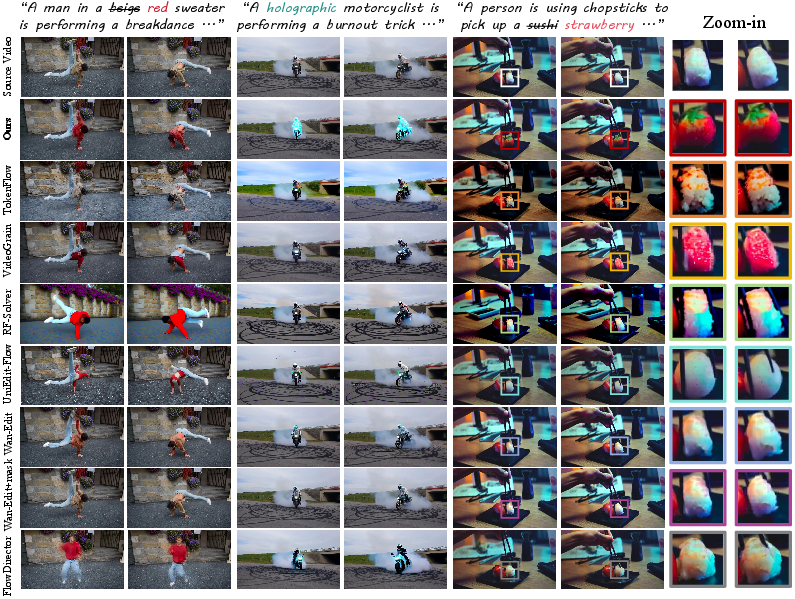
Figure 7: Qualitative comparisons; FlowAnchor exhibits superior localization, fidelity, and temporal stability.
Ablations and Signal Stability
Ablation studies confirm the necessity of both SAR stages; disabling text-token or spatio-temporal modulation degrades localization and CLIP-T performance. AMM is crucial for maintaining signal strength—removal results in negligible editing and dropped alignment scores. Optimal hyperparameter choices are established (β1=β2=0.3, γ=1.0, τ=0.6T).
Editing signal verification against Wan-Edit shows FlowAnchor achieves stronger localization (higher IoU), improved magnitude, and consistently superior Local CLIP-T, confirming enhanced signal stability.
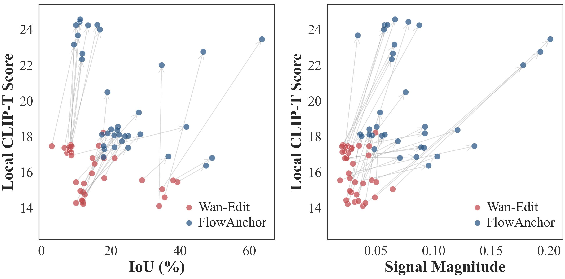
Figure 8: Editing signal analysis contrasting FlowAnchor and Wan-Edit; FlowAnchor maintains precise spatial anchoring and robust magnitude.
Robustness to Mask Granularity
FlowAnchor tolerates imprecise mask annotations, maintaining consistent editing quality across tight masks, hand-drawn scribbles, and coarse bounding boxes. Mask serves solely as a spatial anchor in early denoising, and does not impact detail generation, ensuring practical applicability for interactive editing workflows.
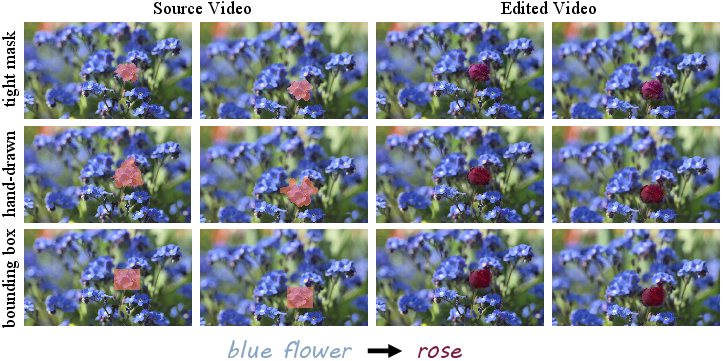
Figure 9: Robustness of FlowAnchor to varying mask granularity, demonstrating stable edits under coarse or imperfect masks.
Limitations and Extensions
Current limitations include restricted capacity for global style transformations and substantial motion edits, a constraint inherent to inversion-free flow paradigms. Addressing these remains an open research direction. FlowAnchor outperforms inpainting-based methods (e.g., VACE) and attention-gated editing frameworks (e.g., FlowDirector) in terms of completeness, structural stability, and semantic localization.
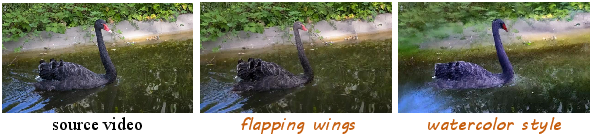
Figure 10: Limitations encountered in global style transfer and motion editing with FlowAnchor.
Practical and Theoretical Implications
FlowAnchor establishes a new methodological baseline for rapid, high-fidelity video editing via training-free inversion-free flow models. Explicit attention anchoring and adaptive magnitude modulation are demonstrated as critical for robust editing signal stability in high-dimensional spatiotemporal latent spaces. This provides a modular framework for further research on video editing under complex temporal or spatial conditions, and invites extensions incorporating global transformations, more generalized mask-free editing, and integration with interactive annotation pipelines.
Conclusion
FlowAnchor stabilizes the editing signal in inversion-free, flow-based video editing by anchoring both the location and the strength of the editing signal. The SAR and AMM modules jointly enable precise, temporally coherent, and efficient editing across complex video scenarios. Empirical results confirm that anchored editing signal stability is indispensable for scaling inversion-free paradigms to video, marking a substantive advance in practical text-guided video editing. Future investigations are suggested in broadening global transformation capabilities, mask-free editing, and adaptive attention beyond local anchors.