- The paper demonstrates that valley-spin hybridization near the anti-crossing enhances the Rabi frequency over 20× via electric-dipole transitions.
- It utilizes CMOS-enabled planar Si-MOS quantum dots with gate-tunable valley splitting and clearly identifies intra- and inter-valley transitions in ESR spectra.
- The work highlights that all-electrical spin control is achievable without micromagnets, paving the way for scalable silicon quantum computing.
Valley-Enhanced Rabi Frequency in Planar Silicon-MOS Quantum Dots
Introduction and Context
This paper investigates control of single-electron spin qubits in planar silicon metal-oxide-semiconductor (Si-MOS) quantum dots, targeting enhanced gate operations via valley-activated mechanisms. Unlike usual Si/SiGe architectures or Si-MOS corner-dot/top-gate devices, the work focuses on planar, industrially scalable MOS platforms with large valley splittings and without integrated micromagnets, presenting compelling results for coherent electrical spin manipulation in a regime previously considered challenging for strong electric-dipole spin resonance (EDSR) effects.
Device and Measurement Overview
The experimental platform is a double quantum dot on a 300 mm SOI substrate, processed using industry-standard CMOS techniques. Single-spin qubits are defined and controlled via gate voltages. Electron spin resonance (ESR) is induced by applying microwave pulses through an aluminum antenna, and spin-to-charge conversion readout employs the Elzerman protocol.
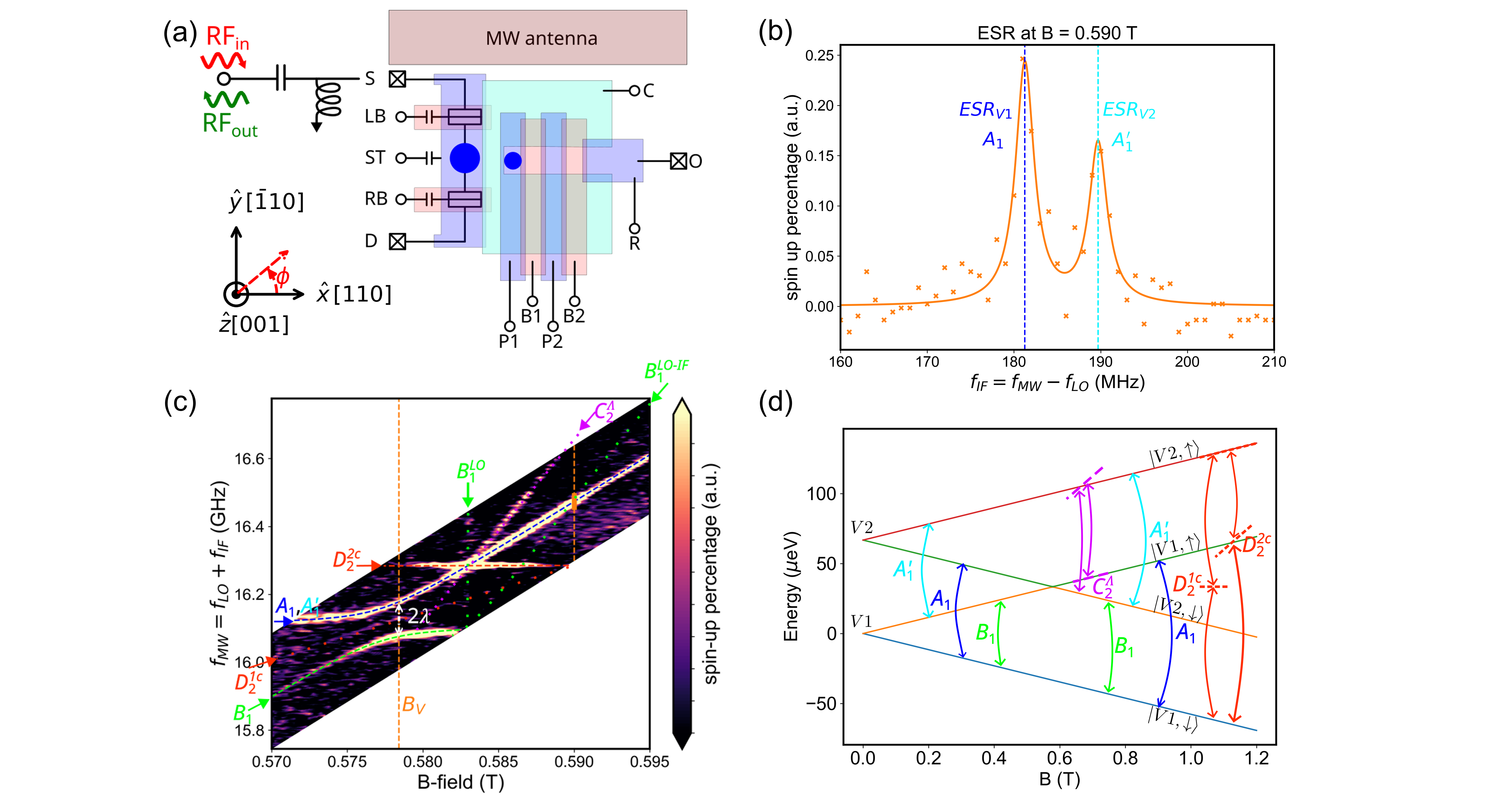
Figure 1: (a) Schematic of the planar Si-MOS device with aluminum antenna for ESR excitation; (b) ESR spectrum far from anti-crossing showing intra-valley spin-flip doublets.
The experimental signature of four-level spin-valley physics is evident in the ESR spectra: distinct one- and two-photon transitions emerge as Zeeman and valley splittings are tuned to resonance, producing a clear anti-crossing with vanishing energy gaps dictated by inter-valley spin-orbit coupling.
Valley Anti-Crossing and Energetics
At a critical magnetic field BV, the Zeeman energy matches the valley splitting, giving rise to a pronounced anti-crossing in the spectrum. This feature is direct evidence for strong spin-valley hybridization, captured by an effective four-level model {∣V1,↓⟩, ∣V1,↑⟩, ∣V2,↓⟩, ∣V2,↑⟩} under external B-field. The ESR spectra identify all intra- and inter-valley transitions, including both single-photon and prominent two-photon Λ-schemes, establishing unequivocal access to both spin and valley degrees of freedom.
Rabi Frequency Enhancement via Valley Admixture
Crucially, as the system is tuned close to the anti-crossing (i.e., as Zeeman and valley splittings approach degeneracy), the Rabi frequency of driven spin transitions increases by more than a factor of 20 compared to the far-detuned regime, at fixed microwave drive amplitude.
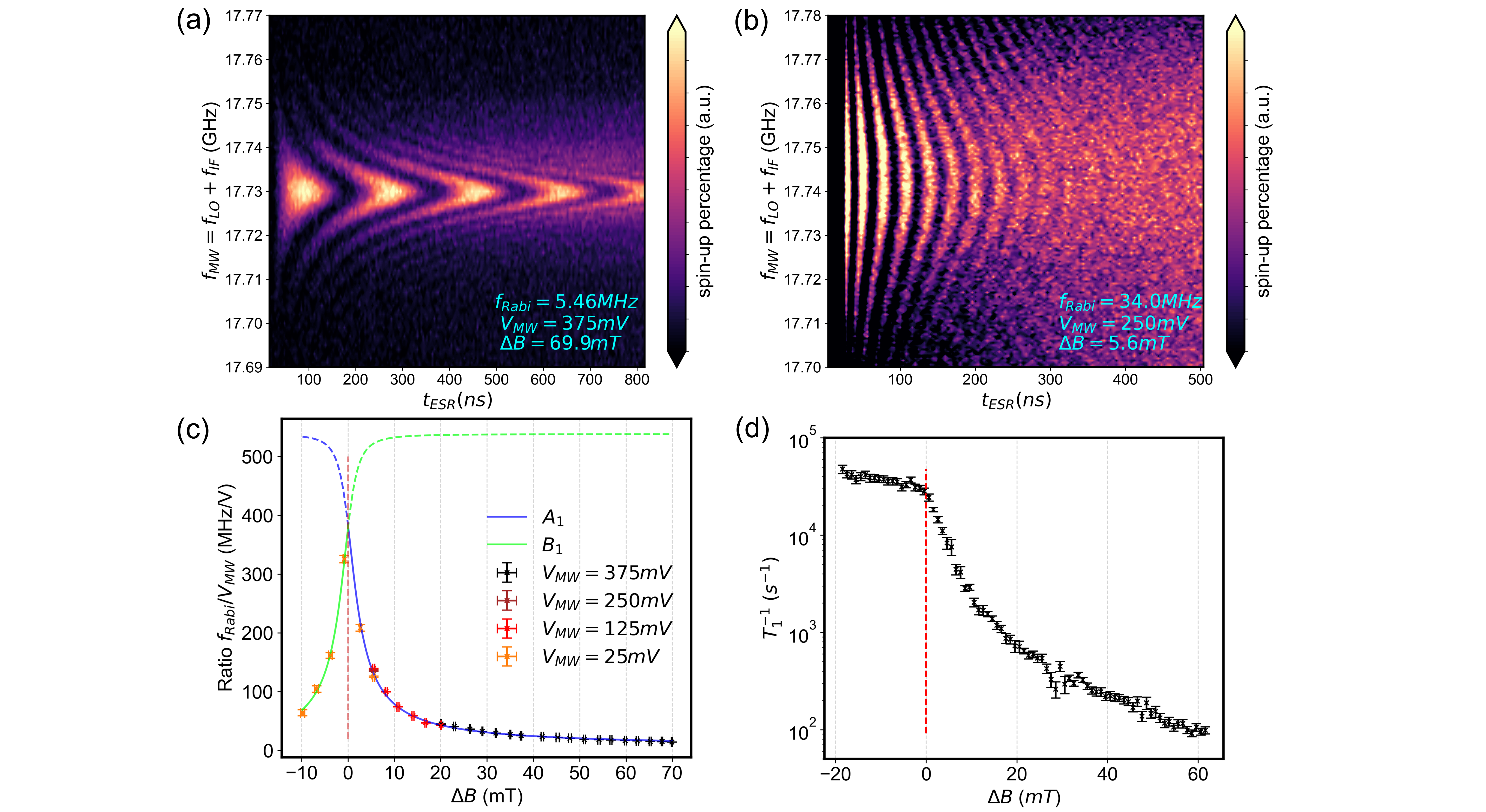
Figure 2: (a,b) Rabi chevrons at different detunings showing strong enhancement near the anti-crossing; (c) Rabi frequency normalized to drive amplitude vs detuning, peaking at the crossing.
This amplification cannot be explained by pure magnetic-dipole coupling; rather, it is quantitatively accounted for by admixed electric-dipole transitions enabled by spin-valley coupling. The effective electric drive channel, likely capacitive in origin from antenna-to-gate coupling, activates valley transitions which strongly admix with spin flips at the anti-crossing. The ratio between extracted electric and magnetic transition matrix elements is ≈200, demonstrating the dominance of electric-coupling in this operating regime even without a micromagnet.
Hot-Spot in Spin Relaxation
The dataset reveals a significant "hot-spot" in spin relaxation T1 near the valley anti-crossing. This relaxation acceleration is indicative of a phonon-mediated inter-valley relaxation channel, activated by strong spin-valley mixing.
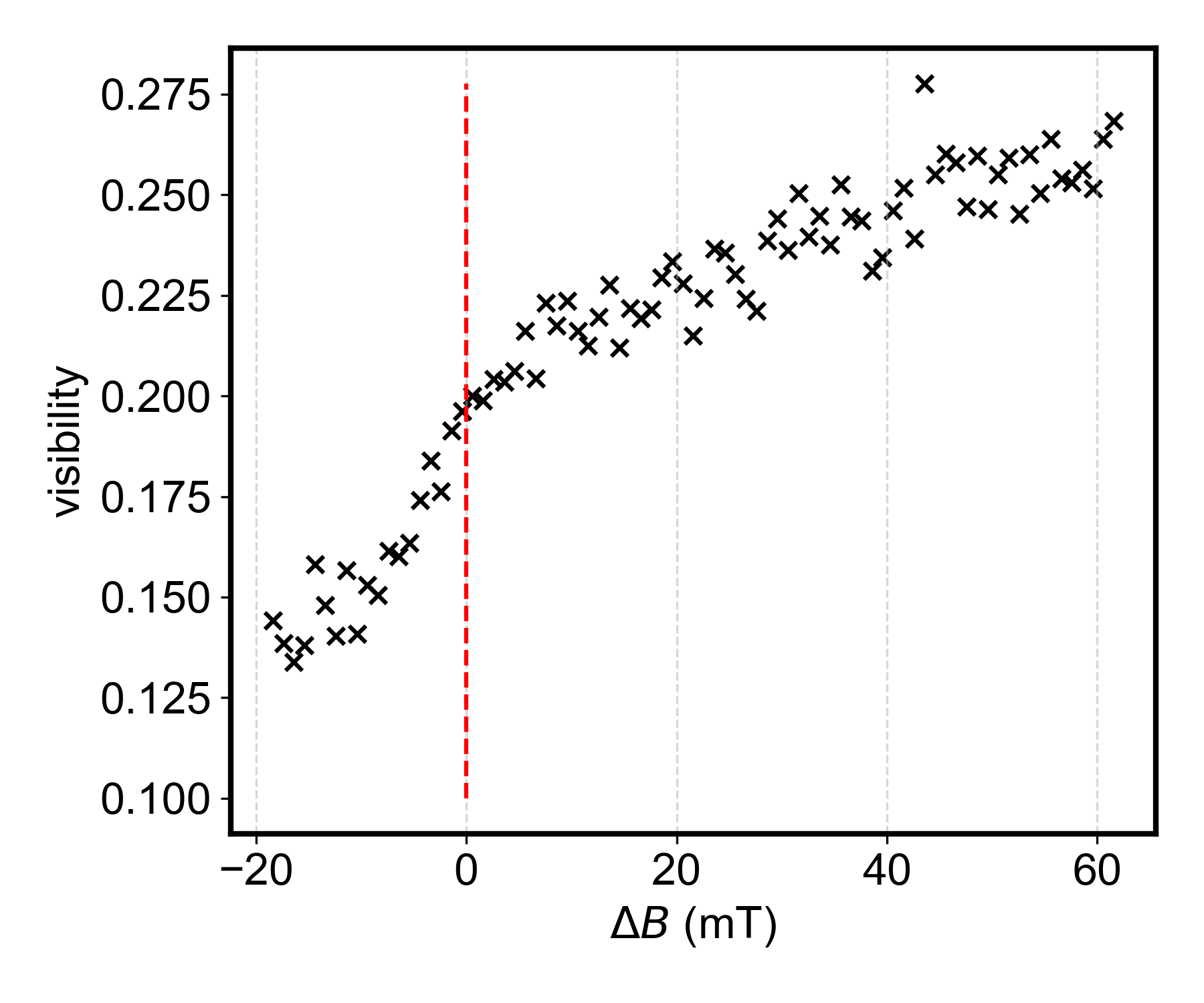
Figure 3: The population of excited-state spin decays more rapidly at the anti-crossing, indicating increased spin relaxation via spin-valley hybridization.
For B fields below {∣V1,↓⟩0, the plateau of rapid relaxation supports the model in which spin-valley admixture dominates the dynamics. The measurement is cross-validated by the voltage dependence of readout visibility.
g-Factor Anisotropy and Spin-Valley Coupling
The work undertakes a comprehensive vector-magnet characterization of both valley-dependent {∣V1,↓⟩1-factor anisotropy and inter-valley coupling. The difference {∣V1,↓⟩2 between the two lowest valley eigenstates is strongly in-plane anisotropic, aligning with {∣V1,↓⟩3 axes as predicted by interface-controlled Dresselhaus coupling models.
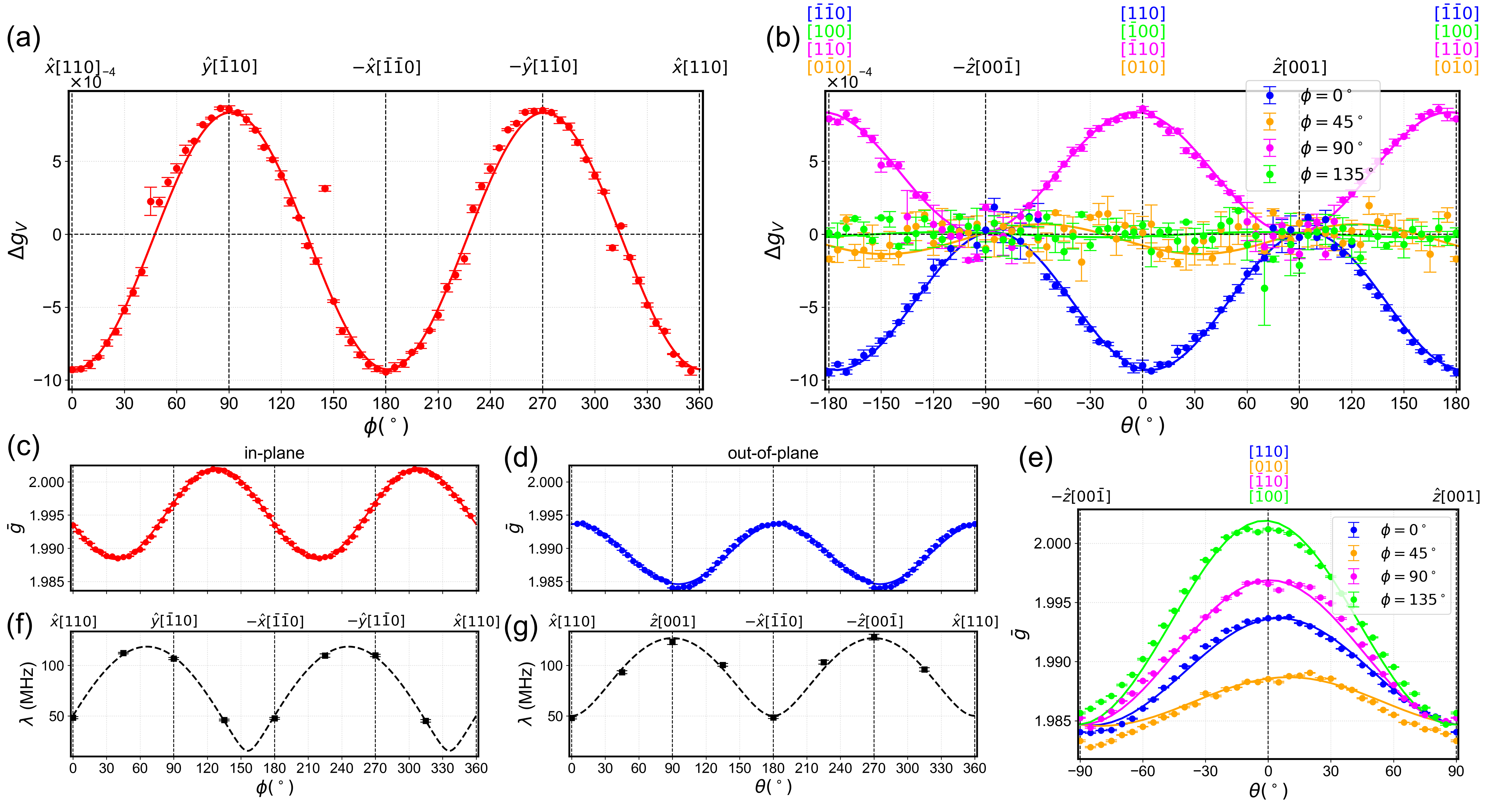
Figure 4: In-plane and out-of-plane anisotropy of valley-dependent {∣V1,↓⟩4-factor and inter-valley spin coupling {∣V1,↓⟩5.
The inter-valley spin-orbit coupling strength {∣V1,↓⟩6 is maximized for out-of-plane magnetic field and shows gate voltage independence, confirming interface-originated coupling with robust spectral tunability.
Valley Splitting and Gate Control
The valley splitting {∣V1,↓⟩7 is measured as a function of plunger and barrier gate voltages. The observed linear gate-voltage dependence of {∣V1,↓⟩8 is consistent with electrostatic control of electron wavefunction overlap with the interface.
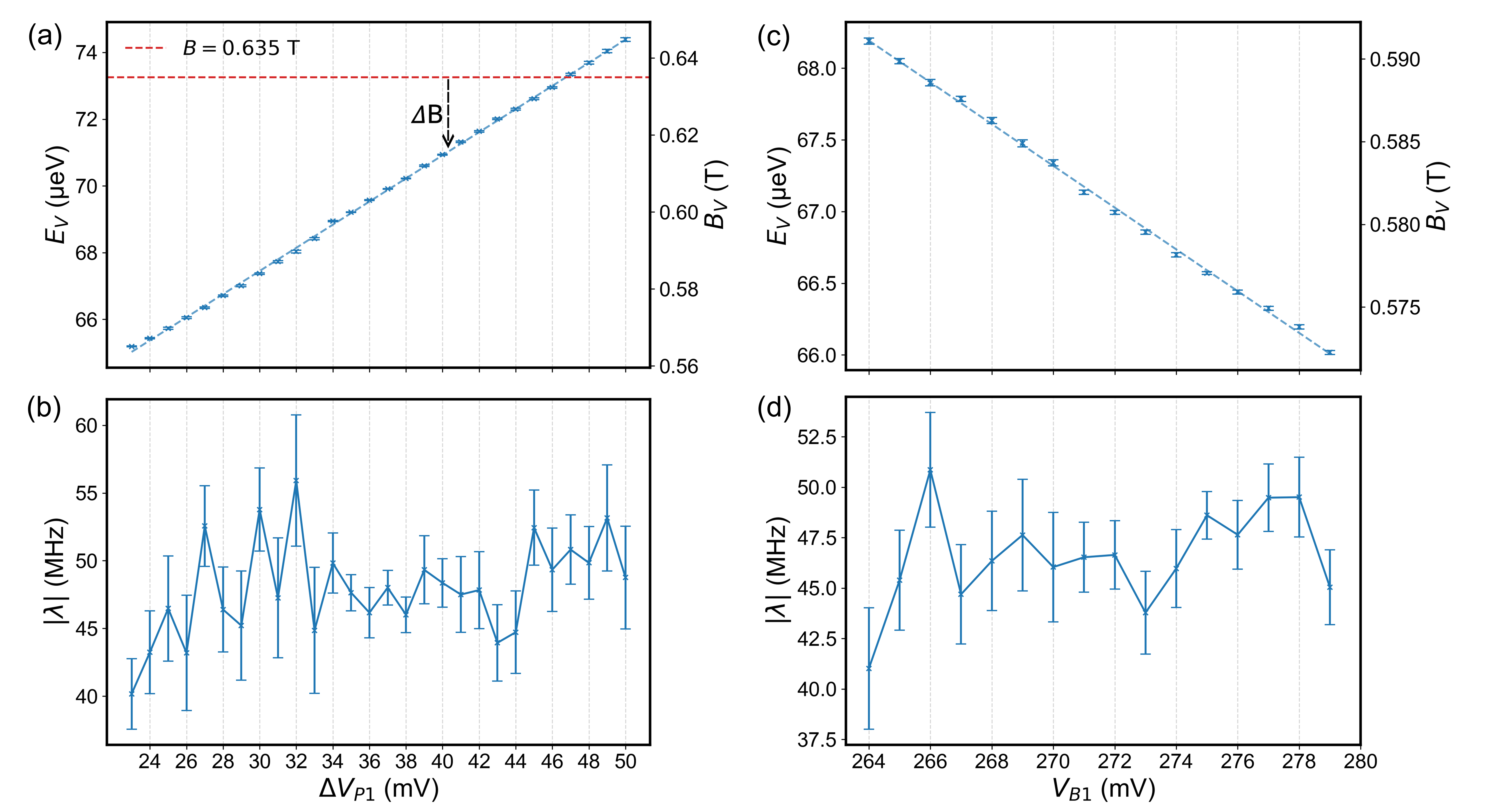
Figure 5: (a,c) Anticrossing field {∣V1,↓⟩9 as a function of gate biases tracks the valley splitting; (b,d) The spin-valley coupling ∣V1,↑⟩0 shows negligible gate sensitivity.
This ability to tune valley splitting with vertical electric field, without affecting spin-valley coupling, offers fine control over device operation points critical for robust quantum logic.
Damping and Charge Noise
Rabi oscillation damping analysis around the anti-crossing shows an optimal regime balancing dynamical decoupling and charge sensitivity. The data indicate noise-induced dephasing increases with larger electric drive strengths, emphasizing the importance of trade-off in practical device operation.
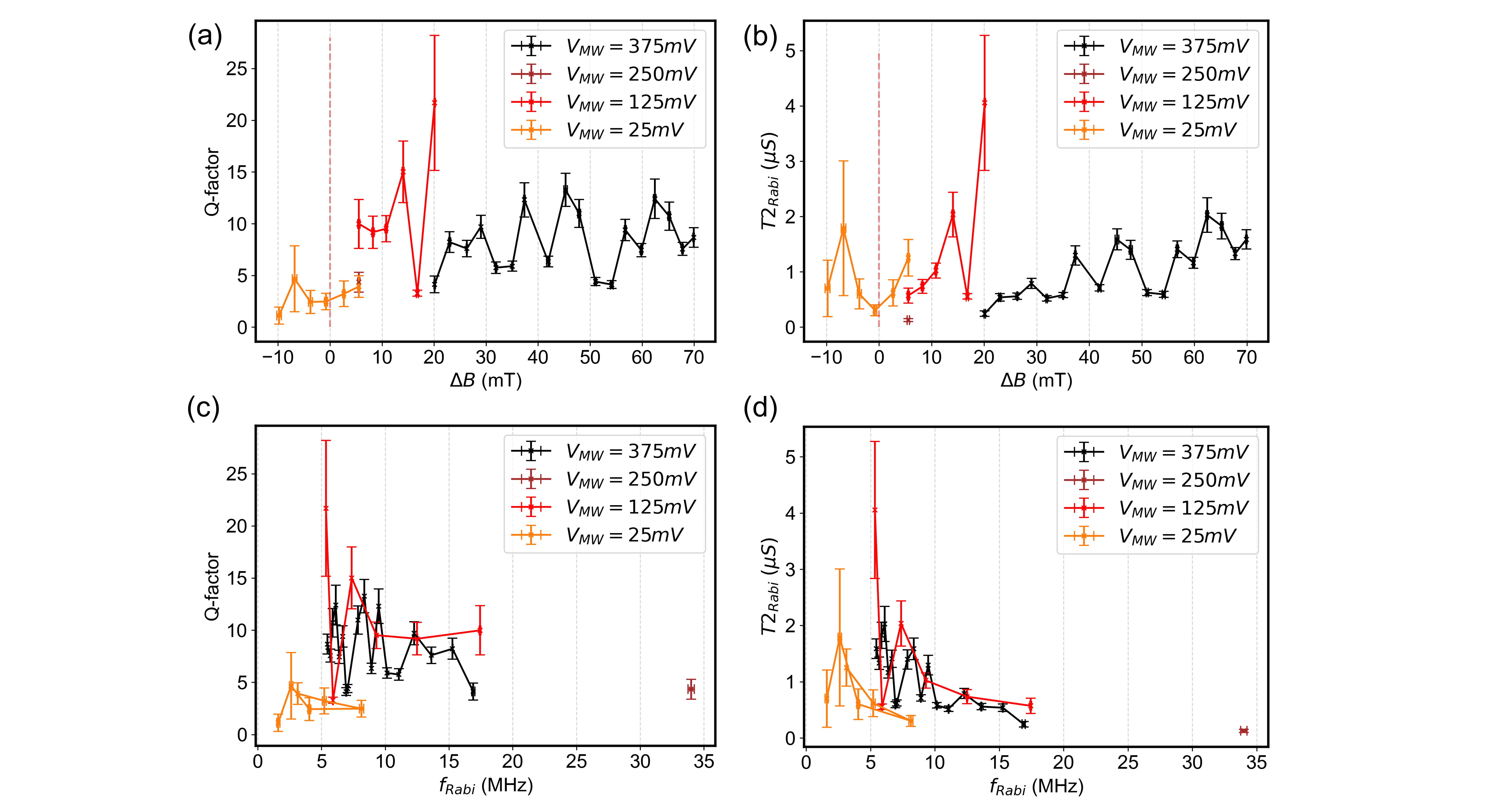
Figure 6: Damping rates (Q-factor, ∣V1,↑⟩1) of Rabi oscillations versus detuning from anti-crossing, revealing stochastic noise dependence.
Implications and Outlook
This work refutes the prevailing notion that planar Si-MOS dots with large valley splitting require integrated micromagnets for EDSR. The results provide direct experimental evidence that all-electrical coherent spin control is feasible in planar industrial platforms through exploitation of spin-valley coupling.
The explicit characterization of spin-valley hybridization, electric-dipole driven transition strengths, anisotropic ∣V1,↑⟩2-tensor elements, and gate-tunable valley splittings directly inform both theoretical modeling (k·p and tight-binding) and practical engineering for robust scalable Si-based spin qubits. The possibility of leveraging valley-enhanced Rabi rates and valley-controlled hot-spots defines a new axis for accelerating spin logic while maintaining scalability and compatibility with commercial CMOS flows.
Regarding future directions, valley physics must be considered for error correction thresholds, fast two-qubit gates, and spin shuttling architectures, especially given the observed strong device-to-device variability due to atomistic interface disorder. Techniques for mitigating charge/spin noise sensitivity at optimal drive points and utilizing two-photon valley-assisted gates appear as promising next steps.
Conclusion
The paper establishes that strong valley-enhanced electric-dipole spin resonance is accessible in industry-compatible planar Si-MOS quantum dots without auxiliary micromagnets. The systematic study of the interaction between spin, valley, electric drive fields, and device geometry yields precise control regimes. This work demonstrates that properly engineered planar MOS devices support high-speed, all-electrical spin manipulation, facilitating scalable silicon quantum computing platforms and expanding the operational toolbox for future quantum technologies.