- The paper generalizes standard causal identification formulas by extending traditional assumptions to incorporate arbitrary interference.
- The study demonstrates that conditional assignment independence (CAI) is crucial for isolating direct treatment effects in settings with treatment spillovers.
- It introduces a novel sensitivity analysis framework to quantify estimator robustness and bias when CAI assumptions are relaxed.
Causal Identification under Interference: Treatment Assignment Independence
Introduction and Motivation
The assumption of no interference—also termed the Individualistic Treatment Response (ITR)—is foundational in much of empirical causal inference, particularly in economics. ITR posits that each unit’s potential outcomes depend solely on its own treatment status, allowing standard identification formulas (e.g., those underlying selection-on-observables, instrumental variables, difference-in-differences, and regression discontinuity designs) to admit transparent causal interpretations like the average treatment effect (ATE) or average treatment effect on the treated (ATT). However, many empirical contexts are characterized by the presence of arbitrary interference, where units interact and treatments spill over, potentially invalidating ITR.
This paper provides a general analysis of the causal content of ITR-based identification formulas when interference is present but its structure is unknown. While prior literature typically requires detailed knowledge of the interference mechanism (e.g., social networks, exposure mappings, or groupings), the authors ask: What, if any, causal estimands are identified by conventional formulas when arbitrary interference exists and little or no information on interaction structure is available?
Three core contributions frame the paper:
- Generalization of Identification Assumptions: In the presence of arbitrary interference, the identifying assumptions underpinning standard designs (such as unconfoundedness, instrument exogeneity, or parallel trends) must be extended to account for the expanded set of potential outcomes indexed by the entire assignment vector.
- Critical Role of Treatment Assignment Independence (CAI): Even with these extended assumptions, ITR-based identification formulas are interpretable as causal only if restrictions are imposed on the dependence structure of treatment assignment. Specifically, it is necessary to require conditional assignment independence (CAI): the own treatment is independent of other units’ treatments, possibly conditional on observed covariates.
- Empirical Inaccessibility and Sensitivity Analysis: Because CAI is generally untestable from observed data, the paper introduces a novel sensitivity analysis, quantifying how statistical inferences are robust (or not) to departures from CAI under arbitrary interference.
Framework: Arbitrary Interference and Causal Effects
The analysis is developed in a finite-population potential-outcomes framework, generalizing standard potential outcomes to allow Yi(d), where d is the entire vector of treatment assignments. This admits the possibility that every unit’s outcome depends on some or all others' treatment status; no restriction is placed on the dependence structure or "exposure mapping." The canonical estimand under interference is the average direct effect (ADE), i.e.,
E[Yi(1,D−i)−Yi(0,D−i)],
which marginalizes over the latent variables and the distribution of other units’ treatments.
The paper's general treatment allows for stochastic potential outcomes, with randomness at the unit level captured via latent variables.
The analysis systematically considers the four most common identification strategies—selection-on-observables, instrumental variables, regression discontinuity, and difference-in-differences—and establishes necessary and sufficient conditions for ITR-based formulas to correspond to well-defined causal effects in the presence of arbitrary interference.
Selection on Observables
If outcomes depend on others’ treatments, the core concern is that conditional comparisons by treatment status (Di) may not hold other units' treatment assignments fixed, and hence do not estimate a direct effect. The paper generalizes the classical unconfoundedness assumption to require independence between the entire treatment assignment vector and the extended set of potential outcomes, conditional on unit-level covariates Wi. However, unless conditional assignment independence (CAI)—Di⊥D−i∣Wi—is imposed, the ITR formula conflates the ADE with bias due to systematic heterogeneity in the distribution of others’ treatments (see Theorem 1 in the paper).
When CAI holds, the formula identifies the covariate-conditional ADE. If not, bias terms can be decomposed and attributed to the differential distribution of others’ treatments across treated and untreated units.
Instrumental Variables
In the presence of interference, even standard IV assumptions (exogeneity, exclusion, monotonicity) are insufficient. Additional independence of the instrument across units is required: Zi⊥Z−i. Otherwise, the Wald estimand combines the local average direct effect (LADE) with a bias term reflecting the correlation between one’s own instrument and the vector of others’ instruments/treatments.
Regression Discontinuity
Here, interference requires extending the standard continuity assumption to the untreated potential outcomes associated with every possible realization of others’ treatments. Independence of the running variable across units implies unconditional assignment independence and allows the RDD estimand to correspond to the ADE. Without it, RDD weights differ across the running variable, inducing bias.
Difference-in-Differences
The identification of ATT in DiD designs with interference requires conditional parallel trends for all possible vectors of others’ treatments. Again, the CAI restriction is required to ensure that treatment group differences in others’ treatment assignments do not confound the estimated effect.
Sensitivity Analysis for CAI Violations
Given that CAI is typically untestable in observational settings, the authors introduce a sensitivity analysis framework quantifying how conclusions based on randomization inference (Fisher p-values) change as one departs from CAI. The procedure models within-stratum treatment assignment as a two-stage process, parametrizing deviations from independence by the variance of treated counts within strata (ξ-sensitivity model). The robustness value ξ∗ is defined as the minimal level of assignment dependence that renders the d0-value non-significant.
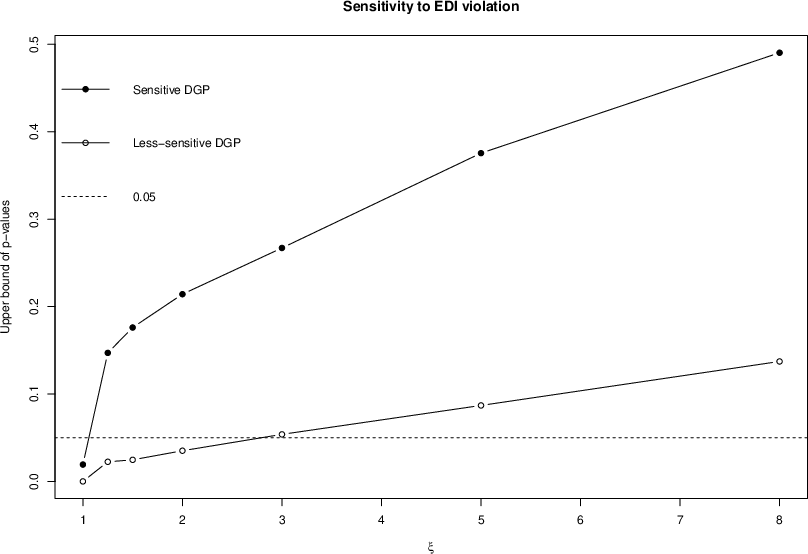
Figure 1: Sensitivity of the test statistic’s d1-value to violation of CAI, demonstrating how increasing assignment dependence (indexed by d2) can abrogate statistically significant findings under ITR-based inference.
Empirical illustrations using the LaLonde job-training dataset demonstrate how, depending on the outcome distribution, inference can be either robust or fragile with respect to mild violations of assignment independence.
Monte Carlo Assessment of Estimator Bias under Assignment Dependence
A Monte Carlo study further demonstrates that IPW estimators are unbiased for the ADE when CAI holds, but exhibit growing bias as treatment assignment dependence increases, even when the propensity score model is correctly specified.
Theoretical and Practical Implications
The central implication is that all classical quasi-experimental identification formulas retain causal content under arbitrary interference if suitable assignment-independence restrictions (typically CAI or its unconditional version) are in place. In these settings, standard estimators (e.g., matching, IPW, two-stage least squares) target ADE or related estimands rather than traditional ATE or ATT.
The theoretical advance lies in demonstrating that specification of the underlying interference structure is not a prerequisite for causal identification, provided assignment mechanisms exhibit (possibly conditional) independence. Practically, this generically fails in social and economic contexts featuring group-, network-, or context-induced dependence in treatment or exposure. The proposed sensitivity analysis offers a principled way to benchmark empirical findings against plausible violations.
Limitations and Future Directions
Inference under arbitrary interference and assignment dependence is more problematic than point estimation—standard error approximations and limiting distributions may not remain valid absent ITR. The development of robust, possibly permutation-based, inference for interference settings remains an underexplored domain.
Methods for empirically distinguishing between bias due to interference per se versus assignment dependence are limited. Further progress would require either partial knowledge about the interference graph or richer data, as in experimental designs with known exposures.
Conclusion
This work formalizes the conditions under which ITR-based identification formulas preserve causal interpretability in the presence of arbitrary interference. The analysis shows that assignment independence—conditional or unconditional—is the crucial additional ingredient required. In its absence, standard formulas generically suffer from non-causal bias, with its magnitude quantifiable by sensitivity analysis. These results recast the empirical practice of invoking ITR-based methods in possibly-interfering settings: such methods estimate meaningful direct effects only if assignment dependence is limited—a property that, in practice, requires careful scrutiny, explicit justification, and, ideally, sensitivity checks.

