- The paper demonstrates that XX-type decoherence on a 2D color code drives an anyon proliferation that yields an intrinsic mixed-state toric order.
- It employs stabilizer formalism, numerical simulations, and TEN to quantify the smooth crossover from a doubled toric code to a single toric code sector.
- Results indicate that robust topological diagnostics are essential for developing noise-resilient quantum memories and error correction protocols.
Decohered Color Code and Emergent Mixed Toric Code: A Topological Entanglement Negativity Perspective
Introduction and Motivation
This study addresses the transformation of the two-dimensional color code under XX-type decoherence applied on a subset of its links, focusing on the resulting mixed-state topological order, which is intrinsic to mixed states and lacks pure-state analogs. By leveraging the stabilizer formalism, numerical simulations, and the diagnostic of topological entanglement negativity (TEN), the authors systematically clarify the emergence of an intrinsic mixed-state topological order (imTO) characterized by a modular sector equivalent to a single toric code (TC) after decoherence. The investigation is motivated not only by fundamental questions about the universal diagnostics of mixed-state topological order but also by practical aspects of quantum memories and error correction under realistic environmental noise.
System: Color Code, Stabilizer Structure, and Decoherence Channel
The color code is defined on a honeycomb lattice embedded on a torus with three-color plaquettes—red, green, blue—such that neighboring plaquettes have distinct colors. Physical qubits reside on vertices. The stabilizer Hamiltonian consists of both X-type and Z-type operators on each plaquette of all three colors:
HCC=−color,plaquette∑(SX+SZ)
Ground states are +1 eigenstates of all stabilizers, with the code hosting four logical qubits, corresponding to eight non-contractible logical operators.
Decoherence is implemented by a quantum channel EXX (probability p) acting stochastically or maximally (at p=1/2) with operators XvrXvr′ on all red links. This operation leads, generally, to a mixed state; at maximal decoherence it becomes equivalent to a projective measurement of the corresponding operator, but without recording the measurement outcomes.
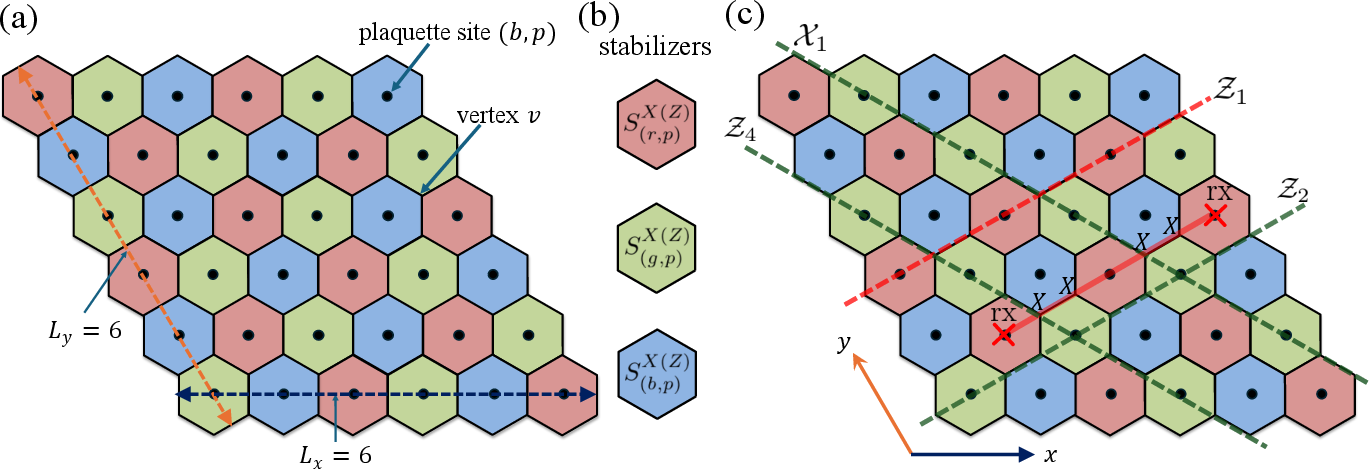
Figure 1: Schematic of the color code on the honeycomb lattice with colored plaquettes, classification of links, and examples of logical and string operators relevant for anyon creation and code properties.
Structural Transition: From Double Toric Code to Mixed-State Toric Code
The color code's anyon content is isomorphic to two decoupled toric codes: ACC≅ATC×ATC, giving $16$ anyon types. The XX-type decoherence channel has two crucial effects:
- Anyon Proliferation: Specifically, the rX anyon becomes proliferated, fundamentally altering the anyon sector by inducing transparency for these anyons and confining those that braid nontrivially with them.
- Gauging-Out and Stabilizer Update: The resultant stabilizer group after full decoherence gains nonlocal stabilizers associated with classical logical operators, while logical partners in the quantum sector are destroyed—effectively yielding a mixture where only a single toric code's logical structure is preserved.
The modular quotient of the transparent sector (rX proliferation) in the anyon content yields the modular (TC-like) sector, mathematically: +10 TC, confirming that the surviving topological order is that of a single toric code.
Measurement and Characterization: Topological Entanglement Negativity
Entanglement negativity, suitable for diagnosing quantum correlations in mixed states, is computable efficiently in the stabilizer formalism. The TEN, the analog of topological entanglement entropy (TEE) for negativity, is extracted by carefully designed subsystem combinations to eliminate non-universal (area-law) contributions and isolate the universal topological correction.
The TEN is defined as:
+11
where +12 are the negativities of respective regions and combinations.
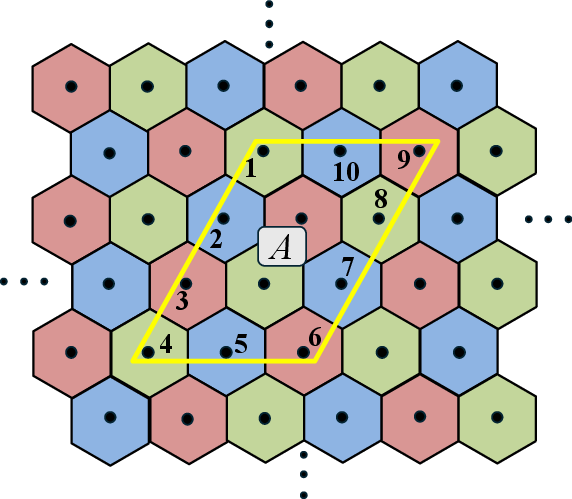
Figure 2: Example of subsystem geometry used for analytical negativity calculation in the undeformed color code.
For the initial color code, analytical calculation demonstrates TEN +13 (+14 in base-2 log), matching expectations for a doubled TC system. Under maximal decoherence, the modular theory reduces to a single TC sector, with +15, i.e., TEN of +16 (in base +17).
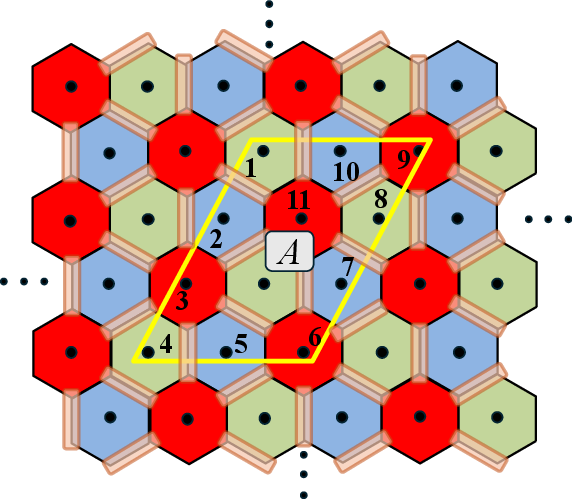
Figure 3: Schematic for the subsystem used in the analytical calculation of negativity in the maximally decohered case.
Numerics: Evolution of TEN and Negativity
Large-scale simulations track the crossover from color code to mixed-state toric code as +18 interpolates between +19 and EXX0. For subsystem shapes commensurate with the emergent triangular TC lattice (formed by red plaquettes), the scaling of negativity and TEN is precise.
Notable findings:
- TEN transitions monotonically and smoothly from EXX1 to EXX2.
- The variance of TEN exhibits a broad, system-size independent peak, indicative of significant state-to-state fluctuations in the intermediate regime, but without the signatures of a sharp transition.
- Negativity for subsystems not commensurate with the emergent lattice loses the scaling law, further underscoring the geometric and topological underpinnings of the transition.
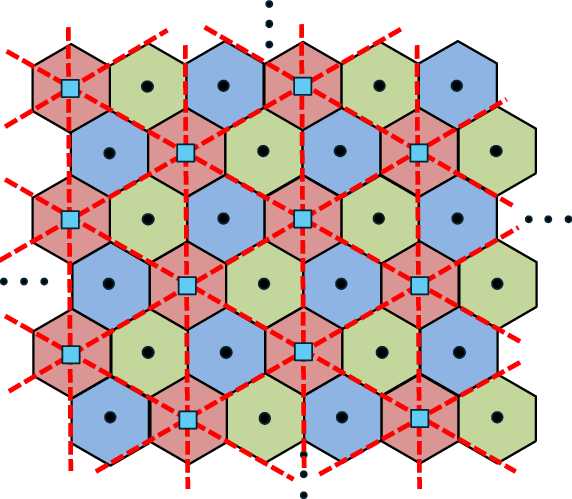
Figure 4: Visual of the emergent triangular lattice on the color code system, highlighting the structure of the residual TC sector after decoherence.
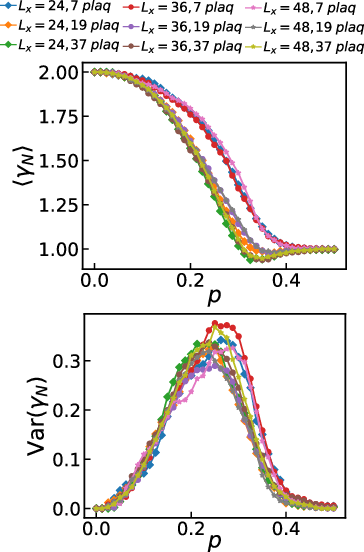
Figure 5: TEN and its variance as a function of decoherence probability EXX3 for various subsystem sizes, confirming the smooth crossover and the absence of finite-size scaling.
A key theoretical insight is that the decohered state's stabilizer group enforces emergent strong EXX5-form symmetries, with certain logical operators now appearing as stabilizers themselves (i.e., becoming 'classical'). This behavior corresponds to the strong-to-weak transition for EXX6-form symmetries in the context of mixed topological orders. The identification of transparent anyons (in this case, EXX7) is a direct reflection of nonmodular theory and the emergence of imTO.
Implications and Future Directions
Theoretical Implications
- Universal Diagnostic: The results strongly support the use of topological entanglement negativity, rather than TEE, as a universal diagnostic of mixed-state topological orders characterized by intrinsic mixed structure or nonmodular anyon theory, in agreement with recent proposals [Cai2026].
- Mixed-State Topological Order: The work provides a clear concrete example of how imTO arises via anyon proliferation under decoherence, definitively linking the modular quotient analysis with operational diagnostics such as TEN.
- Symmetry and Classification: The observed restoration of strong EXX8-form symmetry for noncontractible loops, combined with the proliferation of transparent anyons, connects imTO classification to generalized symmetry-protected structures.
Practical Implications
- Quantum Memories: The findings highlight limitations and potential robustness of topological codes under decoherence, and the need for diagnostics sensitive to genuinely quantum correlations in realistic, open-system conditions.
- Design of Codes and Protocols: Emergence of a residual TC under decoherence suggests that tailored error models can be harnessed to maintain partial topological protection, motivating protocol engineering for near-term devices.
Future Developments
- Exploration of Universality: Extending the methodology to other codes (e.g., beyond color code, higher spatial dimensions) to determine the universality of the observed smooth crossover and variance behavior.
- Tensor Network and Analytical Models: Integration with tensor network approaches, as in [Darmawan_2017], could yield further insights on scalability and state structure in more general noisy stabilizer systems.
- Mixed-State Gaps and Markov Length: Investigation of the mixed-state 'gap', using diagnostics like conditional mutual information and Markov length, could elucidate the nature of state trajectories and the possibility of sharp phase transitions in analogous models [Sang_PRL_2025, negari2025].
Conclusion
The study rigorously demonstrates that XX-type decoherence on the color code induces a crossover to an intrinsic mixed-state topological order identified as a mixed-state toric code. The work establishes that topological entanglement negativity (TEN) robustly diagnoses the universal properties of this emergent order, surpassing TEE in mixed settings. Numerical and analytical results confirm the transition in topological order at the level of universal entanglement content, underpinned by a detailed analysis of anyon structure, stabilizer algebra, and higher-form symmetries.
These results provide a blueprint for analyzing mixed-state topological order and underline the necessity of developing and deploying universal quantum information diagnostics in the theory and practice of quantum memories and error correction.