- The paper presents a behavior-driven gamification framework that transforms repository metrics into actionable feedback to enforce service boundaries.
- It utilizes automated quantitative measures and real-time nudges to distinguish beneficial collaboration from harmful cross-service interactions.
- Empirical simulations and human trials demonstrate measurable improvements in modularity and reduction in organizational coupling.
Gamified Architectural Governance for Reducing Organizational Coupling in Microservice Systems
Introduction and Problem Statement
Microservice architectures, characterized by decentralized team ownership and independent service boundaries, are routinely undermined by organizational coupling (OC). This phenomenon arises when developers contribute across multiple services, resulting in blurred ownership, increased coordination overhead, and gradual erosion of system modularity. Existing approaches to architectural governance in microservice systems predominantly provide diagnostic metrics or static enforcement policies, lacking efficacy in actively influencing developer behavior toward boundary preservation. The work "Gamifying Architectural Governance to Reduce Organizational Coupling in Microservice Systems" (2604.22454) addresses this deficiency by introducing an innovative behavior-driven governance framework grounded in gamification principles.
Motivation and Socio-Technical Context
The misalignment between system modularity and team structure—articulated in empirical studies and anchored in socio-technical congruence literature—has proven to be a persistent challenge in sustainability and maintainability of microservice systems. Repository mining has demonstrated the feasibility of detecting OC and related anti-patterns via cross-service commit histories and contribution switching analysis. However, the prevailing passive diagnostic approach is shown to be insufficient, as increased observability does not inherently catalyze behavioral change.
Gamification, through constructs such as points, badges, leaderboards, and structured challenges, has demonstrated effectiveness in driving engagement in various software engineering tasks (e.g., bug triaging, code review). Nonetheless, its application to architectural governance—particularly at the level of socio-technical alignment—remains essentially unexplored. The framework posited in this study fills this gap by leveraging architectural metrics as engines for behavioral feedback, targeting reduction of harmful coupling and enhancement of team cohesion.
Framework Overview
The proposed governance framework integrates automated repository mining, quantitative socio-technical analysis, and a multi-tiered gamification engine into a closed feedback loop. The architecture is depicted in Figure 1.
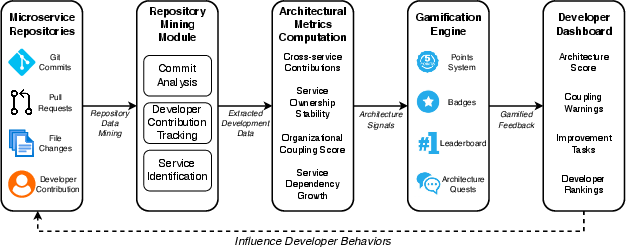
Figure 1: A closed-loop gamified governance framework that transforms repository-derived architectural signals into behavioral feedback to influence developer actions and improve socio-technical alignment.
Development activity is continuously assessed with quantitative measures of OC and organizational cohesion (the latter reflecting contribution focus and ownership stability). Importantly, the framework supports context-sensitive discrimination between necessary collaborative work and deleterious boundary erosion, normalizing intervention triggers to project-specific baselines.
The gamification engine operationalizes these signals through:
- Points and Context-Adaptive Scoring: Reward behaviors congruent with architectural boundaries (e.g., high sustained service focus), while penalizing unjustified cross-service incursions.
- Badges and Progression Systems: Foster sustained, high-cohesion contributions and boundary stewardship via recognition (e.g., "Service Specialist," "Boundary Guardian").
- Leaderboards and Social Transparency: Encourage awareness and friendly competition; mitigated through scoping (e.g., team-level rankings) to avoid negative motivational effects.
- Behavioral Nudges and Real-Time Feedback: Deliver just-in-time alerts when at-risk coupling or undesirable switching patterns are detected.
- Architecture Improvement Quests: Goal-oriented, time-bounded challenges catalyzing explicit action on OC hot-spots (e.g., reducing coupling between specific services).
Crucially, the framework embeds fair attribution, transparency of scoring, and adaptive intervention granularity—prioritizing sustained, meaningful architectural improvement over superficial gameplay optimization.
Evaluation Design
The evaluation strategy comprises three phases:
- Repository Baseline Mining: Quantification of existing OC, cohesion, and switching patterns across selected open-source microservice projects (e.g., SockShop, Spinnaker). This establishes a diagnostic baseline.
- Behavioral Simulation: Deployment of calibrated behavioral models to simulate the incremental effects of different gamification interventions, comparing them against transparent-metrics-only and rigid policy-enforcement controls. Key outcomes include reductions in OC, stabilization of service ownership, and improvements in architectural dependency profiles.
- Human-Centered Experimental Studies: Implementation of A/B and longitudinal trials with students, open-source contributors, and industry practitioners to empirically assess behavioral change, perceived utility, usability, and side-effect risks (such as competitive stress or gaming behavior). Qualitative and quantitative data are collected to support external validity.
Theoretical and Practical Implications
The conceptual shift from passive architectural observability to active behavioral alignment represents a fundamental reframing of software architecture governance. The framework bridges architecture, organizational behavior, and software analytics, empowering organizations to intervene at points of emergent modularity breakdown. Notably, it advocates for gamification as a complementary, non-punitive alternative to code ownership policies, enabling continuous and context-sensitive intervention without the rigidity or overhead typical of rule-based enforcement.
Practical deployment of such a gamification-based governance layer could directly impact software quality, maintainability, and long-term scalability for organizations adopting microservice paradigms. On a theoretical level, it invites further research into which game mechanics are most efficacious for architectural behavior steering, how such interventions affect developer experience and collaboration, and the degree to which behavioral feedback correlates with measurable improvements in system modularity and socio-technical alignment.
Limitations and Research Opportunities
Potential threats to the efficacy of this approach include the risk of metric misattribution (i.e., penalizing justified cross-service work), simulation-experiment congruence, applicability to industrial versus open-source development contexts, and side-effects such as metric gaming or compliance without genuine improvement. Careful empirical evaluation and adaptation of feedback granularity, incentive structures, and transparency mechanisms will be crucial for sustainable adoption.
Research opportunities span refinement of socio-technical metrics, longitudinal impact assessment of gamified governance in diverse settings, and exploration of adaptive gamification strategies tailored to varying organizational scales and cultures.
Conclusion
The study articulates a robust framework for gamified architectural governance targeting the acute problem of organizational coupling in microservice systems (2604.22454). By operationalizing repository-derived architectural signals as behavioral feedback via gamification, the framework aspires to facilitate sustainable socio-technical alignment and architectural integrity. This paradigm bridges software architecture, organizational analytics, and developer engagement, establishing a reproducible model for proactive architectural evolution in distributed software environments. Empirical studies on real-world effectiveness and broader adoption will determine the transformative potential of behavior-driven governance mechanisms in modern software engineering practice.