- The paper introduces an optimal beamforming strategy that minimizes the periodic PCRB in multi-user ISAC systems with heterogeneous parameters.
- It leverages semi-definite relaxation and rank-reduction techniques to ensure a rank-one sensing beam under complex interference constraints.
- Numerical simulations confirm near-optimal sensing accuracy with dedicated sensing beams, outperforming dual-functional designs under realistic rate limits.
Problem Setting and Motivations
This work analyzes beamforming optimization in multi-user integrated sensing and communication (ISAC) systems, focusing on scenarios with heterogeneous unknown parameters relevant to practical 6G deployments. Specifically, the downlink of a multi-antenna base station (BS) serves multiple single-antenna users while simultaneously sensing the azimuth angle of a target, whose prior distribution is assumed known, but with an unknown reflection coefficient (RC) treated as a pure nuisance parameter with no prior statistics. The main objective is to design transmit beamforming so as to minimize the periodic posterior Cramér-Rao bound (PCRB)—a tight lower bound for periodic mean-cyclic error (MCE) in moderate-to-high SNR—while meeting per-user communication rate constraints under a sum power limit.
The system employs a general transmission architecture: communication beams for users, plus—unlike most prior works—one or more dedicated sensing beams with random coding. Communication users are assumed to possess sensing interference cancellation capability. The work critically departs from the homogeneous parameter case by explicitly treating the RC as an unmodeled nuisance, increasing the complexity of the sensing information measure and its functional dependence on the transmit covariance.
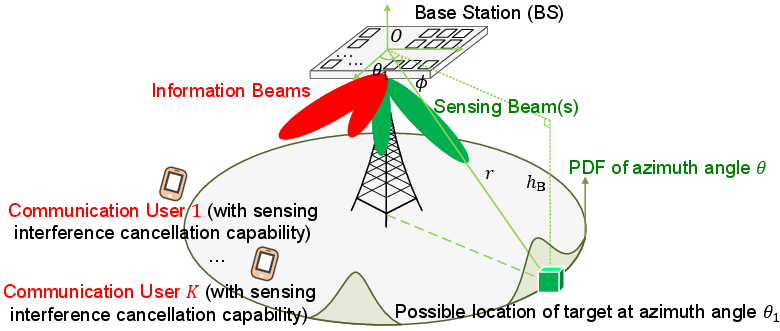
Figure 1: Multi-user ISAC architecture supporting dedicated sensing beams, with perfect sensing interference cancellation at communication users.
Beamforming is optimized by minimizing the periodic PCRB of angle estimation, subject to ensuring each user's information rate meets a target. The periodicity in the angle parameter is handled by cyclic error metrics, distinguishing this treatment from conventional MSE-based bounds. The joint echo model couples the desired azimuth and unknown RC, causing the periodic PFIM and thus the PCRB to take a structure fundamentally more intricate than the classical homogeneous case.
The transmit signal is the superposition of K information beams and an arbitrary number of sensing beams, with the feasibility of perfect interference cancellation enabling this separation. The core optimization problem takes the form:
- Objective: Minimize periodic PCRB of the azimuth;
- Constraints: Each user achieves rate Rˉk and sum power ≤P.
Given the quadratic-fractional structure of PCRB in terms of the transmit covariance, the resulting problem is highly nonconvex, with the additional challenge of multi-user interference terms in rate constraints—a marked difference from single-user and homogeneous scenarios.
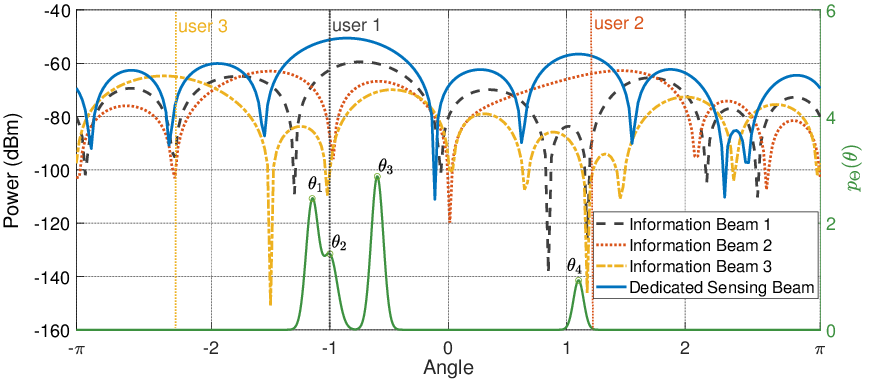
Figure 2: Radiation pattern of designed beams and PDF pΘ(θ) for target angle, emphasizing power focusing on high-probability target sectors and user orientations.
Theoretical Developments and Algorithm
The semi-definite relaxation (SDR) and a series of variable transformations are used to reformulate the problem as a sequence of convex SDPs. The proof leverages Lagrangian duality, KKT conditions, Schur complements, and a custom rank-reduction argument, as standard approaches for homogeneous parameters are not tight here.
Key technical results include:
- SDR Tightness: The optimal solution always satisfies the original rank constraints for information beams. Thus, the relaxation does not lose optimality.
- Rank Bound: For heterogeneous parameters, it is analytically shown that the optimal transmit covariance for sensing beams is always rank-one—at most one dedicated sensing beam is ever necessary, regardless of user count or channel realization, provided sensing interference cancellation capability is present.
- Performance Metrics: The bound PCRBθP emerges as a nested quadratic functional of the signal covariance, influenced by the lack of prior on the RC—a structure unique to the heterogeneous case.
The optimal beamforming procedure is thus: (i) solve the relaxed SDP; (ii) use the tailored rank-reduction algorithm to construct solutions where the sensing covariance is low-rank (in fact, rank one).
Numerical Results and Comparative Analysis
Simulation studies validate the analytical results for a 3-user, 3x3 UPA downlink. The target distribution is modeled using a von-Mises mixture, representative of practical, multimodal angular uncertainties.
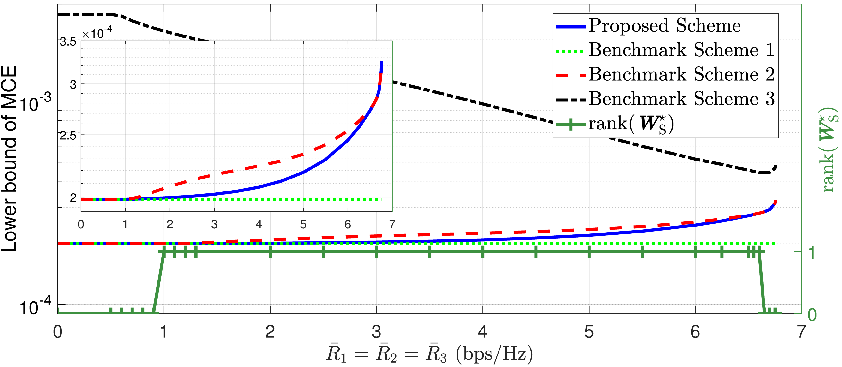
Figure 3: Lower bound of MCE (via periodic PCRB) as a function of per-user communication rate target, comparing the proposed method to benchmarks.
Empirical findings show:
- The proposed scheme consistently requires only one dedicated sensing beam, irrespective of rate targets or user number, matching the theoretical guarantee.
- It yields MCE performance nearly identical to a hypothetical "sensing-only" (no communication) system, provided moderate communication rate constraints, substantially outperforming dual-function schemes (no dedicated sensing beam) or designs based on peak-probability-point priors.
- The dual-functional (no sensing beam) benchmark performs significantly worse except at vanishingly low communication rates, evidencing the necessity of the dedicated sensing beam under realistic trade-off constraints.
Implications and Theoretical Significance
Contrasting Homogeneous vs. Heterogeneous PCRB: The work rigorously shows that for heterogeneous parameter settings, especially with unmodeled RCs, the optimal number of sensing beams collapses to one—a fundamentally sharper result than the sometimes larger bounds (e.g., two) obtained under homogeneous (all stochastic) priors. The distinction arises directly from the structure of the Fisher information matrix and the treatment of nuisance parameters.
Practical Ramifications: The result implies that, given user-side interference cancellation, future ISAC deployments in overloaded multi-user scenarios need not increase sensing beam budget to manage prior uncertainty in RCs or accommodate nuisance parameters—considerably simplifying hardware design and signaling overhead. The technique is robust to user geometry and target prior statistics.
Outlook: The mathematical framework supports further extension to joint sensing of multiple target parameters, exploration of learning-based estimation of distributions, and integration with active RIS and reconfigurable metasurfaces.
Conclusion
This work presents a rigorous and constructive treatment of joint beamforming for multi-user ISAC systems with heterogeneous unknown parameters, incorporating distributional prior information, nuisance parameter modeling, and advanced convex optimization methods. By formulating and solving the periodic PCRB minimization problem, it is definitively shown that a single dedicated sensing beam suffices for optimal performance in the presence of multi-user interference and unknown RCs, provided interference cancellation is enabled at user receivers. This finding is validated both analytically and by numerical evaluation, with substantial implications for future ISAC system design under non-ideal uncertainty and practical implementation constraints.
References:
(2604.22392)