- The paper introduces a unified 5D SU(5) GUT model that employs domain wall configurations to dynamically realize gauge symmetry breaking and field localization.
- It demonstrates a robust mechanism for doublet–triplet splitting by selectively localizing the Higgs doublet while repelling the triplet without requiring fine-tuning.
- The approach offers a flexible Yukawa sector that generates realistic fermion mass hierarchies via generation-dependent overlap integrals of localized zero modes.
Five Key Benefits and Mechanisms in the SU(5) Brane World Scenario
The paper "Five benefits of grand unified SU(5) brane world scenario" (2604.22311) presents a comprehensive construction of a five-dimensional SU(5) Grand Unified Theory (GUT) formulated on a domain wall realization of the brane world. The authors systematically unify mechanisms for field localization, symmetry breaking, and fermion mass generation in a dynamical and minimal framework rooted in the topological properties of domain walls. This essay discusses the technical architecture, theoretical underpinnings, and implications of this construction, with emphasis on the five highlighted benefits and their ramifications for unified model building.
Dynamical Domain Wall Realization and Gauge Symmetry Breaking
This framework replaces ad hoc brane placements common in extra-dimensional models with domain walls arising from the vacuum structure of an adjoint plus singlet scalar field. Domain walls interpolate between energetically favored discrete vacua, and a crucial configuration—the so-called 3-2 split—occurs when three coincident walls and two coincident walls occupy separate positions along the extra dimension. This configuration spontaneously and geometrically breaks SU(5) to SU(3)×SU(2)×U(1) in the four-dimensional effective theory, with the location and separation of the domain walls stabilized by a subdominant potential term.
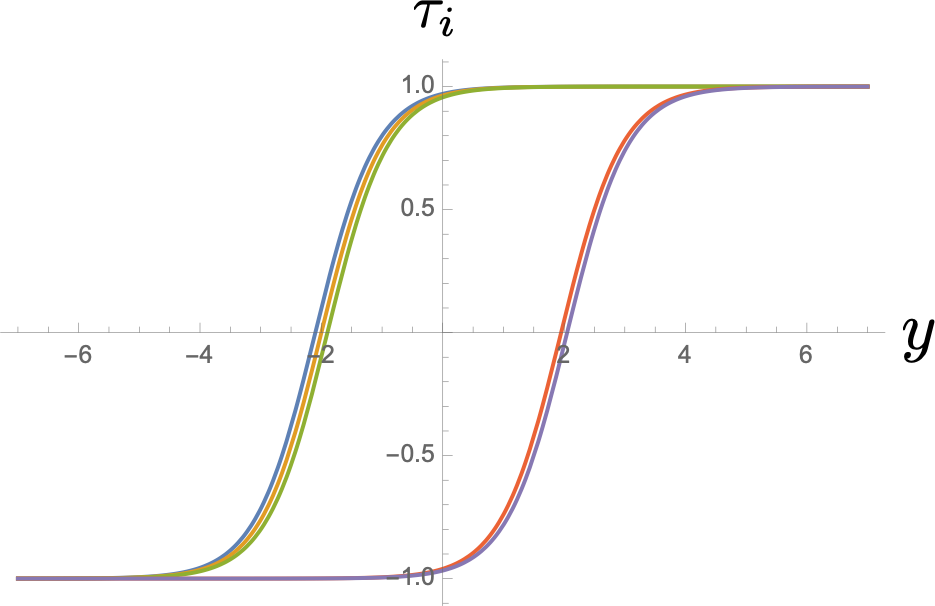
Figure 1: Illustration of the 3-2 split domain wall configuration, which dynamically implements SU(5)→SU(3)×SU(2)×U(1) breaking.
The selection of the SU(5)0-SU(5)1 background as the lowest-energy configuration is supported by a detailed analysis of the effective domain wall potential, which is computed via overlap integrals of hyperbolic tangent domain profiles. The presence of multiple discrete vacua—classified by residual unbroken subgroups—yields a robust spectrum of possible wall configurations, but the energetics described in the paper generically favor the SU(5)2-SU(5)3 pattern unless parameter tuning is substantial.
Unified Localization Mechanisms for Gauge Fields, Fermions, and the Higgs
A significant advance in this work is the deployment of a single adjoint scalar field plus a singlet to localize the bulk Standard Model content. For gauge fields, the localization mechanism utilizes a field-dependent (dielectric) gauge kinetic term. In the presence of a domain wall, when the coefficient function is square-integrable, gauge zero modes become normalizable and localized. This sidesteps confining- or Higgs-phase-based mechanisms, which are technically untenable or imposing in higher-dimensional settings, and ensures that only four-dimensional massless gauge bosons for the unbroken Standard Model group are present in the low-energy spectrum. The localization profile is energetically robust and relatively insensitive to many details of the background.
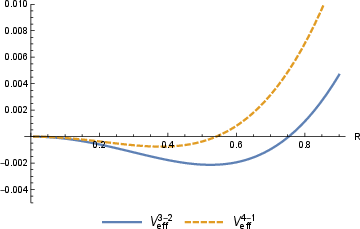
Figure 2: Comparison between effective domain wall potentials SU(5)4 for the SU(5)5-SU(5)6 and SU(5)7-SU(5)8 split configurations, confirming that the SU(5)9-SU(5)0 background is energetically preferable.
Fermion localization is implemented via Yukawa couplings between bulk fermions and the scalar background, leveraging the Jackiw-Rebbi mechanism: the mass term for each representation smoothly interpolates across the wall, yielding localized chiral zero modes (and separating left- and right-handed components according to the sign structure). This method is not only minimal but allows for generation-dependent localization, a critical feature for explaining SM fermion hierarchies.
Novel Higgs Sector and Doublet–Triplet Splitting
One persistent difficulty in SU(5)1 GUTs is the doublet–triplet splitting problem, in which the colored Higgs triplet must be superheavy (to evade proton decay bounds) while the electroweak doublet remains light. The domain-wall framework enables two distinct resolutions:
- Model 1 employs a non-minimal kinetic term for the Higgs field whose profile, controlled by the wall configuration, sharply localizes the doublet while rendering the triplet mode non-normalizable (i.e., its zero mode is projected out of the effective action). This mechanism does not require fine-tuning and is topologically protected, as the mass operator is strictly positive except for the SM doublet, which appears as an edge state.
- Model 2 introduces a potential coupling between the adjoint scalar and the Higgs, yielding a spatially dependent mass term that attracts the doublet toward the wall and repels the triplet, ensuring only the doublet supports a normalizable light mode. However, the model needs parameter fine-tuning to maintain the desired spectrum.
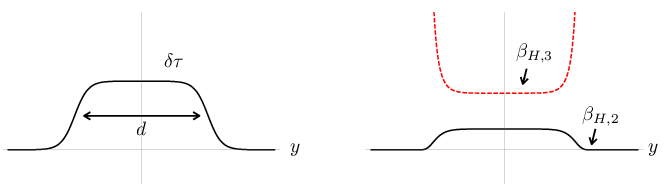
Figure 3: Left panel: Variation of SU(5)2 (domain wall-induced mass difference); Right panel: profiles of the kinetic localization functions SU(5)3 and SU(5)4 for Higgs triplet and doublet, demonstrating selective normalizability.
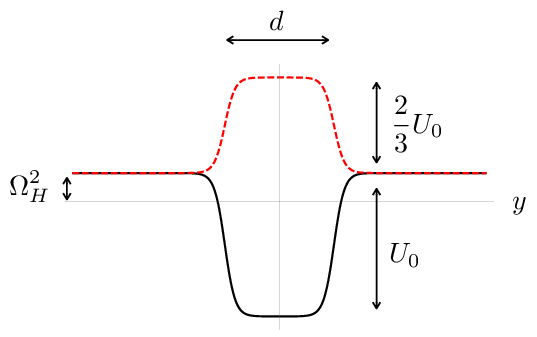
Figure 4: The quadratic mass terms SU(5)5 and SU(5)6 for the electroweak Higgs doublet (solid) and the colored Higgs triplet (dashed), confirming the trapping of the SM doublet and expulsion of the triplet from the wall.
Both models leverage the geometrical properties of the domain wall solutions, directly linking the background configuration to the low-energy scalar spectrum. Model 1, in particular, manifests a bosonic counterpart to the Jackiw-Rebbi edge state, exploiting index-theoretic arguments common in topological insulators for field-theoretic localization.
Realistic Fermion Masses and Yukawa Structures
Bulk Yukawa couplings in 5D are generation-universal at the SU(5)7 unification level, but the effective four-dimensional Yukawa couplings emerge as overlap integrals of localized zero-mode wavefunctions. Since the positions and widths of the chiral zero modes can be generation-dependent (sourced by distinct bulk Yukawa parameters for each generation), the effective theory generically evades the rigid SU(5)8 mass relations such as SU(5)9 that render minimal 4D GUTs phenomenologically untenable. The model reproduces the observed SM fermion spectrum and mixing, as demonstrated by explicit matching of the running Yukawa matrices to their observed values at the weak scale via renormalization group analysis.
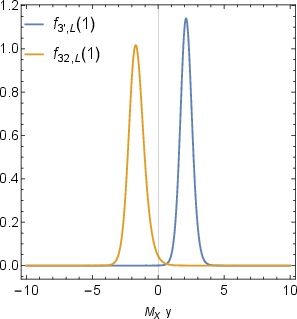
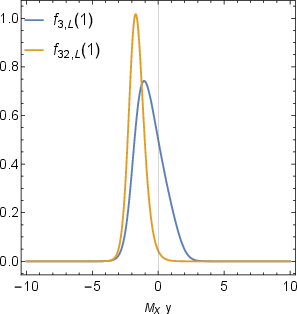
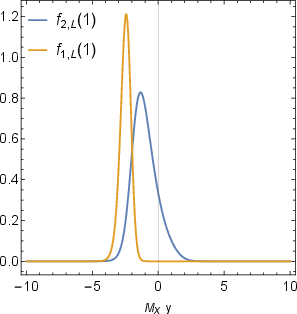
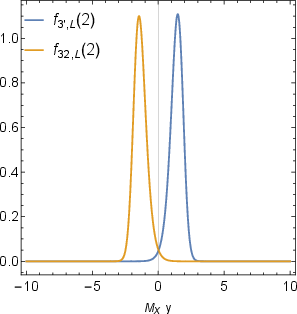
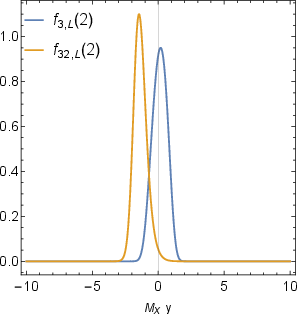
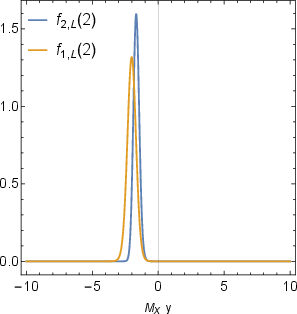
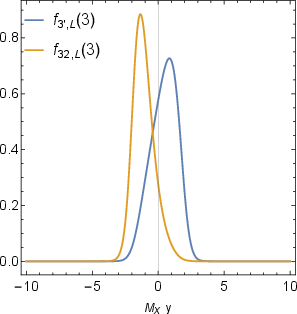
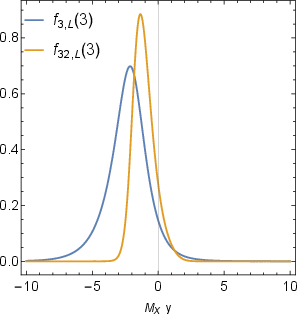
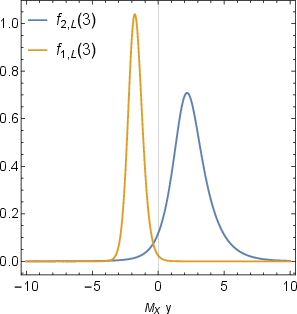
Figure 5: Example overlaps of normalized fermion zero-mode functions for up- and down-type quarks and charged leptons, displaying generation-dependent localization essential for realistic mass hierarchies.
Notably, this solution circumvents the need for extended Higgs representations (such as the Georgi–Jarlskog 30) or higher-dimensional operators—a notable economy.
Implications and Theoretical Outlook
The unification of domain wall–based localization, symmetry breaking, and spectrum generation in a single framework establishes a technically minimal construction with substantial theoretical and phenomenological advantages:
- Dynamical brane realization: The brane emerges naturally as a solitonic domain wall, obviating hand-inserted branes and addressing issues of localization stability.
- Unified field localization: All SM fields—including gauge bosons, chiral fermions, and the Higgs—are localized dynamically through coupling to the same background field configuration.
- Doublet–triplet splitting: The geometric (and, in one realization, topological) solution to projective scalar localization removes the necessity for fine-tuned potentials or engineered orbifold parities.
- Flexible Yukawa sector: Generation-dependent overlaps provide sufficient freedom to fit observed masses and mixings, escaping the unrealistic mass relations endemic to conventional GUTs.
The framework is amenable to further generalization, including other gauge groups or spacetime dimensions, but is subject to the practical caveat that the localization of gauge fields fundamentally relies on the existence of appropriate background field profiles. The construction may prove useful in constructing ultraviolet completions of brane-world GUTs or realizing string-inspired phenomenological models.
Conclusion
This 31 brane world model demonstrates that a single adjoint plus singlet scalar field is sufficient to dynamically break gauge symmetry, fully localize the Standard Model spectrum, and implement robust doublet–triplet splitting without recourse to extended Higgs sectors. The effective action reproduces four-dimensional SM physics at low energies and accommodates a realistic fermion mass sector via generational overlap integrals. Theoretical mechanisms employed—especially the kinetic localization for both gauge and Higgs fields—constitute a significant simplification for unified brane-world model building. This approach warrants further investigation, particularly regarding embedding in higher-dimensional string frameworks and possible connections to flavor symmetry breaking or cosmological domain wall scenarios.