- The paper presents RAG-Reflect, a novel modular framework that predicts valid comment-driven code edits without requiring domain-specific tuning.
- It combines retrieval, reasoning, and rule-driven reflection to achieve balanced precision (0.81) and recall (0.74) on Stack Overflow data.
- Its agentic workflow enhances explainability and adaptability for automatic code maintenance across diverse programming languages.
Agentic Retrieval-Augmented Generation and Reflection for Comment-Driven Code Maintenance
Introduction
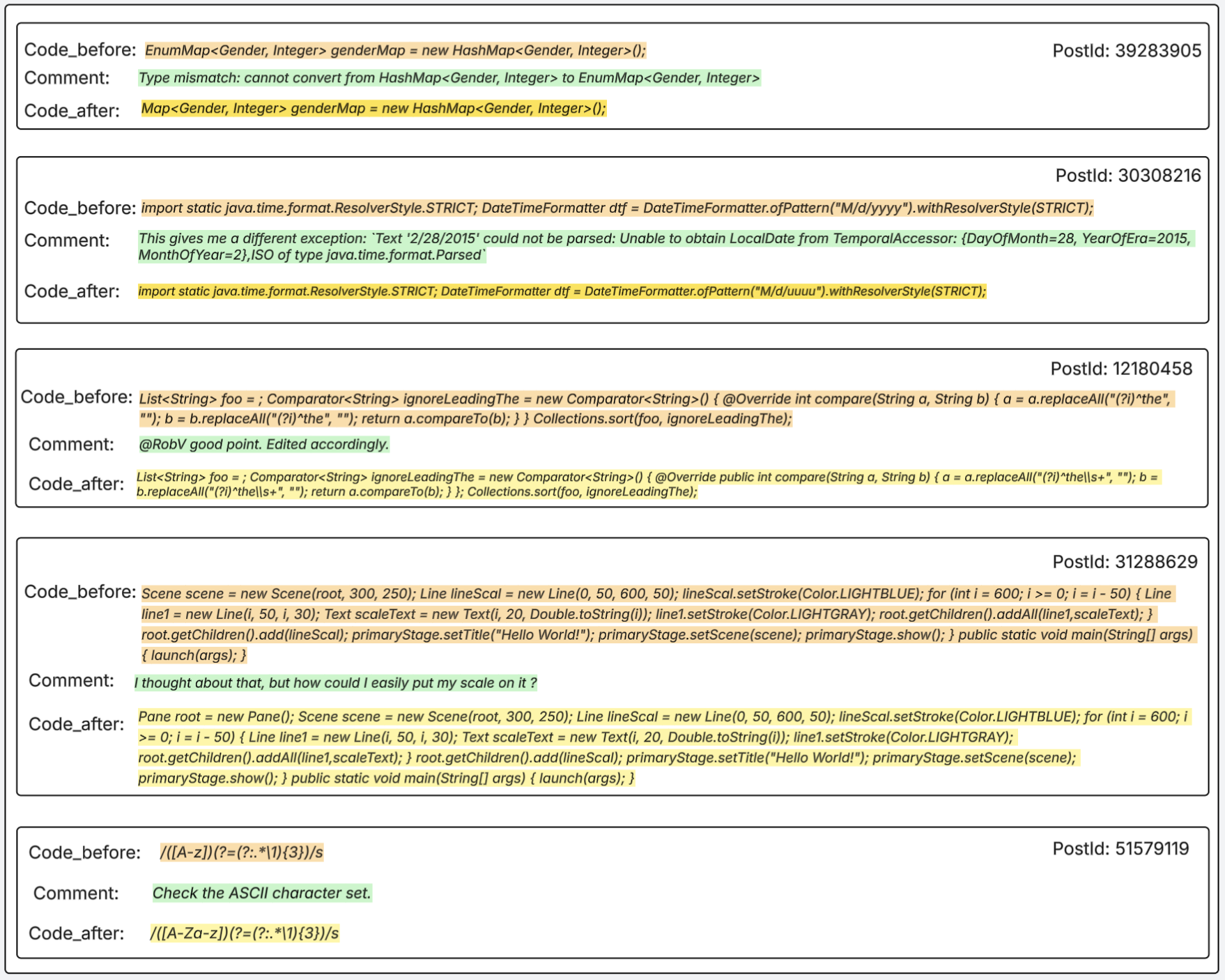
"1RAG-Reflect: Agentic Retrieval-Augmented Generation with Reflections for Comment-Driven Code Maintenance on Stack Overflow1" (261RAG-Reflect: Agentic Retrieval-Augmented Generation with Reflections for Comment-Driven Code Maintenance on Stack Overflow14.22217) addresses the critical challenge of maintaining correctness and relevance in community-managed code artifacts, specifically on platforms such as Stack Overflow. The paper identifies and operationalizes the Valid Comment–Edit Prediction (VCP) task, which involves determining whether a user comment directly motivates a code edit. The authors introduce RAG-Reflect—a modular, agentic workflow combining retrieval, LLM-based reasoning, and rule-driven reflection—to achieve high-fidelity comment-edit alignment without requiring domain-specific fine-tuning.
Stack Overflow's collaborative Q&A paradigm fosters code reuse among developers, amplifying the importance of accurate and up-to-date answers. Comments on posts serve as transient micro-reviews, flagging issues such as deprecated APIs, correctness bugs, or recommended improvements. However, most comments do not prompt actionable edits, and the comment-edit connection is often implicit and context-dependent.
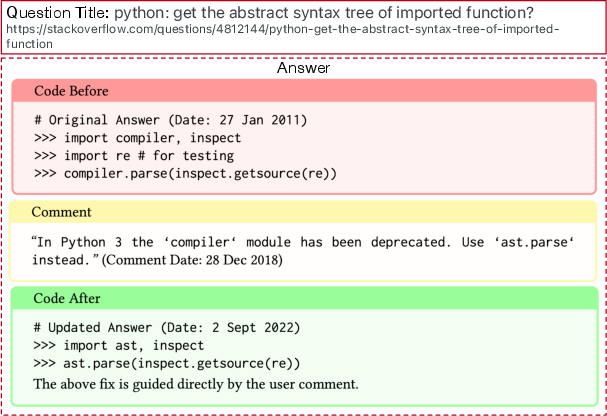
Figure 1: An example of a comment that triggered the edit to a Stack Overflow answer.
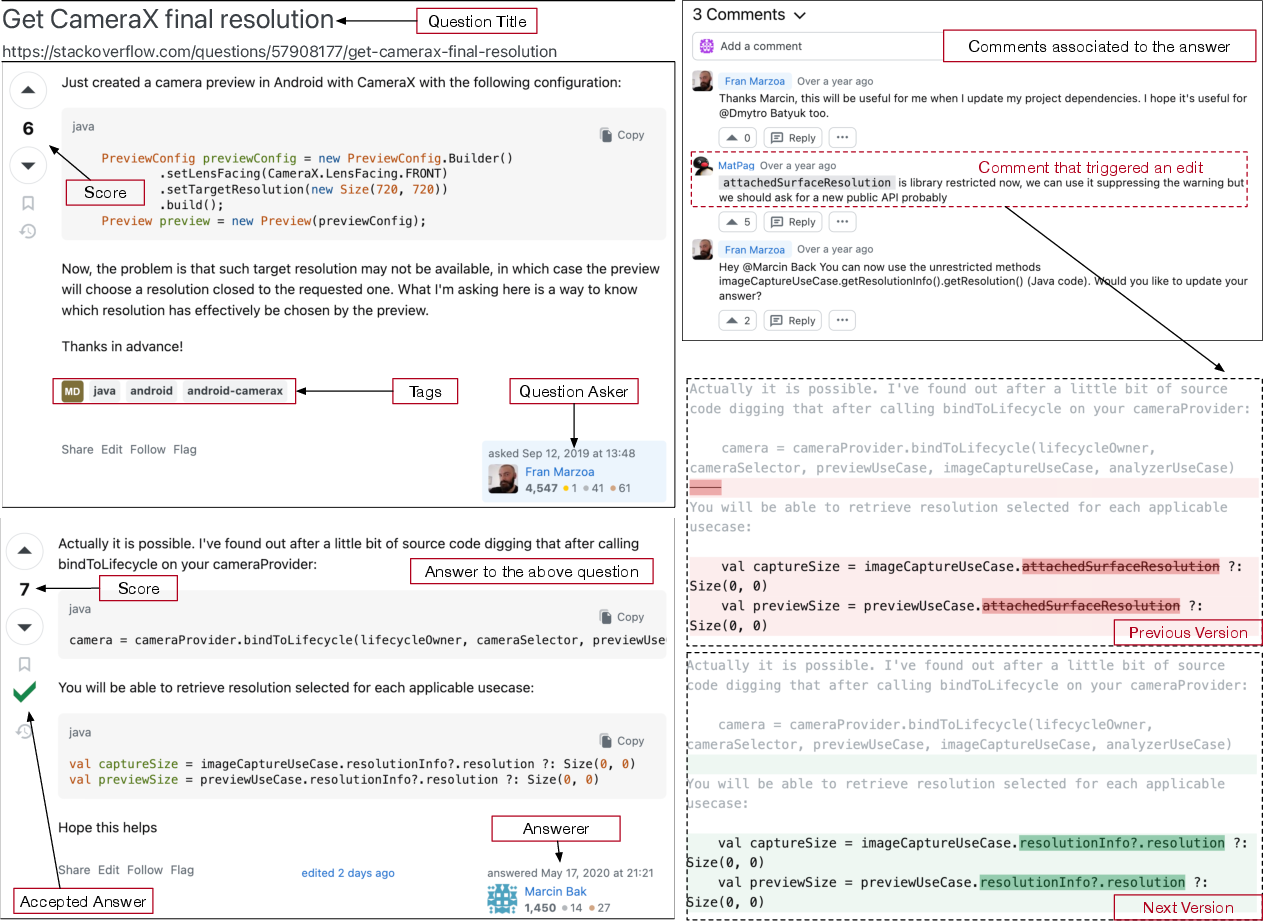
Figure 2: An example illustrating a comment prompting an edit to maintain answer freshness.
The paper’s motivating examples demonstrate that comment-driven edits often entail minimal but semantically critical changes—for example, adding axis=1 to a pandas call or replacing equals("") with isEmpty() in Java.
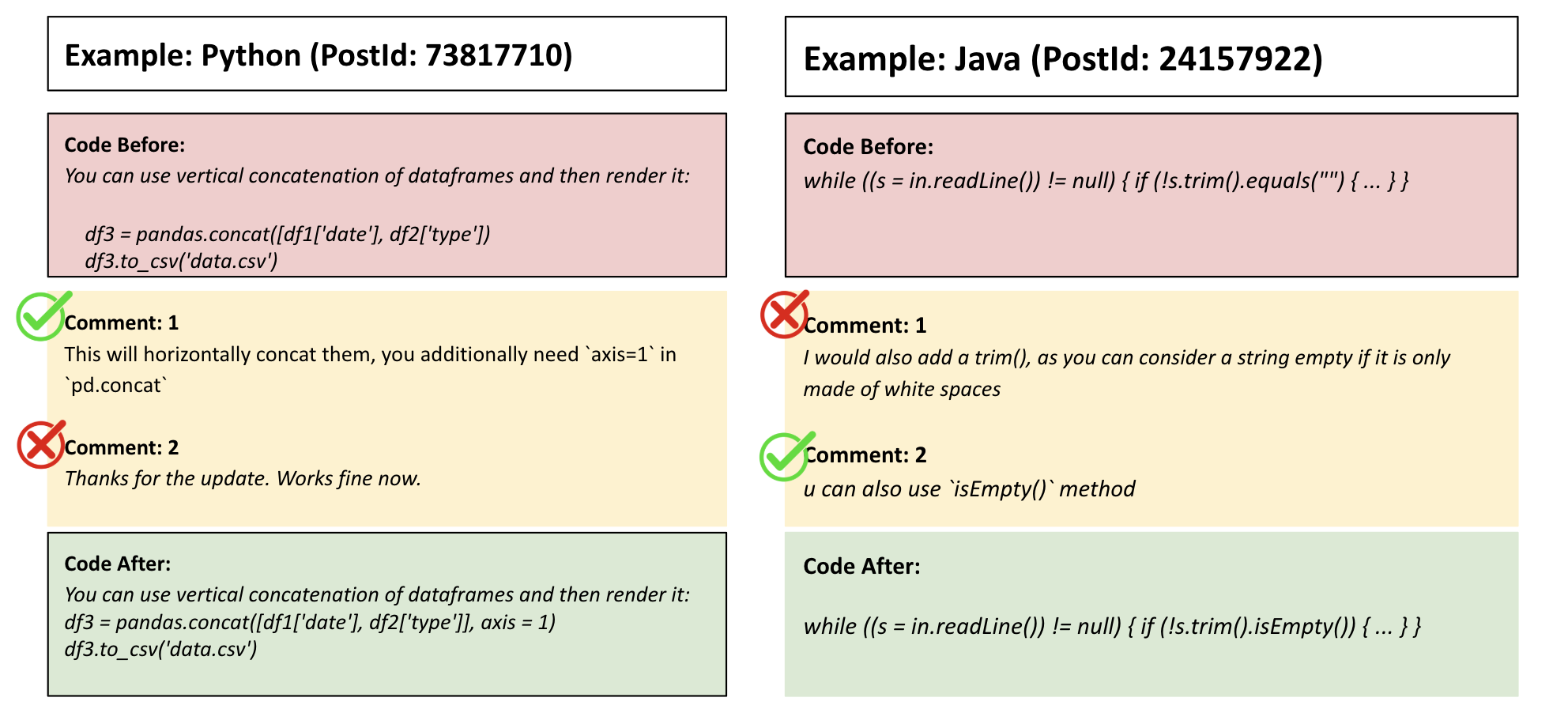
Figure 3: Motivating examples of comment-driven edits on Stack Overflow; small, context-driven edits enhance code correctness and idiomaticity.
Agentic Workflow Architecture
RAG-Reflect operationalizes the VCP task using an agentic workflow structured across four modules:
- Interpretation: Performs a one-time corpus-scale analysis to extract validation rules that distinguish actionable comments from conversational or irrelevant ones.
- Retrieval: Given a test instance, retrieves semantically similar historical comment-edit pairs using MiniLM embeddings and FAISS indexing.
- Reasoning: Prompts an LLM (e.g., GPT-4o) to contextualize the current comment-edit pair against retrieved analogs and decide causality.
- Reflection: Applies pre-extracted validation rules to audit the LLM's initial decision, enforcing logical consistency and correcting misclassifications.
This agentic decomposition enables modular analysis, explainability, and extensibility, converting the traditional single-pass classification paradigm into an iterative, contextually grounded decision-making process.
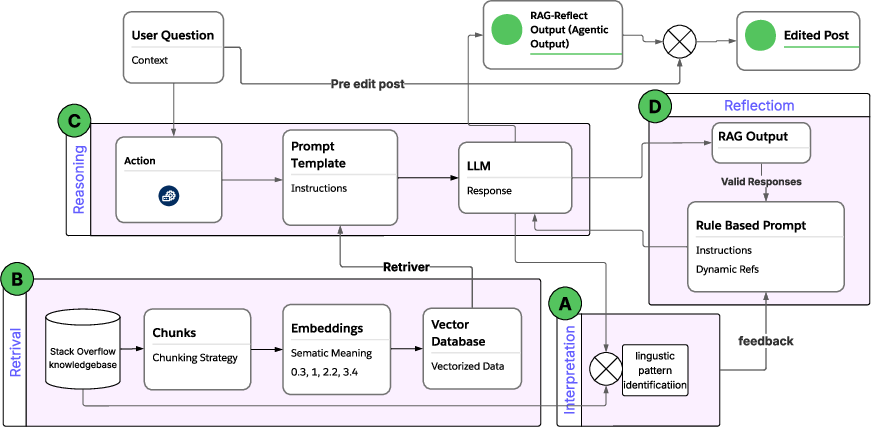
Figure 4: Agentic retrieval-augmented workflow for comment-driven code maintenance—modules act as autonomous agents for perception, memory, reasoning, and reflection.
Empirical Evaluation and Numerical Results
The authors benchmark RAG-Reflect against traditional ML baselines, heuristic matching, fine-tuned LLMs (e.g., SOUP), and strong zero-shot LLMs. On the SOUP dataset (Java):
- RAG-Reflect achieves Precision = 1RAG-Reflect: Agentic Retrieval-Augmented Generation with Reflections for Comment-Driven Code Maintenance on Stack Overflow1.81, Recall = 1RAG-Reflect: Agentic Retrieval-Augmented Generation with Reflections for Comment-Driven Code Maintenance on Stack Overflow1.74, F1 = 1RAG-Reflect: Agentic Retrieval-Augmented Generation with Reflections for Comment-Driven Code Maintenance on Stack Overflow1.78 for the valid class; this performance slightly exceeds the fine-tuned SOUP model (F1 = 1RAG-Reflect: Agentic Retrieval-Augmented Generation with Reflections for Comment-Driven Code Maintenance on Stack Overflow1.773) while offering more stability across examples.
- The modular workflow significantly outperforms feature-based classifiers and heuristic approaches, especially on the challenging valid comment-edit prediction category.
Ablation studies highlight the following:
- Retrieval alone boosts recall but suffers from overgeneralization.
- Reflection improves precision by enforcing linguistic and semantic constraints.
- Their synergy (full RAG-Reflect pipeline) optimally balances precision and recall—neither is sufficient independently.
Prompt engineering (zero-shot, few-shot, chain-of-thought) demonstrated inconsistent performance across models. RAG-Reflect consistently outperforms these prompting techniques, indicating agentic modularity is superior to prompt-only control for this reasoning-intensive task.
Failure Analyses and Limitations
Manual error analysis exposes critical failure cases for RAG-Reflect:
These insights suggest that the framework’s robustness may be further enhanced by incorporating advanced semantic parsing or program analysis, especially to better capture implicit intent and refactorings.
Implications and Future Directions
RAG-Reflect provides a modular, transparent, and easily extensible workflow for actionable comment detection and code maintenance automation, generalizing effectively across languages (Java, Python) without retraining. Its agentic decomposition is theoretically aligned with recent advances in cognitive AI, supporting interpretable reasoning, self-critique, and external memory integration [Acharya21RAG-Reflect: Agentic Retrieval-Augmented Generation with Reflections for Comment-Driven Code Maintenance on Stack Overflow125Survey, Ng21RAG-Reflect: Agentic Retrieval-Augmented Generation with Reflections for Comment-Driven Code Maintenance on Stack Overflow124AgenticWorkflow].
Practically, RAG-Reflect offers:
- Data-efficient adaptation to new domains without expensive fine-tuning.
- Enhanced reliability and explainability in code-edit recommendation systems.
- A principled basis for autonomous code updating agents in collaborative code repositories and Q&A environments.
Theoretically, RAG-Reflect's abstraction of perception, memory, reasoning, and reflection as modules is a forward-looking blueprint for agentic systems in empirical software engineering. Future enhancements may include multi-agent collaboration, language-specific semantic retrieval indices, AST-level reasoning, or integration with code execution/verification tools.
Conclusion
RAG-Reflect exemplifies the practical value of agentic AI workflows for knowledge maintenance in developer forums. By modularizing retrieval, reasoning, and reflection, it achieves fine-tuned-level performance for Valid Comment–Edit Prediction and extensible Automatic Post Updating without per-instance training. The demonstrated reliability, explainability, and adaptability underscore its potential as a foundational technique for next-generation agentic code maintenance systems, with wide applicability across programming languages and evolving knowledge bases.