- The paper presents direct, high-fidelity measurements of full-field transfer matrices in photonic lanterns, establishing that differential modal phase accumulation drives their wavelength response.
- The study employs off-axis holographic imaging to achieve 98% decomposition fidelity, precisely capturing amplitude and phase variations across a 50-nm wavelength range.
- Findings provide a quantitative framework linking multimode fiber length to spectral sensitivity, offering concrete design guidelines for broadband or spectroscopic applications.
Wavelength-Dependent Evolution of Full-Field Transfer Matrices in Photonic Lanterns
Introduction and Motivation
Photonic lanterns (PLs) are key waveguide devices enabling coherent, low-loss interfacing between arrays of single-mode fibers (SMFs) and a multimode fiber (MMF), pivotal for future high-capacity communications, astronomical instrumentation, and advanced beam shaping. The principal device function is encoded in its transfer matrix (TM), relating amplitude and phase between input single-mode channels and guided output modes. Although the device concept originated in astrophotonics for efficient coupling and single-mode filtering [leon-saval_multimode_2005], PLs are now central in diverse applications—lidar, wavefront sensing, sub-diffraction imaging, and multiplexed communications.
A key property of non-mode-selective PLs is their pronounced wavelength-dependent response. Precise characterization and understanding of this evolution are critical where either wavelength stability or spectral discrimination are required. However, a unified physical explanation and quantitative model for this spectral behavior has remained elusive, particularly for non-mode-selective lanterns where arbitrary mixing dominates.
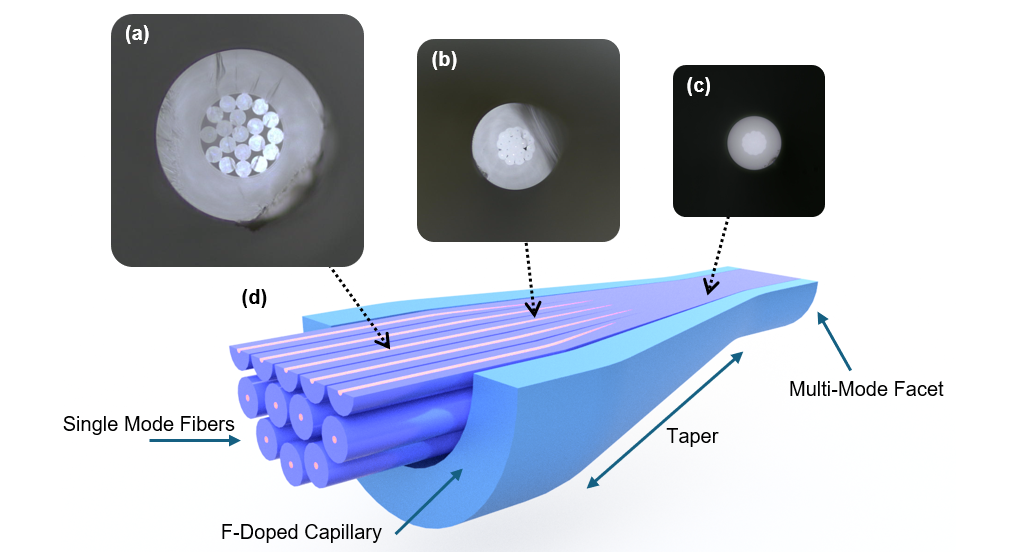
Figure 1: Conceptual structure of an SMF-based photonic lantern, highlighting independent cores in the input, fusion and modal coupling in the taper, and full mixing at the MMF output.
Experimental Strategy: Direct Complex TM Measurement
The authors implement high-fidelity off-axis holographic imaging to directly recover the complex-valued, wavelength-resolved encoding TM of a 19-port SMF-based PL, spanning 1525–1575 nm. The experimental strategy leverages a Mach-Zehnder configuration with polarization control and a programmable optical switch to cycle through input ports. The downstream MMF output field is acquired via a lens onto an InGaAs camera, recording an interference pattern with a reference beam.
The fringe patterns are processed by Fourier domain selection (centering the twin-image via subpixel Fourier binning and low-pass filtering), inverse Fourier transforming to retrieve ES(r), then modal decomposing onto calculated LP modes. Empirical and numerical corrections are applied to mitigate optical aberration and pixelation artifacts, ensuring accurate phase recovery. High decomposition fidelities (98%±0.8%) validate the approach.
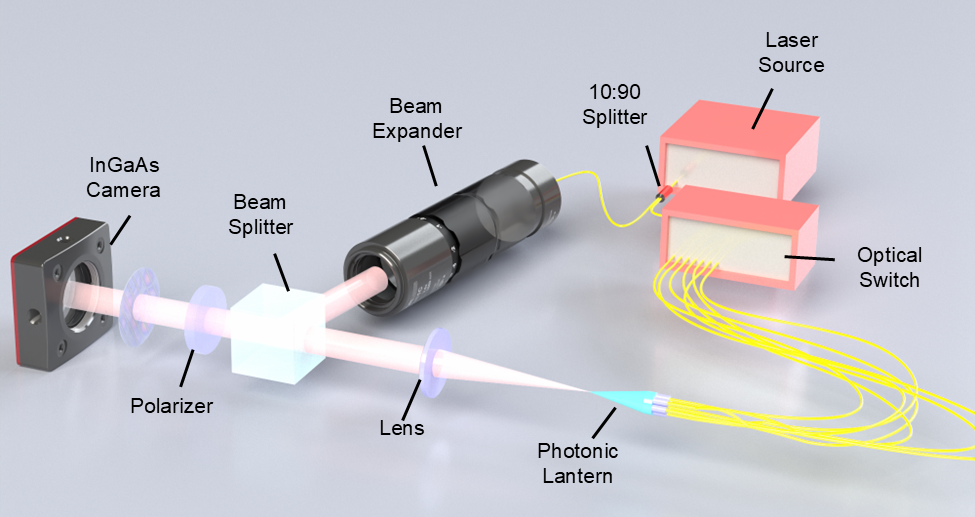
Figure 2: Schematic of the off-axis holography setup for measuring the output electric field of the photonic lantern.
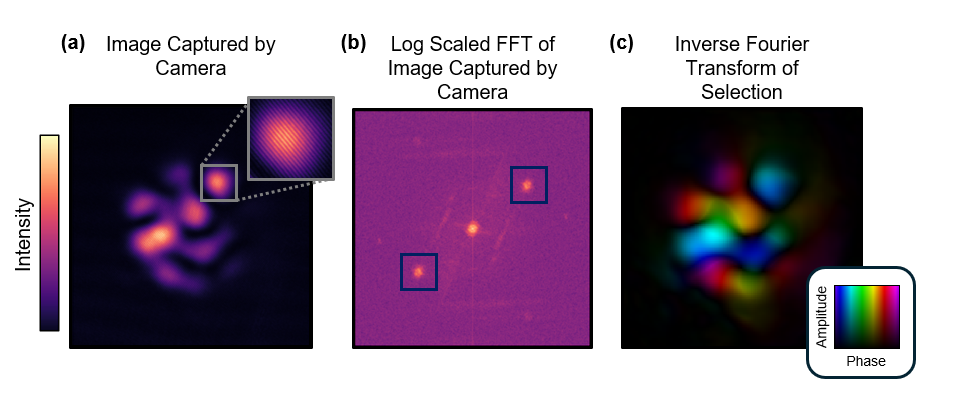
Figure 3: Hologram processing pipeline: (a) captured intensity, (b) Fourier transform with twin-image regions, (c) recovered complex field.
Results: Transfer Matrix Structure and Modal Evolution
Full-Field TM Visualization and Mode Decomposition
The measured encoding TM exhibits pronounced, random mixing with no enforced symmetry, as expected from non-mode-selective fabrication (small Δβ during tapering). Each SMF input maps to an apparently stochastic combination of MMF-supported LP modes, with devices showing a dimensional mismatch—19 inputs vs. 23 supported LP modes. The resulting TM is inherently non-square, precluding unitary transformation and negating the invertibility between encoding and decoding TMs, consistent with recent full-field measurements [romer_decoding_2026, taras_illuminating_2026].
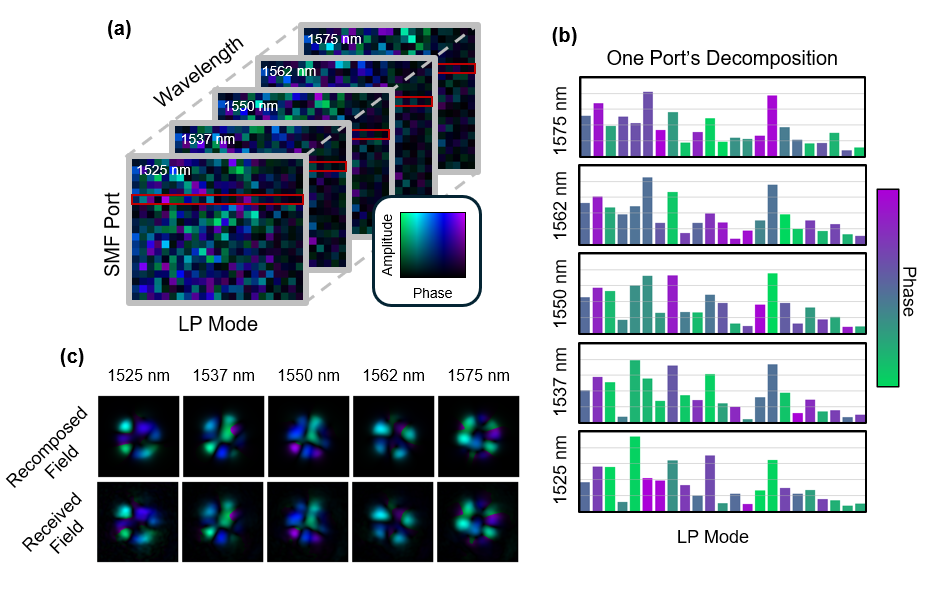
Figure 5: Visualization of the complex TM, modal content of a representative input, and comparison of measured vs. reconstructed field.
Spectral TM Correlations and Physical Mechanism
Quantifying the wavelength evolution, TM correlations as a function of wavelength separation display sinc-like dependence: rapid phase decorrelation occurs over ≈15 nm, with amplitude correlations persisting longer. Secondary correlation maxima appear at larger separations, signifying partial rephasing between modal groups.
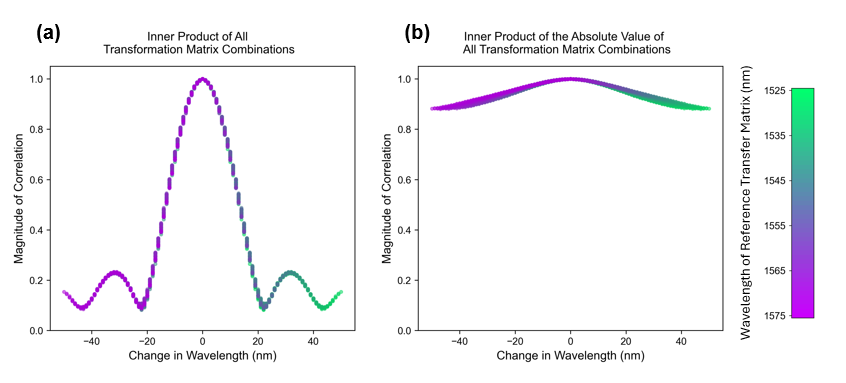
Figure 4: Wavelength correlation of the full-field transfer matrix—phase correlations (a) and amplitude-only correlations (b) vs. wavelength separation.
Simulations implementing the Taper Reference Frame method [tschernig_efficient_2026] confirm that multimode propagation after the taper dominates the measured spectral evolution. The TM at the MMF output is modeled as
TML(λ)=TM0(λ)ejβ(λ)L,
with differential modal phase accumulation (Δβ) determined by MMF propagation constants. With increased MM section length L, the wavelength response accelerates, reducing the spectral correlation width. Experiment and simulation coincide, establishing that the principal wavelength sensitivity mechanism is differential phase accumulation in the MMF section—not intrinsic tapering or core fusion effects.
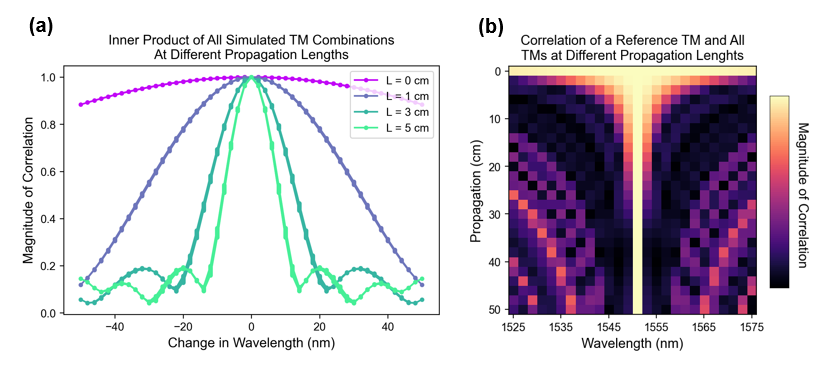
Figure 6: Simulated TM correlations as a function of post-taper MMF length L, demonstrating dominant role of phase evolution.
Discussion: Implications for Design and Application
The results isolate the MMF region as the locus for wavelength sensitivity and enable predictive design: reducing the MMF length improves broadband TM stability for multiplexers or wavefront sensors, while extension amplifies spectral fingerprinting in spectroscopic and imaging contexts [kim_potential_2024, choudhury_computational_2020]. This insight directly links geometry to device function, addressing the previously ad hoc engineering of PL wavelength response.
The observed lack of amplitude decorrelation across the measurement bandwidth, and the residual intensity scrambling attributable to the taper, indicate that phase evolution dominates near the MM/MMF interface, with secondary contributions from fabrication-induced imperfections and possible twisting or material intrusions [wang_impact_2025].
Practically, these findings inform the fabrication of PLs for photonic quantum information, high-fidelity beam combining, and a new generation of broadband integrated photonic devices, leveraging application-tailored spectral responses. Potential avenues include distributed mode-matching control, intentional modal dispersion, and tightly engineered tapers to further decouple amplitude from phase sensitivity, as well as empirical optimization via adaptive modal characterization [zhang_all-fiber_2021, chandrasekharan_polarization-independent_2025].
Conclusion
This work establishes, through direct complex-valued measurement and rigorous modeling, that the dominant mechanism shaping the wavelength dependence of PL transfer matrices is differential modal phase accumulation in the MMF region after the taper. The device geometry—especially the MMF section length—serves as the principal control parameter for engineering the spectral response. Secondary decorrelation mechanisms are attributed to mode scrambling within the taper, influenced by fabrication disorder. Collectively, the results provide a quantitative and physically grounded design framework for photonic lanterns, enabling targeted optimization for spectroscopic discrimination or broadband stability in advanced photonic systems.
References:
- "Wavelength-Dependent Evolution of Full-Field Transfer Matrices in Photonic Lanterns" (2604.22091)
- "Decoding the complex transfer matrix of photonic lanterns" [romer_decoding_2026]
- "Illuminating the lantern: coherent, spectro-polarimetric characterization of a multimode converter" [taras_illuminating_2026]
- "Efficient modeling of tapered photonic structures" [tschernig_efficient_2026]
- "On the potential of spectroastrometry with photonic lanterns" [kim_potential_2024]
- "Computational optical imaging with a photonic lantern" [choudhury_computational_2020]
- "Impact of capillary material intrusion on the photonic lantern performance" [wang_impact_2025]
- "All-fiber photonic lantern multimode optical receiver with coherent adaptive optics beam combining" [zhang_all-fiber_2021]
- "Polarization-independent deterministic mode localization in a photonic lantern" [chandrasekharan_polarization-independent_2025]