- The paper introduces H-Sets, a method that leverages Hessian matrices to detect and attribute set-level feature interactions in vision models.
- It combines Hessian-based interaction detection with Integrated Directional Gradients to generate semantically coherent and sparse saliency maps.
- Empirical results show that H-Sets achieves high model fidelity and sparsity across architectures, highlighting its potential for trust-critical applications.
Hessian-Guided Set-Level Feature Interaction Attribution in Image Classifiers
Motivation and Limitations of Existing Approaches
Contemporary feature attribution techniques for deep neural networks, such as Integrated Gradients (IG), primarily focus on quantifying the marginal effects of individual features. These approaches fail to account for joint, higher-order dependencies between features—an insufficiency that is particularly consequential in image classification, where object semantics are emergent properties of complex pixel interactions. Existing interaction-attribution frameworks are typically either prohibitively expensive for large-scale images, operate only at the coarse superpixel or segment level, or violate key interpretability axioms.
H-Sets Framework: Two-Stage Discovery and Attribution
H-Sets introduces a principled two-step methodology for discovering and attributing set-level feature interactions in vision models:
- Detection of Interaction Sets via Hessians: H-Sets deploys the input Hessian (second-order input derivatives) to identify pairs of features exhibiting non-additive statistical dependencies. These pairs are recursively augmented into higher-order sets, guided by spatial coherence enforced through a segmentation mask (by default, from the Segment Anything Model (SAM), but modular). This approach leverages the Hessian exclusively for interaction detection, circumventing saturation-induced misattribution in flat regions of the input space.
- Set-Level Attribution with IDG-Vis: For each detected interaction set, H-Sets employs Integrated Directional Gradients for Vision (IDG-Vis)—an extension of the IDG method for text. IDG-Vis aggregates directional gradients along paths in pixel space and applies Harsanyi dividends from cooperative game theory to directly characterize the unique joint contribution of feature coalitions, decoupling main and interaction effects.
This methodology enforces sparsity and faithfulness, yielding attributions that are concise, semantically coherent, and axiomatically grounded.
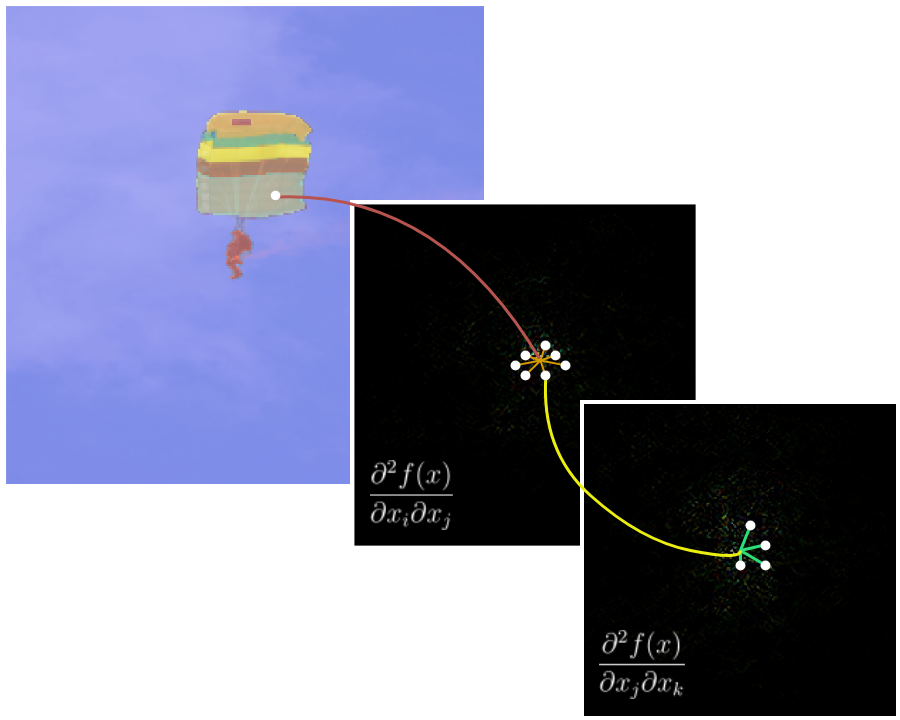
Figure 2: Overview of the H-Sets algorithm, which combines Hessian-based interaction search with segmentation priors to discover and expand interaction sets recursively.
Theoretical and Algorithmic Details
H-Sets formally defines an interaction as a subset I of image features for which the classifier logit f(x) exhibits statistical non-additivity. Pairwise interactions are detected when the corresponding Hessian entry exceeds threshold μ: Hfc[i,j]>μ. Higher-order sets are constructed recursively by appending strongly interacting features from the Hessian and are capped by a size hyperparameter ν.
For attribution, a direction vector is constructed for each set I, and the directional gradient ∇If(x) is integrated from a baseline x′ to the input x. The set-level score is the sum of Harsanyi dividends (difference-in-differences over all subsets), approximated by Monte Carlo sampling of the power set.
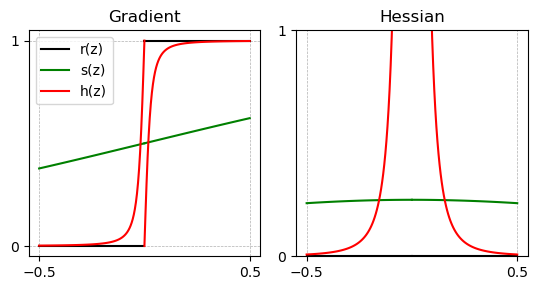
Figure 4: Comparison of gradients and Hessians for distinct activation functions, highlighting the stability of the proposed Zhang \emph{et al.} (2020) smoothing for ReLU in Hessian-based attribution.
Importantly, H-Sets satisfies a suite of essential axioms, including non-negativity, normality, monotonicity, superadditivity, approximate completeness, sensitivity, implementation invariance, linearity, and symmetry, providing theoretical guarantees on explanation behavior.
Empirical Evaluation and Ablation
Experiments are conducted across VGG, ResNet, DenseNet, and MobileNet on ImageNet and CUB datasets. H-Sets is benchmarked against IG, Archipelago, CAFO, CASO, and MOXI.
Qualitative Analysis
H-Sets produces clear, compact, and spatially meaningful saliency maps, outperforming both marginal and prior interaction-based methods in highlighting the true model reasons for prediction.
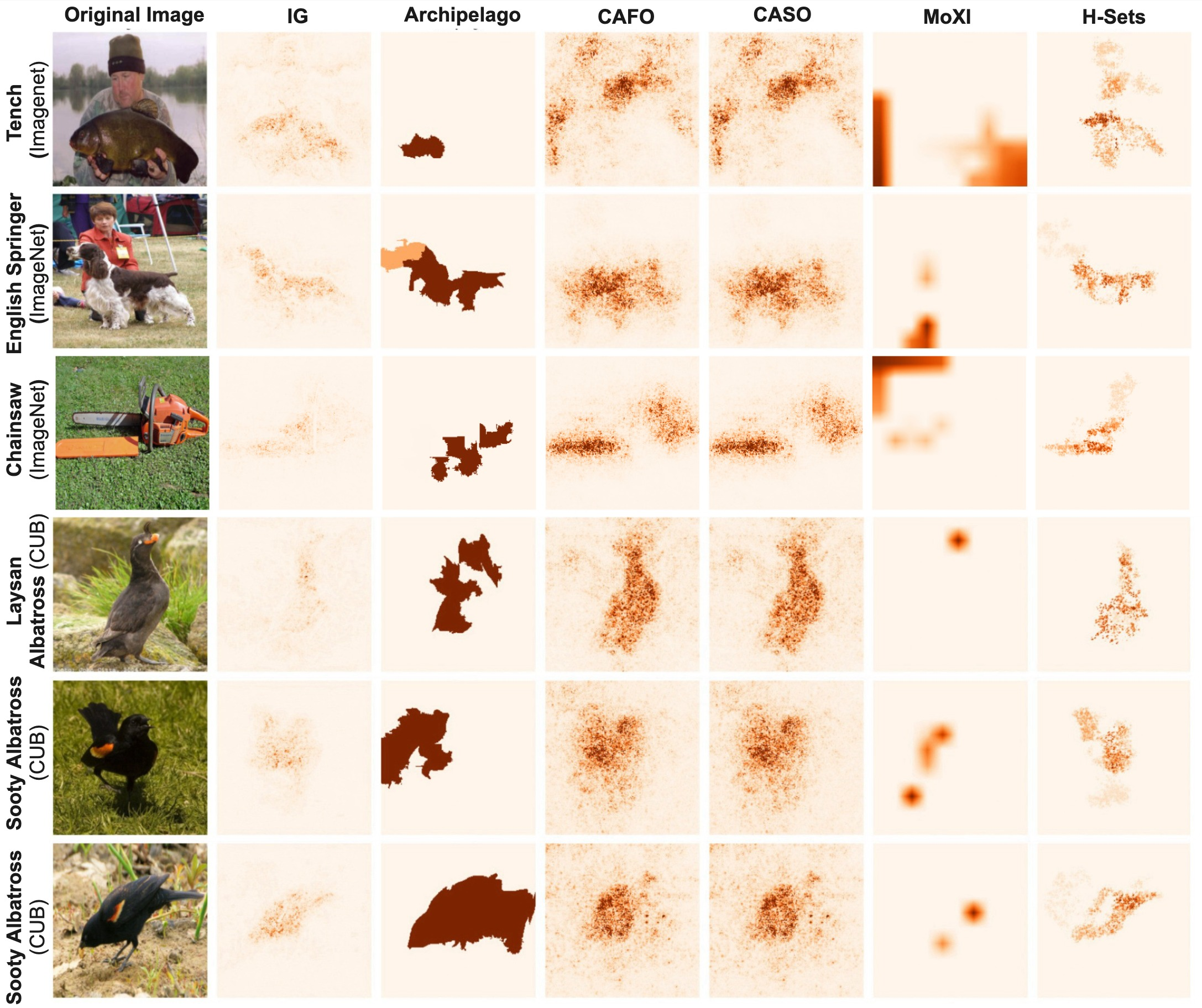
Figure 5: Comparison between IG, Archipelago, CAFO, CASO, MOXI, and H-Sets on ImageNet and CUB samples with DenseNet121 models, demonstrating superior semantic localization and compactness for H-Sets.
H-Sets also successfully attributes non-semantic model shortcuts, as established on DecoyMNIST, where it localizes spurious decoy patches contrary to the strong semantic image prior.
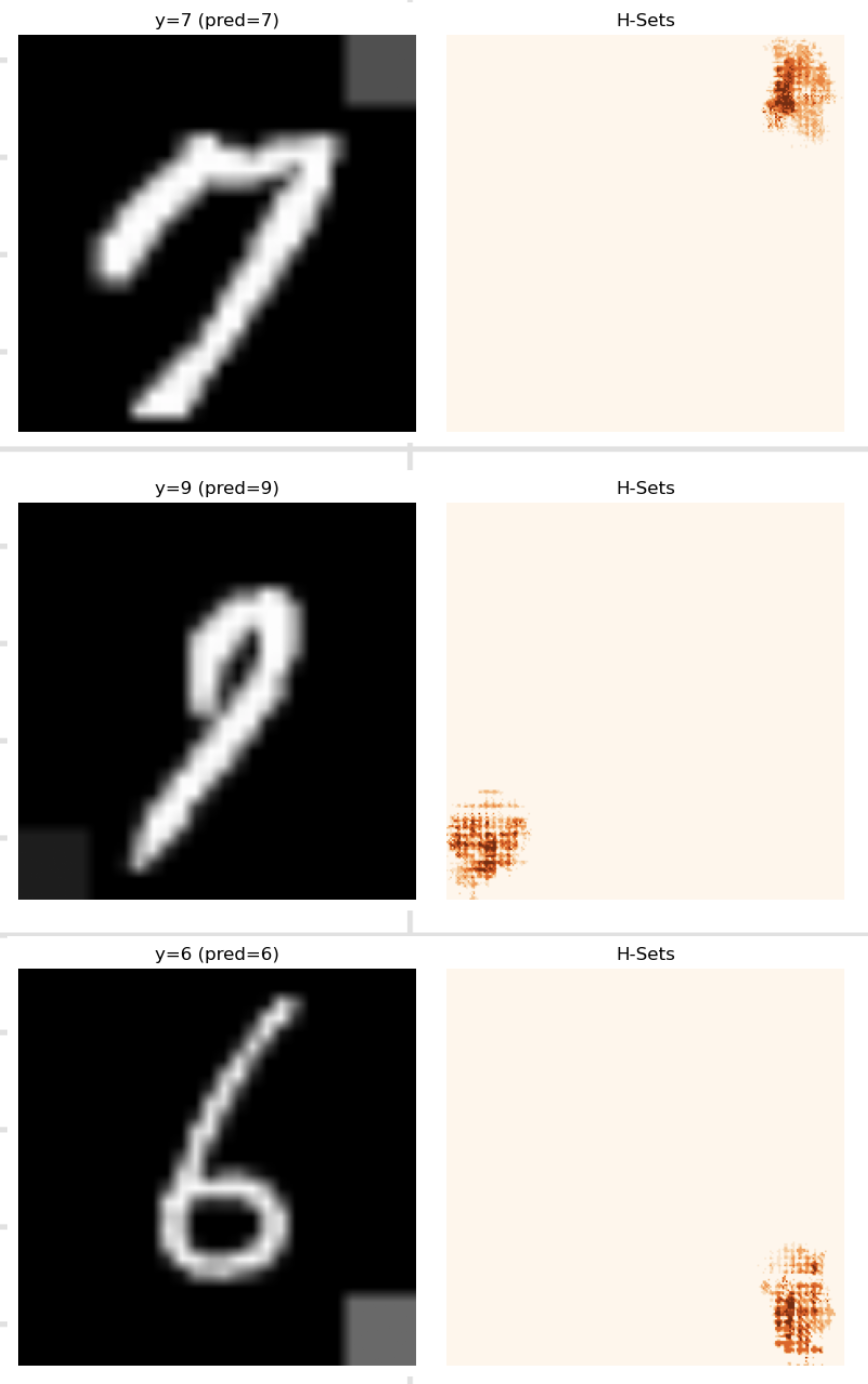
Figure 6: H-Sets attribution on DecoyMNIST, showing precise localization of non-semantic spurious cues, independent of semantic segmentation priors.
Quantitative Results
- Sparsity: H-Sets achieves higher or competitive Gini index scores compared to all baselines across architectures and datasets, with saliency maps that are significantly sparser than those derived from non-interaction or region-based alternatives. In several configurations, H-Sets attains Gini values above 0.95.
- Faithfulness: On the ROAD-AOPC metric, which measures fidelity of attribution by quantifying prediction drop when the most-attributed pixels are removed, H-Sets consistently yields the highest scores across ImageNet and CUB (e.g., up to 0.38 on ImageNet/DenseNet, 0.65 on CUB/VGG), indicating improved alignment with the model’s actual decision-making logic.
Hyperparameter Ablations
Ablation on set size (ν), Hessian threshold (f(x)0), seed initialization, segmentation strategy, and number of interaction sets (f(x)1) show that H-Sets is robust, and performance (both faithfulness and sparsity) is relatively insensitive to moderate parameter changes. Critically, combining IG-based seed selection with SAM segmentation achieves the best tradeoff between interpretability and model faithfulness.
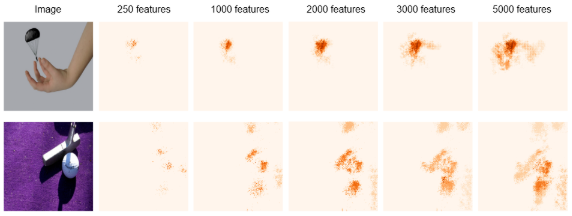
Figure 3: Saliency maps with varying f(x)2 values on ImageNet, illustrating the effect of set size on map sparsity and coverage.
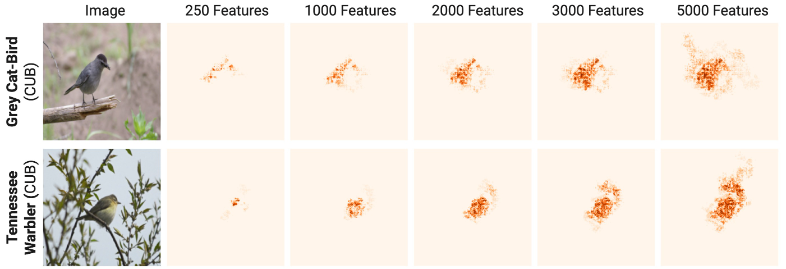
Figure 1: Saliency maps with different values of f(x)3 on CUB, affirming robustness and semantic integrity of attributions at different interaction set sizes.
Computational Considerations and Limitations
The primary computational overhead of H-Sets arises from Hessian computation during the detection phase, but this is amortized by restricting second-order computation to the most salient regions and relies on pixel-space priors for efficiency. The approach is currently tailored to convolutional architectures; adaptation to Vision Transformers and further reduction of Hessian costs are identified as avenues for future work.
Broader Implications and Theoretical Advances
H-Sets establishes that input Hessians are a powerful mechanism for uncovering non-additive interactions at pixel-level granularity and that cooperative game theory can be harnessed to produce set-level attributions which are both interpretable and faithful. Adherence to attribution axioms makes H-Sets amenable for deployment in trust-critical settings such as medical vision and autonomous systems. Furthermore, the modular design (replaceable segmentation and seeds) paves the way for domain-specific customization and generalization beyond classification tasks.
Conclusion
H-Sets (2604.22045) advances the rigor and fidelity of vision model explanation by marrying Hessian-guided interaction discovery with cooperative game-theoretic set attribution. The approach achieves superior sparsity, faithfulness, and semantic coherence on standard vision benchmarks compared to both traditional marginal and recent interaction-centric attribution frameworks. These results provide a robust foundation for future research into scalable interaction discovery, more efficient second-order computations, and extension to broader architectures and modalities.

