- The paper systematically investigates the gap between high student GenAI usage and ambiguous institutional policies, proposing an iterative framework for alignment.
- It employs a mixed-methods approach, combining document analysis and empirical surveys of 151 students to uncover usage rates and regulatory uncertainties.
- The study underscores that effective GenAI integration necessitates continuous policy updates and curriculum adjustments to safeguard academic integrity.
A Systematic Framework for AI Adoption in Higher Education: Aligning Student GenAI Usage with Institutional Integration
Introduction
The proliferation of generative artificial intelligence (GenAI) tools has rapidly altered pedagogical, assessment, and integrity landscapes in higher education. This paper, "A Systematic AI Adoption Framework for Higher Education: From Student GenAI Usage to Institutional Integration" (2604.22030), addresses the critical misalignment between the widespread, volitional adoption of GenAI by students and the fragmented, often ambiguous institutional governance around AI technologies. Through a case study at the University of Applied Sciences and Arts Hannover, the authors systematically investigate GenAI adoption among computer science-oriented students, assess institutional regulatory clarity, and propose an operational, iterative AI Adoption Framework designed for robust policy adaptation.
Methodological Foundations and Case Context
The study employs a case research design grounded in both document analysis and empirical survey methodology.
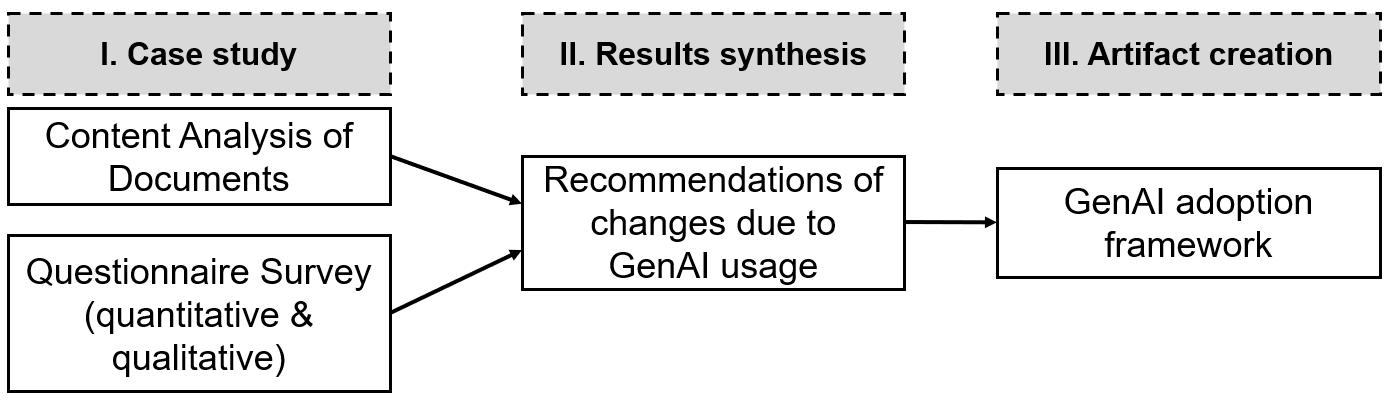
Figure 1: Research design outlining the sequential integration of document analysis, survey data collection, thematic synthesis, and framework development.
151 students from Business Information Systems (BIS) and E-Government (EGOV) programs participated, representing over 20% and 50% of enrolled students in the respective cohorts. The study utilized a cross-sectional online questionnaire, combining structured multiple-choice questions with open-ended queries to quantify GenAI usage, discern policy awareness, and examine usage-contexts in relation to institutional regulations.
The institutional context is one of partial adaptation: while some curriculum guidelines reference GenAI, explicit skill outcomes and clarity on permitted usage remain underdefined, leading to inconsistencies between formal rules and informal instructional practices.
Empirical Insights: Student GenAI Usage and Regulatory Gaps
The survey results establish several robust empirical points:
- High GenAI Penetration: 85.43% of students report active use of GenAI tools, with ChatGPT dominant (93.8% of users). This is statistically higher than previously reported rates for German students in other disciplines (e.g., 63.4% in [von_garrel_kunstliche_2023]), reflecting both rapid technological diffusion and computer science program affinity.
- Primary Use Cases: Students leverage GenAI for research assistance (40.15%), programming (37.8%), and text summarization (34.65%), with additional tasks including exam preparation and translation.
- Policy Awareness and Compliance: A marked policy ambiguity persists. 43.7% of students are unsure if their usage aligns with institutional regulations, 19.1% suspect potential violations, and only 37.2% assert compliance. Over 85% utilize only free GenAI tools.
- Perceived Risks: Students highlight risks of overreliance (erosion of critical thinking), potential unintentional breaches of academic integrity, and privacy concerns regarding AI data management.
Document analysis reveals regulatory gaps—e.g., vague definitions of "independent work," lack of explicit GenAI mention, and inconsistent enforcement—while informal practices by faculty sometimes encourage GenAI usage in the absence of clear regulatory guidance.
The AI Adoption Framework: Architecture and Operational Dynamics
Grounded in the aforementioned findings and a critical review of existing frameworks (e.g., 4E [Shailendra.2024], IDEE [Su.2023]), the proposed AI Adoption Framework for Higher Education seeks to fill the operational and structural deficiencies endemic to prior heavyweight, curriculum-only, or non-data-driven approaches.
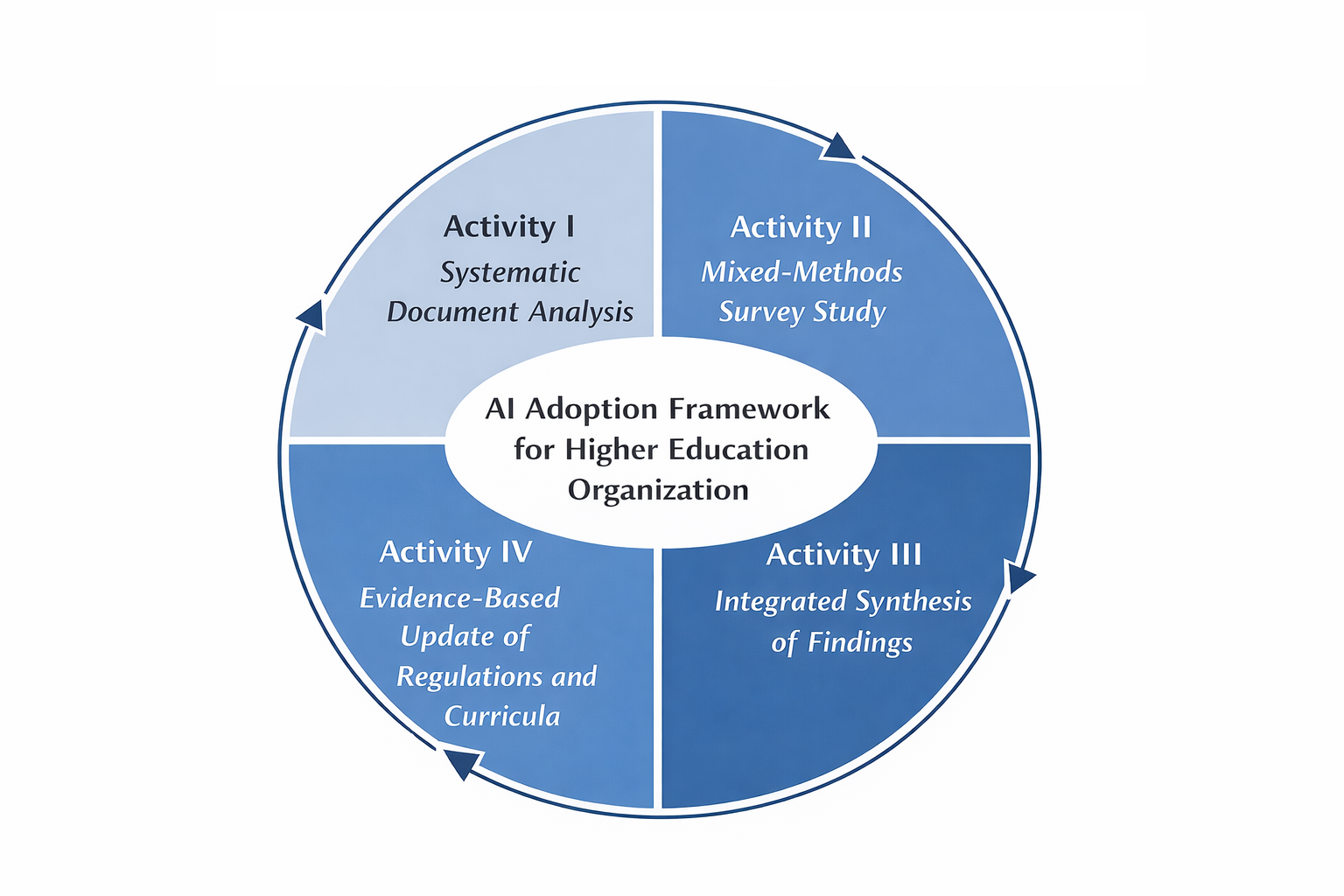
Figure 2: Visualization of the AI Adoption Framework, depicting the iterative cycle of document analysis, quantitative/qualitative surveys, synthesis, and regulatory/curricular updates.
Framework Structure
The framework is characterized by four interlocking activities, optimized for iterative implementation:
- Document Analysis Systematic scrutiny of institutional policies, assessment rules, curricular documents, and guidelines to identify explicit or implicit regulatory stances regarding GenAI. Emphasizes detection of ambiguous terminology, enforcement gaps, and cross-artifact inconsistencies.
- Empirical Surveys Targeted quantitative and qualitative studies to capture actual student (and potentially faculty) usage patterns, tool selections, policy awareness, and interpretative behaviors vis-à-vis GenAI.
- Synthesis of Findings Integration of empirical and documentary evidence to identify actionable discrepancies—e.g., high adoption coupled with regulatory uncertainty—informing recommendations for operational change.
- Regulation and Curriculum Update Formal adaptation of institutional documents, including introduction of specific disclosure mechanisms, explicit normative boundaries, assessment format modifications, and curricular objectives addressing both tool literacy and critical evaluation.
The framework’s iterative logic recognizes the volatile, rapidly evolving nature of GenAI tools and the necessity for continuous policy adaptation and institutional learning, rather than one-off regulatory responses.
Theoretical and Practical Implications
Advances over Prior Work
In contrast to adoption models such as 4E or IDEE—which either lack empirical validation, detailed operational guidance, or explicit regulatory instruments—this framework embodies a lightweight, context-sensitive, empirically anchored approach. It explicitly acknowledges the multidimensionality of GenAI adoption, seamlessly integrating regulatory governance with curricular and pedagogical practice.
Academic Integrity Under GenAI Conditions
The paper produces a series of precise propositions with broad institutional import:
- Academic integrity now demands explicit, operationalized normative boundaries for GenAI-assisted work—beyond the era of implicit assumptions about originality and tool use.
- The epistemic credibility of academic qualifications is linked to human-centered assessment, transparency, and demonstrable individual contribution, which are jeopardized by opaque GenAI integration.
- Regulatory adaptability and communication are central governance tasks: rules must be both explicit and observable, consistently enforced and continuously reevaluated to maintain institutional trust and alignment between student practice and policy.
Broader Impact and Considerations
The practical significance is clear: GenAI usage in higher education is both inevitable and accelerating. Absent careful, transparent institutional adaptation, universities risk undermining both their assessment validity and social legitimacy. Pragmatic assessment redesign, hybrid evaluation formats, and comprehensive, well-communicated policies are critical.
Empirically, the presented adoption framework could serve as a blueprint for institutions seeking to navigate the interface of technological disruption and academic tradition, enabling universities to preserve integrity while embracing innovation.
Future Directions
The authors call for longitudinal, cross-institutional validation of the framework, expansion to a broader set of disciplines, and in-depth analysis of the cognitive, metacognitive, and integrity-related consequences of sustained GenAI integration in student workflows. Exploration of policy efficacy, instructor adaptation, and the evolution of disciplinary-specific GenAI competencies are especially salient avenues.
Conclusion
The study establishes, both empirically and conceptually, that GenAI is a pervasive force in higher education, particularly within computer science disciplines. Fragmented, ambiguous governance is unsustainable given high student adoption rates and broad tool capabilities. The AI Adoption Framework for Higher Education fosters systematic, iterative adaptation—uniting empirical observation, document analysis, and regulatory synopsis—to support institutional integrity, curricular relevance, and responsible GenAI use. The framework’s practical, operational emphasis distinguishes it from prior approaches and positions it as a valuable reference for higher education policy, curriculum design, and integrity assurance in AI-mediated academic environments.

