- The paper introduces CSP, a novel method that achieves an exact, covariance-aware mapping from observed study contrasts to network meta-analysis estimates.
- It resolves ambiguities in decomposing direct and indirect evidence, especially in multi-arm trials, by applying a linear projection operator based on the Fisher information matrix.
- The approach enhances diagnostics with canonical forest and tension plots, providing transparent visualizations and robust quantification of treatment effects.
Introduction and Motivation
Network meta-analysis (NMA) synthesizes comparative treatment effects across complex networks of randomized controlled trials. While classical pairwise meta-analysis provides transparent inverse-variance weighting at the study level, standard NMA methodologies lack a numerically exact and algebraically invariant decomposition of direct and indirect evidence, particularly when multi-arm trials induce within-study correlations. Most existing approaches, including flow-based or electrical network analogues, provide only marginal, often approximate summaries that can fail to reproduce the NMA estimates and may depend on parameterization choices for within-study contrasts.
The paper "Contrast-Space Projection for Network Meta-Analysis: An Exact and Invariant Study-Based Decomposition of Direct and Indirect Contributions" (2604.21994) introduces a contrast-space projection (CSP) formulation establishing an exact, covariance-aware, and representation-invariant mapping from observed study contrasts to network estimates. The CSP method enables an unambiguous decomposition of NMA estimates into study-level direct, indirect, and path-level contributions, reconciling numerical reproducibility with interpretability and providing a foundation to extend classic diagnostics and visualizations such as forest plots to the network setting.
CSP works directly in the space of all estimable pairwise treatment contrasts, parameterizing the network as a vector θ of length m=(2T) for T treatments, subject to linear consistency constraints. The observed contrast vector y, originating from both two-arm and multi-arm studies, is modeled via generalized least squares (GLS) with covariance matrix V that incorporates multi-arm correlations. Crucially, multi-arm trials can be represented in either reduced (baseline) or full pairwise contrast formats; CSP shows these are mathematically equivalent when the induced covariance structure is respected.
The key innovation is expressing the NMA estimator as a linear mapping: θ^NMA=Py
where P is a projection operator, constructed from the Fisher information matrix I=X⊤V+X, that projects observed data onto the consistency-constrained contrast space. This representation preserves the full covariance, accounts for parameter redundancy, and generalizes inverse-variance weighing to the network domain. The algebraic structure further relates to flows in a weighted graph Laplacian, with edge weights reflecting statistical information.
Canonical Decomposition: Direct, Indirect, and Path-Level Components
A central challenge in NMA is disentangling direct from indirect evidence, especially within multi-arm studies where parameterization-dependent ambiguity arises. CSP resolves this through a canonical, representation-invariant decomposition. Each study's contribution to a target comparison is partitioned into direct (arising from studies containing both arms) and indirect (evidence propagating indirectly through the network) terms, with further decomposition of indirect evidence into unique network paths.
The canonicalization proceeds by reducing each study's projection-induced coefficient vector to a minimal path-based representation in the full contrast space, eliminating algebraic redundancy. The result is a set of unique, non-overlapping study-level paths whose weights sum to one for each comparison and which are invariant to within-study parameterization.
Strong claim: This study-based direct/indirect decomposition is unique, invariant, and exactly reconstructs the NMA estimator—a problem unaddressed by prior methods.
CSP enables a suite of exact diagnostic tools that were previously unavailable or only approximated in NMA, including:
- Canonical forest plots: Each direct and indirect (path) component is visualized with its weight and confidence interval, allowing exact reconstruction of the network estimate from study- and path-level contributions.
- Tension plots: Direct and indirect estimates (with uncertainties and associated weights) for each comparison are displayed to assess agreement and detect inconsistency or conflict between evidence sources.
- Global Q-test: Inconsistency is quantified as the squared Mahalanobis norm of the projection residual, directly tying model fit and heterogeneity to the underlying contrast geometry.
The following example figures illustrate the interpretability and granularity achievable using CSP.
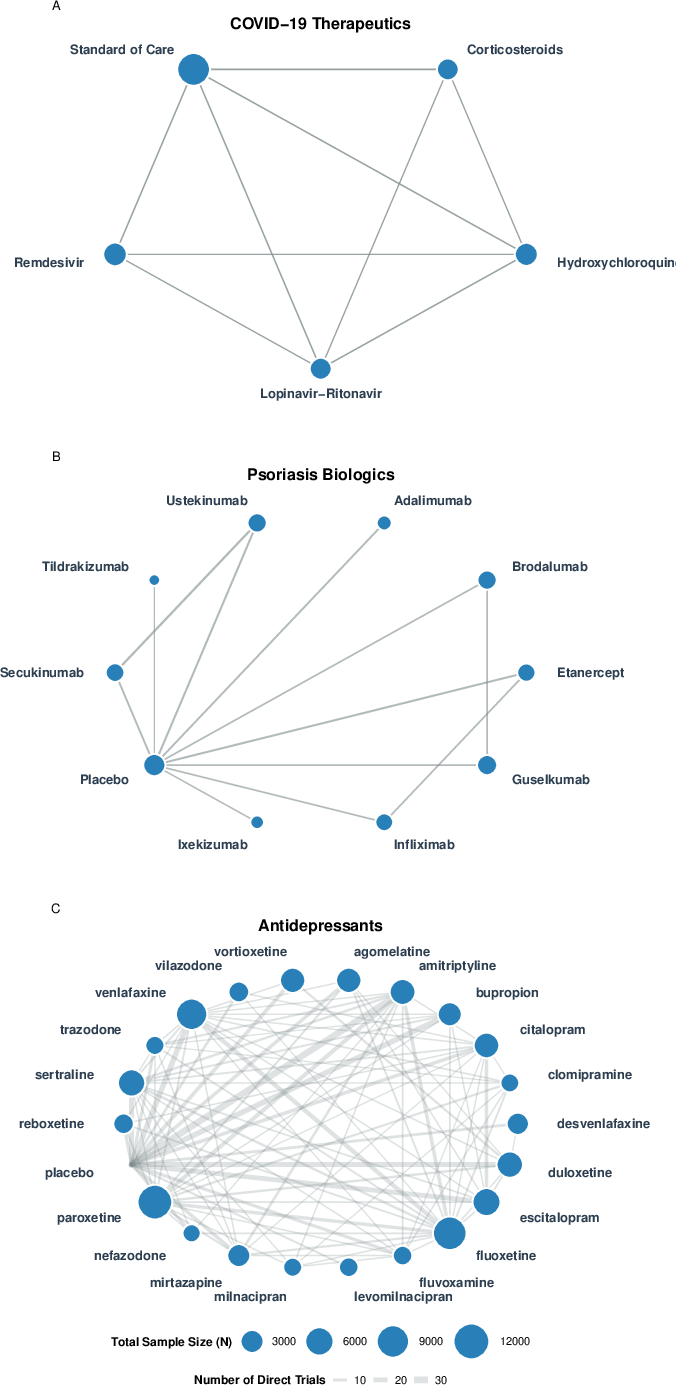
Figure 1: Empirical network topologies of COVID-19 therapeutics, psoriasis biologics, and the antidepressant network, highlighting structural variation and indirect connectivity across networks.
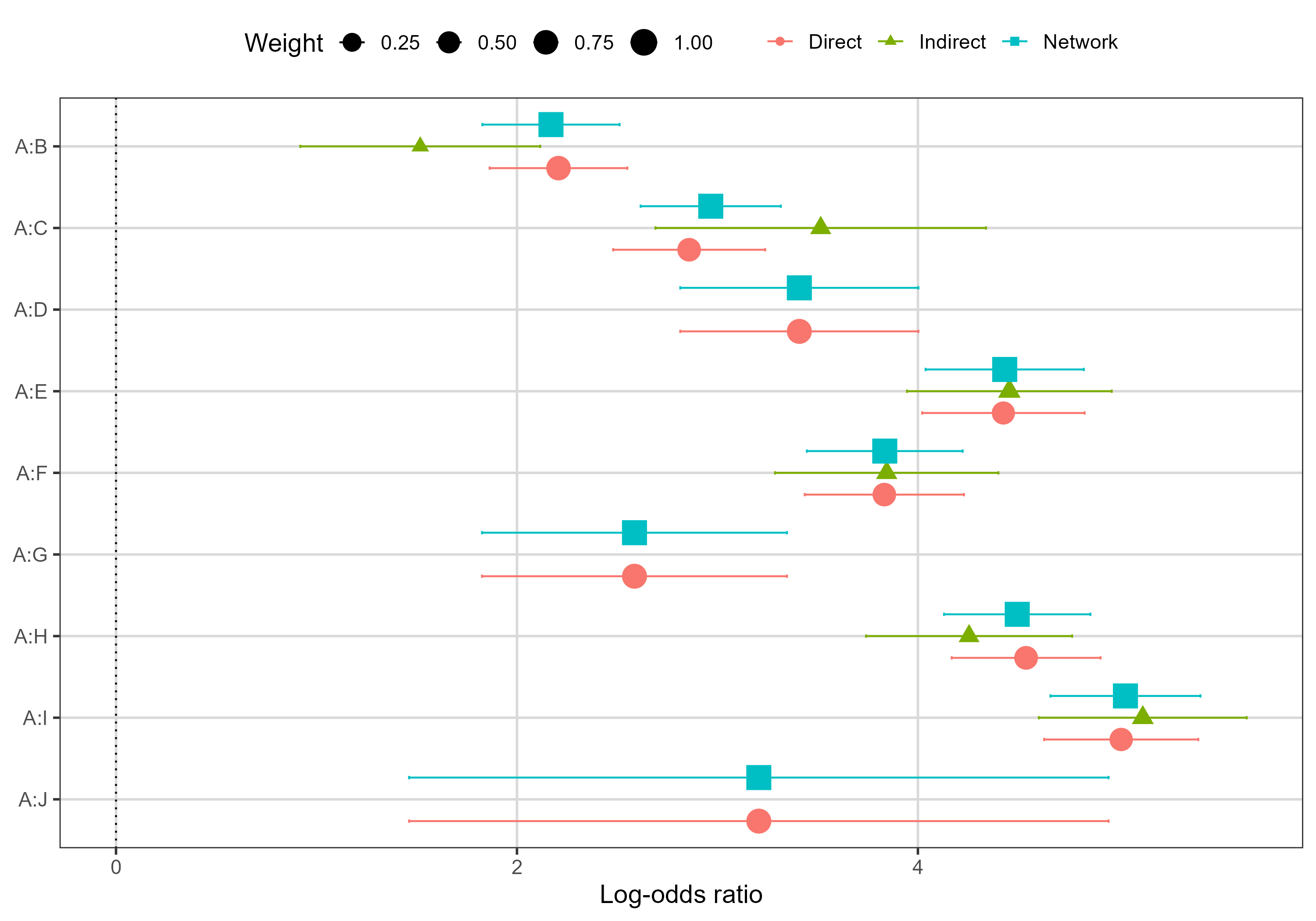
Figure 2: Direct, indirect, and network estimates for baseline comparisons in the psoriasis biologics network, demonstrating consistency and potential areas of tension.
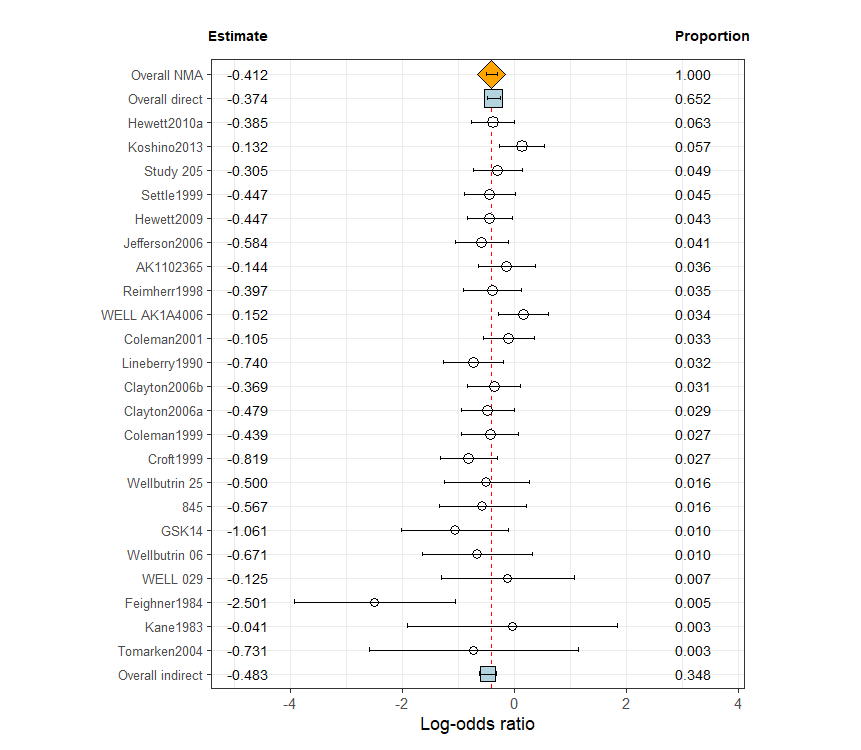
Figure 3: Forest plot for bupropion versus placebo in the antidepressant network; direct, indirect, and aggregate study contributions are visualized with weights and uncertainty.
Empirical Applications
Three empirical datasets are analyzed to highlight various aspects of CSP:
- COVID-19 Therapeutic Network: A compact network dominated by multi-arm platform trials. CSP reveals the dominance of direct evidence in certain comparisons and the exclusive reliance on indirect evidence where no direct trials exist. Path-level decompositions clarify the exact propagation of indirect evidence, with canonical weights illustrating each study's influence.
- Psoriasis Biologics Network: A moderately complex network with mixed-arm trials. CSP demonstrates variable reliance on direct/indirect evidence across contrasts and uses tension plots to elucidate agreement or conflict, exposing structural heterogeneity.
- Antidepressant Network: A large, dense network with extensive indirect connectivity. CSP handles high-dimensionality, producing numerically exact study-level contribution forest plots. Here, the study-level summary remains interpretable while path-level resolution is less tractable due to network size.
These applications confirm CSP's scalability and its capacity to yield interpretable, algebraically exact decomposition and diagnostics across a spectrum of network complexities.
Implications and Future Directions
Practical Implications: CSP advances the reproducibility and transparency of NMA by providing the first rigorous study-level decomposition and unifying model estimation, diagnostics, and graphical representations. This supports systematic reviewers and policymakers in evidence appraisal and sensitivity analyses, particularly in settings dominated by complex multi-arm designs.
Theoretical Implications: The contrast-space projection constitutes a unifying linear-operator framework for NMA with direct connections to statistical information geometry, graph Laplacians, and flow theory. The invariance and exactness properties of CSP set a new standard for methodological rigor in evidence decomposition and will inform future developments in the analysis of complex evidence networks.
Extensions may include projection-based meta-regression, sensitivity tools for path influence assessment, and structural network diagnostics. Further, since the CSP approach is implementable using sparse matrix operations, it is compatible with large-scale biomedical or social science applications.
Conclusion
The contrast-space projection framework for NMA delivers an exact, invariant, and practically interpretable decomposition of study-level direct and indirect evidence, fully respecting the covariance structure and parameter redundancy induced by complex network designs. It bridges a central methodological gap, allowing for transparent visualization and diagnostic assessment, and provides a robust foundation for both practical synthesis and future methodological extensions in evidence synthesis.