- The paper introduces a generalized Schwinger effect where steep matter-potential gradients in neutron stars produce neutrino-antineutrino pairs.
- It employs a Sauter profile and Bogoliubov transformations to derive production rates that scale with the matter-potential jump, distinguishing sharp and gradual interfaces.
- The study reveals that gradient-produced neutrinos modify neutron star cooling curves by inducing heating plateaus or accelerated cooling, offering observable astrophysical signatures.
Gradient-Induced Neutrino Pair Production in Neutron Stars
Generalized Schwinger Effect for Neutrinos
The paper "Gradient-Produced Neutrinos" (2604.21968) explores a generalization of the Schwinger effect, extending it from gauge fields to inhomogeneous matter density backgrounds, particularly relevant in neutron star (NS) interiors. In the standard Schwinger mechanism, sufficiently strong electric fields destabilize the vacuum, resulting in spontaneous electron-positron pair production. The authors consider the analogous case where steep gradients in the effective matter potential V(x) produce neutrino-antineutrino pairs via mixing of positive- and negative-frequency modes in the Dirac equation.
The interaction Lagrangian formulated is −Lint=jextμψˉγμ(cV−cAγ5)ψ, where jextμ is a static external current, e.g., the matter potential from neutrino forward scattering in baryon-rich matter. For Dirac neutrinos, cV=cA=1/2. In steep density/composition gradients, V(x) exhibits critical jumps, analogously to phase boundaries in 1st-order phase transitions within NSs.
Calculation of Gradient-Induced Pair Production
The spatial profile of the matter potential is modeled as a Sauter (tanh) profile: V(x)=21ΔVtanh(z/l), with the jump ΔV and width l. A necessary condition for unsuppressed pair production is that ΔV overcomes the mass threshold (ΔV>2mν). The pair production rate per unit area is derived using Bogoliubov transformations and mapped directly onto the known formalism for Schwinger pair production by spatially varying vector potentials [Fedotov:2022ely, Chervyakov:2009bq]. In the sharp (supercritical) limit, −Lint=jextμψˉγμ(cV−cAγ5)ψ0, the rate scales cubically with the jump:
−Lint=jextμψˉγμ(cV−cAγ5)ψ1
For gradual transitions, −Lint=jextμψˉγμ(cV−cAγ5)ψ2, the rate is linearly suppressed by −Lint=jextμψˉγμ(cV−cAγ5)ψ3. Numerical results, as well as analytic approximations, confirm the crossover from cubic to quadratic scaling with −Lint=jextμψˉγμ(cV−cAγ5)ψ4 as the interface becomes less sharp.
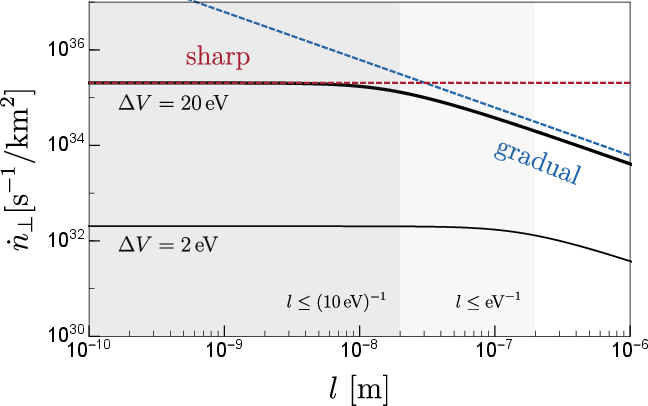
Figure 1: Pair-production rate per unit area −Lint=jextμψˉγμ(cV−cAγ5)ψ5 versus transition width −Lint=jextμψˉγμ(cV−cAγ5)ψ6, exhibiting higher rates for sharper matter-potential jumps.
Consequences in Neutron Star Structure
The application to neutron stars centers on the scenario where a sharp density/composition jump exists (e.g., hadronic-to-quark matter phase boundary), inducing a supercritical matter-potential gradient. The benchmark parameters adopt −Lint=jextμψˉγμ(cV−cAγ5)ψ7, −Lint=jextμψˉγμ(cV−cAγ5)ψ8 km, −Lint=jextμψˉγμ(cV−cAγ5)ψ9, jextμ0, and jextμ1 km. The resulting neutrino production rate is highly efficient:
jextμ2
Neutrinos are confined within the jump radius—accumulating and becoming degenerate as Pauli blocking saturates the phase space, with a total degenerate number scaling as jextμ3.
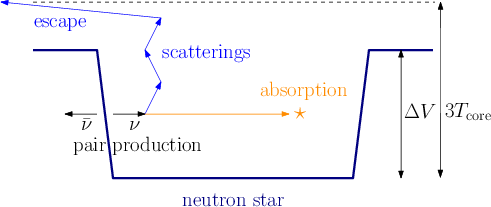
Figure 2: Schematic of pair production at a sharp interface in NS, showing bound neutrino formation and thermal upscattering escape.
Heating and Cooling Channels Due to Gradient-Produced Neutrinos
Bound neutrinos can be depleted by two primary mechanisms: absorption in matter and upscattering, which enables escape. The absorption mean free path (jextμ4) is controlled by available phase space and exothermic transitions, sensitive to chemical potential imbalances. If upscattered above the potential barrier (when jextμ5), neutrinos escape, carrying thermal energy and cooling the core.
The paper constructs a thermal evolution model with terms for photon luminosity (jextμ6), standard thermal-neutrino emission (jextμ7), gradient-produced scattering cooling (jextμ8), and absorption heating (jextμ9):
cV=cA=1/20
Luminosities cV=cA=1/21 and cV=cA=1/22 can exceed cV=cA=1/23 and cV=cA=1/24 at relevant NS surface temperatures (cV=cA=1/25).
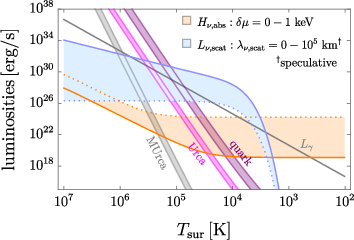
Figure 3: Heating and cooling luminosities as a function of cV=cA=1/26, highlighting dominance over conventional photon and neutrino channels in specific temperature ranges.
NS Cooling Curve Modification and Observational Signatures
The gradient-neutrino mechanisms can produce either heating plateaus or accelerated cooling in NS temperature-age curves, depending on which depletion mechanism dominates. The heating from absorption manifests as a late-time temperature plateau (cV=cA=1/27 yr), whereas enhanced upscattering induces a characteristic knee feature in the cooling history (cV=cA=1/28 yr).
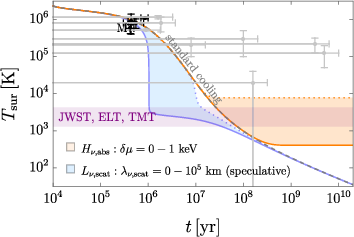
Figure 4: NS cooling curves plotted as cV=cA=1/29 vs age V(x)0, illustrating the effect of gradient-produced neutrino channels.
Surface-temperature measurements of old NSs—particularly within V(x)1 K—by IR telescopes (JWST, ELT, TMT) can test these predictions. The anomalously warm NSs may be explained by enhanced gradient-induced heating, contingent on substantial chemical imbalances.
Spectral Properties of Gradient-Produced Neutrinos
In the sharp limit, the energy spectra of produced particles peak near V(x)2, below the potential barrier, implying confinement except in rare cases of upscattering. This spectral function is symmetric in V(x)3, arising from the pair-production formalism.
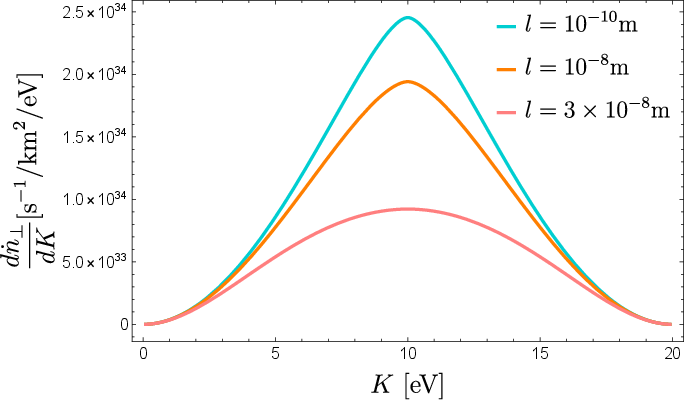
Figure 5: Kinetic-energy spectra for gradient-produced particles in the sharp interface limit, demonstrating confinement by NS matter potential.
Robustness and Implications
Absorption-heating signals are robust under changes to interface width and can persist even for relatively small V(x)4, provided at least one neutrino mass eigenstate is sufficiently light. Observations of cold NSs can, under a reliable model for chemical potential imbalance, set lower bounds on the lightest neutrino mass. The effect persists even for smooth density profiles, with irreducible gradient production, although rates are greatly enhanced by abrupt phase transitions.
The theoretical implications extend to broader classes of backgrounds (not limited to gauge or matter potentials): any sufficiently steep inhomogeneous vector field can drive pair production. This has potential applications in probing BSM fields, new fermion species, and relic neutrino backgrounds.
Conclusion
This study establishes the existence of Schwinger-like neutrino-antineutrino pair production from steep matter-potential gradients as generic in neutron star interiors. For supercritical jumps, the effect yields heating and cooling channels capable of dominating NS late-stage thermal evolution and may provide a probe of baryon-dense QCD. The predicted observational signatures—plateaus and knees in NS cooling curves—are accessible by IR telescopes and radio surveys. The mechanism is theoretically robust and generalizable, prompting further work into NS phenomenology, flavor/chiral effects, interface modeling, and the search for new physics associated with low-energy neutrino matter interactions.