- The paper presents a novel, automated reduction of diverse optimization problems into weighted MaxSAT instances with formal polynomial-time guarantees.
- It utilizes a unified modeling language and systematic Boolean encoding to handle integer, continuous, and combinatorial constraints in a single framework.
- Empirical results across 136 instances demonstrate that GORED consistently matches or outperforms state-of-the-art solvers like CPLEX, Gurobi, and heuristic methods.
A General Optimization Solver Based on OP-to-MaxSAT Reduction
Overview
The paper "A general optimization solver based on OP-to-MaxSAT reduction" (2604.21961) introduces GORED, a general-purpose optimization solver leveraging an automated, theory-driven reduction from broad classes of mathematical optimization problems to weighted MaxSAT instances. The authors formalize the OP-to-MaxSAT reduction process, present theoretical guarantees on its polynomial-time complexity, and empirically validate the generality and quality of the approach across 136 instances spanning 11 optimization problem types. This work systematically challenges the class-specialization paradigm dominating mathematical programming and heuristics by demonstrating a practical, single-algorithm pathway for solving diverse optimization problems.
Theoretical Framework
GORED's core is an automated reduction pipeline that transforms arbitrary optimization problems (OPs) into MaxSAT instances via a series of standardized encoding and reduction steps:
- Unified Problem Modeling: All OPs (integer, mixed-integer, continuous, nonlinear, combinatorial, etc.) are expressed in a formal language based on LaTeX mathematical syntax with explicit quantification and domain specification. This language defines objectives, constraints, variables, and quantification scopes unambiguously, supporting both numerical (linear, nonlinear) and combinatorial constructs.
- Variable Reduction: Problem variables—integers and reals—are encoded into Boolean variables using signed binary fixed-point representations. This facilitates lossless handling of discrete variables and tunable-precision approximation for continuous variables. The number of integer/fractional bits, n/m, governs precision/size tradeoffs.
- Constraint Reduction: Every constraint is recursively decomposed into an operation tree—an acyclic, hierarchical computation graph—with nodes denoting operations (arithmetic, relational, domain). Each node is converted into a set of Boolean clauses via indexed, deterministic reduction rules, supporting, for instance, linear constraints, nonlinear constructs (e.g., max, min, powers, absolutes), and set or quantifier eliminations. The constraints thereby become hard clauses in the MaxSAT encoding.
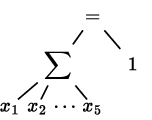
Figure 1: Operation tree representation for a typical constraint, exemplifying how arithmetic and relational nodes are structurally organized prior to reduction.
- Objective Reduction: The objective is similarly constructed as an operation tree; arithmetic nodes are encoded as in the constraints. The root corresponds to the objective value, which, after potential sign-flipping (for minimization), is cast as a set of weighted soft clauses in the MaxSAT instance, with binary bits weighted appropriately to capture the true numeric value under the encoding.
- MaxSAT Instance Solving and Inverse Mapping: The full MaxSAT instance—comprising hard (constraint) and weighted soft (objective) clauses—is solved using any off-the-shelf complete MaxSAT solver. Decoding and inverting the variable encoding maps the Boolean solution back to the original OP solution domain.
These steps are realized in pseudo-code and formalized algorithms within the paper, with strict polynomial-time guarantees for the reduction with respect to model size and encoding parameters.
Architecture and Implementation
GORED implements the above reduction pipeline in an automated, problem-agnostic software stack. The architecture separates the stages of modeling, reduction, MaxSAT solving, and solution mapping. This modularity admits future improvements in either reduction rules or underlying MaxSAT solvers without altering the general workflow.
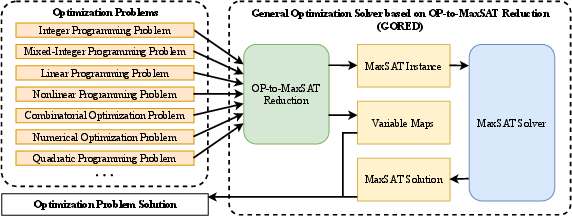
Figure 2: Block diagram of the GORED system, highlighting the flow from user-defined optimization problem specification, through automated reduction, MaxSAT solution, and answer decoding.
Notably, the selection of the weighted complete MaxSAT solver (here Pacose24 (2604.21961)) is independent of the OP structure; progress in MaxSAT technology thus translates directly to improved performance for all OPs processed by the system.
Empirical Results
The authors provide a thorough empirical evaluation on 136 instances drawn from established benchmarks—covering integer/mixed-integer programming, linear/nonlinear programming, combinatorial/numerical, and quadratic/convex/nonconvex problems. GORED is juxtaposed with leading mathematical programming solvers (CPLEX, Gurobi, SCIP) and population-based heuristics (GA, EA, PSO).
Key findings include:
Comparative Analysis
GORED departs fundamentally from the existing landscape in several ways:
- Mathematical programming solvers are each tuned for narrow OP classes, relying on problem properties (linear, integer, convex, etc.), and often require laborious manual reformulation for non-standard constraints or objectives. Their generality comes from method integration, not algorithmic unity.
- Heuristics such as GAs, EAs, PSO, etc., offer some flexibility, but require bespoke encoding, operator tuning, and expert customization for each new OP class, lacking guaranteed completeness or global optimality.
- Manual reductions to MaxSAT appeared previously, but only for narrow combinatorial OPs, and always required substantial problem-specific engineering.
GORED is the first architecture to provide full automation for both numerical and combinatorial OPs, with completeness support (subject to encoding precision and completeness of the MaxSAT solver). Advances in MaxSAT solver design can now impact the entire spectrum of mathematical optimization.
Error Analysis and Limitations
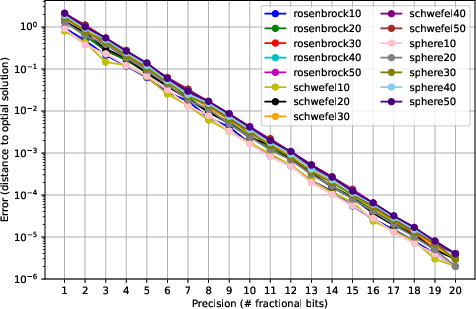
The main source of solution error is the finite-bit encoding of real variables; integers are losslessly represented, but reals are subject to quantization error. The empirical error analysis confirms that increasing the number of fractional bits rapidly shrinks error, at the expense of MaxSAT instance size.
GORED currently does not address multi-objective or black-box (non-explicit constraint/function) OPs. For multi-objective cases, conventional scalarization can be used at the cost of multiple runs; for black-box problems, reduction is not possible without explicit functional forms.
Practical limitations arise for extremely large or highly nonlinear OPs due to the explosion in encoding size (number of clauses/variables) and the associated MaxSAT solver runtime. However, as MaxSAT solver technology progresses, this bottleneck is expected to recede.
Theoretical and Practical Implications
The primary implication is a paradigm shift in optimization methodology: the reduction of OP design, solver selection, and algorithm tuning to the singular task of expressing the problem in the unified modeling language. Once expressed, solution reduces to a single standardized process, separating problem modeling from solution engineering.
This is likely to reshape both the practice of mathematical programming and the structure of black-box optimization software. Progress in MaxSAT solver development (e.g., integration of domain-specific structure, parallelization, improved heuristics, learning-based search) will enhance GORED's efficiency and expand its practical scope.
Future Directions
Areas for further research include:
- Development of more compact reduction rules to minimize instance explosion.
- Extension to truly black-box and multi-objective optimization via surrogate modeling or scalarization techniques.
- Integration with structure-exploiting and learning-augmented MaxSAT solvers for improved scalability.
- Application in quantum-classical hybrid solvers, given emergent interest in quantum-enhanced MaxSAT (see, e.g., [dupontQuantumenhancedGreedyCombinatorial2023]; [sciorilliLargescaleQuantumOptimization2025]).
Conclusion
This study establishes automated OP-to-MaxSAT reduction as a rigorous and competitive paradigm for general mathematical optimization. By shifting the locus of progress to a single MaxSAT algorithm and enabling universal problem expressibility, the authors open a new frontier in optimization solver generality and modularity, unifying advances in satisfiability with widespread practical impact across disparate application domains.