- The paper develops a comprehensive Geant4 simulation framework to model electronic recoil signals from supermassive, charged gravitino dark matter.
- It shows that only high-velocity gravitino events with extended scintillation profiles overcome detector thresholds for observability.
- The study sets upper limits on interaction cross-sections and guides next-generation liquid argon experiments to probe extended supergravity models.
Sensitivity of the DEAP-3600 Experiment to Supermassive Charged Gravitino Dark Matter
Theoretical Motivation and Model Overview
This work addresses the detection prospects for supermassive, fractionally charged gravitinos—as posited in certain extended supergravity frameworks—as viable dark matter (DM) constituents. The context is motivated by the continued null results for more traditional WIMP candidates and increasing consideration of Planck-scale relics. In maximal N=8 supergravity, after removing eight Goldstinos, eight gravitino states remain, which under the SU(3)×U(1)em symmetry decompose into multiplets carrying fractional electric charges. Notably, these states are theoretically stable due to lack of available decay channels once symmetry and charge assignment are enforced, per [Meissner & Nicolai, (Meissner et al., 2023)].
The astrophysical parameters characterizing these gravitinos are markedly distinct: masses on the order of MPl, minuscule relic abundances (∼3×10⁻¹⁴m−3), and consequently a negligibly small flux. These traits challenge detection, since their interaction cross-sections are suppressed to the Planck scale. Crucially, the gravitiono's millicharge implies electromagnetic energy loss through ionization, resulting in predominantly electronic recoil (ER) signatures rather than nuclear recoils (NR).
DEAP-3600 Experiment: Detector Architecture and Event Characterization
DEAP-3600, located at SNOLAB, employs a 3.3-tonne liquid argon (LAr) target coupled with an acrylic vessel, TPB wavelength shifter, a dense PMT array, and substantial water shielding. The experiment's low background and PSD capacity position it among the most sensitive LAr-based DM detectors.
Event discrimination utilizes pulse-shape discrimination (PSD) via the Fprompt parameter, a ratio of prompt to total collected light leveraging the disparate scintillation time constants of LAr singlet and triplet states. NR from traditional WIMP DM and ER from ambient β/γ backgrounds cluster in distinguishable regions of Fprompt-vs-energy space.
Supermassive gravitino signals, predicted to yield only ER tracks via continuous ionization, would thus populate the ER band of this phase space, which is atypical in standard DM analyses.
Simulation Methodology and Signal Morphology
A dedicated signal Monte Carlo was implemented on the DEAP-3600 Geant4 framework, generating millicharged superheavy gravitino traversals through the LAr target at probe velocities (vE∼30 km/s, vS∼230 km/s). Electronic recoil excitation points are spaced according to mean free paths determined by the expected energy loss rates, and full photon transport and detector response—including PMT acceptance and temporal spread—are modeled.
The salient features of the predicted signal are:
- Extended scintillation temporal profiles on the order of microseconds, reflecting both the particle's time-of-flight and the LAr triplet lifetime.
- Uniform PMT hit distribution, correlating with the straight, uniform ionization track.
- Fprompt values substantially below those typical for NR, as illustrated in both simulated event waveforms and the (SU(3)×U(1)em0, photoelectron) scatter plots.
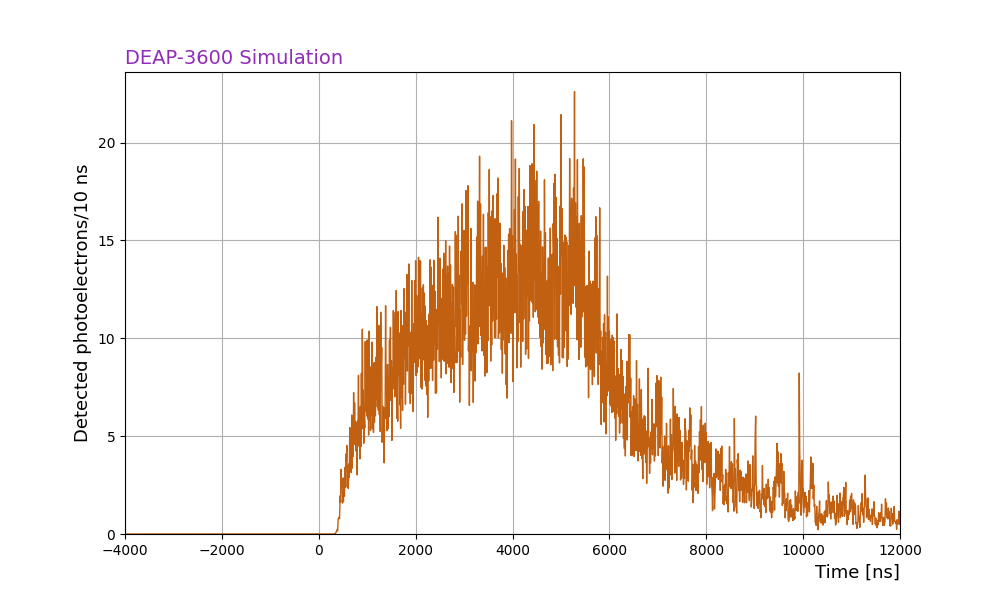
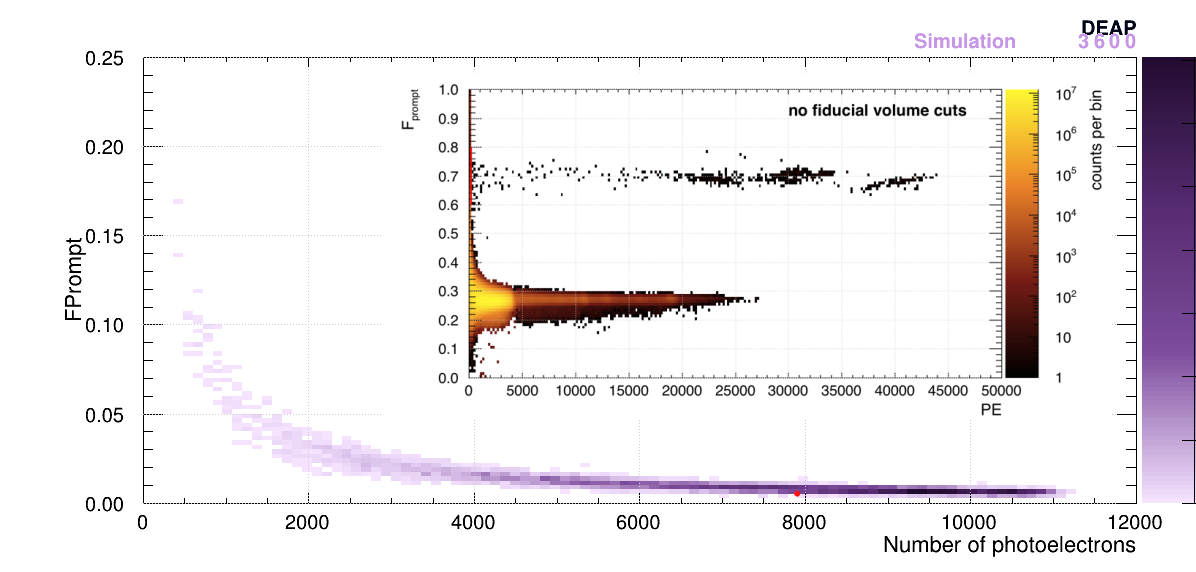
Figure 1: (Left) Reconstructed waveform for a simulated superheavy gravitino DM event, showing the spatially extended, temporally diffuse signature; (Right) SU(3)×U(1)em1 versus photoelectron count for simulated signals with real DEAP-3600 dataset overlay, indicating gravitino events lie deep within the ER band region.
Crucially, at lower velocities (SU(3)×U(1)em2), the expected signals are too faint or too temporally dispersed to be efficiently captured by the hardware and software trigger, effectively precluding detection at these speeds. Only at higher velocities (SU(3)×U(1)em3) does the signal amplitude and timing profile yield an observable event.
Projected Sensitivity and Background Discrimination
With the predicted differential flux (SU(3)×U(1)em4) and DEAP-3600 fiducial volume, the experiment expects an event rate of only 0.15 in 820 live-days for the fastest (galactic-virial) gravitinos. The small signal yields (100–10,000 PE) are bracketed by the APD gain and trigger thresholds, but only for the higher end of the velocity distribution.
The background in the relevant SU(3)×U(1)em5 region arises predominantly from SU(3)×U(1)em6Ar SU(3)×U(1)em7 decays (bulk LAr), and PMT/cryostat U/Th chains, but such events are rare in the low-SU(3)×U(1)em8/mid-energy domain targeted by the gravitino search. Nonetheless, the expected signal rate is low enough that current deployments can only set upper limits on the cross-section for such events, rather than enable affirmative discovery.
Implications and Prospects for Next-Generation Experiments
The study robustly concludes that, given realistic supermassive gravitino fluxes and DEAP-3600 performance, existing data can set exclusion constraints, but not yet probe the full parameter space predicted by extended supergravity models. The unique ER-based signal, the temporal signature, and the requirement for large target mass and efficient background suppression make LAr detectors preferable to LXe and Cherenkov-based detectors (such as Super-Kamiokande), where threshold and trigger logistics or insensitivity to non-relativistic tracks are limiting factors.
Extended sensitivity is anticipated in upcoming larger LAr platforms such as DarkSide-20k and ARGO due to increased fiducial volume, improved PSD, and more flexible trigger architectures. The methodological precedent established here, including event simulation and signal variable choice, will directly inform these future searches.
Conclusion
The investigation details the first comprehensive simulation and analysis framework for searching supermassive, fractionally charged gravitinos in DEAP-3600, contextualized within both theoretical (maximal supergravity) and practical (detector sensitivity and backgrounds) constraints. While null results are projected for current data, the outlined methodology is directly extensible to next-generation LAr experiments, which will be essential to meaningfully probe this class of unconventional, Planck-mass dark matter.