Seeing Fast and Slow: Learning the Flow of Time in Videos
Abstract: How can we tell whether a video has been sped up or slowed down? How can we generate videos at different speeds? Although videos have been central to modern computer vision research, little attention has been paid to perceiving and controlling the passage of time. In this paper, we study time as a learnable visual concept and develop models for reasoning about and manipulating the flow of time in videos. We first exploit the multimodal cues and temporal structure naturally present in videos to learn, in a self-supervised manner, to detect speed changes and estimate playback speed. We then show that these learned temporal reasoning models enable us to curate the largest slow-motion video dataset to date from noisy in-the-wild sources. Such slow-motion footage, typically filmed by high-speed cameras, contains substantially richer temporal detail than standard videos. Using this data, we further develop models capable of temporal control, including speed-conditioned video generation, which produces motion at specified playback speed, and temporal super-resolution, which tranforms low-FPS, blurry videos into high-FPS sequences with fine-grained temporal details. Our findings highlight time as a manipulable, perceptual dimension in video learning, opening doors to temporally controllable video generation, temporal forensics detection, and potentially richer world-models that understand how events unfold over time.

Paper Prompts
Sign up for free to create and run prompts on this paper using GPT-5.
Top Community Prompts
Explain it Like I'm 14
Overview: What this paper is about
This paper is about teaching computers to “feel” and control the flow of time in videos. Humans can usually tell if a clip is sped up (like time-lapse clouds) or slowed down (like a balloon popping in slow motion). Current video AI models aren’t very good at that. The authors show how to train computers to notice speed changes, estimate how fast a video is playing, and even create or improve videos at different speeds—especially convincing slow motion.
The main questions the researchers asked
- How can a computer tell if a video suddenly changes speed and when that happens?
- How can a computer estimate how much a video has been sped up or slowed down?
- Can we build a large, high-quality collection of slow-motion videos to teach models about time?
- Can we train models that:
- generate the same scene at different speeds (on purpose), and
- turn low-frame-rate, blurry videos into sharp, high-frame-rate sequences (extreme slow motion)?
How they did it (in simple terms)
Think of a video like a flipbook: the more pages (frames) you have and the more smoothly you flip them, the more you “see” motion as it really happens. The team used several simple but clever tricks:
- Using sound to find speed changes:
- When a video is sped up, the audio pitch goes up; when slowed down, pitch goes down—like a chipmunk voice vs. a deep voice.
- The researchers used this “free” clue from audio to find the exact moments where playback speed changes.
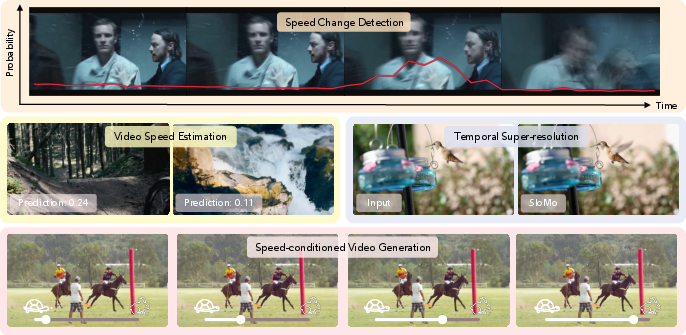
- They trained a visual model on those moments. After training, the model can detect speed changes using just the video (no audio needed).
- Teaching a model to estimate speed without labels (“self-supervised” learning):
- If you take the same clip and keep every other frame, it plays faster. If you keep every 5th frame, it plays much faster.
- The model sees both versions and learns that the predicted speed should scale in proportion to how you sampled the frames—like learning the rule of how fast the flipbook was flipped.
- They then “calibrated” the model using a small set of videos where the true speed is known, to anchor its predictions to real-world values.
- For extremely slow videos (where motion is tiny and hard to spot), they used an “iterative” trick: first estimate the speed, adjust the clip to be closer to normal speed, then estimate again—repeating a few times to get a more accurate result.
- Building a big slow-motion dataset (SloMo-44K):
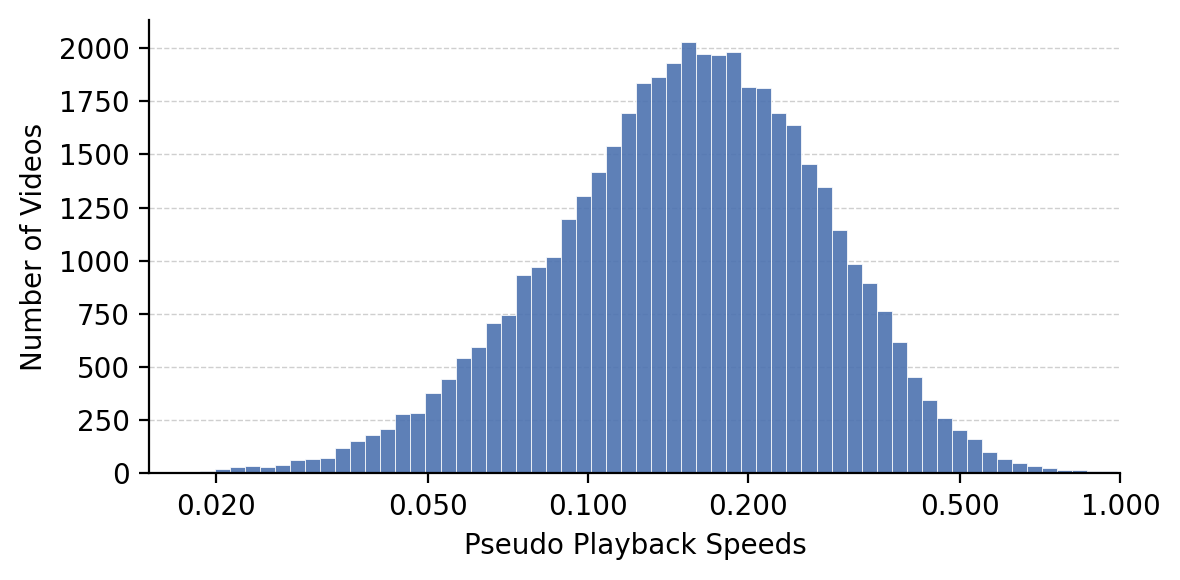
- They searched the web for slow-motion footage (YouTube, Vimeo, Flickr), removed low-quality or fake-looking clips, split videos into shots, detected speed-change points, and labeled each segment with its playback speed.
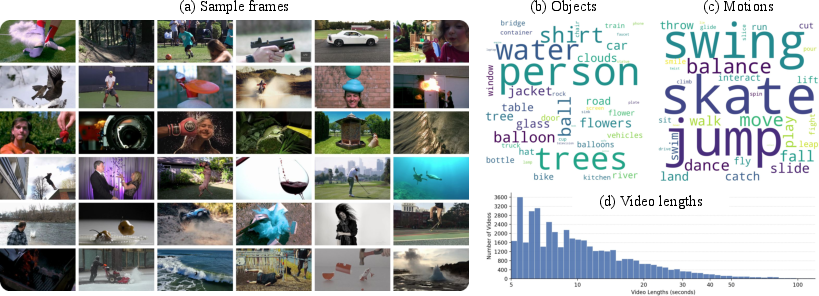
- Result: SloMo-44K—44,632 slow-motion clips with about 18 million frames (much larger and more varied than previous datasets).
- Two time-control abilities trained with this dataset:
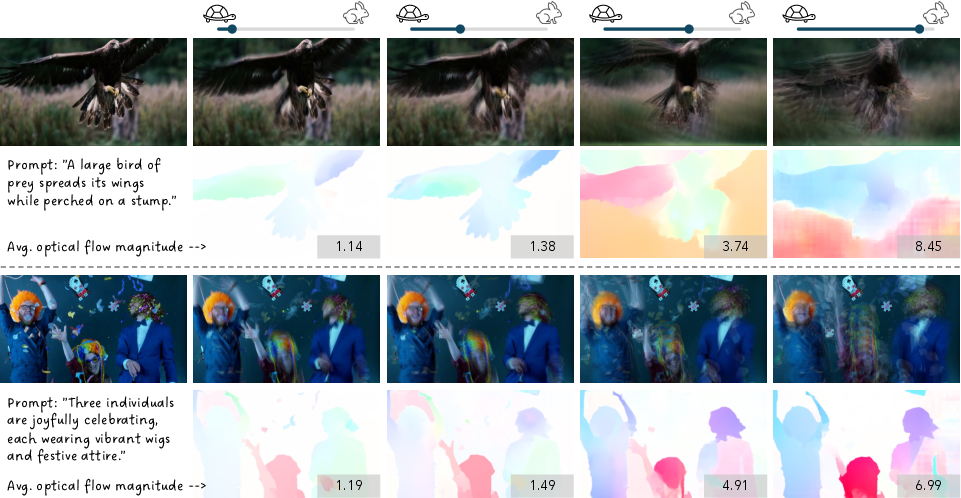
- Speed-conditioned video generation: given an image and a text prompt plus a target speed (like 0.01× for ultra slow), the model generates a video at that speed. It’s not just stretching time—it has to “imagine” the extra in-between moments realistically (like droplets forming during a splash).
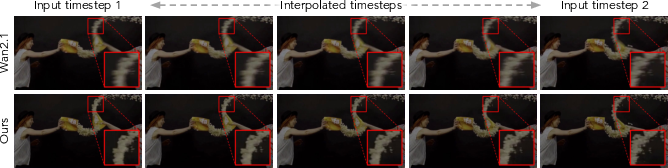
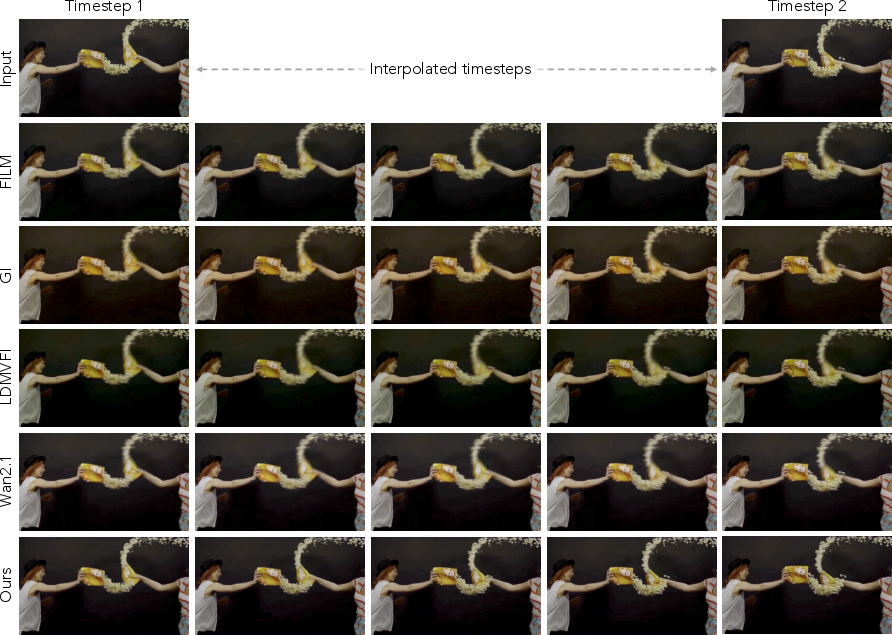
- Extreme temporal super-resolution: turning low-FPS, blurry videos into high-FPS, sharp sequences—like upgrading a choppy flipbook with missing pages into a smooth, detailed one.
What they found and why it matters
- Detecting speed changes:
- Their model correctly spotted speed-change moments about 92% of the time—much better than strong baselines.
- This is useful for video editing, highlight detection, and video forensics.
- Estimating playback speed:
- Their approach beat prior methods and came much closer to human-level estimates.
- This means the model has a better sense of “how fast the world should look,” which is key for realistic video generation.
- SloMo-44K dataset:
- It’s the largest general slow-motion dataset to date (44K clips, 18M frames). Because slow-motion videos capture many more moments, they teach models about real motion details (like tiny ripples, cracks, and vibrations) that normal videos miss.
- Speed-controlled video generation:
- Models trained on SloMo-44K followed speed instructions more accurately and produced higher-quality slow motion than baselines.
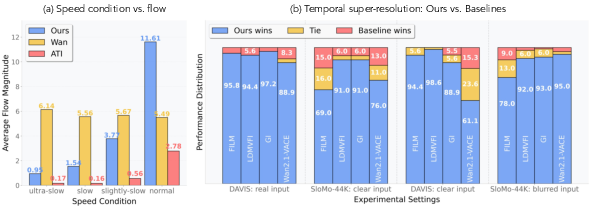
- In metrics that measure realism and diversity, their model scored better; it also showed a clear, measurable link between the requested speed and the actual motion in the output.
- Extreme temporal super-resolution:
- Their model produced sharper, smoother results than existing methods, especially when the input was blurry—something that often happens in real low-FPS videos.
- In human preference studies, people consistently chose their results over baselines.
Why this is important:
- Better control over time means more precise video creation and editing—great for filmmakers, sports analysis, science demos, and education.
- Improved “temporal sense” in AI can help detect tampered videos (forensics), where unnatural timing is a red flag.
- This pushes AI toward building richer “world models” that understand how events unfold—key for robotics, simulation, and safe decision-making.
Big picture: What this could change
By treating time as something a model can learn, measure, and control—not just a fixed frame rate—this work opens the door to:
- Video tools that let you dial motion speed up or down realistically, without artifacts.
- Smarter video analysis that understands when something looks “off” in time.
- AI systems that learn more accurate physics-like behavior (how things move and change), improving simulations, planning, and storytelling.
In short, the paper shows that AI can learn to see “fast and slow,” and that this understanding makes both video understanding and video creation much better.
Knowledge Gaps
Unresolved gaps, limitations, and open questions
Below is a concise list of concrete gaps and open questions that remain unresolved and could guide future work:
- Playback speed vs. physical motion: The paper estimates “playback speed,” not the physical speed of objects. How can models be calibrated to physical units (e.g., m/s, degrees/s) using known kinematic priors (gravity-driven falls, pendulum periods) or sensor metadata (FPS, exposure)?
- Audio-derived labels assumption: Speed-change detection relies on audio pitch shifts during training, which breaks under pitch-corrected time-stretching, dubbed audio, silence, or background music. Quantify how often this assumption holds in-the-wild and develop robust visual-only labeling strategies.
- Label noise in speed-change training: Automatically generated audio-based labels may be noisy; only the test split was human-verified. Measure training-label noise, adopt noise-robust learning (e.g., bootstrapping, confident learning), and evaluate gains from partial human refinement.
- Disentangling intentional slow motion: Models can be misled when humans deliberately move slowly rather than the video being slowed. Develop content-aware priors (human biomechanics, gravity-bound motions) to disambiguate intentional slow action from playback speed changes.
- Camera motion confounds: Estimation can be biased by camera panning, zooming, and stabilization artifacts. Incorporate camera motion disentanglement (e.g., video stabilization, scene flow) and quantify robustness across handheld vs. tripod footage.
- Per-frame speed ramps: The current pipeline segments clips into homogeneous-speed chunks and outputs a single speed per clip. Extend to continuous per-frame speed estimation to capture ramps and easing curves common in modern edits.
- Self-supervised resampling validity: Temporal-equivariance training assumes resampling preserves perceived speed linearly, but aliasing, motion blur, and scene dynamics violate this. Analyze failure modes and incorporate blur-aware or exposure-aware resampling.
- Calibration coverage: Supervised calibration relies on a small set (e.g., Adobe240fps). Build larger, verified, multi-FPS calibration sets (with exact capture FPS, shutter/exposure) for stronger anchoring over 0.01×–10× speeds.
- Iterative prediction heuristic: The multi-pass “accelerate then re-estimate” approach lacks theoretical guarantees. Study convergence, sensitivity to initialization, and robustness across extreme slow motion; provide stopping criteria and uncertainty estimates.
- Speed scale inconsistency: The paper uses 0.01–1.0× buckets for generation but evaluates with control values {1,4,7,10}. Clarify and standardize the mapping from control inputs to actual playback speed to ensure reproducibility.
- Continuous speed control: Discretized buckets (N=10) limit fine-grained control. Investigate continuous conditioning (e.g., scalar speed embeddings, monotonic controllers) and generalization to unseen speeds.
- Evaluation metric gaps: Speed controllability is assessed via average optical-flow magnitude, which is confounded by texture, camera motion, and lighting. Develop physics-grounded metrics (trajectory consistency, period/frequency accuracy) and standardized benchmarks for temporal correctness.
- Real blur modeling: Training blur via frame averaging does not capture sensor nonlinearity, rolling shutter, ISO noise, exposure variability, or HDR pipelines. Create paired real datasets with synchronized high-FPS cameras and matched blurred low-FPS captures.
- Objective evaluation on real blur: The “Real-input” setting uses human preference only. Add objective blur metrics (exposure-aware sharpness, deblurring fidelity) and task-grounded measures (e.g., tracking stability, event timing accuracy) on real footage.
- Scalability to extreme upsampling: Results target 8× temporal super-resolution. Evaluate stability and artifacts at 16×–64× upsampling and characterize failure regimes.
- Backbone dependency: Generation relies on Wan2.1 with LoRA adapters. Investigate full fine-tuning, alternative backbones, diffusion schedulers, and architectures explicitly designed for temporal control to reduce inherited biases.
- Dataset domain bias: SloMo-44K is scraped from public platforms, likely over-representing sports, demos, and visually salient scenes. Audit domain coverage, long-tail content (e.g., industrial processes, microfluidics), and demographic/geographic diversity; introduce stratified sampling or reweighting.
- Annotation provenance and uncertainty: Most speed annotations are model-generated. Quantify annotation error rates, propagate uncertainty via probabilistic labels, and study training with soft labels vs. hard assignments.
- Licensing and reproducibility: Web-scraped data may have unclear licenses. Provide legally distributable subsets with explicit licenses and reproducible pipelines for broader adoption.
- Multimodal speed conditioning: Current generation conditions on speed scalars; audio cues (tempo, beats) are unused. Explore joint audio–visual speed conditioning and alignment to rhythmic structure.
- Physical plausibility: No explicit physics constraints are enforced during generation. Incorporate differentiable physics or kinematic priors (e.g., acceleration profiles, fluid continuity) and evaluate with domain-specific physical tests.
- Post-production forensics: Robustness of speed-change detection to common editing operations (frame duplication, optical-flow interpolation, frame dropping, pitch-corrected time-stretch) is unquantified. Build forensic benchmarks and assess resilience.
- Silent/music-only videos: Many online slow-motion clips lack original production audio. Quantify performance on silent/music-overlaid inputs and develop a purely visual speed-change detector trained without audio-derived labels.
- Resolution and aspect-ratio robustness: Test performance on vertical, low-resolution, and heavily compressed mobile footage; characterize degradation and design resolution-invariant training.
- Absolute FPS vs. playback speed: Estimators target relative playback speed, not actual FPS or variable frame pacing. Integrate encoding metadata, detect dropped/duplicated frames, and estimate true effective FPS.
- Uncertainty calibration: The estimator provides point predictions without confidence intervals. Add calibrated uncertainty estimates, reliability diagrams, and risk-controlling inference for downstream use.
- Long-horizon, multi-shot reasoning: Current evaluations use short clips and middle-third detection. Extend to long videos with multiple edits, transitions, and nested speed ramps; evaluate temporal segmentation quality and edit-boundary detection.
Practical Applications
Immediate Applications
The paper’s methods enable several deployable tools and workflows across media, safety, software, education, and industry. Below are concrete, sector-linked use cases that can be implemented now, along with feasibility notes.
- Media post-production speed forensics and QA (Media/Entertainment, Advertising)
- What: Integrate speed-change detection and playback-speed estimation into NLEs (e.g., Adobe Premiere, Final Cut, DaVinci) to automatically mark slow/fast segments, normalize playback rates, and flag unnatural timing.
- How: Use the visual-only speed-change detector and the calibrated, iterative playback-speed estimator as timeline analyzers; export annotations as EDL/JSON.
- Tools/products/workflows: Plugin that runs “Detect Speed Shifts” → inserts markers → “Normalize to Natural Speed” action → batch render.
- Dependencies/assumptions: Works best when there is sufficient motion; can be misled by intentional slow acting or static scenes; compute overhead is moderate for offline analysis.
- Sports broadcast slow-motion replays from standard cameras (Sports Media, Live Production)
- What: Generate 4–8× slow-motion replays from normal-FPS feeds; reduce reliance on expensive high-speed cameras.
- How: Deploy temporal super-resolution (robust to motion blur) as a replay service in production trucks or cloud; feed recent buffer → output high-FPS, deblurred replay.
- Tools/products/workflows: “Slow-Mo Service” microservice; SDI/NDI ingest → GPU inference → replay output; integration with EVS/LiveTouch.
- Dependencies/assumptions: Requires GPU capacity and a few hundred ms to seconds of latency; quality depends on motion/lighting; legal/team approvals for generated media.
- Platform content labeling and policy enforcement (Social Media/UGC Platforms, Policy)
- What: Auto-detect speed-manipulated videos to enforce rules (e.g., prohibit deceptive slow-mo in political ads, prevent sped-up uploads to circumvent length caps).
- How: Run speed-change detection at ingest; flag segments and attach “speed altered” labels; trigger reviewer workflows for sensitive categories.
- Tools/products/workflows: Backend pipeline with “Speed Integrity Check” → metadata tags → trust & safety dashboards.
- Dependencies/assumptions: Accuracy varies with motion content; high-throughput inference needed; clear escalation rules to manage false positives/negatives.
- Journalism and fact-checking of viral videos (Newsrooms, NGOs)
- What: Verify whether clips were slowed down/speeded up to change perceived intent or severity.
- How: Use the playback-speed estimator + change detector to audit suspect videos; produce side-by-side “natural-speed” reconstructions.
- Tools/products/workflows: Desktop tool/CLI that outputs a report with estimated speed curves, change points, and re-timed reference.
- Dependencies/assumptions: Provide uncertainty intervals; combine with editorial judgment; maintain chain-of-custody for evidentiary use.
- CCTV forensics and incident analysis (Public Safety, Legal)
- What: Identify tampering (e.g., time compression), localize speed edits, and reconstruct approximate natural speed for review.
- How: Apply visual speed estimation and change detection to surveillance footage; export forensic reports for investigators.
- Tools/products/workflows: “Temporal Integrity Report” with timeline, segments, and confidence; plug-in to existing VMS.
- Dependencies/assumptions: Legal admissibility requires validation studies; low-motion scenes reduce reliability; iterative prediction improves extremes but should be documented.
- E-commerce and ad compliance screening (Retail/Ad Tech)
- What: Detect speed manipulation in product demos (e.g., faster cleaning, slower reaction times).
- How: Scan creative assets for speed tags; trigger compliance checks if slow/fast segments are detected.
- Tools/products/workflows: API within creative QA pipeline; flag+human review workflow.
- Dependencies/assumptions: Domain-specific thresholds; false-positive handling needed for stylistic edits.
- Manufacturing/inspection without high-speed cameras (Industrial, Quality Assurance)
- What: Inspect fast processes (e.g., pick-and-place, packaging, fill lines) using normal cameras augmented with temporal super-resolution to reveal anomalies.
- How: Record standard-FPS line cameras; offline TSR to produce high-FPS review clips for QC teams or CV analyzers.
- Tools/products/workflows: Batch TSR jobs on collected shifts; integrate with defect detection models.
- Dependencies/assumptions: Training domain mismatch may require fine-tuning; lighting and motion blur vary by plant.
- Robotics data augmentation and video deblurring (Robotics/Autonomy, R&D)
- What: Improve training data by deblurring and temporally enriching sensor videos; synthesize variable-speed clips for robustness.
- How: Apply TSR to robot/dashcam videos; use speed-conditioned generation to create slow/fast variants of rare events.
- Tools/products/workflows: Data prep pipeline stage: “Deblur+Interpolate” → “Speed Augmenter.”
- Dependencies/assumptions: Synthetic artifacts must not bias learning; verify on downstream tasks; maintain annotation integrity after time scaling.
- Education content with controllable motion (Education, Science Communication)
- What: Generate/retime demonstrations of physics, biology, or sports skills at multiple speeds to reveal dynamics.
- How: Use speed-conditioned generation for pedagogical clips; retime lab phenomena for lectures.
- Tools/products/workflows: Teacher-facing web app: upload prompt/video → export slow/fast variants.
- Dependencies/assumptions: Ensure factual motion fidelity for science curricula; disclose generated content.
- Archival and digitization assist (Museums, Film Restoration)
- What: Normalize vintage footage to plausible natural speeds; segment and label speed variations introduced during digitization.
- How: Run estimator to produce speed curves; apply inverse scaling to stabilize playback.
- Tools/products/workflows: Restoration toolkit with “Speed Curve → Global Retiming” function.
- Dependencies/assumptions: Ground-truth speeds often unknown; produce conservative corrections with provenance logs.
- Developer APIs and SDKs (Software)
- What: Offer cloud/local SDKs for speed-change detection, playback-speed estimation, and temporal super-resolution.
- How: Expose REST/gRPC endpoints; provide Python/JS bindings and FFmpeg filters.
- Tools/products/workflows: “/detect_speed_changes”, “/estimate_speed”, “/temporal_super_resolve”.
- Dependencies/assumptions: GPU availability; cost controls; usage guidelines to mitigate deceptive use.
- Consumer camera and player features (Consumer Electronics, Daily Life)
- What: Smartphone “Temporal Super-Res” to turn standard videos into smooth slow motion; “Natural Speed Meter” overlay in players.
- How: On-device/lightweight models for 2–4× TSR; player-side speed estimation to normalize or annotate playback.
- Tools/products/workflows: Camera app mode; media player toggle “Normalize to natural speed.”
- Dependencies/assumptions: Must be optimized for power/latency; privacy-first processing; quality degrades on extreme motions.
- Benchmarking and evaluation for generative video models (AI/Research, Tooling)
- What: Use SloMo-44K to benchmark temporal fidelity and speed controllability of new video generators.
- How: Standardize FID/FVD + optical-flow-based controllability metrics; host public leaderboards.
- Tools/products/workflows: Eval kit, dataset splits, and reference metrics.
- Dependencies/assumptions: Dataset licensing for research; maintain test set secrecy to prevent overfitting.
Long-Term Applications
The paper also suggests future products and policies that require additional research, scaling, or standardization before deployment.
- Real-time, on-device high-ratio temporal super-resolution (Mobile/Edge, Consumer Cameras)
- Vision: 8–16× slow-motion capture from normal sensors in real time on phones, bodycams, or drones.
- Path to readiness: Model distillation, quantization, and hardware acceleration (NPU/DSP); handling rolling shutter and extreme low light.
- Dependencies/assumptions: Significant efficiency gains; robust quality under varied capture conditions.
- Temporal integrity standards and provenance (Policy, Platform Trust & Safety)
- Vision: Extend provenance frameworks (e.g., C2PA) with “speed integrity” declarations and verified speed-change metadata; standardized “slow-motion” labeling policies for political ads and news.
- Path to readiness: Cross-industry consensus on error bounds; interoperable metadata; independent audits.
- Dependencies/assumptions: Platform adoption; legal frameworks; minimizing overreach/false positives.
- Time-aware world models for autonomy (Autonomous Vehicles/Robotics, AI Research)
- Vision: Train perception/planning models that explicitly reason about variable event speed, improving prediction and control.
- Path to readiness: Integrate speed conditioning and temporal equivariance into foundational models; extensive closed-loop benchmarks.
- Dependencies/assumptions: Scalable data and compute; safety validation; domain adaptation to sensors beyond RGB.
- Clinically validated motion analysis (Healthcare)
- Vision: Use TSR and speed estimation to improve assessment of tremors, gait, cardiopulmonary motion, or endoscopic videos without high-speed hardware.
- Path to readiness: Clinical trials, bias analysis, and regulatory approval (FDA/CE).
- Dependencies/assumptions: Domain-specific fine-tuning; rigorous calibration against medical standards.
- Replacing niche high-speed instrumentation in labs (R&D/Industry)
- Vision: Emulate certain high-speed camera use cases with normal sensors plus TSR for cost savings.
- Path to readiness: Calibration pipelines that map TSR outputs to physical units; uncertainty quantification for measurements.
- Dependencies/assumptions: Precision limits acceptable for the experiment; controlled lighting and setup.
- Speed-aware video compression and streaming (Media Tech, Standards)
- Vision: Codec tools that trade native FPS for reconstructible high-FPS via learned TSR at the edge, reducing bandwidth.
- Path to readiness: Evaluate rate–distortion with perceptual and temporal metrics; standardization in MPEG/Alliance for Open Media.
- Dependencies/assumptions: Decoder-side compute; consistent quality across content types; fallbacks for failure cases.
- Misinformation mitigation policies for time manipulation (Public Policy, Platforms)
- Vision: Require disclosure labels when videos are time-warped; throttle virality of deceptive slow-motion in sensitive contexts.
- Path to readiness: Societal consensus on thresholds; transparent appeals; context-aware enforcement.
- Dependencies/assumptions: Detector accuracy across domains; safeguards for legitimate artistic use.
- Advanced sports performance analytics (Sports Science)
- Vision: Time-normalized kinematic metrics (e.g., swing phases, acceleration profiles) computed consistently across varying capture framerates.
- Path to readiness: Validation against motion-capture systems; integration with coaching tools and wearables.
- Dependencies/assumptions: Accurate mapping from video timing to biomechanical metrics; per-sport calibration.
- General-purpose time-aware multimodal models (Academia/AI)
- Vision: Incorporate self-supervised temporal rescaling equivariance into foundation video–LLMs to reduce hallucinations about timing and motion.
- Path to readiness: Training at scale, new curricula, and comprehensive temporal reasoning benchmarks.
- Dependencies/assumptions: Access to diverse high-FPS data (e.g., SloMo-44K+); compute and sustained community effort.
- Cultural heritage restoration at scale (Museums, Archives)
- Vision: Large-scale correction of historical film timing with uncertainty-aware speed curves and conservative normalization.
- Path to readiness: Collaborative standards for restoration fidelity; curator-in-the-loop tools.
- Dependencies/assumptions: Ethical guidelines; provenance preservation; acceptance in curation communities.
Notes on feasibility across applications:
- Model limitations: Accuracy drops with minimal motion, deliberate slow acting, or extreme domain shifts; iterative prediction mitigates, but confidence scoring and human-in-the-loop review remain important.
- Compute and cost: Generation and TSR are GPU-intensive; real-time and edge use will require model compression.
- Data and rights: Training uses in-the-wild slow-motion content; productization must respect licensing, privacy, and consent.
- Safety and ethics: Tools can aid forensics but also enable more convincing manipulated media; guardrails, provenance, and disclosure are critical.
Glossary
- Arrow-of-time (AoT): The concept of determining temporal direction in video (forward vs. backward). "earlier works on arrow-of-time (AoT) sought to determine if a video is playing forward or backward."
- Audio spectrogram: A time–frequency representation of audio used to visualize pitch and frequency content. "Left: Audio spectrogram ({used only during training})."
- Binary cross-entropy loss: A loss function for binary classification measuring the difference between predicted probabilities and true labels. "using a standard binary cross-entropy loss."
- CoTracker3: A tracker that extracts dense point trajectories (tracklets) across frames. "extract its dense tracklets using CoTracker3~\cite{cotracker3}."
- Cross-modal supervision: Supervision derived from one modality (e.g., audio) to train models in another (e.g., vision). "we can obtain free cross-modal supervision to train models that visually detect speed changes."
- Denoising schedule: The time-step schedule used by diffusion models during the denoising process. "align its denoising schedule with the temporal speed of the video."
- Diffusion models: Generative models that iteratively denoise data from noise using learned dynamics. "image or video diffusion models"
- Equivariance (under temporal rescaling): A property where predictions transform proportionally with input rescaling. "equivariance of speed estimation under temporal rescaling"
- FID: Fréchet Inception Distance; a metric for measuring the quality of generated images/videos against real ones. "we compute FID~\cite{fid} and FVD~\cite{fvd}"
- FloLPIPS: A flow-aware version of LPIPS that accounts for temporal consistency via optical flow. "e.g., LPIPS~\cite{lpips}, FID~\cite{fid}, FloLPIPS~\cite{flolpips}, and FVD~\cite{fvd}"
- Frame interpolation: Synthesizing intermediate frames to increase a video's frame rate. "Frame interpolation addresses this by synthesizing intermediate frames between two existing inputs, effectively increasing a video's temporal resolution."
- FVD: Fréchet Video Distance; a metric assessing quality and temporal coherence of generated videos. "we compute FID~\cite{fid} and FVD~\cite{fvd}"
- High-speed cameras: Cameras capable of capturing at very high frame rates, enabling slow-motion playback. "typically filmed by high-speed cameras"
- InternVL3: A large vision-LLM used here for dense video captioning. "we densely caption them with InternVL3~\cite{zhu2025internvl3}"
- Iterative prediction: An approach that refines predictions by repeatedly reprocessing adjusted inputs. "we adopt an iterative prediction approach."
- LoRA adapters: Low-Rank Adaptation modules that fine-tune large models efficiently by injecting low-rank updates. "we optimize both the linear projection layers and the LoRA adapters applied to the transformer backbone."
- LPIPS: Learned Perceptual Image Patch Similarity; a metric for perceptual similarity between images. "e.g., LPIPS~\cite{lpips}, FID~\cite{fid}, FloLPIPS~\cite{flolpips}, and FVD~\cite{fvd}"
- Multimodal cues: Information derived from multiple modalities (e.g., audio and video) used jointly for learning. "We first exploit the multimodal cues and temporal structure naturally present in videos"
- Multilayer perceptron (MLP): A feed-forward neural network with multiple layers used for conditioning or mapping embeddings. "apply a multilayer perceptron "
- OCR: Optical Character Recognition; extracting text from images/video frames. "an OCR model~\cite{ye2023dptext}"
- Optical flow: Per-pixel motion estimation between frames that represents apparent motion. "optical flow estimation~\cite{huang2022rife,film}"
- Pearson correlation coefficient: A statistic measuring linear correlation between predicted and true values. "We report the Pearson and Spearman correlation coefficients (, )"
- RMSE (root mean squared error): A measure of the magnitude of prediction errors. "root mean squared error (RMSE)"
- SEA-RAFT: An optical flow estimator used to compute motion magnitudes across frames. "we adopt SEA-RAFT~\cite{sea-raft} to compute flow magnitudes"
- Self-supervised (learning): Learning without explicit labels by enforcing intrinsic consistency or invariances. "in a self-supervised manner"
- Sinusoidal positional embedding: A deterministic embedding scheme encoding positions (e.g., time indices) via sinusoidal functions. "encode the bucket id with sinusoidal positional embedding "
- SloMo-44K: A large-scale slow-motion video dataset curated in this work. "SloMo-44K (Ours)~~"
- Speed-conditioned video generation: Video generation where motion speed is controlled via explicit conditioning. "speed-conditioned video generation"
- Spearman’s rank correlation: A statistic measuring monotonic relationship between rankings of predicted and true values. "Spearmanâs rank correlation "
- Temporal resampling: Changing the sampling rate of a video in time (e.g., speeding up/down) for training or analysis. "temporal resampling as a powerful self-supervised training signal."
- Temporal super-resolution: Increasing a video's temporal resolution (frame rate), often recovering fine motion details. "temporal super-resolution, which tranforms low-FPS, blurry videos into high-FPS sequences with fine-grained temporal details."
- Time–frequency scaling: The principle that time compression/expansion shifts frequency content (e.g., pitch) accordingly. "timeâfrequency scaling"
- Trajectory-based motion control: Conditioning generation using precomputed motion trajectories to guide dynamics. "a trajectory-based motion control model, ATI"
- TransNetv2: A model for shot boundary detection/segmentation in videos. "we then use TransNetv2~\cite{soucek2024transnet} to segment videos into shots"
- VACE: A video generation/editing framework supporting flexible conditioning via masks and reference videos. "The VACE framework takes a reference video and an arbitrary binary mask"
- Video forensics: Analytical techniques for detecting manipulations or anomalies in videos. "demonstrating its potential for video forensics."
- VideoLLM: A LLM specialized for video understanding. "We compare against a SOTA VideoLLM, Gemini 2.5"
- VideoMAEv2: A video masked autoencoder backbone used for visual representation learning. "based on VideoMAEv2~\cite{wang2023videomae}"
- Wan2.1-I2V: A variant of the Wan 2.1 model for image-to-video generation used as the base for speed control. "We build model upon Wan2.1-I2V~\cite{wan2.1}"
- Wan2.1-VACE: A Wan 2.1-based framework variant used for temporal super-resolution with flexible conditioning. "We build our model upon Wan2.1-VACE~\cite{jiang2025vace} for its flexible conditioning capability."
Collections
Sign up for free to add this paper to one or more collections.

