- The paper shows that quantum state preparation protocols can simultaneously generate non-classical resources and enable superextensive energy storage, scaling as N^(4/3).
- It employs coupled superconducting LC resonators with spin-squeezing and bosonic nonlinearities to achieve dual-functionality in resource generation and battery charging.
- The study establishes a framework for modular quantum architectures that can dynamically switch between sensing, energy storage, and computing tasks.
Dual-Use Quantum Hardware for Quantum Resource Generation and Energy Storage
Introduction
The development of quantum technologies has prioritized the efficient generation and utilization of non-classical resources such as entanglement, coherence, and non-Gaussianity—concepts captured by resource-theoretic frameworks. Simultaneously, there is increasing interest in quantum batteries, devices leveraging collective quantum effects to achieve energy storage and release capabilities surpassing classical protocols. This paper establishes a rigorous connection between these two fronts, demonstrating that hardware and protocols designed for quantum resource generation can, with a single time-dependent trajectory, also achieve advantageous quantum battery charging, and vice versa. This dual-use paradigm is instantiated with protocols implementable on current superconducting circuit platforms, specifically using coupled LC resonators.
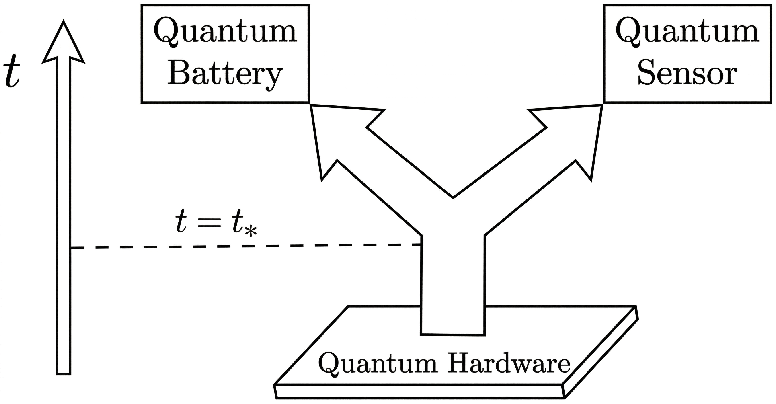
Figure 1: The same quantum hardware can serve as a quantum battery or a quantum sensor, with the specific use determined at the point where a metrological resource peaks in time.
The authors formalize a mapping between the problems of fast quantum state preparation (for metrological utility) and quantum battery charging. State preparation is viewed as the time evolution of an initially uncorrelated product state to a non-classical target state using a unitary or non-unitary process. By interpreting the initial state as the low-energy ground state of a battery Hamiltonian, and the preparation process as the charging protocol, the same quantum hardware can serve a dual function. The paper rigorously shows that spin-squeezing protocols, such as one-axis twisting, commonly used for generating entangled resources, also achieve quantum battery charging with power that scales superextensively (∝N4/3), where N is the system size—an unequivocal quantum advantage over classical scaling.
Key numerical and analytical results underline this duality. For finite-size systems not requiring a Kac normalization, the collective effects inherent in spin-squeezing or bosonic nonlinearities enable both resource generation and superextensive energy storage within a single protocol, contingent on the system's parameter trajectories.
Quantum Battery Protocols as State Preparation Engines
Conversely, the paper demonstrates that quantum battery Hamiltonians possessing nonlinear mode couplings are efficient platforms for preparing metrologically useful states. Focusing on a model with two coupled superconducting LC resonators (with frequency commensuration), the authors show that the battery charging protocol inherently generates states at intermediate times with high quantum Fisher information (QFI), enabling Heisenberg-limited metrology, and supports nontrivial two-mode squeezing for suitable initial coherent preparations. These findings are supported by a combination of analytic short-time expansions and exact diagonalization.
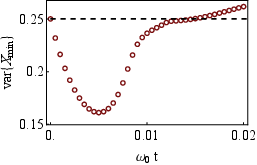
Figure 2: Time evolution of the variance of the numerically optimized squeezed operator Xmin, showing the emergence and survival of squeezing due to nonlinear interactions.
The detailed analysis reveals that for nonlinear interaction order n>2, significant squeezing is present for experimentally relevant timescales, with the optimally squeezed quadrature typically residing in a hybridized mode basis.
Integrated Protocol for Sensing and Energy Storage
Building on the duality, the work proposes an integrated hardware protocol realizable in current superconducting architectures. By controlling the activation sequence of the interaction Hamiltonian, the hardware remains agnostic as to whether it is harvesting a metrological resource or performing energy storage until a critical point in its time evolution. Interruption at the QFI (or squeezing) peak enables immediate quantum sensing; continuation allows the system to evolve into a fully charged quantum battery.
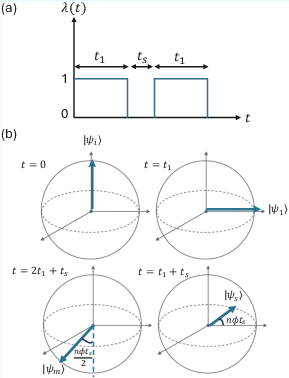
Figure 3: Protocol combining charging and sensing using the two coupled superconducting LC resonator model; Bloch sphere illustrates state evolution during the protocol and conditional measurement outcomes.
This approach provides a mechanism for modular quantum architectures that dynamically allocate resources for sensing or energy storage based on demand, significantly enhancing hardware efficiency and experimental throughput. Notably, even after the sensing operation, there exists a finite probability that the system is fully charged, further increasing operational versatility.
Broader Paradigm: Towards Multi-Use Quantum Technologies
The authors generalize the dual-use principle by mapping broader interconnectivity among quantum batteries, quantum sensors, and quantum processors. Established and hypothesized protocol connections suggest that future quantum devices can be dynamically reconfigured for computation, metrology, or energy storage without additional hardware.
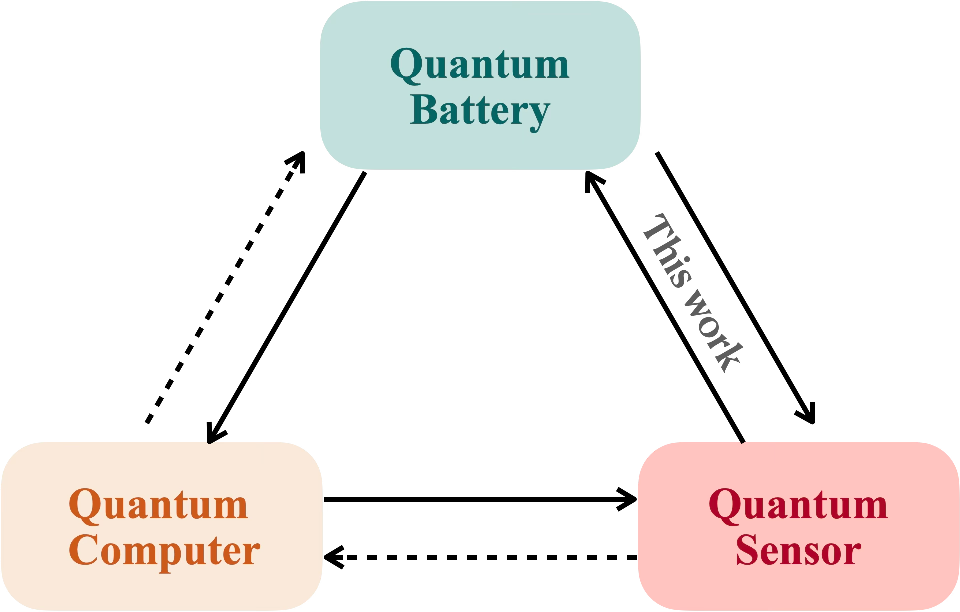
Figure 4: Schematic depicting potential inter-connectivity among quantum batteries, sensors, and processors, highlighting the protocol links established in this work and open directions for hybridization.
Such a paradigm implies that future quantum platforms—potentially realized in superconducting qubits/resonators, trapped ions, or photonic systems—could run context-dependent protocols that transition between sensing, computation, and energy storage, significantly improving resource optimization, hardware lifetimes, and modularity.
Conclusion
This paper introduces a rigorous and experimentally realizable framework for dual-use quantum hardware, where the generation of quantum resources and energy storage become co-producible and operationally interchangeable. The combination of analytic and numerical techniques substantiates all claims regarding scaling behavior and metrological utility. The formal equivalence and operational protocols outlined suggest clear routes for future developments, including resource-adaptive quantum processors, ultra-efficient quantum sensors, and self-powered quantum computing elements. This work positions modular, multi-use quantum hardware as a central theme for the next generation of quantum architectures and highlights open directions arising from resource interconversion protocols at the hardware level.

