Robust continuous symmetry breaking and multiversality in the chiral Dicke model
Published 23 Apr 2026 in quant-ph and cond-mat.quant-gas | (2604.21820v1)
Abstract: The Dicke model (DM) serves as a paradigm for understanding collective light-matter interactions. We introduce the chiral Dicke model, a generalization where an atomic ensemble couples to a two-mode cavity via chiral interactions. Unlike the standard DM, the chiral DM is endowed with an inherent continuous $U(1)$ symmetry associated with angular momentum conservation. The ground-state phase diagram and the associated quantum phase transitions are charted out, revealing a $U(1)$-broken superradiant phase that spans a broad parameter space. We demonstrate that the spectrum of quantum fluctuations is highly tunable in both the symmetric and broken phases. Strikingly, our calculations reveal that the system exhibits `multiversality', where distinct universality classes govern the transition between the same two phases. In particular, along a special line in parameter space, the dynamical critical exponent for the normal-superradiant phase transition changes from $zν=1$ to $zν=1/2$. Our work establishes the chiral Dicke model as a powerful platform to realize novel quantum phases and multiversal critical phenomena in light-matter coupled systems.
The paper introduces the chiral Dicke model, demonstrating robust U(1) symmetry breaking and path-dependent quantum phase transitions.
The analysis employs mean-field theory and Bogoliubov fluctuation techniques to reveal a tunable excitation spectrum with both linear and square-root gap closures.
The findings highlight experimental feasibility with controlled polariton modes and resilience to interactions and dissipation in quantum light-matter platforms.
Robust Continuous Symmetry Breaking and Multiversality in the Chiral Dicke Model
Introduction
The Dicke model (DM) is a canonical framework for collective interactions between an atomic ensemble and quantized electromagnetic modes, central to a wide variety of platforms including cavity/circuit quantum electrodynamics, ion traps, and magnon-photon systems. A fundamental feature of the DM is a quantum phase transition (QPT) from a normal to a superradiant phase driven by light-matter coupling. Classic generalizations of the DM tend to possess discrete symmetries, such as Z2, with continuous U(1) symmetry realized only under fine-tuned conditions, rendering such phases fragile to perturbations. This work introduces the chiral Dicke model (chiral DM), a two-mode extension with robust U(1) symmetry and tunable chiral light-matter coupling, and systematically explores its equilibrium phase structure, excitation spectrum, and quantum criticality.
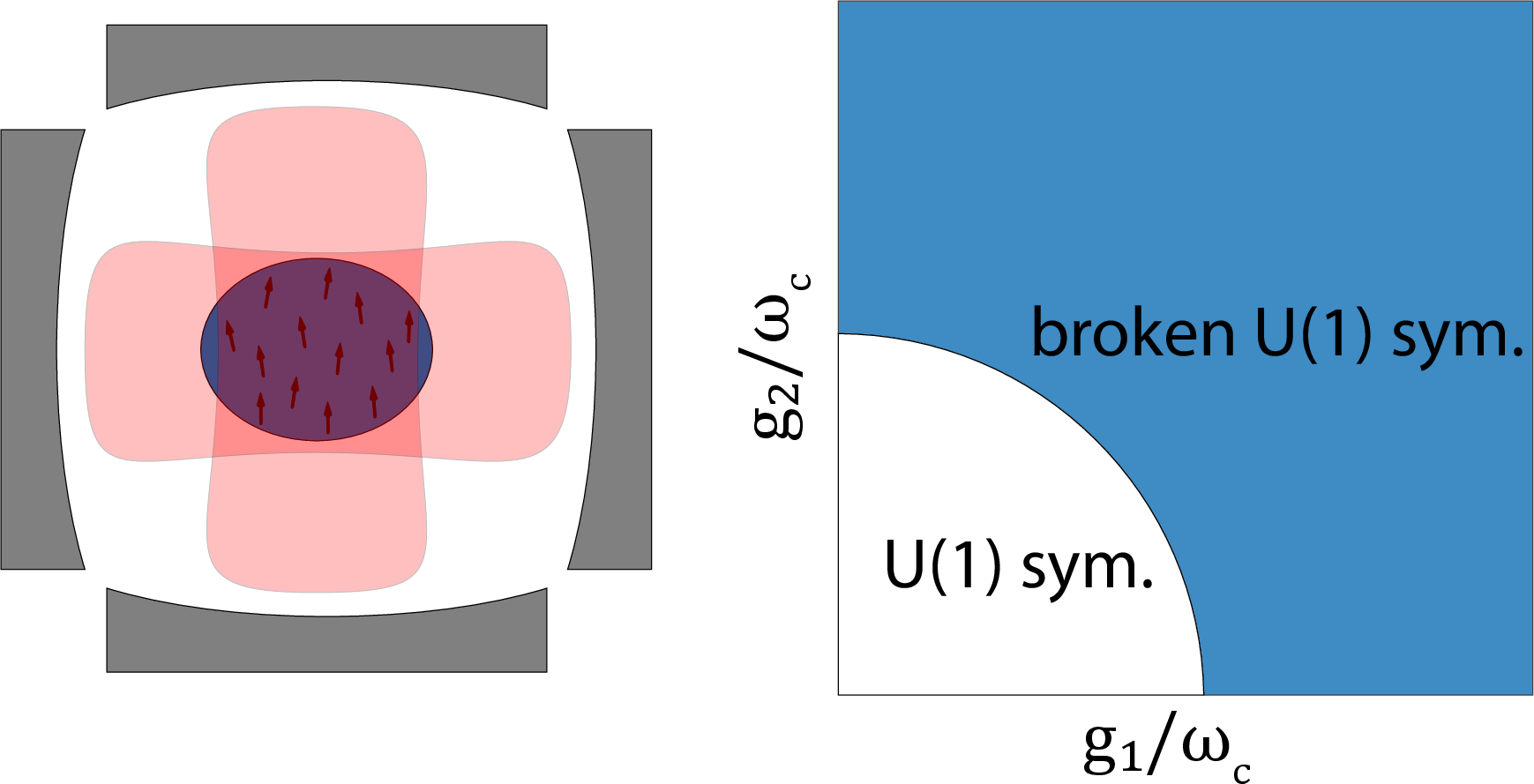
Figure 1: Schematic of the chiral Dicke model and its ground-state phase diagram showing the U(1)-symmetric normal phase and the U(1)-broken superradiant phase.
Model and Symmetries
The chiral Dicke model consists of N two-level atoms coupled to two degenerate cavity modes of frequency ωc via both co-rotating and counter-rotating interaction terms with independent strengths g1 and g2. The Hamiltonian is given by
where U(1)0, U(1)1 are annihilation operators for the photon modes and U(1)2, U(1)3 are collective atomic operators. The interaction structure confers an intrinsic U(1)4 symmetry associated with angular momentum conservation, realized for arbitrary U(1)5, U(1)6. The chiral DM is thus unique in possessing robust U(1)7 symmetry not reliant on fine-tuning, in contrast to standard multi-mode DMs.
Mean-Field Phase Diagram
Mean-field analysis reveals two distinct quantum phases: a U(1)8-symmetric normal phase and a U(1)9-broken superradiant phase. The order parameter, proportional to the coherent spin amplitude U(1)0, develops continuously at the phase boundary, which occurs for
U(1)1
with U(1)2. The superradiant phase is thus stabilized over a broad parameter regime and does not require fine-tuning, marking a strong distinction from previous Dicke model extensions.
Excitation Spectrum and Tunability
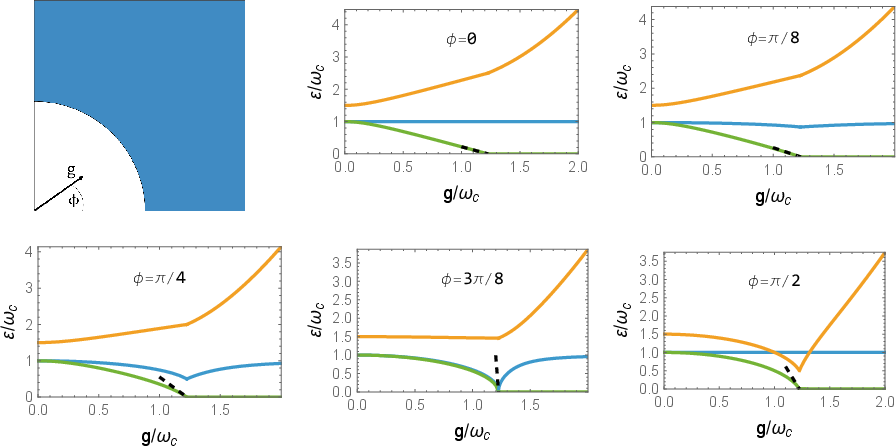
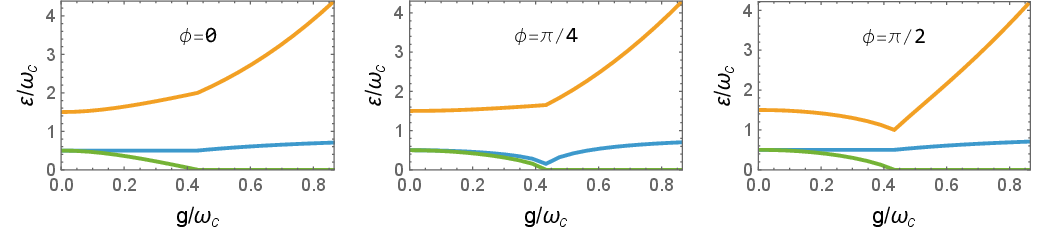
The excitation spectrum around mean-field ground states is characterized at the Gaussian (Bogoliubov) level, resulting in three polariton branches. In the superradiant phase, U(1)3 symmetry breaking produces a gapless Goldstone mode. The chiral couplings U(1)4, U(1)5 provide continuous and highly tunable control over polariton energies. The normal-superradiant QPT can be traversed along different paths in the U(1)6 parameter space, and the elementary excitation gap closes either linearly or with a square-root singularity, depending on the direction. This nontrivial path dependence directly leads to multiversality in the critical properties.
Figure 2: Spectrum of Gaussian fluctuations above mean-field ground state as a function of coupling and path angle U(1)7 in the parameter space; the dashed line highlights linear gap-closing and the emergence of nontrivial scaling.
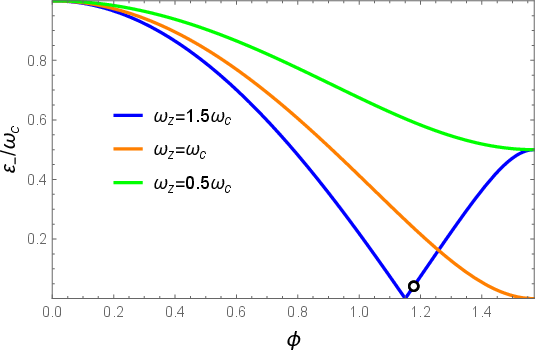
Figure 3: Energy of the lower polariton mode U(1)8 along the critical line for different parameter realizations, demonstrating the degeneracy and associated singular gap closing at special points.
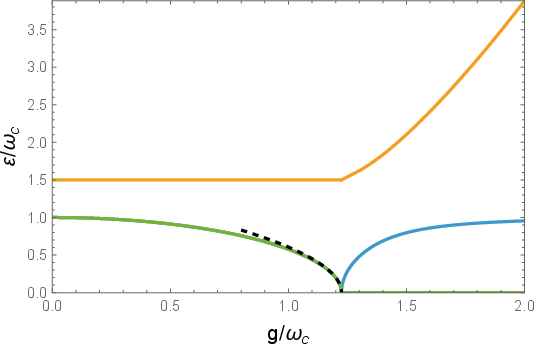
Figure 4: Energy branches at the special point U(1)9 showing mode degeneracy and altered criticality in the normal phase.
Figure 5: Energy branches across parameter space cuts with nonzero interaction U(1)0, confirming the robustness of the spectral features beyond U(1)1.
Multiversality and Critical Exponents
A principal result of the analysis is the identification of "multiversality": the QPT between normal and superradiant states is governed by different universality classes depending on the chosen path in parameter space. In specific, for most trajectories, the closure of the excitation gap is linear with coupling detuning (U(1)2), but along critical directions where mode degeneracy arises, the scaling changes to a square-root form (U(1)3). This phenomenon illustrates that the same quantum phase transition in the same model can exhibit multiple scaling exponents depending on approach, providing an explicit instance of multiversal criticality (2604.21820).
Robustness to Interactions and Dissipation
The structure of the phase diagram and excitation spectrum persists under perturbations such as nonzero interaction U(1)4 and moderate cavity dissipation. For U(1)5, the modified cavity frequency U(1)6 renormalizes the phase boundary and the excitation energies, but the essential features—U(1)7 symmetry, Goldstone mode, and path-dependent criticality—are preserved. Semiclassical analysis with cavity loss demonstrates that, unlike in alternative models where infinitesimal dissipation destabilizes continuous symmetry breaking, the U(1)8-broken superradiant phase can be stable above a critical coupling in the chiral DM for balanced chiral couplings, enhancing its feasibility for experimental realization.
Implications and Future Directions
The chiral Dicke model establishes a minimal, yet highly tunable, setting for robust continuous symmetry breaking and tunable universality. Practical implications include:
Experimental Feasibility: The absence of fine-tuning requirements for U(1)9 symmetry greatly facilitates laboratory implementation, notably in cavity/circuit QED, trapped ions, and hybrid magnon-photon platforms.
Novel Nonequilibrium and Dissipative Phenomena: The robustness of symmetry breaking and accessible multiversality invite studies of driven-dissipative dynamics, dynamical phases (including time crystals), and engineered quantum chaos.
Critical Point Engineering: Tunable critical exponents could be exploited for protocols where sensitivity to critical scaling is a resource, such as metrological enhancement, quantum information scrambling, or designer non-equilibrium quantum devices.
Potential future research directions include mapping the full dynamical phase diagram under drive and loss, extending to atom-cavity chain geometries, and leveraging the chiral DM for engineered nonequilibrium quantum matter.
Conclusion
This work systematically characterizes the chiral Dicke model, demonstrating its capacity for robust, generic continuous U(1)0 symmetry breaking and for supporting quantum phase transitions with path-dependent critical exponents (multiversality). The model's analytically tractable excitation spectrum, robustness to interactions and dissipation, and experimental accessibility position it as a platform of broad interest for exploring nontrivial collective phenomena and for engineering quantum light-matter systems with tunable universality (2604.21820).
“Emergent Mind helps me see which AI papers have caught fire online.”
Philip
Creator, AI Explained on YouTube
Sign up for free to explore the frontiers of research
Discover trending papers, chat with arXiv, and track the latest research shaping the future of science and technology.Discover trending papers, chat with arXiv, and more.