- The paper demonstrates a passive on-chip photon sorter that unambiguously separates single- and two-photon states, surpassing the 50% linear-optical bound.
- It employs a quantum dot embedded in a nanophotonic waveguide with chiral coupling to achieve one-photon sorting fidelity up to 92% and two-photon sorting improvement via temporal filtering.
- The study paves the way for scalable quantum computing and communication by enhancing Bell state measurements and fusion-based quantum protocols.
Photon Sorting with a Quantum Emitter: Deterministic Nonlinear Photonic Circuits for Enhanced Bell State Measurements
Introduction
Achieving scalable quantum information processing in photonics fundamentally requires two-qubit entangling operations such as Bell state measurements (BSMs) with high fidelity and efficiency. Linear optical approaches inherently limit the probabilistic nature of such operations to a 50% success probability unless resource-intensive ancillary states are employed, leading to exponential hardware overheads and exacerbated loss sensitivity. Realizing strong, scalable photonic nonlinearities at the single-photon level is vital to surpass these limitations. In "Photon Sorting with a Quantum Emitter" (2604.21758), the authors demonstrate a passive photon sorter using a deterministic solid-state quantum emitter, unambiguously separating single- and two-photon components of an incident light field. By embedding a quantum dot (QD) into an on-chip nanophotonic waveguide architecture engineered for chiral coupling, the work reports strong photon sorting and an increase in post-selected BSM success probability well beyond linear optical bounds.
Device Architecture and Physical Principles
The conceptual photon sorter is a Mach-Zehnder interferometer (MZI) containing a nonlinear element in each arm. Ideally, this is a single-mode Kerr nonlinearity imparting no phase to one-photon states and a π phase shift to two-photon states. This ideal scenario directs single- and two-photon states into distinct output modes through interference. The physical realization adopts a solid-state quantum emitter—specifically, a self-assembled InGaAs quantum dot deterministically coupled to a nanobeam waveguide terminated with a photonic crystal mirror, creating effectively chiral light-matter interactions.
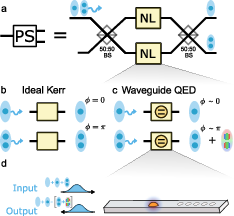
Figure 1: Building blocks and physical implementation of the photon sorting interferometer, nonlinear phase mechanisms, and the effective chiral light-matter coupling via a single-sided waveguide.
Unlike previous bidirectional coupling approaches, this single-sided chiral configuration both enhances photon-emitter interaction and increases robustness and integrability. The quantum dot acts as an effective nonlinear phase shifter. When embedded in the interferometer, it leads to highly asymmetric scattering for different photon-number components—one- and two-photon Fock states are separated based on interferometric phase relations modulated by quantum nonlinear photon scattering.
Experimental Realization and Sorting Characterization
The experimental setup utilizes programmable pulsed excitation of the QD with time-bin encoding. The interferometry is implemented as a compact, self-stabilized double-pass Mach-Zehnder configuration, projecting time-bin modes onto spatial output ports and allowing photon-number-resolved detection.
The photon sorter is characterized by measuring the probabilities of detecting one-photon and two-photon events in each output mode as a function of laser detuning (Δ) from the QD resonance. The performance is benchmarked against a theoretically optimal linear beam splitter.
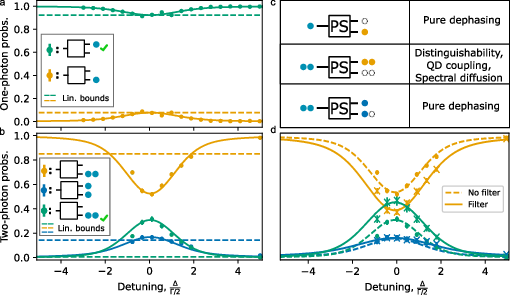
Figure 2: a) One-photon and b) two-photon output probabilities as a function of detuning; c) Error mechanisms and d) improvement via temporal filtering.
On resonance (Δ=0), the one-photon sorting fidelity reaches P10=92%±1% (upper output mode), and the two-photon sorting into the lower mode achieves P02=32%±2%. The equivalent linear circuit yields only P02lin≈0.64%, confirming the nonlinearity-induced separation. The average sorting performance is Pavg=62%±2%, notably exceeding the fundamental linear optical bound of 50%.
Dominant sources of imperfection include non-unity QD-waveguide coupling (β), spectral diffusion, and pure dephasing—primarily phonon-induced. Temporal filtering of the two-photon detection window further enhances sorting, pushing P02 to Δ0 at the cost of added loss.
Theoretical Analysis and Noise Modelling
Photon scattering is modelled via input-output theory, incorporating spectral diffusion and pure dephasing as stochastic fluctuations of the QD resonance and decay rates. Fits to the photon-number statistics yield Δ1, a pure dephasing rate Δ2, and spectral diffusion Δ3 (all normalized to QD linewidth).
Theoretical extrapolations indicate that near-unity coupling (possible in photonic crystal waveguides) would enable Δ4 above Δ5 under realistic noise parameters, and Δ6 in the idealized regime (Δ7, no dephasing or diffusion).
Impact on Bell State Measurements
A principal application of the photon-sorting architecture is in boosting BSMs beyond the linear optical barrier. The scheme integrates photon sorters into a BSM circuit: after standard fusion operations, a layer of photon sorters is used to disambiguate Δ8 and Δ9 Bell states, with subsequent fusion steps enabling access to all four Bell states.
The performance is quantitatively analysed against emitter imperfections:
- The experimentally realized device demonstrates a post-selected BSM success probability of Δ=00, already exceeding the linear optic bound.
- The normalized success probability rapidly improves with increased Δ=01: values exceeding Δ=02 are projected for Δ=03 (state-of-the-art).
- Error and failure rates remain dominated by pure dephasing, with spectral diffusion mostly impacting collection efficiency.
These results contrast with two-sided waveguide approaches, which only marginally exceed linear-optical limits even under ideal conditions.
The enhanced photon sorter directly impacts loss thresholds and key rates in large-scale photonic quantum computing and quantum communication:
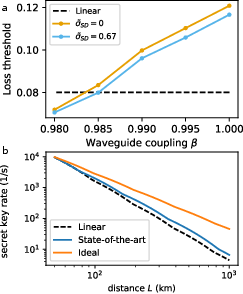
Figure 3: a) FBQC loss threshold versus Δ=04; b) Secret key rate in quantum repeater networks versus distance, for linear and nonlinear (photon-sorted) architectures.
- In fusion-based quantum computing (FBQC), the use of nonlinear BSMs increases the tolerable loss threshold from 8% (linear optics) to up to 12% for noiseless nonlinear sorters. However, Δ=05 is required for an actual improvement, highlighting stringent device requirements.
- In quantum key distribution repeater protocols (e.g., DLCZ), nonlinear BSMs significantly enhance the secret key rate over long links. State-of-the-art quantum emitters can already provide a measurable gain over the strictly linear case.
Outlook and Future Directions
This work provides the first unambiguous demonstration of a passive, on-chip photon sorter capable of deterministic nonlinear operations, verified via photon-number-resolved output statistics. The practical advance lies in boosting fusion-based quantum computing and entanglement distribution protocols beyond linear-optical ceilings.
Critical future directions include:
- Further photonic engineering to achieve near-unity coupling (Δ=06), reduced phonon-induced dephasing, and suppressed charge noise.
- Integration with large-scale multiplexed photonic platforms for scalable cluster state generation and feed-forward measurement architectures.
- Investigation of more advanced photon-sorting protocols, such as those requiring multiple scatterings and temporal mode filtering, which theoretically enable Δ=07 sorting fidelity but at increased experimental complexity.
Conclusion
The deterministic photon sorter based on QD-waveguide interfaces marks a key development in nonlinear quantum photonics. The experimental realization achieves a measured photon-sorting probability of Δ=08 and BSM success rates exceeding the linear optics bound. With further advances in device integration and coherence engineering, these passive nonlinear photonic elements will become pivotal for scalable quantum computation and communication architectures.