- The paper shows that introducing an external magnetic field renders the phase space non-integrable, leading to transitions between regular and chaotic orbits.
- The study implements and compares second, fourth, and PRK6(4) symplectic integrators, revealing PRK6(4) as significantly more accurate for long-term energy conservation.
- Observational EHT shadow constraints tie theoretical parameters to physical reality, enhancing the astrophysical relevance of the chaos diagnostics.
Chaotic Dynamics of Charged Particles Near Weakly Magnetized Black Holes in Einstein-ModMax Theory
Problem Definition and Theoretical Framework
This paper delivers a thorough investigation of the nonlinear dynamics and chaos in the motion of charged particles around black holes with purely magnetic charge, embedded in a uniform external magnetic field, utilizing the Einstein-ModMax framework. The spacetime metric is given as a spherically symmetric solution with a modification parameter e−ν and magnetic charge Qm, which together provide screening for electromagnetic effects and accommodate non-Maxwellian dynamics. The electromagnetic environment is constructed using a generalized Wald solution, and the dynamics incorporate non-integrability introduced by the external field.
Key conserved quantities—energy E, angular momentum L, and Carter's constant Ck—allow the classical system to be integrable in the absence of magnetization. The introduction of an external magnetic field, however, yields a Hamiltonian system whose phase space is no longer integrable and exhibits rich, complex behavior including transitions between regular and chaotic regimes.
Numerical Integrators and Precision Analysis
To resolve the equations of motion for the non-integrable Hamiltonian system, an explicit symplectic integrator is constructed, decomposing the total Hamiltonian into five analytic sub-Hamiltonians. Both second-order (S2), fourth-order (S4), and optimized PRK (PRK64) explicit symplectic schemes are examined for long-term energy conservation and accuracy. Numerical simulations reveal that PRK64 achieves superior precision, reducing Hamiltonian errors by orders of magnitude compared to lower-order methods, thereby ensuring reliable chaos diagnostics even for extended integrations.
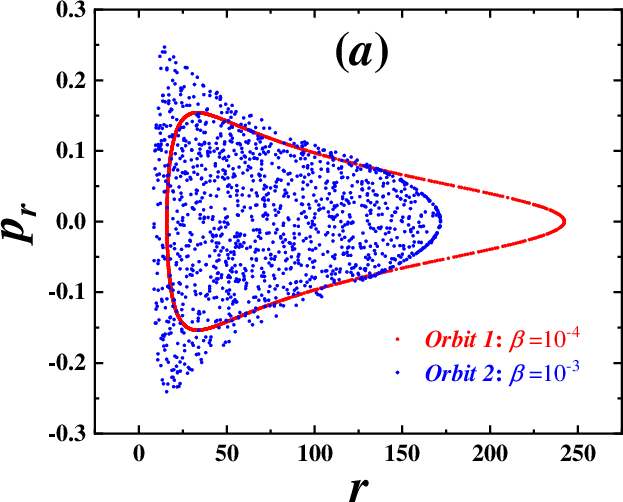
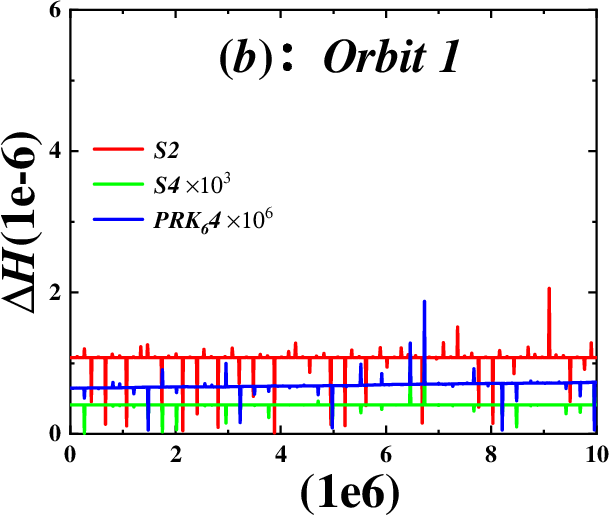
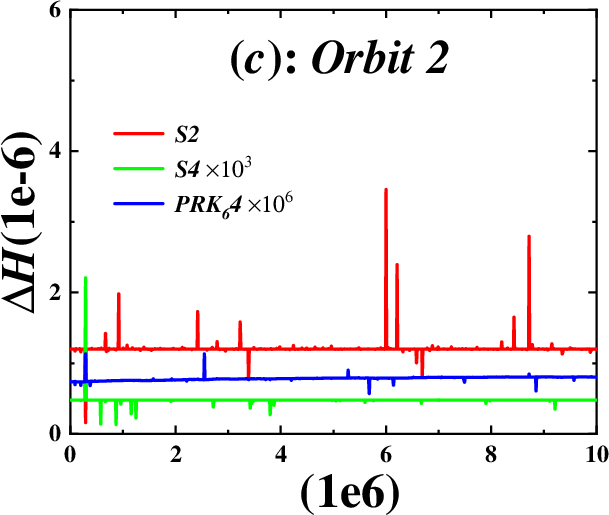
Figure 1: Poincareˊ sections and Hamiltonian errors for multiple symplectic integrators, confirming the accuracy and stability of PRKQm0 over Qm1 timesteps.
Observational Parameter Constraints
The study integrates astrophysical constraints derived from Event Horizon Telescope (EHT) shadow observations of Sgr A*, which limit the permissible values of Qm2 and Qm3 based on the observed shadow radius, providing direct correspondence between theoretical models and empirical data. Only parameter regions consistent with Qm4 within Qm5 to Qm6 are retained for dynamical analysis, which enhances the physical relevance of the chaos exploration.
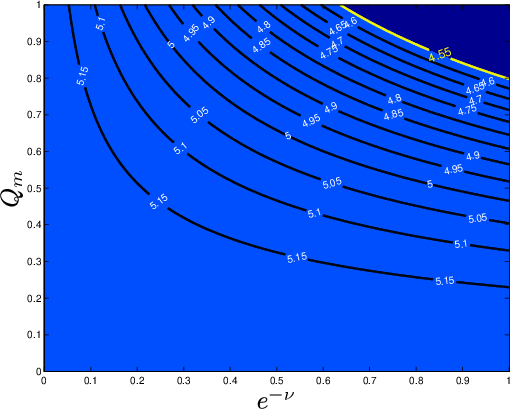
Figure 2: EHT shadow radius constraints on Qm7, delineating physically allowed and excluded regions for Einstein-ModMax black holes.
Chaos Diagnostics: Methodological Innovations
Three quantitative chaos indicators are adopted:
- PoincarQm8 sections: Identify ordered/chaotic orbits via intersection pattern.
- Shannon entropy: Quantifies orbit unpredictability; fluctuates strongly for chaotic states.
- Mutual Information for Particle Pairs (MIPP): Measures statistical correlation between nearby trajectories; values near 1 indicate regularity, values near 0 indicate chaos.
These indicators together delineate transitions between dynamical states more sensitively than classical Lyapunov metrics, with MIPP providing a robust measure for parameter scans due to its computational efficiency and clear discrimination.
Influence of Physical and Geometric Parameters
Systematic scanning in the allowed Qm9 space addresses the impact of E0, E1, E2, and E3 on chaos:
- Energy (E4): Directly expands chaos-dominated regions with increasing E5; regular regions contract, showing high sensitivity.
- Angular momentum (E6): More complex; increases in E7 may suppress chaos, shifting regular regions and generating layered boundaries.
- E8 and E9: Affect phase space structure less profoundly; regular zones persist near event horizons. Their modulation is comparatively moderate.
These trends are corroborated by scanning diagrams and multi-dimensional phase space plots.
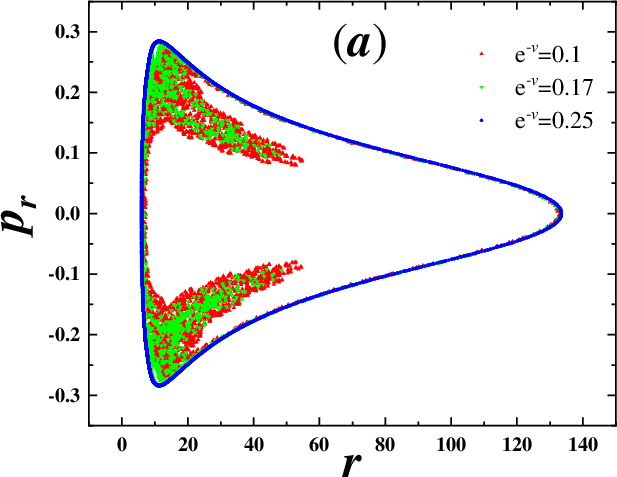
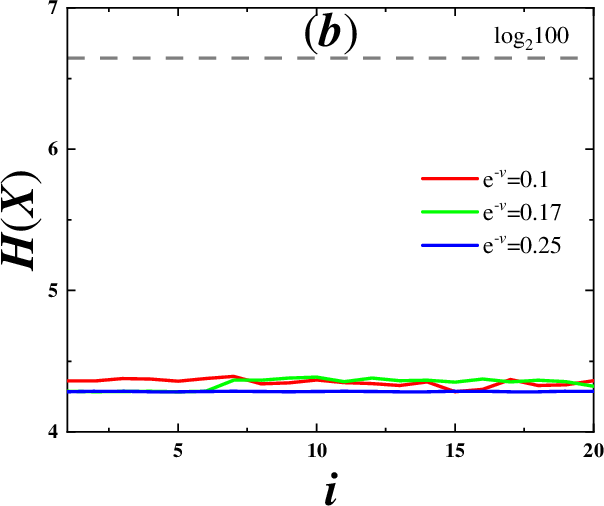
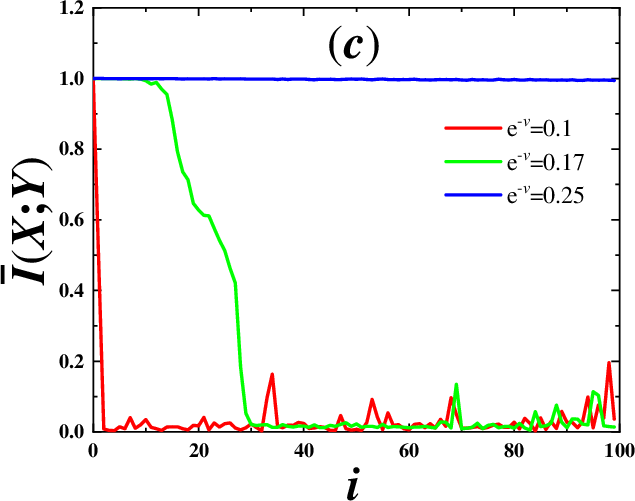
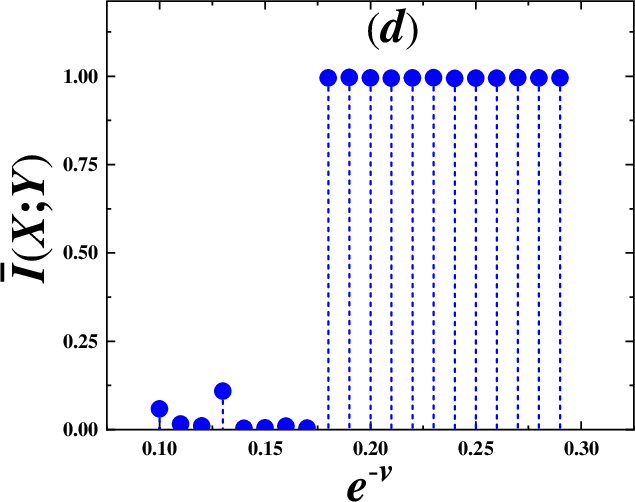
Figure 3: Chaos indicators for varying L0, highlighting the threshold between chaotic and regular regime transitions.
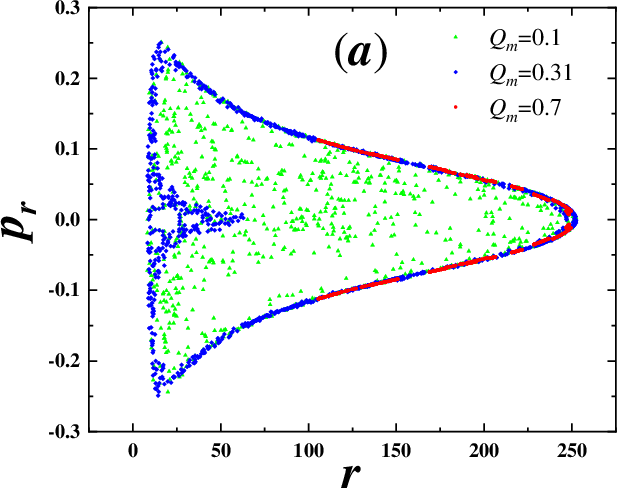
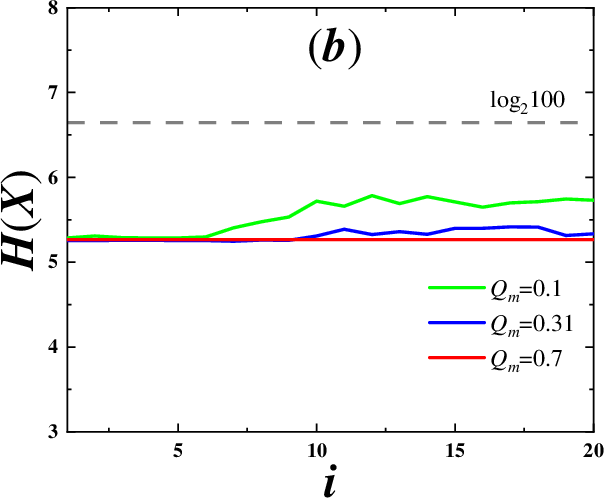
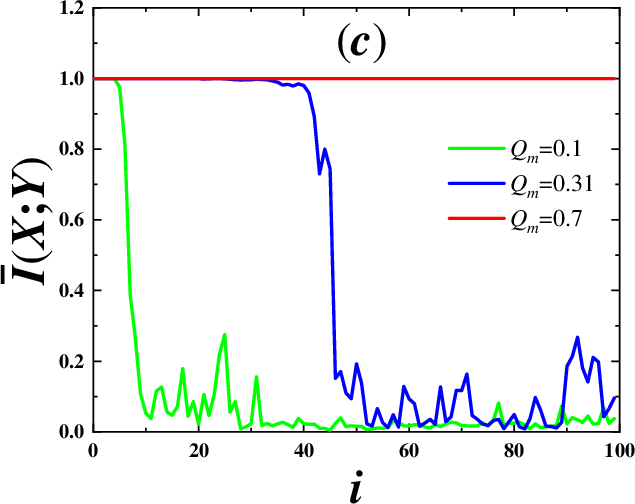
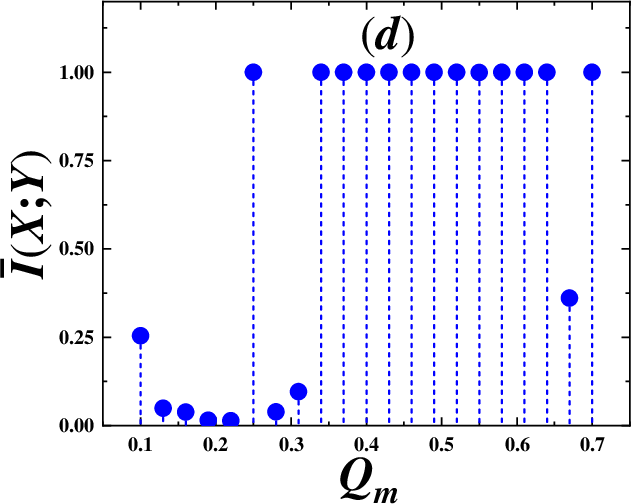
Figure 4: Chaos indicators for L1 scans, demonstrating complex and non-monotonic influence on orbital phase transitions.
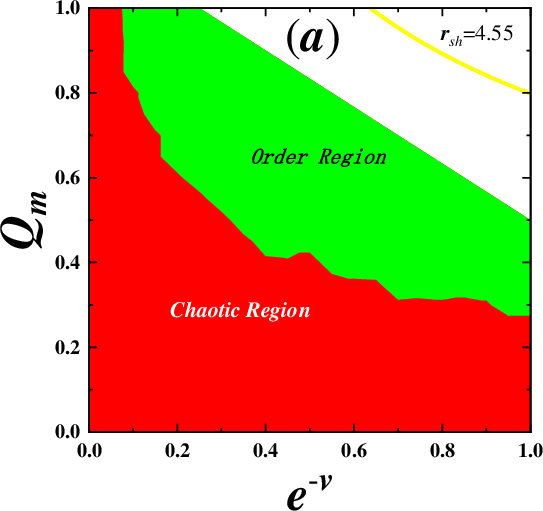
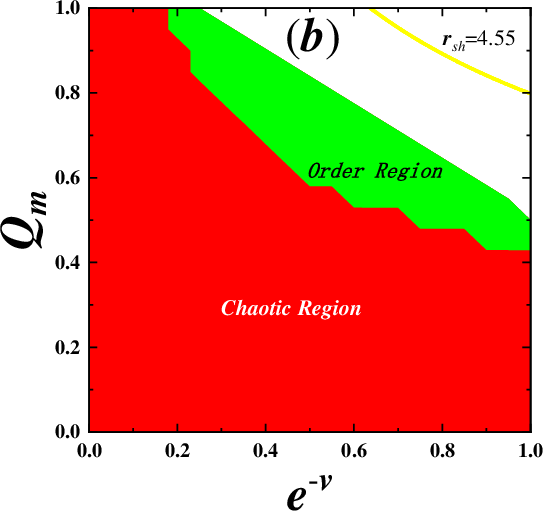
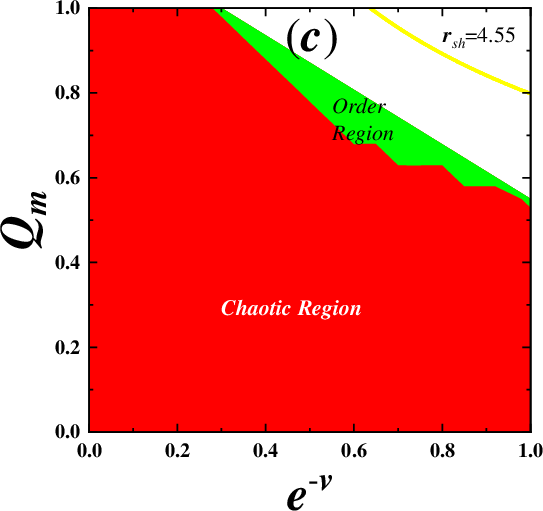
Figure 5: MIPP parameter space scans with increasing energy L2, showing expanding chaotic regions and shrinking regular domains.
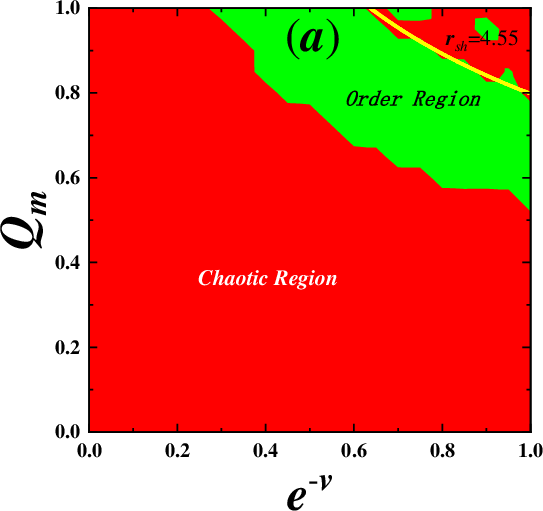
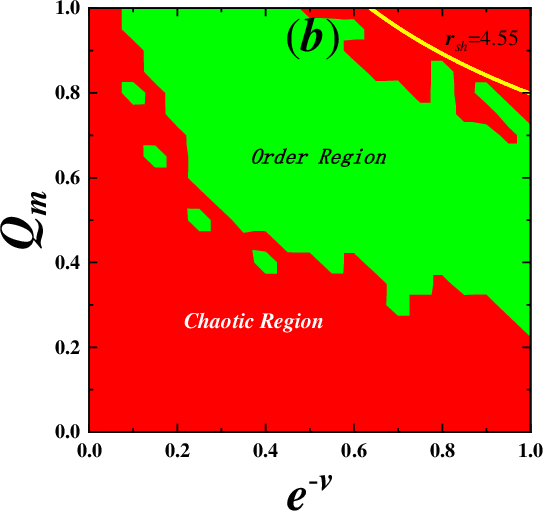
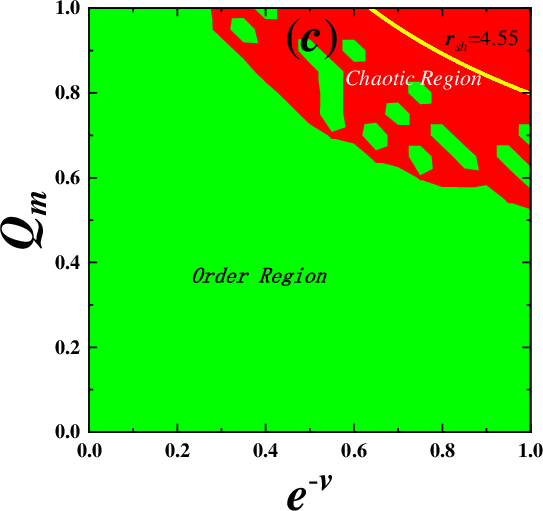
Figure 6: MIPP parameter space scans for angular momentum L3, with shifting boundaries and complex transitions.
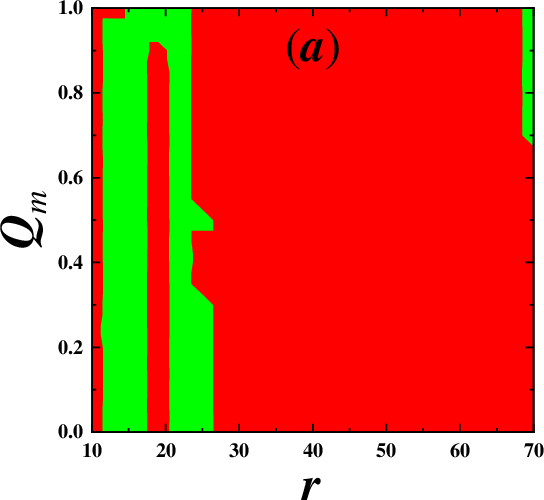
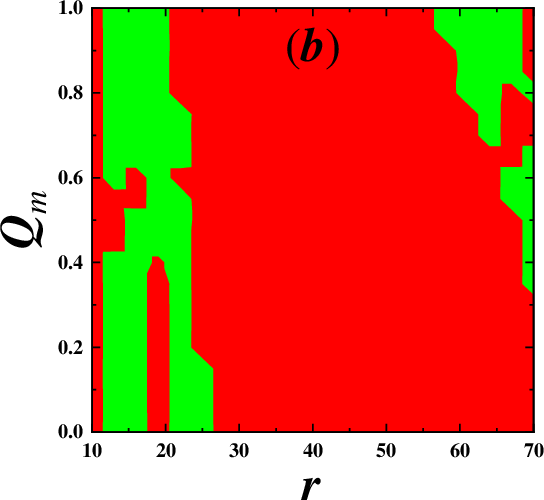
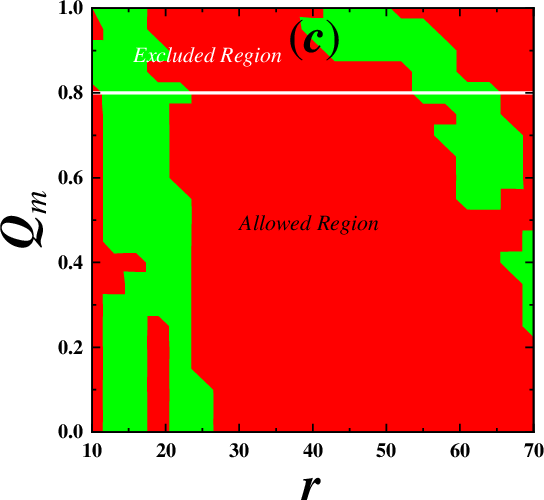
Figure 7: MIPP scans for varying L4, displaying persistent regular regions near the event horizon and expansion with increased screening.
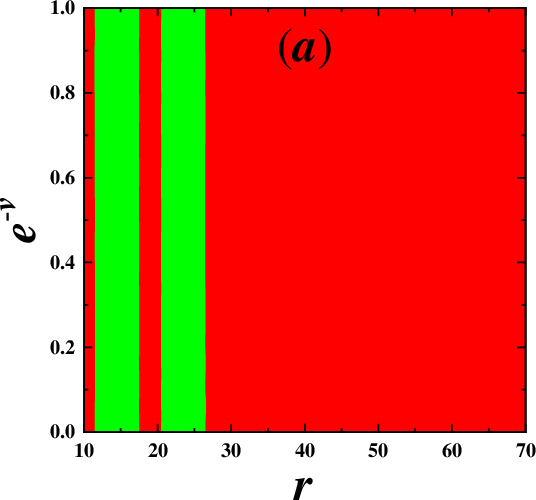
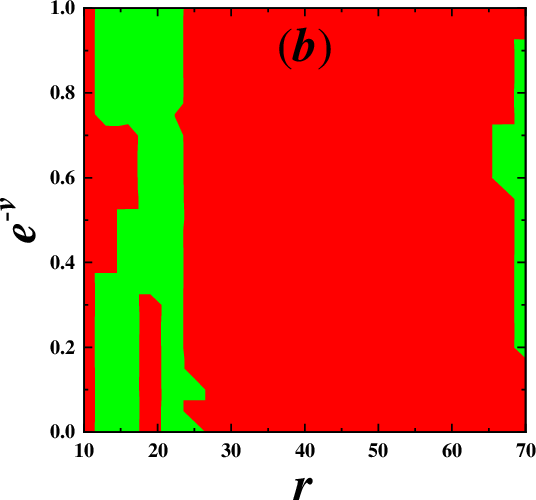
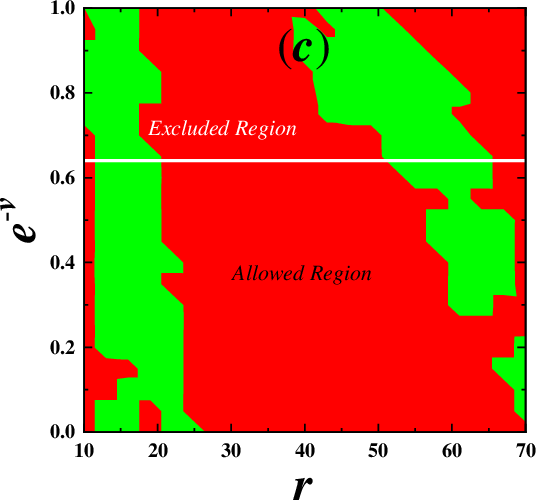
Figure 8: MIPP scans for L5 variation, again verifying moderate impact relative to conserved dynamical quantities.
Physical Interpretation and Theoretical Implications
Analysis of the Hamiltonian reveals dominant contributions from gravitational and inertial terms associated with L6 and L7, while L8 and L9 mainly provide moderate metric corrections. At high Ck0, stronger gravitational effects enhance global phase space accessibility, increasing chaos. Conversely, increased Ck1 augments centrifugal barriers, suppressing chaos.
From an astrophysical perspective, these findings clarify the hierarchy in sensitivity of orbital chaotic transitions to underlying physical and geometric parameters. The prominence of energy and angular momentum in modifying phase space structures posits practical implications for the dynamics of high-energy plasma and charged particles near magnetized compact objects, potentially impacting observable features such as jet launch mechanisms, accretion disk structure, and shadow morphology.
Future Outlook
The methodology of combining high-order symplectic integration and advanced information-theoretic chaos indicators (Shannon entropy, MIPP) establishes a robust framework for future investigations of test particle dynamics in modified gravitational theories. Extending this approach to rotating black holes, multi-charge configurations, and more general spacetime backgrounds can further elucidate the universality and diversity of chaos phenomena in strong gravity. Astrophysical observations (such as EHT/vLTI mass-to-distance ratios, gravitational wave signals) will continue to constrain theoretical parameter spaces and refine the dynamical models.
Conclusion
This paper presents a comprehensive numerical and theoretical study of chaotic particle dynamics near Einstein-ModMax black holes, integrating observational parameter constraints with advanced chaos diagnostics. The dominant role of energy and angular momentum in shaping orbital phase transitions is quantitatively established, with Shannon entropy and MIPP providing effective characterization of complexity. The approach and results lay the groundwork for deepened understanding of chaos in strong field gravitational environments, facilitating further exploration in the context of both fundamental GR extensions and observational astrophysics.

