- The paper presents a stochastic control framework for pricing and hedging derivatives in M&A deals, deriving optimal dynamic trading strategies under temporary and permanent market impact.
- It demonstrates that physical delivery contracts minimize manipulation risk, while cash-settled and path-dependent contracts incur higher fees and potential statistical arbitrage.
- Numerical simulations reveal state-dependent complexities in collars and TWAP contracts, underscoring the need for advanced risk monitoring and regulatory considerations.
Pricing and Hedging Derivatives in M&A Deals under Price Impact
Overview and Contributions
This paper presents a comprehensive stochastic control framework for the pricing and hedging of financial derivatives used in merger and acquisition (M&A) deals when trades exert both temporary and permanent market impact. The contracts analyzed—total return swaps (TRS), collar structures, and TWAP-based (time-weighted average price) agreements—are pervasive in M&A transactions that require careful acquisition of significant equity stakes without breaching regulatory thresholds or incurring excessive market impact.
The authors establish value functions and derive optimal dynamic trading strategies and associated indifference utility prices for both physical delivery and cash-settled contracts. They leverage a filtration-based market model with linear price impact and solve the Hamilton–Jacobi–Bellman (HJB) equations via a blend of closed-form and finite-difference numerical methods. The results quantitatively demonstrate key distinctions between contract structures in terms of pricing, manipulation risk, and the emergence of statistical arbitrage.
Contracts are modeled as agreements between a broker (executing trading and hedging) and a counterparty. The broker's inventory Q(t) and wealth X(t) evolve through continuous-time trading with linear permanent (b) and temporary (l) price impacts. Settlement can occur via:
- Physical Delivery: Obligation to deliver a fixed stock amount at maturity.
- Cash Settlement: TRS-style payout reflecting the price change of N shares, with mandatory unwinding of inventory.
Collar contracts add nonlinearities by incorporating put and call payoffs with specified strikes (K1, K2). Asian-style (TWAP) contracts further introduce an averaging process in the payoff definition.
Optimal fees are determined via exponential utility indifference pricing. The HJB equations governing the value functions for each contract category are rigorously derived and shown to admit unique viscosity solutions under standard regularity conditions.
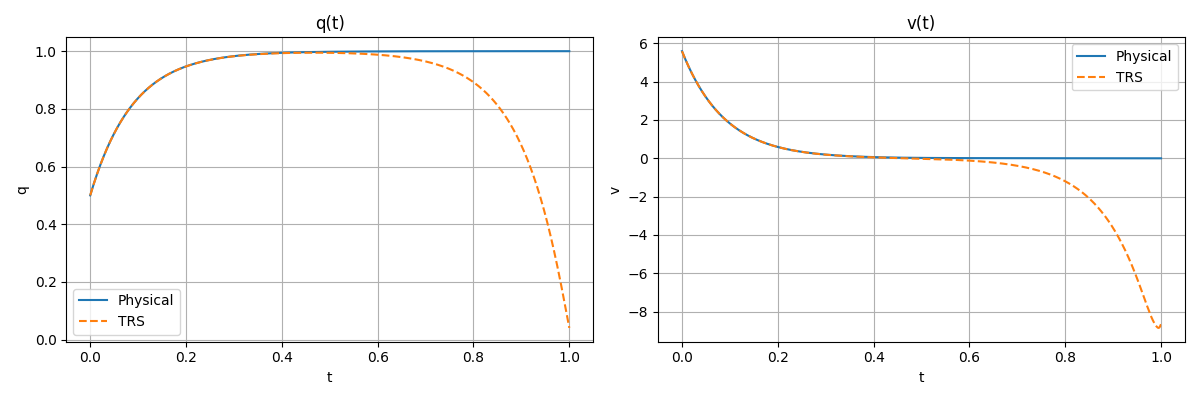
Figure 1: Inventory q (left) and optimal trading rate v (right) for physical delivery and TRS contracts, highlighting fundamental differences in inventory dynamics and liquidation behavior under both settlement types.
Analytical and Numerical Results
Optimal Strategies and Manipulation
The analysis establishes striking differences in optimal trading trajectories between contract forms:
- Physical Delivery: Strategies maintain monotonic inventory accumulation to match delivery obligations, with no sign reversals in v(t); thus, manipulation is absent.
- Cash-Settled/TRS: Inventory is built up initially to hedge price risk and is systematically unwound prior to maturity, leading to sign reversals in X(t)0 and the possibility of manipulation or round-trip statistical arbitrage—a fact confirmed by positive expected broker payoffs even with zero initial capital.
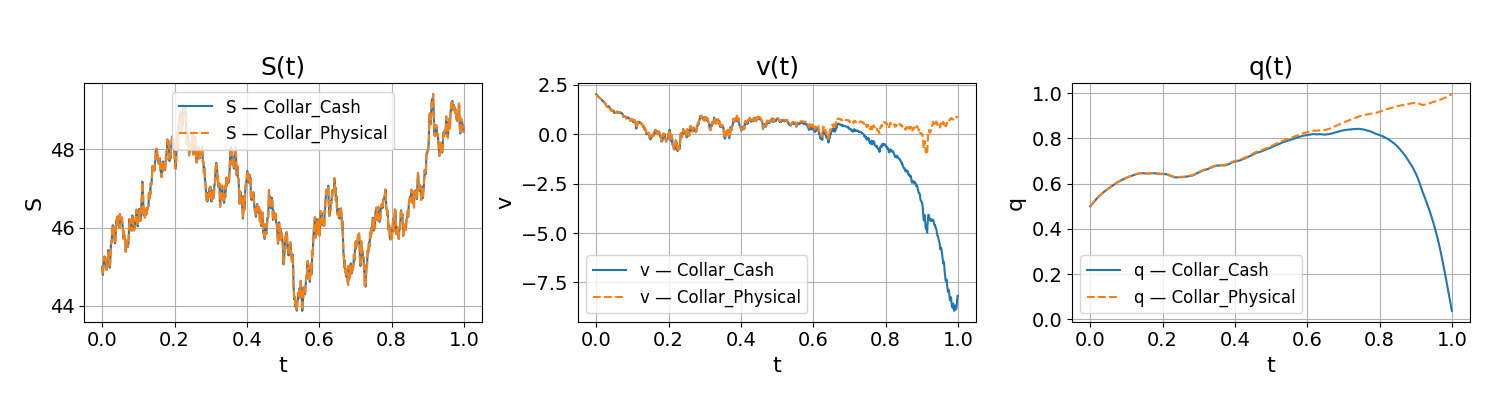
Figure 2: Simulations for collar contracts (physical delivery and cash settlement): asset price X(t)1 (left), optimal trading rate X(t)2 (middle), and inventory X(t)3 (right). Collars introduce state-dependent strategies sensitive to the path of X(t)4.
Collar and TWAP contracts, due to their nonlinear or path-dependent structure, induce significantly more complex and potentially manipulative optimal trading patterns. The optimal inventory and trading speed surfaces exhibit path and state dependence, especially around barrier zones for collars and in high-volatility environments for TWAP-based contracts.
Utility Indifference Pricing and Statistical Arbitrage
Indifference fees are consistently higher for cash-settled agreements compared to their physically delivered counterparts, with the difference attributable to the additional trading and liquidation risk and costs associated with cash settlement. Numerical results reveal:
- Physical delivery pricing: Minimal susceptibility to price manipulation.
- Cash settlement pricing: Higher fees and empirically detectable statistical arbitrage for the broker; expected payoffs are strictly positive after entering the contract (Table below).
| Contract Type |
Indifference Fee |
Statistical Arbitrage (X(t)5) |
| Physical delivery |
45.0029 |
–0.0137 |
| TRS |
45.0130 |
0.0530 |
| Collar (Physical) |
45.0042 |
–0.0101 |
| Collar (Cash) |
45.0078 |
0.0527 |
Numerical sensitivity analysis illustrates that market parameters—interest rate, asset drift, volatility, risk aversion, and liquidity cost—substantially affect both optimal strategies and fees. For instance, higher volatility increases the broker's hedging demand, with the effect strongest for linear contracts. Collars dampen this sensitivity due to their bounded payoff structure.
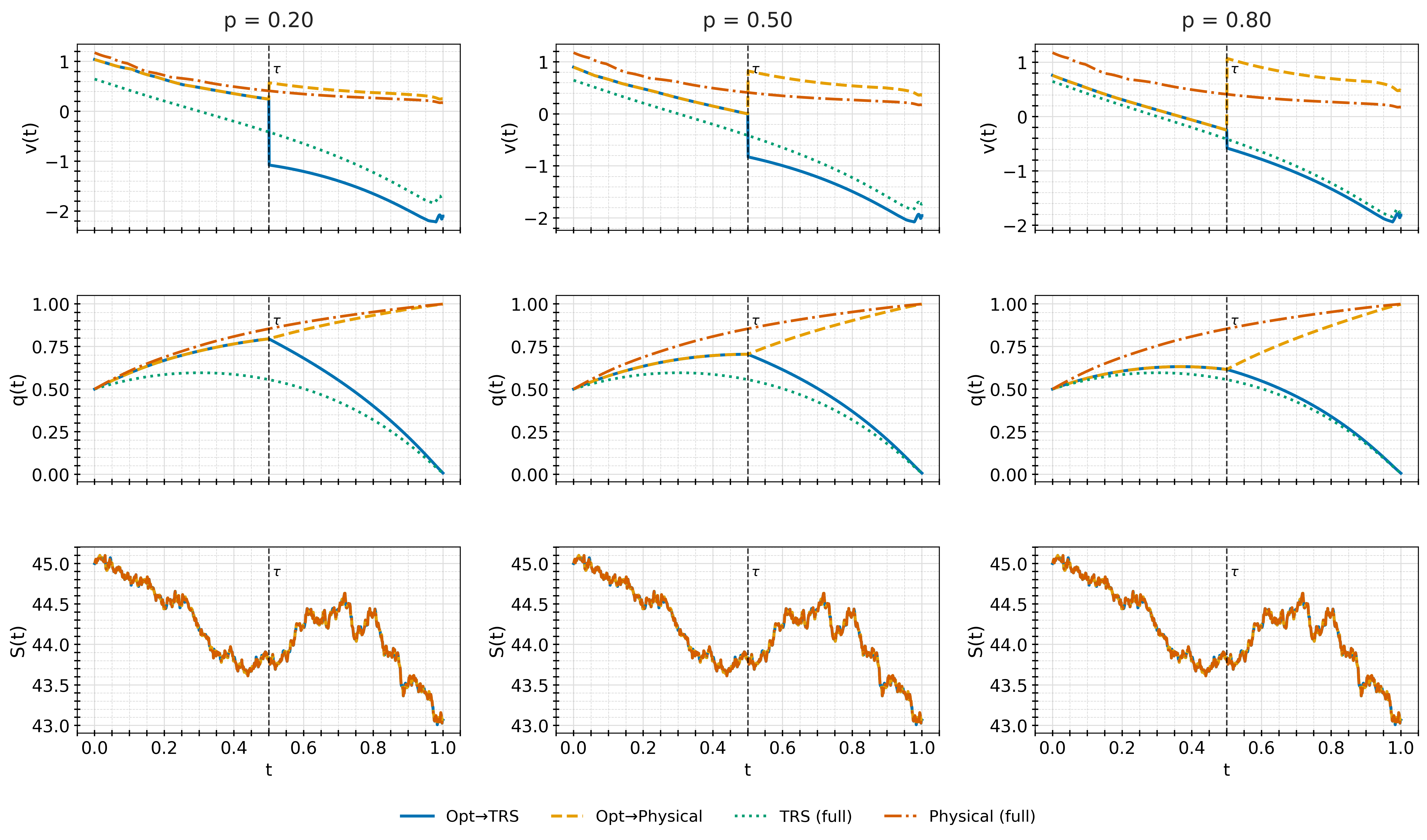
Figure 3: Simulation under varying values of regulatory approval probability X(t)6 with decision time X(t)7 and X(t)8. The trading policy interpolates between cash settlement and physical delivery, emphasizing regulatory risk's influence on execution.
Model Extensions
Regulatory Approval
A tractable two-stage model incorporates the stochastic outcome of regulatory approval, creating an optimal switching problem. The broker’s anticipatory inventory and trading rate during the “waiting” period interpolate between the pure strategies for physical and cash settlement, with optimally mixed policies dependent on the approval probability.
TWAP Benchmark Contracts
TWAP-based contracts, reflecting delegated trading mandates where broker payoff depends on the average price over the interval, admit a further state variable and path dependence. The paper presents reduced-form transformations for efficient solution, demonstrating that:
- TWAP contracts are generally priced lower than linear contracts due to the averaging effect.
- Both cash-settled and physically settled TWAP contracts permit statistical arbitrage and manipulation when volatility is high.
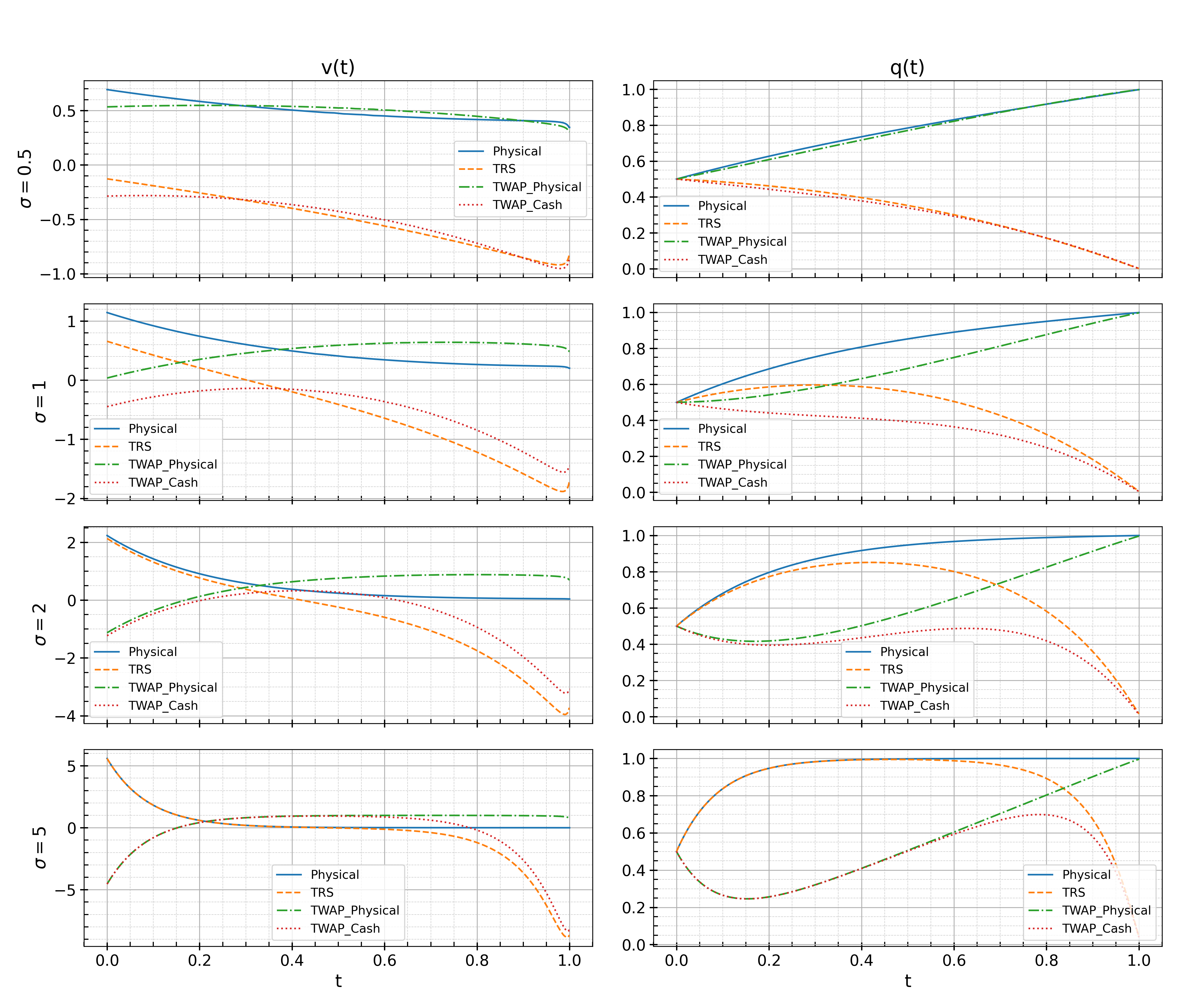
Figure 4: Comparison of X(t)9 and b0 dynamics across physical, TRS, TWAP-physical, and TWAP-cash contracts under different volatility regimes, demonstrating the convergence of trading strategies and inventories under high-volatility scenarios and divergence near maturity.
Practical and Theoretical Implications
The findings have direct relevance for M&A practitioners, risk managers, and regulators:
- Contract structure critically impacts the exposure to manipulation and statistical arbitrage. Regulatory and legal frameworks should acknowledge that cash-settled or path-dependent compensation schemes can amplify incentives for manipulative trading under price impact.
- Physically delivered contracts are preferable for minimizing manipulation risk, particularly when significant market impact is expected.
- Nonlinear designs (e.g., collars, TWAP) necessitate more advanced risk monitoring due to state and path dependence in hedging strategies and potential for more sophisticated forms of market impact exploitation.
On the theoretical front, the paper demonstrates the utility of viscosity solution theory and numerical HJB schemes for analyzing complex, path-dependent contract forms in realistic market impact settings.
Conclusion
The paper provides a rigorous, quantitative foundation for understanding pricing and hedging of derivatives in M&A deals in illiquid markets with explicit market impact. The core results—a higher cost and increased manipulation risk for cash-settled and complex contracts vs. physical delivery—offer concrete guidance for contract design and regulatory policy.
Future work may extend this framework to game-theoretic broker–client scenarios or transient/concave price impact settings, as well as explore further path-dependent compensation mechanisms.