- The paper introduces a novel inflationary model where gravitational torsion induces four-fermion interactions that lead to condensate formation akin to NJL dynamics.
- The paper leverages a dual condensate scenario, where a dynamical waterfall mechanism triggers instant preheating, paving the way for Q-ball and primordial black hole formation.
- The paper explores observable implications such as gravitational wave signatures and dark matter contributions, providing testable predictions within a high-scale cosmological framework.
Fermion Condensate Inflation and the Dynamical Waterfall Mechanism Leading to Primordial Black Holes
The paper "Fermion Condensate Inflation, Dynamical Waterfall Mechanism and Primordial Black Holes" (2604.21535) develops an inflationary scenario based on emergent scalar degrees of freedom arising from a four-fermion interaction. These interactions originate from the coupling of fermions to spacetime torsion as described by the Einstein–Cartan–Holst framework, with the torsional degrees of freedom integrated out to yield a four-fermion axial current-current interaction. For negative values of the effective coupling, the resulting strong attractive force among fermions triggers condensate formation analogous to the BCS/Nambu–Jona-Lasinio (NJL) mechanism.
Upon performing a Hubbard–Stratonovich transformation, auxiliary gap fields Σ (scalar) and Π (pseudoscalar) are introduced, which correspond to condensates of the form ⟨ψˉψ⟩ and ⟨ψˉiγ5ψ⟩. The effective action for these composite fields, after integrating out fermion fluctuations, includes kinetic terms generated by the covariant heat-kernel expansion and a Coleman–Weinberg-type effective potential, incorporating curvature corrections and ultraviolet regularization.
The model is extended to encompass two distinct fermion sectors, ψ and χ, each giving rise to their own composite states. This two-sector structure mimics the field content of hybrid inflation, with one condensate sector playing the role of the inflaton and the other furnishing an auxiliary (waterfall) field.
Effective Potential Structure and the Waterfall Mechanism
The effective potential for the two bound states, parameterized as real scalar field A (gap field from sector ψ) and real/pseudoscalar B (bound state from sector χ), contains both mass-like terms and logarithmic radiatively generated contributions, reminiscent of the NJL/BCS models:
Π0
The potential admits a structure with multiple local minima, with the possibility of a phase transition as Π1 (the inflaton) evolves towards its minimum, triggering the instability and condensation of the auxiliary field Π2 via a waterfall mechanism. The minima for Π3 and Π4 as functions of the fields are visualized in the effective potential plot:
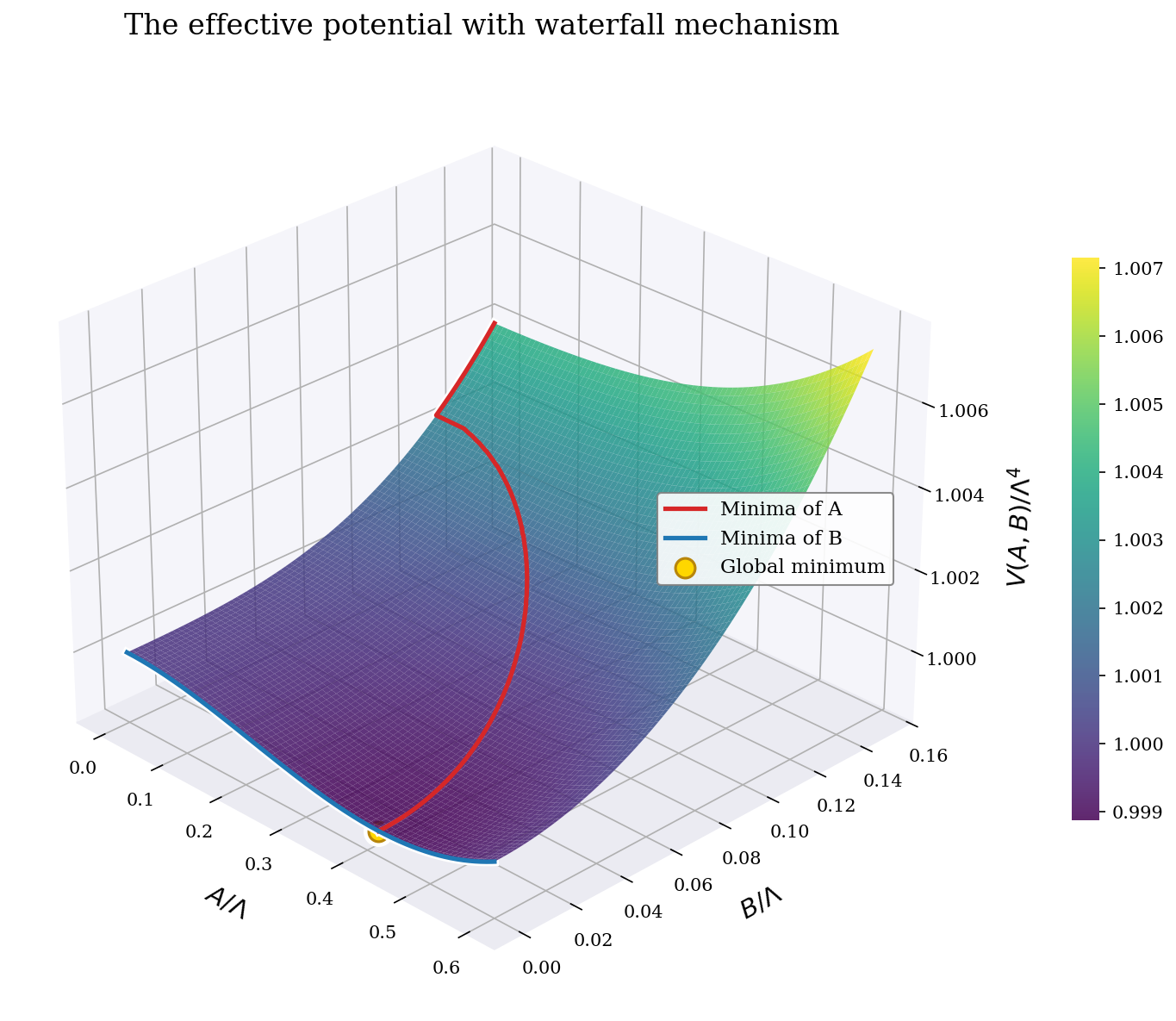
Figure 1: The normalized effective potential Π5 shows the loci of minima for Π6 (red) and Π7 (blue), illustrating how the dynamical waterfall mechanism is realized at their intersection.
The waterfall occurs due to the logarithmic singularity of the second derivative of the effective potential at the origin, reflecting the Cooper instability—indicative of unconditional instability in the symmetric (unbroken) phase at zero temperature.
Exit from Inflation: Axial Chemical Potential and Instant Preheating
The model incorporates an axial chemical potential Π8, which explicitly breaks chiral symmetry and leads to dynamical particle number generation during inflation. The effective gap equation and the number density constraints are coupled; their interplay drives a continuous buildup of axial number density. As the density reaches a critical value, the gap equation ceases to admit solutions with nonzero condensate, forcing the condensate to “melt”.
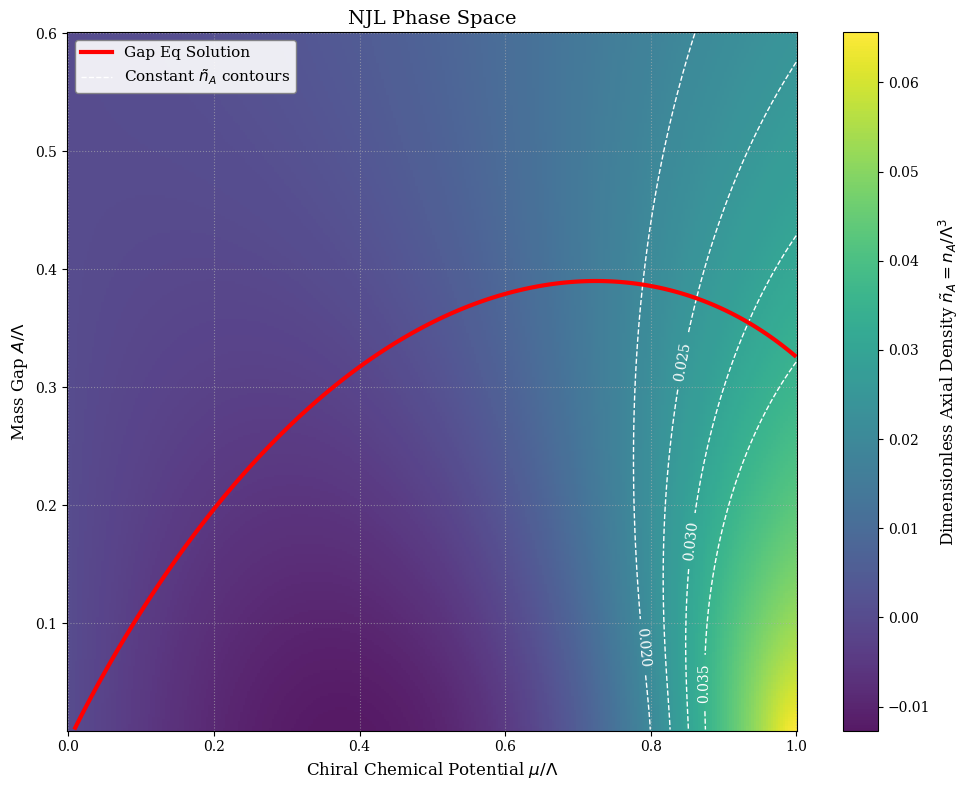
Figure 2: Phase space of the equation of motion for the chemical potential. The red curve depicts the allowed vacuum manifold; intersections with density contours (white) show the attainable states. At high densities, intersections disappear, marking exit from inflation.
This process realizes a density-driven, temporally triggered dynamical waterfall mechanism. The destruction of the condensate is accompanied by an explosive, nearly instantaneous preheating; the large composite Yukawa couplings ensure efficient and prompt energy transfer to radiation, naturally ending the inflationary phase.
During the waterfall phase, the negative curvature of the effective potential with respect to the composite field Π9 (i.e., ⟨ψˉψ⟩0) provides the necessary instability for the growth of fluctuations and fragmentation. This generates non-topological solitons—Q-balls—associated with the global ⟨ψˉψ⟩1 symmetry of the composite field.
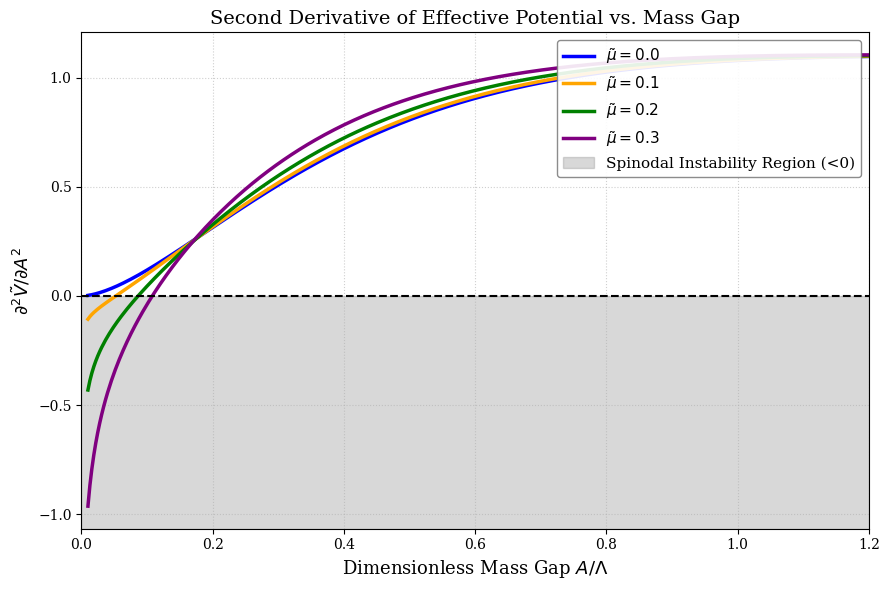
Figure 3: The second derivative ⟨ψˉψ⟩2 transitions from negative to positive values as a function of ⟨ψˉψ⟩3 for various chemical potentials. The instability region where ⟨ψˉψ⟩4 supports Q-ball formation.
The Q-ball solution arises as a time-dependent phase-rotating ansatz for the complex gap field, ⟨ψˉψ⟩5, resulting in localized, stable objects with conserved global charge ⟨ψˉψ⟩6. The scaling of Q-ball mass and radius with ⟨ψˉψ⟩7 follows established analytical estimates familiar from supersymmetric and NJL contexts.
Primordial Black Hole Production from Q-ball Clusters
Dense clusters of Q-balls may gravitationally collapse to form PBHs if their total mass and compactness satisfy the necessary conditions. The probability to form a PBH, the resulting PBH mass function, and its contribution to relic dark matter density are derived using a combination of Poisson statistics for Q-ball number densities and sharp collapse criteria based on gravitational binding versus Hubble expansion.
The constraints for PBH formation translate into inequalities involving Q-ball parameters, cluster number, and the energy scale ⟨ψˉψ⟩8 of the cutoff. For the canonical choice ⟨ψˉψ⟩9 GeV, parameter regions exist where Q-ball clusters collapse into PBHs sufficiently abundant to play a significant role in the dark matter content, contingent on detailed model microphysics.
Implications and Outlook
This framework achieves several objectives without invoking fundamental scalar fields beyond the Standard Model. The inflaton and the waterfall field both emerge as composites of fermions coupled via gravitational torsion, naturally incorporating parity violation and facilitating links to Chern–Simons gravity, with possible direct imprints in gravitational wave observations such as birefringence and damping effects. The parametric structure accommodates high-scale inflation consistent with Planck constraints. The density-driven dynamical waterfall and instant preheating mechanisms offer robust and testable predictions for gravitational wave signatures, PBH mass functions, and potential connections to dark matter.
Beyond cosmology, the theoretical unification of condensation, inflation, and non-perturbative soliton dynamics in a gravity-induced NJL framework opens avenues for exploring composite paradigms for other astrophysical and cosmological phenomena.
Conclusion
The paper presents a technically robust and internally self-consistent scenario for early universe inflation, reheating, and PBH production sourced by four-fermion interactions induced by spacetime torsion. It demonstrates, with detailed analytical and numerical treatment, that gravitational fermion condensates can drive inflation with a dynamical waterfall exit, Q-ball and PBH formation, and observables tied to parity-violating gravity. This construction avoids introducing fundamental scalars, tightly links high-energy gravitational and particle-physics phenomena, and motivates further phenomenological investigations of fermion condensate cosmologies and their signatures in gravitational wave and PBH observations.

