- The paper introduces a novel Transformer-based method utilizing local patch descriptors for precise 3D edge detection.
- It leverages dual projection distances and multi-head self-attention to capture both sharp and smooth edge transitions.
- Experimental results on ABC and PartNet datasets show superior performance with high precision (0.890) and recall (0.922).
Introduction
Edge detection in 3D point clouds is a critical task underpinning numerous vision applications, including simplification, segmentation, reconstruction, and part-level analysis. As surfaces in point clouds present both irregular sampling and varying scale features, traditional geometric and surface fitting approaches struggle with detecting fine-grained and smooth edges, especially in densely distributed regions or with small-scale gradients. Learning-based methods have improved efficiency and representation, but suffer from input-size limitations or lack of resolution for structural detail.
EdgeFormer introduces a novel paradigm based on local patch analysis and Transformer architectures for edge classification in 3D point clouds (2604.21387). By associating each point with its k-nearest neighborhood, the method encodes relative projection distances—namely, dpipj and dpjpi between target and neighbor points—for superior local surface gradient approximation. This encoding schema forms the cornerstone of robust feature descriptors that capture both sharp and smooth transitions. The Transformer, operating on these local patches, models relational dependencies and yields edge predictions on a per-point basis. Rigorous testing on large-scale datasets demonstrates the effectiveness and robustness of the architecture.
EdgeFormer reframes edge detection as a per-point binary classification problem. Each point serves as the anchor of a local surface patch formed by its kNN, which enables patch-wise training samples. The primary feature descriptor encapsulates geometric relationships via projection distances, defined as:
- dpipj: Projection distance from pi onto pj’s normal.
- dpjpi: Projection from pj onto pi’s normal.
The difference between these values is maximal for edge points (indicating large or small gradients), minimal for non-edge points. This approach leverages the spatial coherence of point normals, translating surface transitions into numerical descriptors.
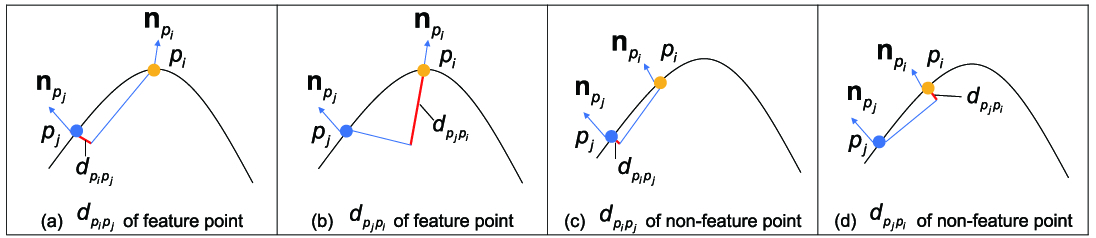
Figure 1: EdgeFormer feature descriptor leverages projection distance between neighboring points to distinguish edge and non-edge characteristics.
The EdgeFormer network consists of four principal modules:
- Feature Embedding: Converts local descriptor matrices into high-dimensional representations, employing MLPs for dimension mapping.
- Feature Enhancement: Utilizes a multi-layer Transformer encoder with multi-head self-attention to capture global contextual relationships within patches.
- Feature Fusion: Merges enhanced features from both projection directions, preventing loss during concatenation and providing comprehensive patch descriptors.
- Feature Decoder and Point Classification: Applies stacked MLPs with ReLU activations, BatchNorm, and dropout for probability estimation, culminating in category logits.
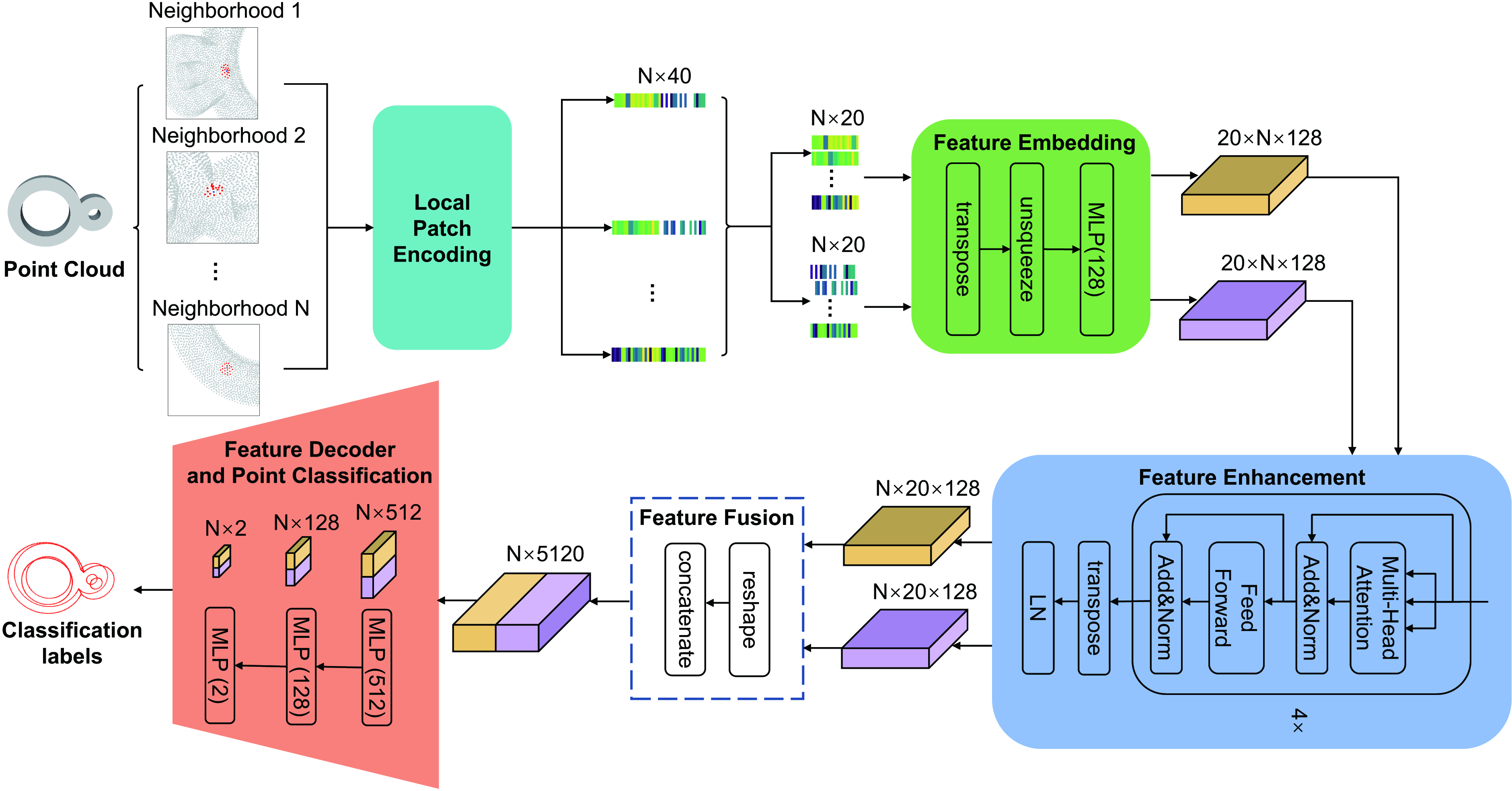
Figure 2: Architecture of the EdgeFormer network, detailing patch encoding, Transformer enhancement, feature fusion, and classification modules.
The computational complexity is mitigated by restricting the Transformer’s scope to local patches, ensuring scalability for dense point clouds.
Datasets and Experimental Setup
Evaluation utilizes the ABC dataset—a repository of CAD models with annotated sharp features—and PartNet, which provides hierarchical part-level segmentation labels. The ABC dataset enables comprehensive quantitative benchmarking through parametric curve ground truth (feature lines and surfaces). PartNet is used for generalization assessment.

Figure 3: Example CAD models from ABC dataset, highlighting diverse structures and edge complexity.
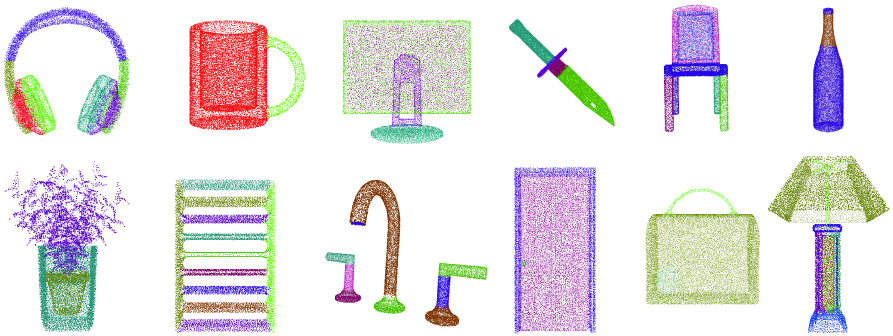
Figure 4: Sample objects from PartNet dataset used for evaluating cross-domain generalization capability.
Quantitative and Qualitative Results
EdgeFormer is benchmarked against six baselines: BE, PBRG, SGLBP (geometric), EC-Net, PIE-Net, and NerVE (deep learning).
- Hausdorff Distance: EdgeFormer achieves 0.115, outperforming all baselines.
- IoU & MCC: 0.839 and 0.885, respectively—comprehensively superior.
- Precision & Recall: High values (0.890, 0.922), reflecting the network’s ability to avoid false positives and miss fewer true edges.
Qualitative experiments further illustrate EdgeFormer’s capability to localize sharp, smooth, and fine-grained features that baselines often miss. EdgeFormer’s output aligns closely with the ground truth, especially for minute structural elements.
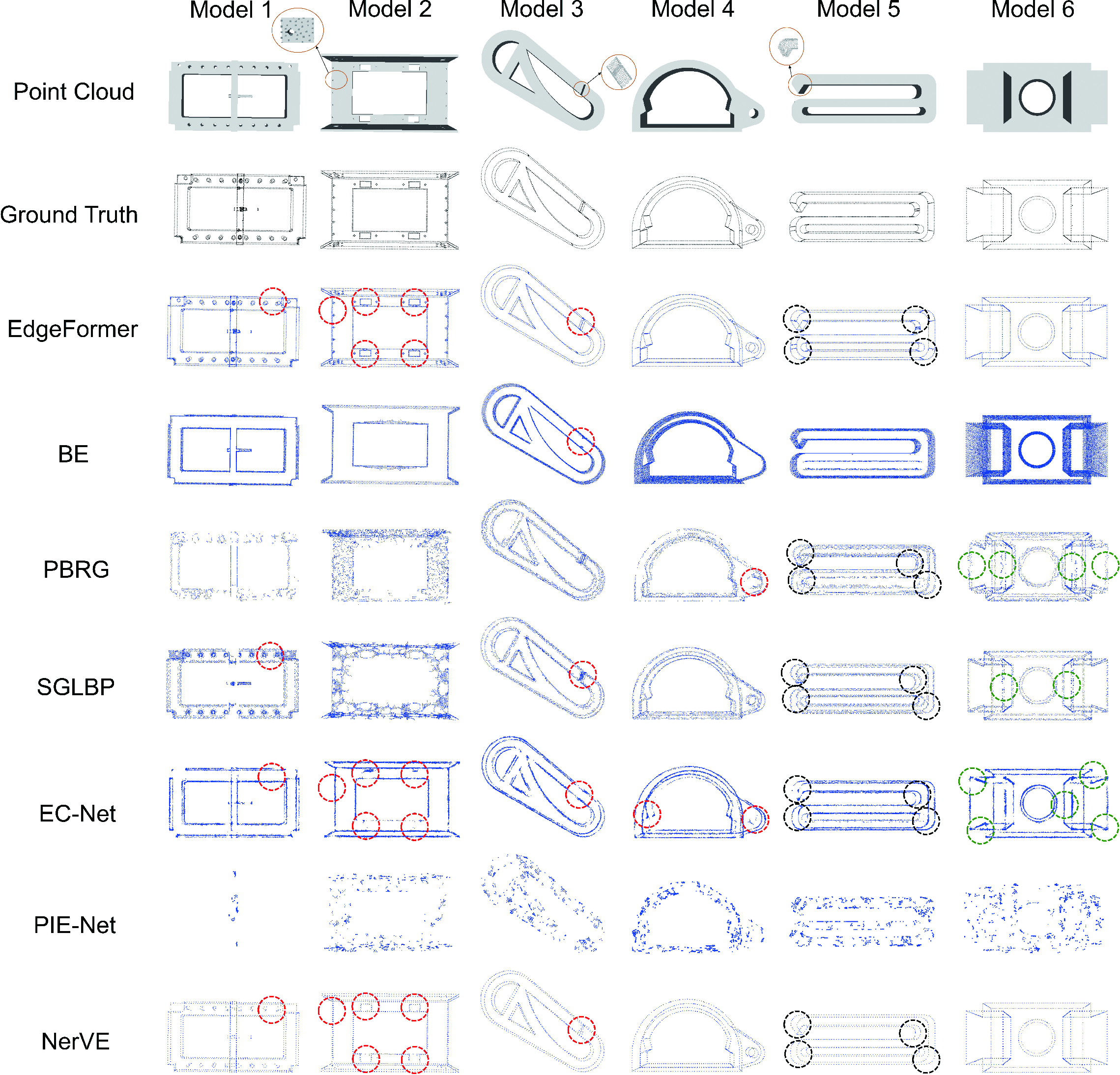
Figure 5: Visual comparison between EdgeFormer, baselines, and ground truth on ABC dataset, with sharp, smooth, and fine-grained features highlighted.
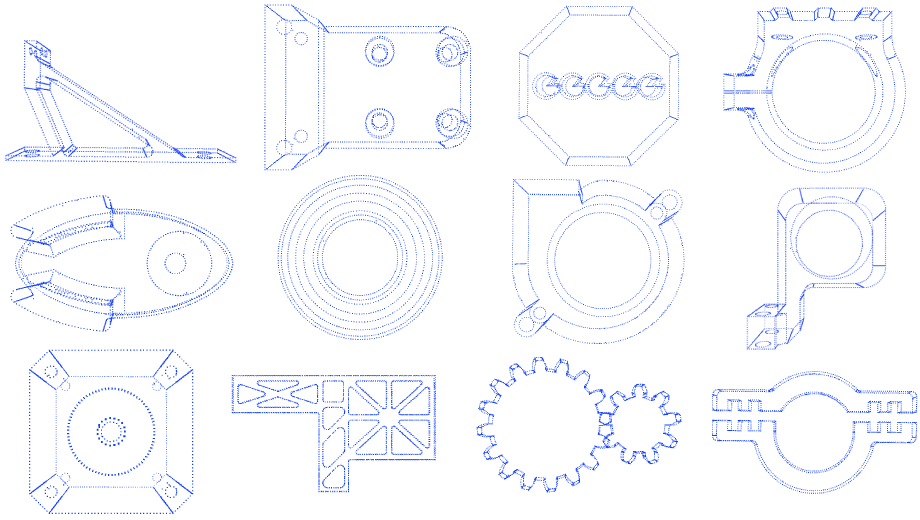
Figure 6: Additional ABC results showing EdgeFormer’s high fidelity to ground truth across representative shapes.
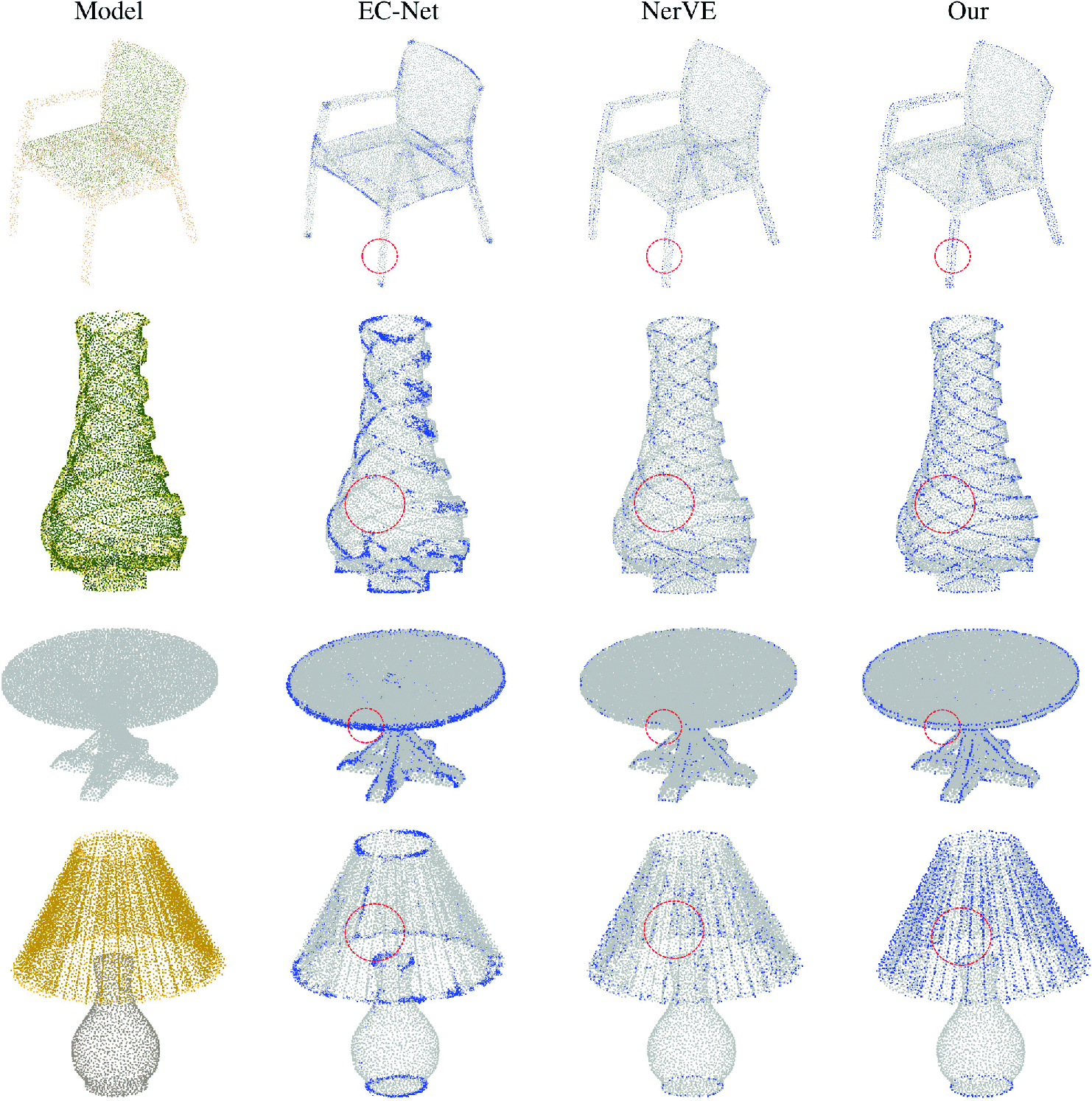
Figure 7: Edge detection performance on PartNet objects, demonstrating generalization and resilience, in comparison to EC-Net and NerVE.
Robustness Studies
EdgeFormer demonstrates notable robustness against reduced sampling density and noise perturbations:
- Sampling Density: EdgeFormer retains high accuracy under aggressive downsampling (to dpipj0), with only moderate degradation in Chamfer Distance (CD).
- Noise Perturbation: Maintains reliable edge detection with Gaussian noise up to dpipj1, confirming stability for real-world noisy inputs.
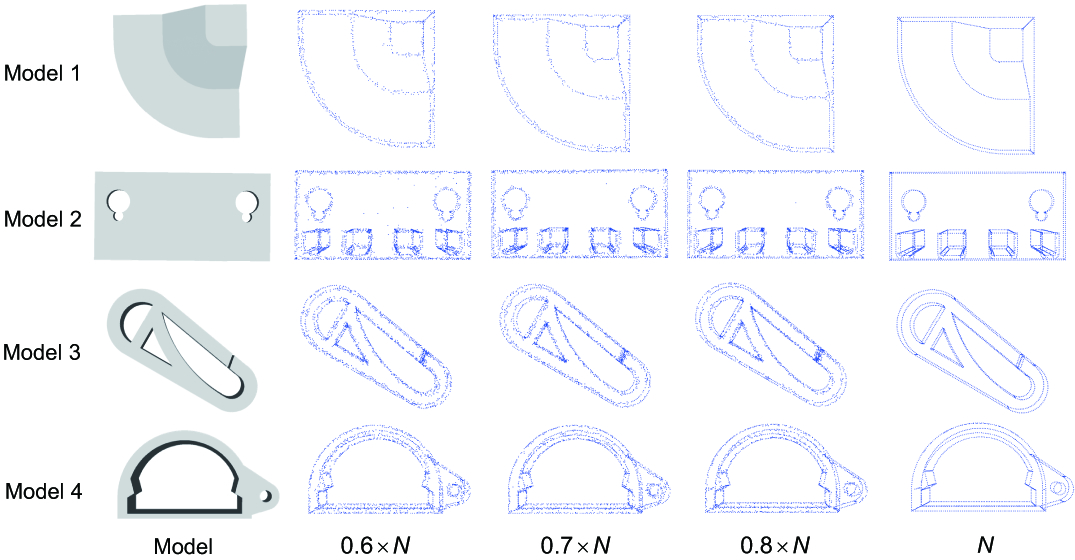
Figure 8: Edge detection results under varying point cloud densities, showcasing resilience.
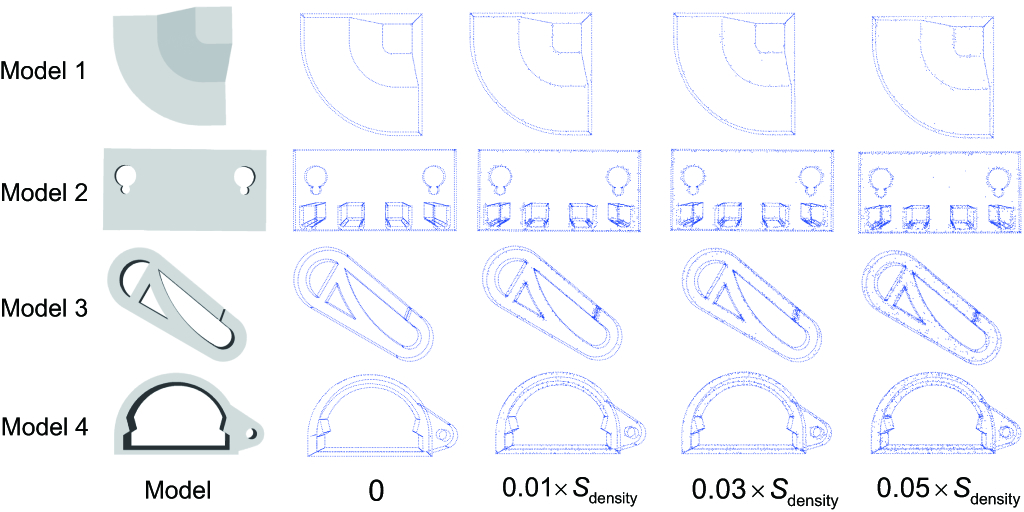
Figure 9: Edge detection results subjected to escalating noise, preserving accuracy and localization.
Ablation and Efficiency Analysis
Ablation studies verify the criticality of the full feature descriptor and the combination of MLP and Transformer components. Removing either dpipj2 or dpipj3 significantly impacts performance; substituting classic descriptors (Spin Image, 3DSC, SHOT, PFH) results in inferior accuracy.
Runtime measurements show that EdgeFormer processes large (90k point) clouds within 13.574 seconds, underscoring efficiency due to the local patch strategy.
Limitations
EdgeFormer may falter when local patches are excessively sparse, leading to incomplete representation and degraded classification performance. The method assumes sufficient neighborhood structure for accurate normal and descriptor computation.
Implications and Future Directions
The methodology of local patch encoding combined with Transformer modeling offers a scalable and precise solution for 3D edge detection, improving upon both traditional geometric and deep learning approaches. The explicit use of projection distances as features is empirically superior to classical descriptors and generic neural embeddings.
Practically, EdgeFormer can be integrated in downstream tasks such as surface reconstruction, part segmentation, and non-realistic rendering, where edge fidelity is paramount. Theoretically, the demonstrated robustness and generalization highlight the Transformer’s adaptability to irregular domains; this paradigm may inspire granular, locality-preserving architectures for other 3D vision problems, including shape analysis and scene understanding.
Further research should explore the extension of patch-based descriptors to semantic segmentation, unsupervised structural clustering, and differentiable reconstruction pipelines.
Conclusion
EdgeFormer establishes a rigorous, Transformer-driven approach to point cloud edge detection, leveraging point-wise local patch descriptors for robust classification. Its performance across dense, noisy, and cross-domain datasets substantiates its utility for both academic and industrial applications. The architecture’s modularity and efficiency recommend it as a candidate for future models handling complex 3D geometry.