- The paper establishes a unified framework for temporal coarse graining that yields time-uniform error bounds for GKSL master equations in Markovian open quantum systems.
- It rigorously derives error bounds that remain controlled over arbitrary time scales, overcoming linear or exponential divergence typical of earlier approximations.
- The findings support the reliable long-time use of GKSL master equations, with significant implications for simulating dissipative quantum dynamics in various applications.
Background and Motivation
The open quantum system paradigm addresses the inevitable interactions between a quantum system and its environment, resulting in dissipation and decoherence. The canonical approach, leveraging the Born-Markov approximation, produces the Redfield equation—a time-local master equation describing the reduced system's evolution. Although the Redfield equation is analytically tractable, it fails to guarantee complete positivity, which can lead to unphysical dynamics, e.g., violation of density matrix positivity. In practice, to circumvent this issue, secondary approximations—most notably various forms of the rotating-wave approximation (RWA), time-averaging, and geometric-arithmetic methods—are applied to yield master equations in the Gorini-Kossakowski-Sudarshan-Lindblad (GKSL) form, ensuring complete positivity.
Previous rigorous analyses of these approximations provided error bounds that typically scale with time, diverging either linearly or exponentially, thus validating the approximations only in the short-time regime. Furthermore, error bounds have historically been derived in a scheme-specific manner, limiting their applicability and theoretical clarity.
Unified Approach via Temporal Coarse Graining
This paper introduces a unified framework termed temporal coarse graining, subsuming a broad class of approximation schemes that transition from the Redfield to GKSL generators. Temporal coarse graining is defined by partitioning transition frequencies into “slow” and “fast” modes, controlled by a coarse-graining timescale Δt chosen such that bath correlations decay on a timescale B, and dissipation occurs on a timescale D=1/γ, with B≪Δt≪D.
Two technical criteria characterize temporal coarse graining:
- The approximation must be accurate on slow modes, with error bounded by cγ(B/Δt)α for some α>0.
- Error on fast modes is allowed to be O(γ), reflecting the inherent smallness of off-resonant contributions.
This setup encompasses the full/partial RWA, time-averaging, and geometric-arithmetic approximations by tuning the group structures of transition frequencies and the exponent α (with values ranging from $1/2$ to ∞ for different schemes).
Main Theoretical Result: Time-Uniform Error Bound
The central contribution is a rigorous, time-uniform error bound for temporal coarse graining in Markovian quantum dynamics. Unlike prior results, which diverged with time, the derived bound remains controlled for arbitrarily long durations, provided the timescale separation B0 is maintained.
Formally, the trace-norm distance between the exact Redfield evolution B1 and the GKSL evolution B2 is bounded as
B3
for all B4, where the error parameter B5 can be made arbitrarily small by appropriate choice of B6 in the regime B7 (explicitly, B8). This result provides a scheme-uniform, long-time guarantee that was unattainable in previous work. The error bound's dependence on system size is mediated through constants appearing in the bound and is not optimal in the many-body case.
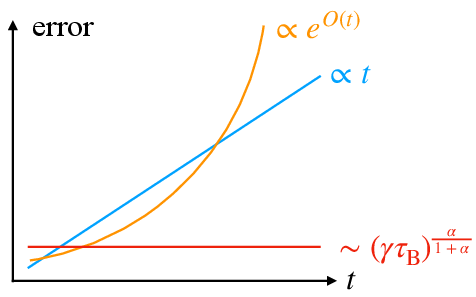
Figure 1: Previous error bounds grow linearly or exponentially in time, while the new error bound remains uniformly small for arbitrary time B9.
Detailed Analysis of Approximation Methods
The framework benchmarks the following widely-used GKSL generator derivations as temporal coarse graining:
- Full Rotating-Wave Approximation (RWA): Only resonant (energy-conserving) terms are retained, strictly valid for ultra-weak coupling and large frequency separations; produces error scaling with D=1/γ0.
- Partial RWA: Groups close transition frequencies, with error scaling linearly with D=1/γ1 (D=1/γ2), accommodating systems with clustered spectra.
- Time-Averaging Procedures: Integrate system-bath interactions over intermediate timescales (D=1/γ3), balancing accuracy with spectral overlap.
- Geometric-Arithmetic Approximations: Apply matrix-analytic techniques to enforce positivity with error shaped by spectral properties (D=1/γ4).
All these approximations are captured by the temporal coarse graining conditions, allowing for uniform treatments of their induced errors in the GKSL regime.
Implications and Future Directions
The demonstrated time-uniform error bound establishes the trustworthiness of GKSL master equations derived by temporal coarse graining for all timescales compatible with the Born-Markov separation. This result enables rigorous analysis of dissipative quantum processes, quantum thermodynamics, and stochastic unraveling strategies, as the complete positivity of the GKSL form is ensured uniformly in time. Practically, it justifies the long-time use of such master equations in simulations and analytic work beyond perturbatively short intervals, provided system-bath coupling remains sufficiently weak.
The authors note that the bound's dependence on Hilbert space dimension renders it suboptimal for genuine many-body systems. Theoretical refinement—potentially leveraging Lieb-Robinson bounds or operator spreading techniques—could make the error bound uniform in both time and system size, which remains an open problem of high relevance for quantum statistical and condensed matter physics.
Conclusion
This paper rigorously establishes that temporal coarse graining—a generalization encompassing several common Markovian master equation derivations—yields time-uniformly accurate GKSL generators in open quantum systems for all timescales in the Born-Markov regime. This unified error analysis advances the foundations of dissipative quantum dynamics, facilitating robust application of GKSL equations for both theoretical investigation and design of quantum technologies. Future work may extend these bounds to large-scale many-body systems, providing quantitative rigor at the heart of quantum statistical and information science.