- The paper introduces ITEA, an inverse TTC algorithm that efficiently enumerates Pareto-optimal allocations in one-sided matching markets by recovering TTC preimages.
- It leverages a tagging system and recursive breadth-first search to prune explored configurations and avoid redundant TTC computations.
- Empirical results demonstrate orders of magnitude speedups over brute-force methods, highlighting significant computational savings in practical settings.
Pareto Frontier Enumeration in One-Sided Matching via Inverse Top Trading Cycles
Problem Setting and Motivation
The paper "Finding Pareto frontier for one-sided matching" (2604.21306) addresses a foundational problem in mechanism design and market allocation: the explicit enumeration of all Pareto-optimal (PO) allocations in one-sided matching markets with strict ordinal preferences. Such settings, typified by assignments like hostel room allocation, require each agent to be matched to a unique item (e.g., room) based only on preference rankings, with monetary transfers disallowed.
Top Trading Cycles (TTC), a well-studied and algorithmically tractable mechanism, is known to efficiently yield a PO allocation through a directed graph process. However, PO in this context lacks uniqueness; TTC's outcome depends on the initial endowment, leading to potentially many distinct PO allocations. This multitude critically affects downstream decision-making if fairness or welfare criteria are to be subsequently optimized, necessitating full knowledge of the Pareto frontier rather than selecting a single arbitrarily obtained solution.
The Inverse-TTC Enumeration Algorithm (ITEA)
Denote the agent set as N (∣N∣=n), item set as R, preferences as O, and the space of allocations as A (∣A∣=n!). The TTC mapping f:A→P maps any initial allocation to its final PO allocation, with P the (unknown) set of all PO allocations.
The principal task is to efficiently enumerate P, ideally by partitioning A into TTC-equivalence classes, avoiding the redundant exponential work of naively executing TTC from all ∣N∣=n0 initial allocations.
Algorithmic Structure
The proposed ITEA avoids brute-force redundancy by only executing forward TTC once per unique PO allocation, and reconstructing (by algorithmic inversion) all initial allocations mapping to that PO outcome.
A key conceptual innovation is the enumeration of preimages under ∣N∣=n1, enabling the inverse traversal of the TTC mechanism. This is accomplished via a two-component tagging system on the rooms (unmarked, circled, squared) and a recursive exploration (devour) of preimage configurations using breadth-first search, augmented by a procedure for updating eligible rooms (dressup).
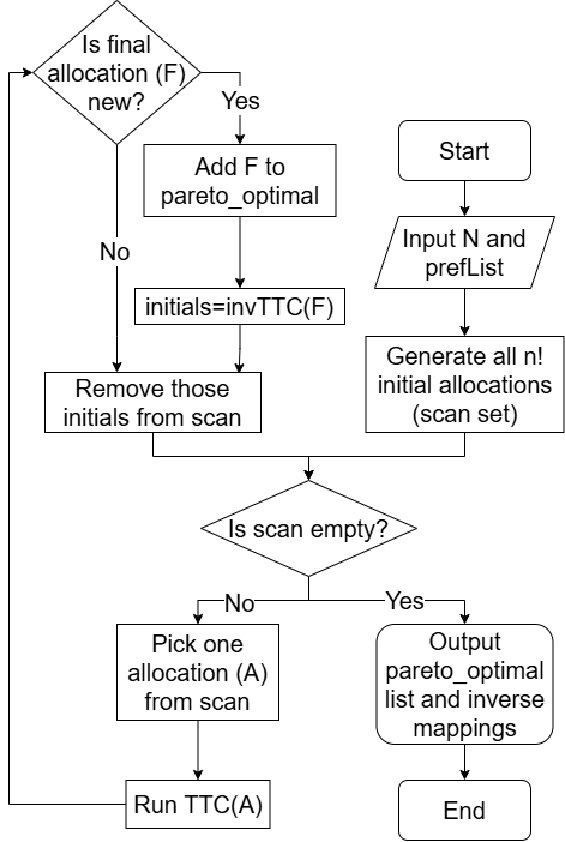
Figure 1: Algorithmic flow outlining ITEA's forward TTC and inverse enumeration steps.
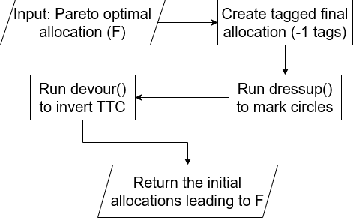
Figure 2: Schematic depiction of the InvTTC process for reconstructing all initial allocations leading to a target PO allocation.
By updating tags and permuting eligible rooms, the algorithm recursively recovers each equivalence class ∣N∣=n2 for all ∣N∣=n3, pruning explored configurations and guaranteeing complete coverage without redundancy.
Example
Consider ∣N∣=n4 agents and a specified preference profile. The diagram enumerates twelve initial allocations all converging under TTC to a particular PO allocation, illustrating the multi-level preimage structure and the recursive subdivisions.
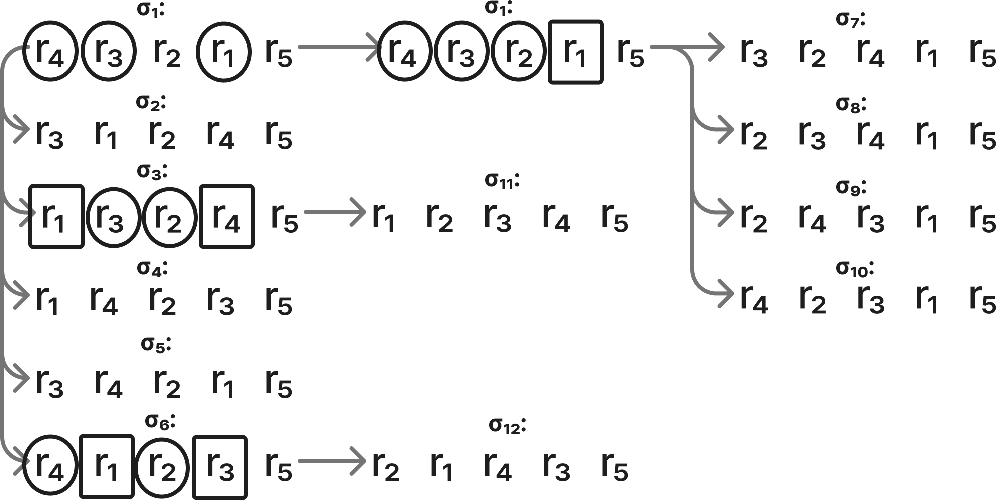
Figure 3: The twelve allocations in invTTC([4,3,2,1,5])—all distinct initial allocations that TTC maps to the same PO assignment.
Theoretical Analysis
Soundness and Completeness
The paper rigorously establishes that:
- Soundness: Every allocation produced by invTTC for a PO target ∣N∣=n5 satisfies ∣N∣=n6.
- Completeness: Every initial allocation ∣N∣=n7 with ∣N∣=n8 is generated by invTTC.
This ensures a bijective correspondence between equivalence classes of initial allocations and the set of PO outcomes, with each class precisely recovered.
Computational Complexity
Let ∣N∣=n9 be the number of PO allocations (typically much less than R0):
- Brute-force: Requires R1 TTC runs, each R2 or R3.
- ITEA: Requires R4 TTC runs (one per PO allocation) and R5 additional complexity for the inverse traversals. Thus,
R6
(or better with pointer-based TTC).
- Empirically, for R7 up to 9, R8 drops sharply with R9, making ITEA orders of magnitude faster in TTC invocations for larger O0.
Empirical Evaluation
The authors evaluated ITEA and brute-force TTC enumeration over 700 randomly sampled profiles for O1 to O2, with 100 instances per O3. For each, they measured wall-clock runtime for full Pareto frontier recovery.
ITEA outperforms brute force for all O4, with speedup factors increasing with O5 as O6 shrinks. For O7, the average Pareto frontier size is O8 (versus O9 allocations in total), implying a reduction of over A0 in TTC calls.
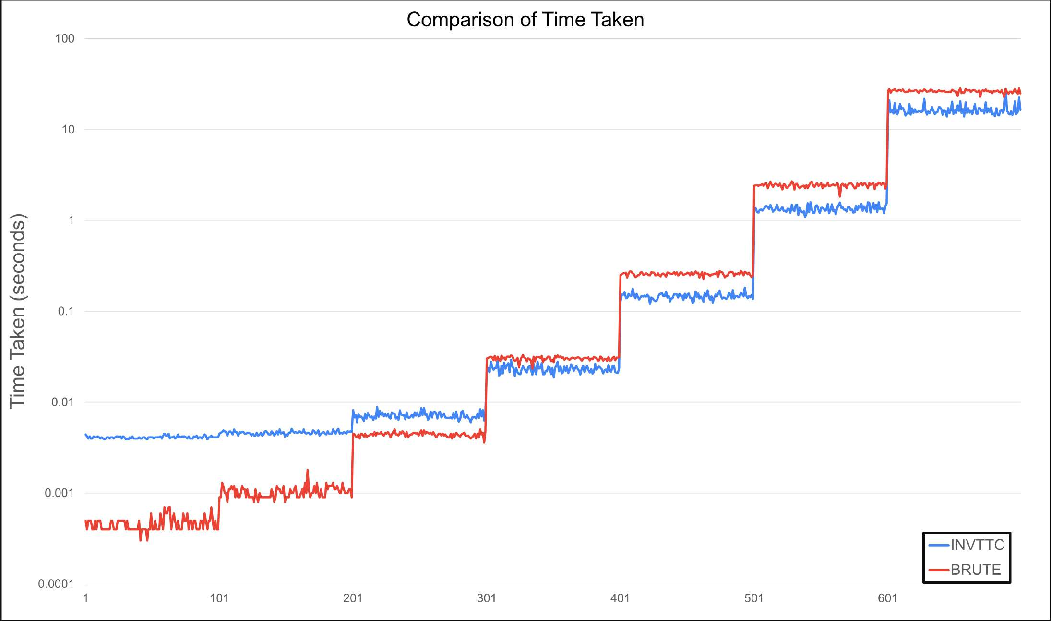
Figure 4: Empirical runtime comparison between ITEA and brute-force as A1 grows, averaged over 100 random instances per A2.
Implications and Future Research
Practical and Theoretical Ramifications
ITEA provides a concrete, polynomial-space mechanism for explicit Pareto frontier enumeration in one-sided matching. This enables:
- Secondary Optimization: Once the set A3 is enumerated, arbitrary polynomial-time computable selection criteria (e.g., maximizing utilitarian or egalitarian welfare, minimizing envy) can be optimized via brute-force search over A4.
- Structural Analysis: The approach reveals the full structure and diversity of PO allocations, relevant for both fairness diagnostics and property testing of different selection mechanisms.
- Algorithmic Efficiency: Empirical evidence underscores that for typical preference profiles, the frontier is far smaller than the full combinatorial allocation space, validating the practical impact of the proposed methodology.
Open Directions
- Efficient PO Selection: While ITEA enumerates all PO allocations, developing algorithms for selecting (without full enumeration) PO allocations optimizing secondary criteria (e.g., welfare, fairness) remains an open question for future work.
- Scalability: Though improved over brute-force, factorial complexity remains the bottleneck in worst-case instances. Further advances could seek relaxations, parameterized complexity refinements, or succinct PO representation.
- Extensions: Exploring adaptations to many-to-one matchings, ties in preferences, or other preference/assignment domains would enhance general applicability.
Conclusion
This work introduces a principled and computationally efficient inverse enumeration approach to fully characterize the Pareto frontier in one-sided matching with strict ordinal preferences. The ITEA algorithm provably yields all and only PO allocations, offering substantial computational savings over brute-force methods in non-pathological instances. This explicit characterization of the PO frontier provides a crucial tool for mechanism designers, enabling informed secondary optimization and a deeper understanding of the trade-offs inherent in one-sided matching markets.