Condensate states in Fermi and Bose-Hubbard ladders
Published 23 Apr 2026 in cond-mat.str-el and cond-mat.quant-gas | (2604.21296v1)
Abstract: Although neither hardcore bosons nor fermions can occupy the same single-site state, they still obey different statistics, resulting in distinct many-particle quantum states, such as condensate states versus Fermi-liquid states. However, when only pair states are considered, the two can take the same form, since a local hardcore Bose pair and a Fermi pair obey the same statistics. In this work we demonstrate this by studying both Fermi and Bose extended Hubbard ladders, which can be realized experimentally in synthetic atomic ladders. A set of exact condensate-pair eigenstates for the Fermi ladder is constructed under SU(2) symmetry and can then be obtained by the spectrum generating algebra. The corresponding hardcore boson counterpart can be simply obtained by replacing fermionic operators with hardcore bosonic ones. Nevertheless, the boson-pair eigenstates are associated not with symmetry but with the restricted spectrum generating algebra. We also investigate the effect of next-nearest-neighbor hopping on the condensate states through numerical simulations of the dynamic response. The conclusions can be extended to a two-layer system. Our result reveals not only the resemblance of fermions to hardcore bosons, but also a possible mechanism of Hilbert-space fragmentation.
The paper introduces an exact construction of pair-condensate eigenstates in both Fermi and hardcore Bose-Hubbard ladders using spectrum generating algebra (SGA) and its restricted form (RSGA).
The paper demonstrates that local fermionic and hardcore bosonic pair statistics yield similar off-diagonal long-range order (ODLRO), despite differing global symmetries.
The paper analyzes stability under next-nearest-neighbor perturbations, revealing rapid fidelity decay in Fermi systems versus robust protection in hardcore Bose systems.
Condensate States and Pairing Mechanisms in Fermi and Bose-Hubbard Ladders
Introduction
This work addresses fundamental questions regarding condensation and pairing in quantum lattice systems, specifically contrasting the condensate states in Fermi-Hubbard and hardcore Bose-Hubbard ladders. The analysis is rooted in rigorous algebraic construction—leveraging spectrum generating algebra (SGA) and its restricted form (RSGA)—to produce exact eigenstates representing condensates of pairs rather than single particles. The study provides a comprehensive examination of the similarities and distinctions between condensate behavior in fermionic systems (where the Pauli exclusion principle applies) and strongly interacting bosonic (hardcore) systems (where on-site occupation is constrained), and rigorously explores the stability of such pair condensates under perturbations, such as next-nearest-neighbor (NNN) hopping.
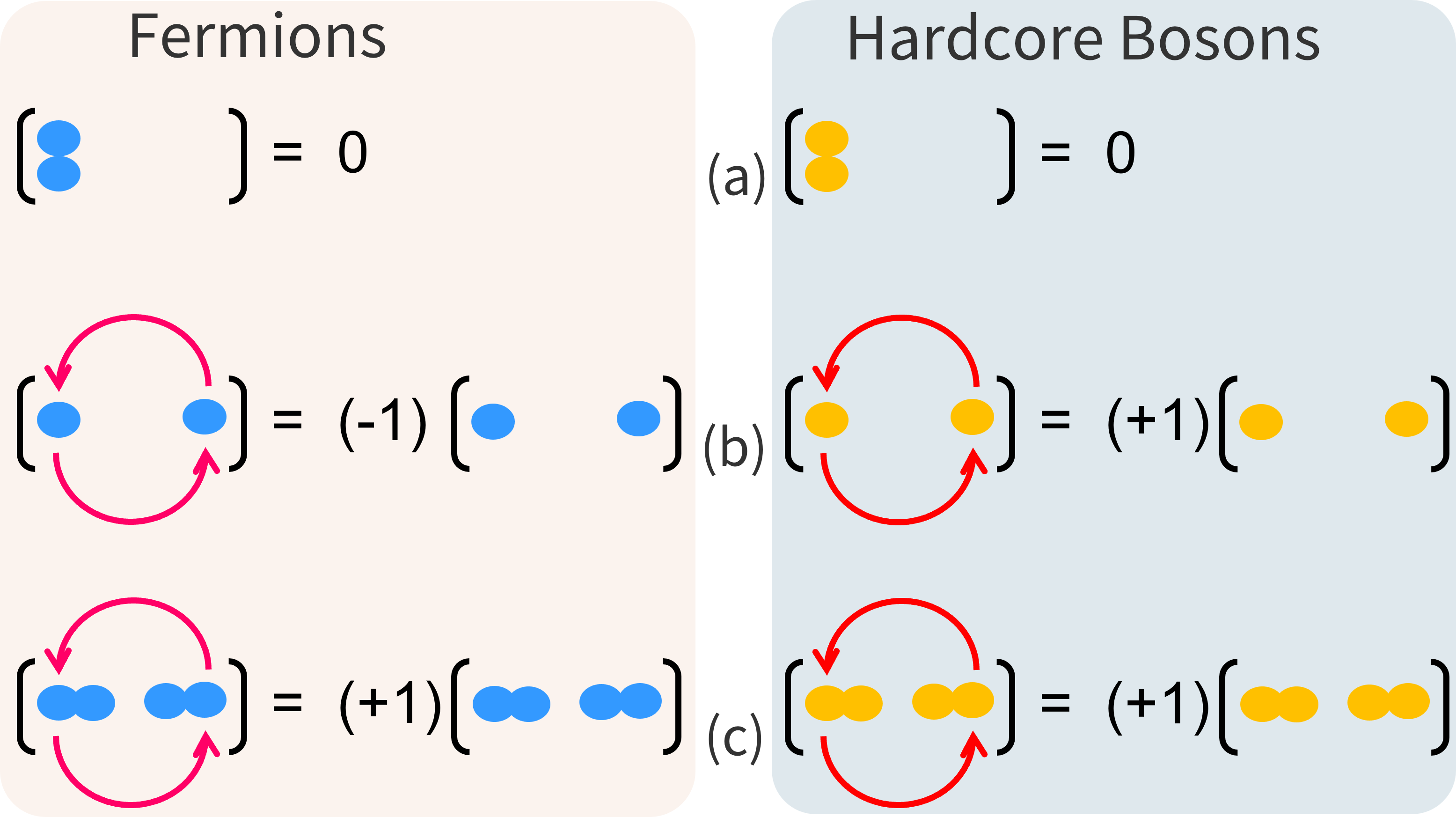
Figure 1: Comparison of the statistics of fermions and hardcore bosons shows identical statistics for local pairs, enabling related condensate pair states.
Theoretical Framework and Construction of Pair Condensates
The paper begins with a detailed formalism for constructing condensate eigenstates in composite Hamiltonians by exploiting the algebraic structure of their sub-Hamiltonian building blocks. The focus is on discrete many-body Hamiltonians, H=H1+H2, defined over lattice partitions, where each sub-Hamiltonian either exactly commutes with suitable pair creation operators (SGA) or does so only on specific vacuum-like states (RSGA).
The principal algebraic insight is that condensate eigenstates can be built by acting repeatedly with a suitable pair operator, sa+sb+sc, on a reference vacuum state when
[Hi,sα+sβ]=0
(SGA), or
[Hi,sα+sβ]∣vac⟩=0,[[Hi,sα+sβ],sα+sβ]=0
(RSGA). This construction is flexible, applicable across lattice geometries and dimensions.
The Fermi-Hubbard ladder is considered first, with exact eigenstates constructed via global η-pairing operators exploiting SU(2) symmetry, yielding condensate of fermion pairs exhibiting ODLRO. The hardcore Bose-Hubbard ladders are addressed in parallel: while lacking SU(2) symmetry, the algebraic structure still enables pair condensates via RSGA, rooted in the identical behavior of local fermion and hardcore boson pairs.
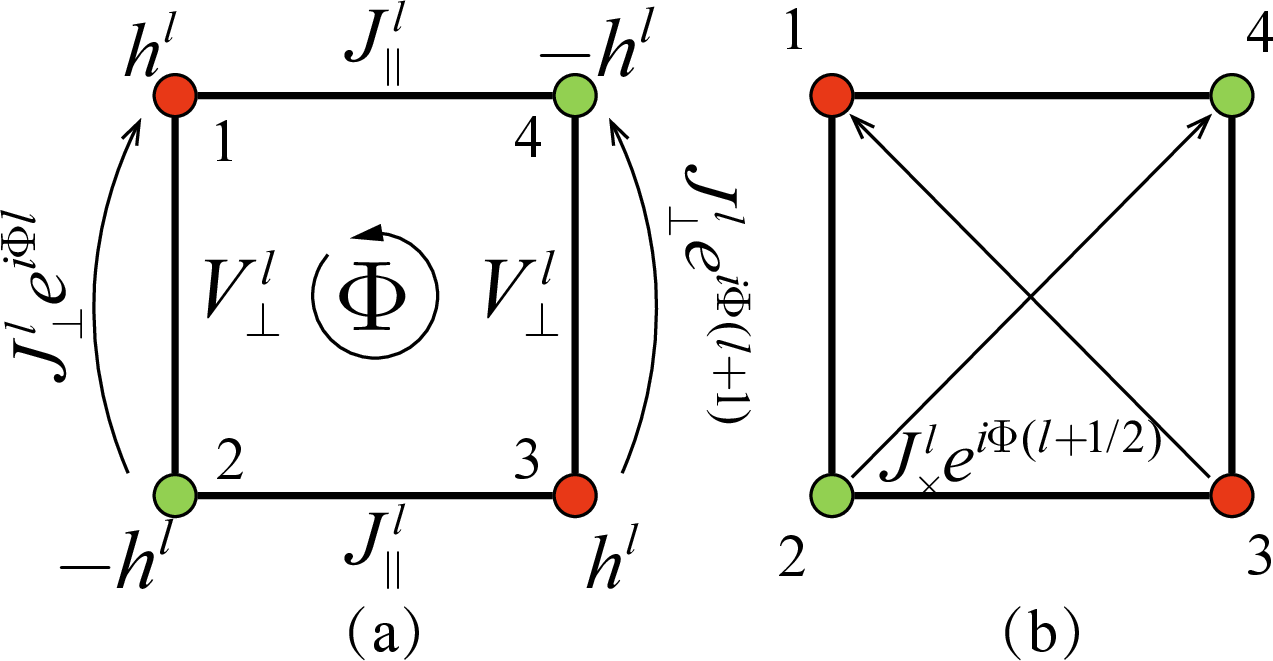
Figure 2: Schematic of the lattice structures and local plaquette Hamiltonians for the Fermi and hardcore Bose systems.
Fermi-Hubbard and Hardcore Bose-Hubbard Ladders: Exact Pair Condensates
The explicit construction is demonstrated for both plaquette and ladder geometries. In the Fermi-Hubbard system, the pair creation operator ηF=j∑(−1)jcj,1†cj,2† exactly commutes with the ladder Hamiltonian, enabling the construction of paired eigenstates
∣ψnF⟩=n!CNn1(ηF)n∣0⟩
which exhibit long-range pair correlations. The correlation function
demonstrates ODLRO—a hallmark of condensate states.
For the hardcore Bose-Hubbard ladder, replacing the fermionic operators with hardcore bosonic counterparts yields eigenstates of identical form and pair correlation structure, emphasizing the equivalence of the local pair sector between the two particle statistics—a nontrivial result since single-particle behavior and global statistics remain distinct.
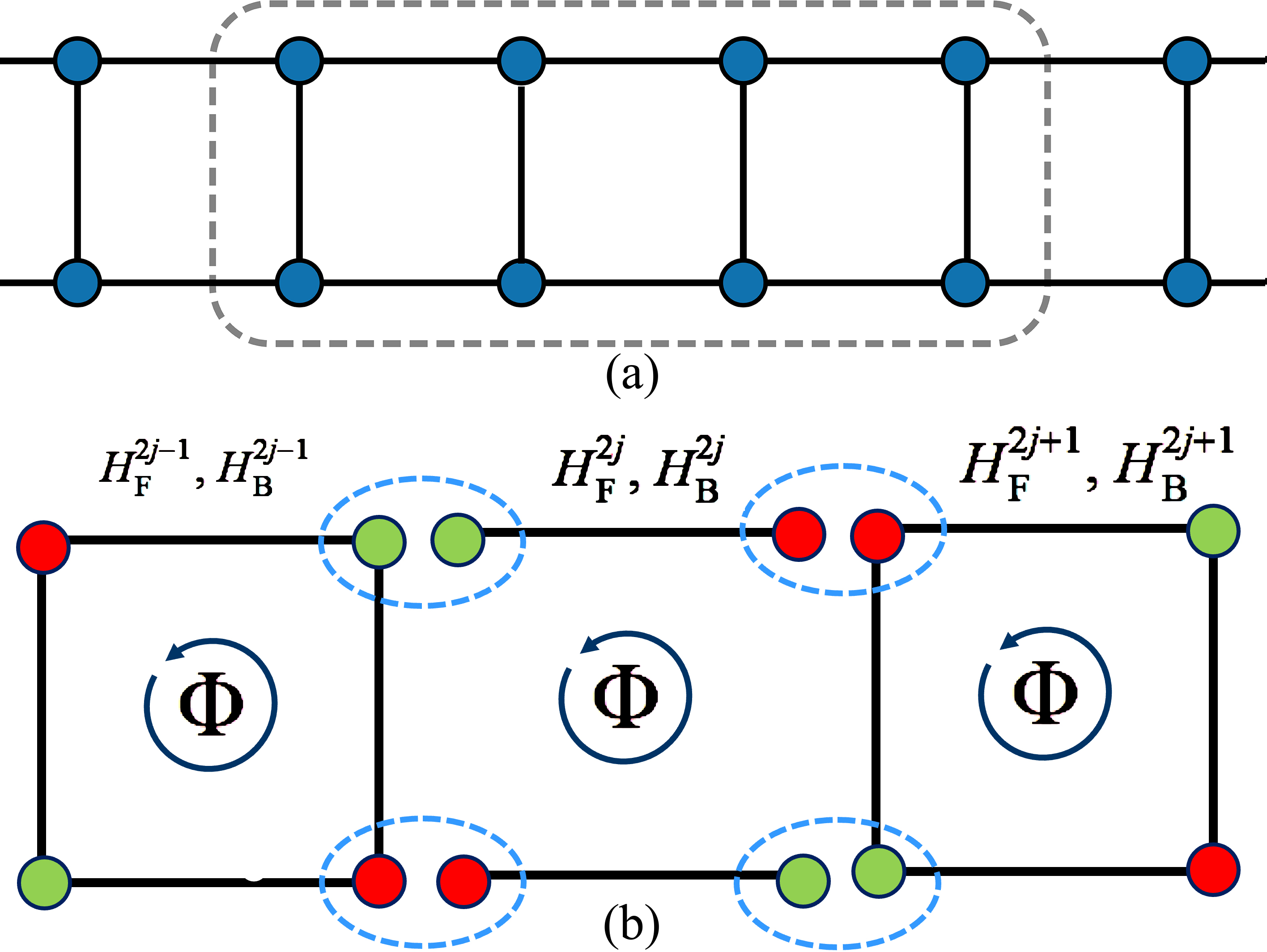
Figure 3: Illustration of ladder decomposition into plaquettes and the locality of pair-creating algebraic structure in both Fermi and Bose systems.
Dynamic Stability Under Perturbations
A distinctive contribution of this work is the analysis of pair-condensate stability under NNN hopping perturbations. Introducing sa+sb+sc0 terms breaks the commuting structure with the sa+sb+sc1-pair operator in the fermionic system, thereby destroying the protection (both SGA and RSGA fail). By contrast, in the hardcore bosonic ladder, the RSGA—crucial for pair-condensate protection—remains intact under analogous perturbations.
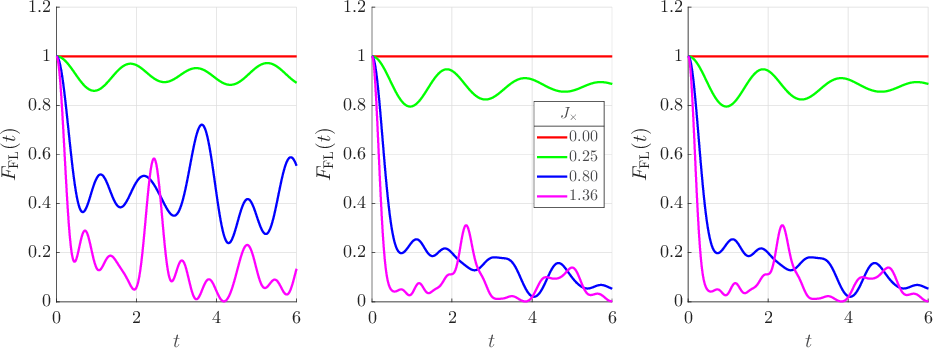
This is quantitatively shown by simulating the quantum quench dynamics and monitoring the fidelity of the initial paired-condensate state under time evolution with the perturbed Hamiltonian. For the Fermi system, the fidelity decays rapidly (with the decay rate sensitive to sa+sb+sc2), confirming the loss of exact eigenstate status for the pair-condensate. In the hardcore boson system, the fidelity remains unity, indicating full protection of the condensate under such perturbations.
Figure 4: Time evolution of fidelity for sa+sb+sc3-paired states in a Fermi-Hubbard ladder with NNN hopping perturbation, showing rapid decay for all sa+sb+sc4.
Implications and Outlook
The paper’s findings have several implications. First, the construction of robust pair-condensate eigenstates in both Fermi and hardcore Bose-Hubbard ladders extends the catalogue of exact scarred-like eigenstates in strongly correlated quantum systems, bridging concepts from quantum many-body scars and Hilbert space fragmentation (HSF). The resilience of hardcore boson pair condensates to NNN perturbations, contrasted with their fragility in Fermi systems, emphasizes the key role of dynamical constraints and statistical structure beyond global symmetry.
Secondly, the results guide the identification and engineering of many-body scarred states and dynamically protected subspaces in experimentally relevant synthetic lattices, such as optical lattices with controlled geometry and interactions. The connection to HSF suggests avenues for exploring nonthermal quantum states and ergodicity-breaking phenomena, including their stability and control in quantum simulators.
Finally, the methodology developed herein—a general construction leveraging SGA and RSGA—provides a blueprint for generating new nonthermal eigenstates and probing dynamical isolation in a broader range of quantum lattice models, spanning both fermionic and bosonic statistics.
Conclusion
This study systematically elucidates the conditions for the existence of exact pair-condensate eigenstates in both Fermi-Hubbard and hardcore Bose-Hubbard ladders. By demonstrating the equivalence of local pair statistics and exploiting algebraic structures via SGA and RSGA, the work unifies the description of condensate physics across particle statistics in the strongly correlated regime and quantifies the robustness of these states under physically relevant perturbations. These results open new directions for the controlled exploration of nonergodic dynamics, quantum scars, and Hilbert space fragmentation in lattice many-body systems (2604.21296).