- The paper introduces third quantization, demonstrating that the macroscopic order parameter naturally arises from second quantization via a conjugate phase-number framework.
- It analytically bridges BCS superconductivity and BEC by deriving coherent-state descriptions and highlighting the role of phase locking in the crossover.
- The study’s unified framework offers practical insights for controlling macroscopic quantum phenomena in superconducting circuits and quantum simulators.
Third Quantization of the Order Parameter: A Macroscopic Quantum Theory for the BCS–BEC Crossover
Introduction
The quantization of the order parameter—termed "third quantization"—is investigated as an emergent property in many-body quantum systems, specifically within the context of the BCS–BEC crossover. By systematically analyzing the commutation relation between the macroscopic phase operator and the particle-number operator, the work establishes that this structure is not a separate postulate but derives naturally from second quantization in the thermodynamic limit for both bosonic (BEC) and fermionic (BCS) systems. This framework yields a unified theoretical language for describing BECs, BCS superconductors, and their crossover regime, connecting the quantization of macroscopic coherent states to spontaneous symmetry breaking and long-range order.
Third Quantization via Second Quantization: Emergence of Macroscopic Phase-Number Conjugacy
The analysis begins with the conventional second-quantized description of a Bose-Einstein condensate, formulated via a multimode coherent state Ansatz. By minimizing the mean-field energy functional under global U(1) phase invariance, it is shown that the BEC order parameter can be endowed with a uniform phase across all occupied modes, reducing the many-mode order parameter to a single global phase degree of freedom. This leads directly to the Gross–Pitaevskii equation for the order parameter in the ground state.
Treating the phase as a dynamical variable, the macroscopic phase operator ϕ^ and the total particle-number operator N^ satisfy the canonical commutation relation [ϕ^,N^]=−i in the thermodynamic limit. Examination of the overlap between phase states demonstrates orthogonality in the large mode-number (M→∞) limit, analogous to the Pegg–Barnett construction for phase operators in quantum optics. The underlying bosonic structure guarantees rigorous Hermiticity and conjugacy of the phase-number pair for the macroscopic order parameter.
Extension to Fermionic Systems and the BCS–BEC Crossover
The framework is generalized to BCS superconductors, where the collective degree of freedom is the phase of the fermionic pairing amplitude (Cooper pairs). Minimization of the BCS variational ground state energy reveals that all Cooper pairs share a global phase, establishing a direct analogy with the bosonic case. By explicit decomposition of the BCS ground state in terms of number states, it is again shown that the phase operator ϕ^ and the Cooper-pair number operator N^c satisfy [ϕ^,N^c]=−i in the thermodynamic limit.
A central result is the identification of conditions under which the collective excitations of Cooper pairs can be treated as effective bosons. The operator corresponding to the creation of a composite bosonic mode formed by many Cooper pairs is constructed. Its commutation relation deviates from the ideal bosonic form by terms proportional to particle occupancies. In the strong-coupling (BEC) regime—where particle occupancy per mode is low—these deviations become negligible, justifying the coherent-state description. The continuous evolution from the extended, overlapping Cooper pairs in the weak-coupling BCS regime to tightly bound molecular pairs in the BEC regime is thus explicit at the macroscopic quantum level.
Macroscopic Phase Locking and Off-Diagonal Long-Range Order
To elucidate the mechanism of global phase coherence, the system is modeled as N macroscopic superconducting segments, each described by a local phase. Coupling between segments is mediated by both single-particle and pair-tunneling processes. The low-energy effective Hamiltonian in the presence of Cooper-pair tunneling (Josephson coupling) and charging energy (Coulomb blockade) reduces to a chain of coupled quantum rotors, where the phase difference between adjacent segments is the key degree of freedom.
Quantum fluctuations in phase and particle number are analyzed via the quadratic expansion, yielding a set of effective harmonic oscillators. The ground-state wavefunctions encode the degree of phase coherence: in the strong Josephson coupling (EJ≫Ec), global phase locking is realized, leading to a sharp order parameter across the system. In the converse limit (Ec≫EJ), phases of individual segments become independent.
The onset of macroscopic off-diagonal long-range order (ODLRO) is formally connected to the quantum fluctuations of phase differences. The explicit calculation yields exponential decay of phase correlations with spatial separation in the locally incoherent regime, but in the global phase-locked regime, ODLRO persists across the entire system. The critical parameter for the crossover is the ratio N^1, with global coherence established for N^2.
Unified Macroscopic Quantum Interpretation of the BCS–BEC Crossover
Within this third quantization framework, the BCS–BEC crossover attains a transparent macroscopic interpretation. As the intra-segment interaction is tuned from weak to strong coupling, each segment transitions from a BCS-like state to a bosonic coherent state. Inter-segment couplings then mediate the synchronization of local phases, resulting in a macroscopic wavefunction with global coherence—i.e., a Bose–Einstein condensate of composite bosons (Cooper pairs or molecules).
The evolution of the chemical potential, pairing gap, and phase transition boundaries as a function of interaction strength and coupling parameters are numerically characterized by simultaneous solution of the gap and number equations. The unified phase diagram in N^4 space identifies the boundary between BCS and BEC states (set by N^5) and the threshold for global phase coherence (N^6), allowing for mixed macroscopic states with both BCS- and BEC-like segments under partial phase coherence.
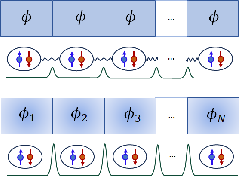
Figure 1: When the Coulomb blockade of Cooper-pair tunneling dominates (N^7), each superconducting segment retains an independent phase; for N^8, phase locking results in global coherence.
Implications and Future Directions
The demonstration that third quantization emerges naturally in the thermodynamic limit provides a rigorous foundation for describing macroscopic quantum phenomena in many-body systems. The framework rigorously justifies the use of coherent-state and number-phase conjugate descriptions, connecting them directly to the underlying second-quantized theory. The approach provides theoretical tools for studying macroscopic quantum tunneling, phase dynamics, and ODLRO in complex assemblies of superconducting, superfluid, and hybrid quantum matter.
The results have direct implications for the microscopic description of superconducting circuits and Josephson junction arrays, where local and global phase coherence compete. The coherent-state formalism supports systematic quantization of such devices, in consistency with the effective circuit models used in quantum information protocols.
Further extensions, as announced, include incorporating spatially local fields, dissipation, and nonequilibrium effects, suggesting that third quantization may provide a broad and natural language for macroscopic quantum systems, including quantum circuits, arrays, and engineered quantum simulators.
Conclusion
This work establishes the third quantization of the order parameter as a universal, emergent feature of many-body quantum systems with spontaneous symmetry breaking. The canonical conjugacy of phase and number operators arises directly from the microscopic theory in the thermodynamic limit, without the need for additional postulates. The framework achieves a unified description of BEC, BCS superconductivity, and the BCS–BEC crossover as manifestations of macroscopic quantum coherence, enabling new avenues for both theoretical investigation and practical application in the control of macroscopic quantum matter and superconducting quantum technologies.